Zantac Lawsuit


Researching drug company and regulatory malfeasance for over 16 years
Humanist, humorist
Showing posts with label zopiclone. Show all posts

Tuesday, July 25, 2017

EXCLUSIVE: MHRA Asked Sky News to Remove Antidepressant Reference


The controversy and confusion created last week by MHRA and their Sky News article continues. In the interview, MHRA enforcement officer, Danny Lee-Frost, stated, “...sleeping pills and antidepressants are a lot more dangerous. People have committed suicide as the ultimate resort to try to get off them. They are fiercely addictive.”

The original article aired on the Sky News website at 10:14 am on Thursday, July 20.

I wrote to Lee-Frost approximately an hour later asking:
Is it now the position of the MHRA that antidepressants are addictive and that "people have committed suicide as the ultimate resort to try and get off them?"
Can you clarify that this is a personal belief or one of the MHRA?
Lee-Frost promptly responded:
Dear Mr Fiddaman
Thank you for your enquiry regarding the article commissioned by Sky News on the dangers of buying medicines online.
I work in the Enforcement group and my role is concerned with investigating illegal activity involving medicines. I am not medically qualified and therefore matters of clinical diagnosis are not in my area of expertise.
The focus of this piece was the online sale and supply of medicines and the increased use of Facebook as a medium of sale.
Part of the interview concerned sleeping tablets and I referred to Zopiclone and Diazepam specifically.
We have seen an increase in the number of websites offering both of these medicines for sale. Sky presented evidence that both were available on Facebook and I asked for details of the sites they had found in order to make further enquiries.
We also discussed the dangers of purchasing large quantities of these medicines from websites without medical supervision and the increasing amounts that we are seizing as part of our enforcement activities.
My reference to suicides was in relation to a case that the MHRA is aware of involving addiction to Zopliclone.
Sky did not include the interview in its entirety in their piece.
Regards
Danny Lee-Frost MSc
Head of Operations
Enforcement Group 
What's striking here is the timeline of events.

At 3.15 pm Sky News edited its original version and omitted part of Lee-Frost's original statement. The statement had been changed to, "The sleeping pills and antidepressants are a lot more dangerous. Sleeping pills particularly, they can be addictive. People have committed suicide as the ultimate resort to try and get off them. These are fiercely addictive."

However, the video of Lee-Frost's original statement remained on the Sky News website.
Screenshots, with Sky News provided subtitles, are found below:


The original video can be viewed here, with Lee-Frost's 18-second segment here.

Puzzled as to why Sky News would change Lee-Frost's direct quotes and make edits after publication, I inquired:

Stephanie Jones, Sky News PR Manager, states:
"The changes were made after MHRA got in touch to clarify Frost's comments. They made the point that antidepressants shouldn't be included with sleeping pills."
Hmm...MHRA and Lee-Frost's original statements couldn't possibly be referring to ads such as this, now could they?


All ads still remain on Facebook today.

Lee-Frost's Email Response

Let's look at the email Lee-Frost sent me, in particular, his statement:

"My reference to suicides was in relation to a case that the MHRA is aware of involving addiction to Zopiclone."

This new info is troubling as nowhere on the product labeling does it suggest Zopiclone can be addictive. Moreover, the SPC label does not mention suicide being a result of withdrawing from Zopiclone.

The  SPC-DOC_PL 41684-0003.PDF is hosted on the MHRA website and was last updated on 02/06/2017

If Zopiclone is or can be addictive as soon as you start taking it, as Lee-Frost suggests (see video) then why does MHRA omit this info on its website? Moreover, if Zopiclone is a drug where "people have committed suicide as the ultimate resort to try to get off them," why is this relevant information not included by MHRA in the SPC?

The SPC for the other drug mentioned  in Lee-Frost's  reply, Diazepam, does not support Lee-Frost's two claims that:

1) withdrawal can lead to suicide and
2) is "fiercely addictive once you start taking them"

On the subject of dependency (addiction), the Patient Information Leaflet for Diazepam states:
Dependence: When taking this medicine there is a risk of dependence (a need to keep taking the medicine). The risk increases with the dose and length of treatment period.

As you see, the Patient Information Leaflet clearly states the risk of addiction increases with the length of the treatment period. It does not state it "can be addictive as soon as you start taking it." Therefore, it's safe to assume MHRA believes neither Zopiclone or Diazepam can cause addiction as soon one starts taking them, nor can they cause people to carry out "suicide as the ultimate resort to try to get off them" as Lee-Frost claimed.

According to MHRA's public documents, Lee-Frost's claims are false. So why would Lee-Frost believe differently than his employer, the MHRA? (Remember, Lee-Frost is the head Enforcement Officer of the MHRA!)

Why would he make repeated statements that antidepressants can be addictive and cause suicide upon withdrawal if he did not know this to be true?

Why would he later claim he was speaking about Zopiclone and Diazepam instead of antidepressants as he said in his original article?

Why would MHRA contact Sky News and direct them to change their Enforcement Officer's own statement?

I think I know why and my readers likely know why, too. I believe in his Sky News interview, Lee-Frost was speaking about antidepressants as a whole. He subconsciously told the truth, something MHRA didn't appreciate. I believe MHRA knows that drugs labeled "antidepressants" are addicting. It appears MHRA also knows "antidepressant" withdrawal is such torture that some people would rather die than suffer these drug side effects. Hence, sufferers end their lives. I don't prefer to call these drug-induced deaths "suicides" as they are iatrogenic.

Stay tuned: Next week the saga continues with the MHRA and Lee-Frost responses.

Lee-Frost now claims the suicide related to Zopiclone withdrawal he referred to in his first email to me, was simply "anecdotal."

an·ec·do·tal
[ˌanəkˈdōdl]

ADJECTIVE
(of an account) not necessarily true or reliable, because based on personal accounts rather than facts or research

Bob Fiddaman


Sunday, September 01, 2013

The Mysterious Suicides of Tony Scott and Tooker Gomberg

Today I'd like to draw comparisons to two suicides that happened years apart and in different parts of the world. Both persons were famous, both deaths came out of the blue and left family members and friends in deep shock and wondering why?

Tooker Gomberg
Tooker Gomberg [above] was a bike and climate activist who made headlines a number of times.

In 2001 Tooker fell into depression which took him out of action for around 9 months - a year or so later he locked himself into a vault in Alberta Premier Ralph Klein's office and faxed out hand-written press releases on Klein's own letterhead, this was in protest at the Kyoto Protocol and global climate change.

In 2004 Tooker, who was now enduring another bout of depression, started taking antidepressants which, according to his bio written by his surviving wife, Angela Bischoff, "lead to increased anxiety and agitation, a common adverse reaction and potent predictor of suicide. After just five weeks on the drug, he was driven to end his anguish by jumping off the MacDonald bridge into the Halifax harbour. His bicycle, helmet, and suicide note were found on the bridge. His body has never been recovered."

Tony Scott
In 2012 Hollywood and the rest of the world woke to the news that Tony Scott, a British film director and producer, had killed himself by jumping off the Vincent Thomas Bridge in Los Angeles.

Scott, who was the younger brother of Sir Ridley Scott (English film director and producer) had been taking an antidepressant at the time of his death.

Both Scott and Gomberg were prescribed the SNRi Remeron, (mirtazapine) a drug indicated for use in patients suffering with major depressive disorder.

Scott's autopsy report showed that he had a “therapeutic level of mirtazipine (Remeron) and zopiclone (Lunesta), a sleep-aid” in his system on the day of his death on August 19.

During the past year or so I have collected information [gained under the Freedom of Information Act] regarding suicides in New Zealand.

I asked for information on patients who died from suicide between 1 January 2007 and 31 December 2010 and a list of drugs they were taking at the time of or 6 months prior to their suicide.

Zopiclone appears a lot in the information provided to me, although in the main it was prescribed alongside a whole host of other psychiatric drugs.

In Auckland, just one of the many DHB's I contacted, there was a total of 31 suicides by patients under the care of Auckland DHB, of these 31 there were 10 on Zopiclone at the time of or 6 months prior to their suicide. That's almost a third!

In the UK, the British drug regulator, the MHRA, have received 1,451 adverse drug reaction reports related to Zopiclone use, of these 68 have been fatal. When we look at the adverse drug reaction to mirtazapine [Remeron] we learn that there have been a total of 2,728 reports filed to the MHRA, 87 of which are fatal.

This doesn't mean that 87 patients killed themselves whilst on Remeron, to look at the deaths one has to look further into the MHRA's drug analysis prints. [DAP's]

Remeron, it appears, is associated with 10 cardiac disorders that led to the patient dying, 18 deaths are listed as "general disorders" 13 deaths listed as "injuries", whilst 21 are listed as "psychiatric disorders".

Apart from cardiac disorders these explanations are rather vague, don't you think?

Digging a little deeper into the Remeron DAP we can see it get even more confusing.

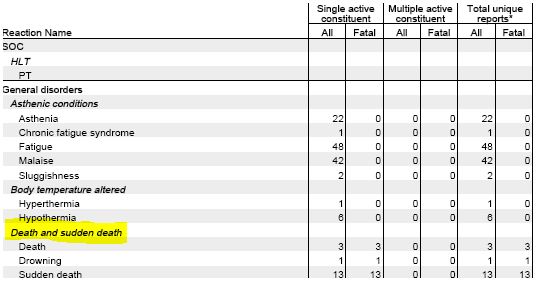
Fig 1 shows that there were 3 deaths reported, 1 drowning and 13 "sudden deaths".

Fig 1
This has confused me somewhat, so much so that I Googled 'Sudden Death'. The Merriam medicine dictionary defines sudden death as "unexpected death that is instantaneous or occurs within minutes or hours from any cause other than violence."

So, given that there have been 13 sudden deaths reported to the MHRA why then are the 3 deaths listed above not 'sudden'?

Are we to assume that the 3 deaths were prolonged deaths as opposed to sudden? I would have thought that any death is sudden, wouldn't you?

Again, I referred to the Merriam medicine dictionary, it defines death as "the irreversible cessation of all vital functions especially as indicated by permanent stoppage of the heart, respiration, and brain activity : the end of life."

It becomes even more confusing when we see there have been 12 adverse reactions reported regarding overdose. [fig 2] Overdose is, just like death, split into three categories, namely; intentional overdose, overdose and prescribed overdose. No deaths were reported for prescribed overdose but there was 10 reported for overdose and 2 for intentional overdose.

Fig 2


Are we to assume that 'overdose' actually means accidental overdose? If so, how can we determine whether or not an overdose is accidental? If 10 patients on Remeron died as a result of overdose then it could be deemed as suicide, could it not? It could also mean that these 10 patients overdosed not by their own choice, was it homicide then? Were these 10 patients killed by someone slipping large amounts of Remeron into food?

It's bizarre that the MHRA don't add 'accidental' given that they add 'prescribed' and 'intentional' to the other categories.

Remeron is considered to be relatively safe in the event of an overdose. [1] The figures from the MHRA database would suggest otherwise. 41 overdose and survived. 10 overdosed and died - I wouldn't call that relatively safe, would you?

Further into the DAP we learn that the 21 psychiatric disorders I mentioned earlier are all listed as 'completed suicide.' [Fig 3] So, is completed suicide a psychiatric disorder?

87 deaths attributed to Remeron in Britain alone, 21 of those deaths were by suicide but the MHRA, in what I can only describe as a cover your ass tactic, decide to mask these suicides by labeling them as "psychiatric disorders".

Fig 3


They fail to mention exactly what these psychiatric disorders were. One can only assume that anyone who takes their own life has a psychiatric disorder of some sort... I mean, it couldn't have possibly been the Remeron that caused these 21 patients, Tony Scott and Tooker Gomberg to take their lives, right?

The Remeron product monograph [Merck] treads carefully.

Adults and Pediatrics: Additional Data
"There are clinical trial and post-marketing reports with SSRIs and other newer antidepressants, in both pediatrics and adults, of severe agitation-type adverse events coupled with self-harm or harm to others. The agitation-type events include akathisia, agitation, disinhibition, emotional lability, hostility, aggression and depersonalization.
"In some cases, the events occurred within several weeks of starting treatment.
Rigorous clinical monitoring for suicidal ideation or other indicators of potential for suicidal behaviour is advised in patients of all ages. This includes monitoring for agitation-type emotional and behavioural changes."

Merck cleverly omit the brand Remeron from this important piece of information for the consumer. Other pharmaceutical companies use this tactic too. It's designed to lump all the group of antidepressants together, it's then the job of the Remeron rep to convince a doctor that Remeron is safer than the other antidepressants on the market, they do this with company written documents, lavish dinners, gifts and payments [disguised as consulting fees] for doctors.

You'll note that Merck also list emotional lability as an "agitation-type event."

I first came across the term "emotional lability" when I read through the infamous Paxil 329 study.  GlaxoSmithKline used this term to hide the 5 attempted suicides that had occurred during the clinical trials of Paxil.

In fact, all of the agitation-type events Merck list for Remeron are precursors to suicide. Remember they are not talking about an illness here, they are talking about a drug that can induce these thoughts... something the MHRA adverse reports for Remeron fail to do.

Tony Scott and Tooker Gomberg both took Remeron, both killed themselves by leaping to their deaths. Family and friends will tell you that they were completely shocked by their acts.

Keeping an eye out... or monitoring patients on these drugs is nigh on impossible. Suicide is impulsive and these types of drugs inhibit emotion.  Fear is an emotion inhibited by these drugs and if we, as humans, do not fear death then we will embrace it.

The makers of Remeron have a lot to answer for as do the makers of other groups of antidepressants.


Bob Fiddaman.


[1] Relative safety of mirtazapine overdose.
Velazquez C, Carlson A, Stokes KA, Leikin JB. - http://www.ncbi.nlm.nih.gov/pubmed/11757992


Please contact me if you would like a guest post considered for publication on my blog.