Zantac Lawsuit


Researching drug company and regulatory malfeasance for over 16 years
Humanist, humorist
Showing posts with label Side Effects. Show all posts

Tuesday, November 01, 2016

SSRI Tips and Tricks on Withdrawal


One thing you won't see on SSRI patient information leaflets is how to combat the withdrawal effects. There are literally dozens and dozens of Facebook groups offering support to those struggling the debilitating withdrawal effects of SSRIs such as Prozac, Paxil, Zoloft etc. These groups are patients who have either gone through or are going through SSRI withdrawal - they shouldn't be dismissed, in fact, they are far better than what health care professionals have to offer.

The drug companies or medicine regulators won't help, to do so would be an admittance that SSRIs can, for many, cause serious problems when withdrawing and if they admit there's a problem then this will be a sign that they have licensed a drug, or drugs, to the public that can make matters worse rather than rectify or subdue the problem they were originally prescribed for.

When one takes a look at the patient information leaflet one sees the phrase that the benefits of taking an antidepressant outweigh the risks - the risks being thoughts of self-harm, suicide and akathisia, which, in essence, is a pre-cursor to completion of suicide.

Health committees spring up every now and again, their sole purpose, it appears, is to recognise there is a problem withdrawing from SSRIs and, well, and nothing. They offer no advice, they don't tell us why - they merely give you hope by stopping the carousel, asking you for your story then, putting you back on the carousel, ergo leaving you to deal with your problems by yourself - they will of course throw out the one line that covers their arse, "Talk to your doctor."

Most people that have wrote me over the years have told me that their doctors either up their dose when they experience withdrawal or change/substitute one SSRI for another - these patients then leave armed with a prescription and a ticket to ride the carousel.

For years the line 'Talk to your doctor' has been used as a tool by the pharmaceutical industry. To promote the use of SSRIs adverts have appeared on TV, in magazines, by proxy on radio shows where the host has been paid vast amounts of money to persuade listeners to use a certain brand of drug. When the problem of withdrawal kicks in, pharmaceutical companies and medicine regulators continue to use the 'Talk to you doctor' line, knowing that any prescribing doctor does not have a clue how to help people suffering severe withdrawal - Okay, there are some who know how to help, eg; Healy et al, but these are few and far between - perfect for the industry and regulators because it means they continue passing the buck, at the same time avoiding potential lawsuits for defective products.

Speaking of lawsuits, in 2002 GlaxoSmithKline settled with over 3,000 plaintiffs who had claimed that Paxil caused serious withdrawal problems of many kinds, resulting in patients unable to stop taking the drug. The settlement (with each plaintiff) saw them sign a confidentiality agreement whereby they could not discuss the award (monetary) they received from Glaxo. Here's how it works...

Any lawsuit claiming severe withdrawal effects from an SSRI will be denied and defended in a number of stages.

A - We warned them (the patient) already.

B - It was the condition whereby the patient declined into a spiral of decline, ergo this caused depression and the patient suffered anxiety as a result of his underlying illness and coming off the drug that was treating his underlying illness.. (In other words it wasn't a withdrawal effect, it was agitation caused by him stopping the drug.  We utterly refute this claim as our drug has benefited millions of people world wide...yadda yadda.

Prosecution team will point out that even by the drug company's own admission their drug can induce severe withdrawal effects and this is where the pharmaceutical company will argue point C.

C - Yes your honour, but we don't believe that to be the case in this particular litigation, we believe it to be the underlying illness that caused what plaintiff deems as 'withdrawal effects'.

When they feel the case slipping out of their hands they offer a settlement, one which they don't have to admit any wrong-doing.

It's a game and pharmaceutical companies play it to their advantage.


Brain zaps

One problem that exists with SSRI withdrawal is the "brain zaps" - if you've never experienced these you are one of the lucky ones - the only way to combat these (to make them go away) is to stop withdrawing and start taking your medication again at the prescribed dose (back on the carousel you go)

Looking through the Facebook support groups it seems the brain zaps is one of the more common side effects - it's played down by pharmaceutical companies and regulators.

In laypersons terms, or to use an analogy, brain zaps is basically your brain trying to deal with something it has become accustomed to over the months, years you having been taking the drug - it's no different to any other reduction you may encounter apart from the fact it gives you this feeling like your brain is being poked by a cattle prod, resulting in your whole body jerking, twitching. Turning your head too quick gives the effect of dizziness - this 'dizziness' is, once again, played down by the pharmaceutical industry and regulators. When reading the patient information leaflet you will see 'dizziness' as a common side effect - it looks harmless - hey, what's a bit of dizziness? For some the dizziness is best described as feeling like a cartoon character, you know they type, the kind of characters whose eyes are able to be pulled out before being let go and retracting at high speed back into their sockets.

More often than not withdrawal will cause this problem. You may turn your head and feel that your eyes do not follow your turn, they are left temporarily stationary in their original position. Once your head is turned it will take them a split second longer to follow the movement of your head - this will cause you the 'dizziness' referred to in the patient information leaflets - this is what taking, or withdrawing from an SSRI, can be like for a lot of people. The vast majority of which find it difficult to describe this 'dizziness' to their doctors.

The brain zaps  (your brain wanting it's normal daily fix) is your brain reminding you to feed it. For months or years you have been feeding it a regular dose - so, if you lived on three potatoes, chicken and vegetables for a year, and that meal satisfied you, gave you a sense of being full upon eating it, it then stands to reason if someone came along and removed a piece of chicken or potato, you'd be pretty pissed off - your meal wouldn't satisfy you anymore  - you'd be left unfulfilled and you'd probably reach for a snack to fill the gap that the missing potato or chicken piece had left. Same goes for when you are tapering from an SSRI - Your brain has become used to it's regular meal of potatoes, chicken and vegetables.

Now, imagine if just one pea was taken from your daily meal, it wouldn't be so bad, and you probably wouldn't even notice it, right? This is how you have to taper. Personally, I came down by just half a milligram per week. Some weeks, when I wasn't ready to drop another half, I didn't. My body, my rules.


The God Factor

Throw a stethoscope around a neck, give that stethoscope-wearing person a title, such as 'Dr', and you have before you a person that can fix any ailment you may have. These people have been through years of training, they are clever, so much more intelligent than you and I, right?

Wrong.

They have been trained to basically spot symptoms then use a medicine to treat that symptom - that is all - they don't have a magic wand, they do not have healing hands - they are not your modern day Jesus Christ nor indeed should they be treated as such. They are just normal people who chose a career path because they felt the need to want to help people - it's admirable that any human would want to care for another human - Sadly, the pharmaceutical industry is a machine that is constantly striving to see a niche in the market - to take control of that niche they first need to target the agents who sell their wares - namely; your prescribing physician. They, through various methods, convince the young Dr going through med school that they are the good guys, that depression is a disease that can be stabilized and controlled. Somewhere along the line financial and marital problems have become a disease as have fears that have been with us since the year dot. Shyness, being anxious because you have to give a speech are just two examples - both treatable with an array of meds, or so we are told.

If you've read this far down then you are probably here because of the title of this post, "SSRI Tips and Tricks on Withdrawal."

It's important to know why you are here and reading all of the above will, hopefully, give you the reason. You are not crazy, you are not in the minority, you are not abnormal - the drug you were prescribed was licensed by a regulator based upon the benefits you may receive from it. To date, the British drug regulator, cannot list one single benefit for any of the SSRIs on the market. They claim that these invisible benefits outweigh the highly visible risks - You've been duped ladies and gentlemen, just like your prescribing physician. (Source - Correspondence between myself and the MHRA)

So, the zaps - horrible aren't they? Kind of make you curl up into the fetal position because that's the only way you can cope, right?

There is a way that may or may not help you. It's free, it doesn't involve putting anything into your body apart from tap water (or bottled water if you prefer) - in fact, water is used a lot in these series of tips.

You won't see these on the patient information leaflet because, well, because the whole idea of selling sickness is to not warn you about the severe side effects you may experience.

1. If you decide to taper do so in the winter months and not the summer months. I can't quite put my finger on why you should choose the colder months but I know, through my own tapering experience of Paxil withdrawal, that it seemed to be worse when it was warmer outside.

2. Never try to quit by going cold turkey. Don't attempt to taper by missing doses every other day. Don't attempt to taper by halving your pill, although for some (Cymbalta for example) there is no liquid formulation, which brings me on to tip number three.

3. Taper using the liquid formulation (if you can) - Don't ask your Dr for the liquid, tell him/her - Dr's are there to help you and, at the end of the day it is you that is suffering the withdrawal, it is your brain crying out for its extra potato each time you skip or halve a dose. Tell your Dr you want to be prescribed the liquid - Do not ask.

4. Go at your own pace when withdrawing, this is not a sprint, it's a marathon and may take many months or even years to get completely off the drug. Again, many Dr's will dispute this, if they do then give them the middle finger - remember, this is your plate you are eating from and not theirs.

5. The dreaded brain zaps - Okay, this is my own personal tip, it helped me somewhat.

Run a bath full of cold water. Find a suitably sized bath towel and soak the towel in the water. Wring the towel and wrap it around your head in the style of a turban. Keep repeating this process once the towel starts to dry or if the zaps appear again.

6. Run cold water over your wrists (the part where you feel your pulse)

7. Go for walks (again the winter months is probably best) - Don't overdress - wear loose clothing - this may be difficult as you have probably gained a lot of weight during your time on your SSRI. Walk and push yourself - don't just walk around the block, find a park, tell yourself you are going to lap the park just by walking - treat the cold weather as your friend. Treat the walk as a way of helping you and not as a chore - at the same time weight will fall off you - let the daily walk be your addiction.

8. Drink lots of water, up to 8 pints a day - yes, it seems a ridiculous amount but you are basically helping flush out the culprit causing you the problem - If you can't manage 8 pints then just drink as much as you can - in any event, water is good for you.

None of the above will cost you a single penny - give it a try and write to me in a few months time to let me know if you feel you are on the road to recovery after using these tips.

In the meantime, good luck - you will get there - maybe once you do, you can advocate and help others stuck in this rut of SSRI withdrawal, particularly children.


Bob Fiddaman
Former Paxil addict.


Thursday, March 24, 2016

Seroxat (Paxil) and Noise Intolerance


Hyperacusis is a condition that arises from a problem in the way the brain’s central auditory processing center perceives noise. Common causes include, but are not limited to, ear damage from toxins or medication.

During my time on GlaxoSmithKline's Seroxat I noticed I could not tolerate sounds that I used to be able to tolerate. Sudden loud noises not only startled me but they made me feel agitated. This problem continued through the whole withdrawal process of Seroxat and still exists today. I wouldn't say that my condition is hyperacusis as many of those who suffer from that particular ailment have difficulty with every day noises, such as;  running tap water, riding in a car, walking on leaves, dishwasher, fan on the refrigerator, shuffling papers.

I would, however, suggest, that Seroxat, known as Paxil in the US and Canada and Aropax in Australia, does something to the central auditory processing center as many people have experienced an intolerance to sudden loud noises during their time on Seroxat, withdrawing from Seroxat and years after taking it.

For me, it's sudden loud noises - an example would be a busy restaurant or coffee shop, the clinking of crockery or the clogged filter from the coffee machine being banged. Babies crying on public transport is also troublesome for me. Ironically, I love music so people may say why can you tolerate the likes of AC/DC yet cringe at the sound of breaking glass or random banging? Well, the answer is simple, music has a beat, a rhythm, I kind of know what is in store.

In my book, The evidence, however, is clear, the Seroxat scandal, I describe an incident with my three children and nephew. It relates to the noise issue associated with Seroxat and is something that I found extremely difficult to write about. Basically, my three children and nephew were being boisterous, as kids are, whilst playing on a games console - I told them to keep the noise down - they didn't. I flew into a rage, swore at them and told them to get out. Directly after this incident I went walking through a country park - my intention was to seek confrontation.

Maybe I have a mild form of hyperacusis, one that will, seemingly, stay with me for the rest of my life - a condition I never had before taking GlaxoSmithKline's antidepressant.

With this in mind I reached out to some forums on Facebook where Seroxat patients discuss the problems they face, and have faced, whilst taking Seroxat.

I asked the following...

Has anyone ever suffered with an intolerance to sudden loud noises when withdrawing from Paxil/Seroxat/Aropax and has this intolerance continued after you successfully tapered from Paxil?

Unsurprisingly, I got a good response.

Here's some of the replies that are followed by GlaxoSmithKline's 2014 product monograph for Seroxat. A product monograph is what your doctor gets to see but you don't. Here's some comments first...

I'm still on Paxil and trying to slowly taper, but I can tell you though when I have been in withdrawal all the noises seem to be intensified and I jump out of my skin when anything bangs. I have children so it's very difficult , their sudden tantrums can send me in a spin. I think I'm more on edge with noise and other things since tapering. I'm not off them yet and it's going to take a long time till I'm finished. ~ Giovanna Lee - Sydney, Australia
I became intolerant but it wasn't only loud sudden noise.  For me, even the sound of the toilet flushing sounds like an aeroplane, it gets on my nerves so bad and makes me really angry. I actually had my brother by the throat because he kept running the hot water and the sound of the boiler firing up sent me into a rage. Loud music is really bad as well the neighbours playing music or cars passing makes me wants to throttle them. I have bad insomnia but even when I do sleep the slightest noise wakes me up and really upsets me. I was on Seroxat for 15 yrs and looking back noises irritated me whilst on it but became much worse when I started to wean. I have been off it for 10 months and still hate noise but I don't actually so violently towards it now. ~ Anne Marie McMillan, 47, Scotland
If someone knocks on my car window, I've been known to hit myself in the face when they're out of sight, the same if someone makes me jump. My mum is deaf in one ear so she talks rather loud, sometimes I have to go into the toilet to dig my nails into my palms as a distraction then calm down. It can also be chatter in a supermarket, packaging being handled, gates opening etc. I know we all get distracted by noises, but the rage I feel really worries me. ~ Jane Teece, 52, East Sussex
I didn't notice that I was sensitive to loud noises at first, it is especially sudden loud noises that make me anxious and jittery, when I was on Seroxat it was hard to wake me up and I would sleep through the alarm clock. Off it now for 2 years 4 months and it has caused so many arguments with husband & family members, when sudden noises happen they make me anxious and verbally aggressive and I go into the fight or flight mode, it's as if I'm on high alert and everything is amplified and I'm on edge, it is only recently that my husband has stopped using the alarm due to the issues I was having with it. ~ Julie Anson-Boynton, 46, West Midlands
What I can remember is that when I tapered down from 20mg to 10mg too fast loud noises made my whole body shake. I did not know that this was due to withdrawal, thank God I know a lot more now. ~ Miranda Springer, 43, Holland
Sudden noises during withdrawal but as withdrawal didn't work with me after three attempts, the anxiety of sudden noises (not necessarily loud) have been left with me i.e. thunder, a tap on the shoulder, someone saying my name unexpectedly, car/bike backfire, balloons, fireworks .. the list goes on. ~ Anon, UK
I am in the middle of a pretty significant wave right now and the noise thing is really bothering me. I keep turning the tv down and startle to any noise ie; Kids dropping a fork. ~ Jodie Chinn

Now to Glaxo's product monograph which I spoke about at the head of the patient comments. Glaxo are careful not to let us know if the side effects happened during withdrawal. They also cover themselves by claiming, "It is important to emphasize that although the experiences reported did occur during treatment with PAXIL®, they were not necessarily caused by it."

Events Observed During the Clinical Development of Paroxetine.

Special Senses


  • Ear pain
  • Otitis media (a group of inflammatory diseases of the middle ear)
  • Tinnitus (the perception of noise or ringing in the ears)
  • Hyperacusis (a collapsed tolerance to usual environmental sound)
  • Otitis externa (inflammation of the outer ear and ear canal)
  • Deafness
I bet your doctor never told you about these adverse events related to Seroxat, huh?

Why would he/she? The product monograph for Seroxat is 57 pages long, we surely don't expect doctors to read all of it, do we? In any event, Glaxo make it crystal clear, "It is important to emphasize that although the experiences reported did occur during treatment with PAXIL®, they were not necessarily caused by it."

Furthermore, those limp-wristed medicine regulators, the MHRA have had 36 yellow card reports regarding paroxetine and hyperacusis - see page 11/67

David Healy's RXisk website database shows 163 reported events for hyperacusis, which has a Proportional reporting ratio (PRR) of 15.6% (Link)

So, folks, the next time you jump out of your skin because your child is playing noisily or someone drops a plate on the floor or bangs a coffee filter against a metal container to unclog it, just remember that Glaxo are aware of these problems but claim that they were not necessarily caused by their product.

The Glaxo mission statement has never changed, it's still, "At GSK our mission is to improve the quality of human life by enabling people to do more, feel better and live longer."

GlaxoSmithKline, doncha just love them!

Special thanks to those who took time to email me with their stories. Apologies to those who never made this blog post.


Bob Fiddaman.


Tuesday, February 02, 2016

Pharmaceutical Rape - Do We Need Video Evidence?


A series of guest posts on David Healy's blog (links at the foot of this post) have coined a new phrase, "Pharmaceutical Rape."

The posts, eloquently written by Laurie Oakley, a first-time author (Crazy And It Was - Surviving the Corporate Pharmaceutical Corruption of Western Medicine) and, in her own words, a simplicity junkie who delights in the rhythms of the so-called ordinary, have caused quite a stir and are a series of extracts taken from Laurie's second book, 'Rape Is Not A Metaphor - A Framework For Understanding Everyday Pharmaceutical Harms', due for publication later this year.

When one reads the headline, 'Pharmaceutical Rape' one can take it as the writings of a conspiracy theorist who is merely out to grab headlines, to shock, or one can also see it, as I do, as the quintessential analogy of the harms pharmaceutical companies (and their wares) can cause those who are not fully informed of potential risks when taking prescription medications. (That means all of us).

In fact, it's not even an analogy as it stands very much alone in its own right, yet we find ourselves explaining or clarifying it. Nor should it be deemed a metaphor, to do so would distract the reader from the harsh reality of it all. It is exactly what it is, it exists yet it's taken mother of two, Laurie Oakley, to tap into our psyche to show us what is already in front of us, such is the stranglehold and culture of the pharmaceutical industry.


In her latest post, Pharmaceutical Rape: The Good Patient, Laurie defines pharmaceutical rape culture. Take a long hard look at this paragraph, it's pure poetry...

A pharmaceutical rape culture is a culture in which iatrogenic harms are pervasive and normalized due to societal attitudes about medicine and health care. It is a complex set of beliefs that tolerates the commercialization of healthcare and supports everyday harms in medical and mental health care settings. It is a society where harm is only acknowledged as rare, yet is accepted as necessary, and inevitable. In a pharmaceutical rape culture, doctors and patients unknowingly trust what are oftentimes pseudo-scientific facts put forth by drug makers about drug safety. Both doctors and patients end up disbelieving the reality of the adverse events they see, and instead believe alternate explanations for such events. A pharmaceutical rape culture condones widespread medical harms that are rooted in reckless practices within the industry-government-medical trade alliance because multiple societal systems are involved in producing, reproducing, and disseminating “information” about pharmaceutical products. This “information” sat-urates the public and reinforces that alliance.

Coining the term, 'Pharmaceutical Rape', Laurie writes...

Pharmaceutical rape stems from the collective decisions of powerful individuals within an industry-government-medical trade alliance. It is an offense that results in an invasive violation of bodily autonomy for the victim. A pharmaceutical product is introduced into one’s body that causes harm — something one did not consent to — something that one had a legal right to more information about so that a different choice could have been made. Most often, it involves trusting and having that trust violated.

Which leads me to a video that has recently gone viral on the internet. It's not for the faint-hearted. Before you click the play button imagine, if you will, that the officers featured in the video, are, to family and friends, law abiding citizens who never cross the line between right and wrong. On the face of things they are decent human beings who have sworn an allegiance to protect the public.

Take a good look at their version of events compared to the version that was captured on CCTV. Also, listen to the county sheriff at the end of the video.


It's pretty shocking huh?

The video above depicts what is wrong with power. Imagine if the only angle of this footage that ever became available was the angle filmed by officers on the day, the victim, in this case Derrick Price, would no longer be the victim and, more than likely, the officers would have been praised for keeping crime off the streets.

The video is, more or less, an insight into how the public can be vocal when they see an abuse of power. Sadly, in the world of the pharmaceutical industry, the public rarely get an insight into what really goes on behind closed doors - many cases of harms caused by pharmaceutical drugs are settled and evidences are sealed and locked away from the public. We have no leaked videos of pharmaceutical bosses preparing their reps to promote drugs for use in children...when those drugs have never been deemed safe in children, nor do we have video footage of reps bribing doctors with monetary payments or lavish "gifts". More importantly, for me at least, is that not one single CEO of any pharmaceutical company, to my knowledge, has lambasted and taken action against those managers or key opinion leaders who knowingly violated the bodily autonomy of the countless victims who have suffered at the hands of pharmaceutical drugs, many of whom have been children.

Let's not forget the bystanders, namely the medicine drug regulators who have, for years, sat back and watched this pharmaceutical rape and said nothing - an accessory to pharmaceutical rape, perhaps? Remember, this isn't just pharmaceutical rape, it's pharmaceutical rape of minors.

Is the video above anymore shocking than the points raised by Laurie Oakley?

Judge for yourself by reading the first three parts in a series of five.


Bob Fiddaman


Further Reading:


Thursday, July 16, 2015

The Misuse of Abilify and Risperdal


I was recently contacted (via the comments section) by a mother who lost her son, Paul Victorian, due to, what she claims, was a result of being prescribed two very powerful medications, namely, Risperdal (Johnson & Johnson) and Abilify (Bristol-Myers Squibb Company)

Paul Gerard Victorian Jr was just 25 when he passed away on February 22, 2013. Cause of death, according to his mom, Tina, was cardiac arrest which, she believes, was caused by the medication he was taking prior to his death.

Tina has been at loggerheads with the US Food and Drug Administration (FDA) and has been trying to get answers to the type of questions we all should be asking.

It's painful to read but we, as humans with empathy, should not shirk our responsibilities just because this is someone else's child.

Tina writes...

"Only thing I know for sure is that my one and only son passed from a cardiac arrest on 30mg of Abilify. He didn’t have a heart disease, his heart was normal. He just had a complete Physical January 17, 2013 and he passed away February 22, 2013. Thirty two days later. I’m in pain. Most family went to visit there kids at there homes this Christmas, I went to Rockville Cemetery Row 2, Plot 1 on Campi Ave to spend Christmas with my one and only son. The crazy thing that we noticed is that the ground where his casket lays haven’t settled into the earth yet, my husband said it’s because Paul’s case/death isn’t settled. I promised Paul at his casket that mom was going to make this right, He didn’t have a voice but I, going to speak for him.I been trying to seek help since February 23, 2013 even before my baby was laid to rest trying to seek help."

Emails to the FDA and various other organisations have, it seems, proved fruitless. I know the feeling of frustration Tina must be feeling. Medicine regulators are notorious for giving people, and patients, the runaround.

As you can imagine, her online story regarding her son's death is fast-moving and packs a punch, it also pulls at the heart strings.

At present, I'm trying to make contact with Tina to put everything into one simple format. Hopefully, she will respond as I would love to share her story with readers of this blog.

Meantime, she has a blog and has come out fighting against the system that, seemingly, failed her son.

Her blog can be found here, it's harrowing but, hey, I've not found a pharmaceutical company or medicine regulator yet who can throw out any form of light to guide us, in fact, most of the stuff they regurgitate is surrounded by darkness.

Her story needs sharing and she needs support. I urge all the mothers and fathers out there to reach out to this woman, the same mothers and fathers who, over the years, I have met and listened to regarding the deaths of their children. You will know, more than I, what this tortured soul is going through right now, you will feel the pain and the frustration much more than someone like me who just writes about these kind of stories then has the ability (at times) to switch off and sleep.


Bob Fiddaman.


Wednesday, July 15, 2015

Who Regulates the Patients?


Shocking news earlier today that over 30,000 people with learning disabilities and autism are being wrongly prescribed antipsychotics and antidepressants. The news has prompted health officials to say that urgent action is promised.

The National Health Service (NHS) were quoted in the Telgraph article as saying, "...it was completely unacceptable that vulnerable people were being left on the drugs for years, without proper checks to see if the medication was suitable."

The Telegraph also report that...

In recent years there has been concern about the use of antipsychotic drugs for patients with dementia, with research showing the medication can increase the risks of stroke and death.
The new research led by Public Health England (PHE) estimates that up to 35,000 adults with a learning disability or autism are being prescribed an anti-psychotic, an anti-depressant or both without appropriate clinical justification 
Some children were also being put on unsuitable drugs, the audit of GPs’ prescribing found. 
The review established that 58 per cent of adults receiving anti-psychotics and 32 per cent of those receiving anti-depressants had no relevant diagnosis recorded.


Hello, earth calling the MHRA.

The MHRA, if you didn't know, are the British medicine regulator who, through my own experience of them, shirk any responsibility whatsoever when it comes to looking after the British public where psychiatric medicine is concerned. One only has to look at their reluctance to speak out about the dangers of SSRi medications, opting instead to give SSRi's a clean bill of health after forming apparent "expert" advisory committees.

So, do we blame the medicine regulator or do we blame the doctors prescribing these meds to the elderly, young and disabled?

That's the age-old question and one that repeatedly gets batted around from pillar to post with nobody really knowing what the answer is.

I'll spell it out for you.

The Medicines and Healthcare products Regulatory Agency regulates medicines and medical devices in the UK. They proudly boast that they are "recognised globally as an authority in its field" and that they "play a leading role in protecting and improving public health."

Earlier this week the MHRA promoted, through various social networking websites, the launch of the new app for Yellow Card reporting. It's a good move but I don't really think they have thought things through, particularly with news that over 30,000 people have been wrongly prescribed mind-altering drugs.

The new Yellow card app, claim the MHRA, is an "app that allows patients, carers and healthcare professionals to report side effects directly to the Yellow Card Scheme to help MHRA ensure they are acceptably safe for patients."

The app will also enable users to...


  • create a ‘watch list’ of medications to receive official news and alerts on
  • view numbers of Yellow Cards received by MHRA for medicines of interest
  • see immediate response that shows Yellow Card has been accepted
  • submit updates to Yellow Cards already submitted
  • view previous Yellow Cards submitted through the app
Nice to see the old-timers spring into the 21st century.

If you are a user of the app then expect lengthy delays on finding answers to whether or not your medication can cause suicidal thoughts and severe withdrawal effects. Also, don't expect any help if you are, indeed, addicted to your medication - The MHRA won't/can't help you on that front. They will, just like the manufacturer of the said drug, refer you back to your doctor.... and so the psychle (misspelling intended) continues. Oh, and any news alerts on drugs will be straight from the mouth of pharmaceutical companies so take these alerts with a pinch of salt. Let's face it, pharmaceutical companies don't really have a great history of telling the truth, do they?

Am I right to blame the MHRA for these latest figures?

Let's look at it again.

Over 30,000 people with learning disabilities and autism are being wrongly prescribed antipsychotics and antidepressants!

And how, may I ask, do the MHRA propose that these 30,000 download, let alone use their app?

Do the MHRA know exactly what it's like to experience psychiatric medicinal torture? You can, at times, barely get out of bed. Do the MHRA think for one minute that the 30,000 over-prescribed these mind-altering drugs will get help from the very same doctors who wrongly prescribed them the drugs?

Here we have a bunch of people with learning difficulties (I'm on about the 30,000 and not the MHRA) - If life wasn't bad enough for them, health professionals make it even more difficult by adding a chemical cosh.

Since when did learning disabilities fall under the banner of having a brain disease?

The MHRA claim that they "play a leading role in protecting and improving public health." (Insert laughter here)

So, one would expect that this latest news would have had some input from the MHRA, correct?

Wrong.

The research was led by Public Health England (PHE)

For years the MHRA have known that children are being prescribed antipsychotics and antidepressants, they claim that these are, at times, prescribed off-label and many of the drugs aren't meant for children.

Tell us something we don't know!

Point is, what are they doing about it? In a word, nothing.

So, these latest figures from PHE will, no doubt, cause quite a stir. The MHRA will blame the doctors, in turn, the doctors will blame a lack of alternative options. Meantime, during this passing the buck of responsibility game, patients with learning difficulties will be silenced and dumbed-down with drugs that have, for years, been prescribed to children who have suffered at the hands of them.

Who is looking out for these kids and adults with learning disabilities?

It's bad enough that the medical profession and regulators treat learning disabilities with such disdain. It's as if they are the dog shit on the bottom of healthcare professional and MHRA's boots.

"Silence Them!"

Meantime, the MHRA continue to backslap themselves for creating an app, that should have been created many years ago, I mean, apps have been around for years, haven't they?

If the MHRA really wanted to gain public support then they should step into the arena and stop pussy-footing around and buck-passing.

The Telegraph article, 'More than 30,000 people with autism and learning disabilities 'under the chemical cosh', can be read, in full, here.


Bob Fiddaman.


Wednesday, January 15, 2014

A Message From RxISK


Have you developed visual problems on anti-depressants, or when stopping them? RxISK.org are looking for those that have.

http://wp.rxisk.org/keeping-an-eye-on-the-ball-visual-problems-on-ssris/

Although the person in the article lists a number of visual symptoms, it is worth noting that their main problem is blurred vision and poor night-vision.

If you experience these problems, please get in touch.

We're very keen to hear from SSRI users, but we would also be happy to hear from other anti-depressant users. You don't have to be based in the UK, providing you can arrange the same testing.

We need to get this message out to as many anti-depressant users as possible. Please help us to spread the word.

Many thanks.

James Bennett (assisting RxISK.org)

Thursday, November 28, 2013

Letters From Generation RX - Radio Interview


Kevin has been instrumental in creating awareness regarding the way psychiatric prescription medications are handed out willy-nilly to patients whom are rarely informed about the side-effects.

In Kevin's ground-breaking first movie, Generation RX, he showed the infiltration of the DSM and FDA by pharmaceutical companies and the volume of people who seem to be profiting from the sales of these drugs.


In this interview, from Truth News Australia, Miller talks about his new movie, 'Letters From Generation RX'.
It's well worth the listen particularly for the way Miller explains how people are targeted when they speak out against the pharmaceutical industry and psychiatry.


If you are having difficulty with the player then you can download the MP3 direct HERE


Kevin P. Miller can be followed on Twitter here and the 'Letters' Facebook page is here.


Bob Fiddaman


Related:

Exclusive: Interview With Kevin P. Miller (Letters From Generation RX)


Tuesday, October 08, 2013

So, Do You Care About Children?


Every now and again something comes along that really needs no introduction. Something as simple as a two minute video kinda sums up the needless over-prescribing of powerful antidepressant-type medications to the most vulnerable.

This two minute video was put together by the Citizens Commission on Human Rights [CCHR]. They've been banging the drum for years regarding the dangers of these types of medications.

I've wrote about the CCHR before on this blog [here and here] and in my book. They are an organisation who pretty much kick ass and an organisation that recognise that others kick ass too.

Any healthcare professional with a conscience should see that handing out powerful drugs to kids whose brains have not yet fully developed is wrong on so many levels.


Here's the video and also the accompanying message I put on Facebook too.

"Check it out. If it moves you then share it. If it doesn't then continue posting fluffy kittens or bunnies to your Facebook wall. Truth is 280,000 babies, from 0 to 12 months of age, are being prescribed psychiatric drugs. Truth is almost 200,000 children, under the age of 5, are taking ADHD drugs. Truth is.... well, just watch the video."


Please share.


Bob Fiddaman


Saturday, October 05, 2013

Exclusive: Interview With Kevin P. Miller (Letters From Generation RX)

International Award Winning Film Director, Kevin P. Miller

Yesterday I interviewed Internationally acclaimed filmmaker Kevin P. Miller.

Kevin has been instrumental in creating awareness regarding the way psychiatric prescription medications are handed out willy-nilly to patients whom are rarely informed about the side-effects.

In Kevin's ground-breaking first movie, Generation RX, he showed the infiltration of the DSM and FDA by pharmaceutical companies and the volume of people who seem to be profiting from the sales of these drugs.

Generation RX also challenged the labelling of children with psychiatric disorders and featured many experts who also challenged the model of using psychiatric medication as a first line treatment in children.

Footage was also shown from an FDA hearing where parents, husbands and wives, who had lost loved ones to suicide as a result of antidepressants, were given a chance [3 minutes] to try to convince the FDA that there was a suicide link with these drugs. It's well worth the watch and can be ordered here.

One would think, after watching Generation RX, that Miller had made his point. Job done so to speak. But Miller has more to say on the subject and his latest offering, Letters from Generation RX, is due for release next year.

I spoke with him yesterday about his new movie. The result of which is below.


BF: Firstly, congratulations on the success of Generation RX, It has received much critical acclaim, is this the reason that prompted you to make the second movie, Letters From Generation Rx?

KM: Thanks Bob. Letters From Generation RX really came about because I received about 2000 emails, letters and more from family members, teens, and others after I released Generation RX. Some said "Generation RX told the story of my life," others shared truly tragic tales of how their life went off the rails or loved ones died once they started using psychotropics. The outpouring of support and the avalanche of the emotional letters I received really motivated me to produce Letters From Generation RX.

BF: As an International award-winning filmmaker your work takes you all over the world. Do you feel that medicine regulators, such as the FDA, MHRA, Health Canada etc are doing enough to warn the public about the dangers of psychiatric medication?

KM: No I do not. What Generation RX revealed was that the FDA and others were actually helping the drug companies behind closed doors by strategizing to counter the negative publicity associated with the serious adverse events surrounding Prozac and the antidepressants in general. They plotted and schemed, even after they discovered the violence and suicidality these drugs can cause. That's what I really resent...that they would put all this energy and PR into protecting the drug companies without first rushing to make the public aware of the serious potential consequences. That is so unethical it's mind blowing. I've been following the FDA for 25 years. Over that time, I've constantly heard people say, "FDA does not have enough funding to do its job properly." What nonsense. Instead of protecting the public, FDA has colluded with the very groups they are charged to regulate. It is unconscionable.

BF: Have you faced opposition from medicine regulators, psychiatrists or the pharmaceutical industry?

KM: It's funny you ask that, Bob. On the first day that Generation RX was released, 12 drug companies and/or their PR firms purchased a copy of the film. So I knew immediately that the drug companies were going to do their utmost to try to discredit the film. They took the film apart like the competition does with a new iPhone, too see how it was assembled. They did their best to find inaccuracies and to deflect the science I included in GenRx. But they could not.

This is why it is so vital to produce films with integrity to force Pharma to deal with the cold, hard truths.

So, yes, I'm definitely on their radar. Do I care? No.

BF: There's been a lot of talk in the media over the years regarding the mass school shootings and the link to psychiatric medication. Does your new movie, Letters From Generation Rx, cover this subject?

KM: Letters From Generation RX does cover some of the tragic shootings over the past three years, but it is not the main emphasis of my new film. my main focus on real people and how their lives were altered by these drugs, in addition to what alternatives exist.

BF: Healthcare professionals, on average, spend about 5-10 minutes with a patient, more often than not they then use antidepressants as a first line treatment. How do you believe we can change the shift in healthcare professionals thinking?

KM: I had a scientist contact me recently who saw the teaser for Letters From Generation RX. She said she was moved to write because of the video. It was a long and effusive letter, a beautiful letter, truly. She said that my video forced her to examine the way her own science is conducted; how it affects patients’ outcomes...real people. I think that is the way forward. We need to move medical doctors and others who are prescribing these drugs to "put themselves and their neighbors shoes," or to at least to listen to the voices of their neighbors, and learn from them. Remove the arrogance from science.

There has been so much blow-back on psychiatric medicines since the release of Generation RX that many doctors are beginning to understand the unnecessary tragedies that are occurring and are questioning whether these drugs are appropriate for their patients. I don't think that's ever happened before on this kind of scale. In order to create meaningful change, this is vital.

BF: As an author and blogger I sometimes feel that I am preaching to the converted. In Letters From Generation Rx do you talk to people who were shocked when they learned the truth about some of the dangers with psychiatric medications?

KM: Absolutely. As a matter of fact, I always aim for the widest audience humanly possible. I often ask "how can I entice someone to examine this issue, particularly if they have no vested interest in it?" I have determined that it is through telling stories to the eyes of our neighbors.

BF: This time around your movie is accompanied by a book. Why did you decide to write a book and what is the book about?

KM: Again, I received 2000 emails and letters following the release of Generation RX. As you will see in the new film, so many of them are so powerful, so powerful, in fact, that I could not fit nearly the number of stories into the film that I wanted to. There will be dozens of other stories in the book, which will be released after the film has been completed. It’s just one more way to educate others and share stories that I think are so tragically important.

BF: Tell me a little bit about the Indiegogo campaign and how people can help with donations.

KM: We are in the middle of an Indiegogo campaign to raise the finishing funds for the film. This is the New Way, Bob. I have never enjoyed "Michael Moore budgets," so I must rely on real people who care about these issues. I see it as an opportunity for people to make their voices heard. I've never done this before, so it is a bit like throwing yourself at the feet of the public worldwide. It is daunting and humbling, because we are depending upon others to get involved so that we can finish the film. And make people proud they did so.

BF: Thanks for talking to me Kev.


Below is a trailer for Letters From Generation RX. It's a movie that will make pharmaceutical companies and medicine regulators squirm. It's a movie where those harmed by psychiatric medications or those left behind to pick up the pieces of a suicide get their chance to tell it like it is.

It's also a movie that should be seen by healthcare professionals. It's a wake-up call and the clear message is that this problem is not going to be tackled by the likes of the FDA or MHRA, it has to be tackled by the agents [doctors] who hand these drugs out blindly.

I've never really been a fan of global regulators, they've had many years to get their house in order and they have constantly failed on a huge scale to protect the public from unsafe drugs.

The only thing regulators seem to be efficient at is closing down websites that offer cheap generics because, apparently, these cheaper generics, are poorly made. They have no concern about the content of these drugs, they close down and target these websites because the pharmaceutical industry are losing money to such competition. If the regulators really cared about the content of these drugs then they would never have granted them a licence in the first place. They are also very good at telling us that safety committees have reviewed the evidence regarding the safety and efficacy of psychiatric medications. What they fail to tell us is that members of those committees have financial ties to the pharmaceutical industry.

The British drug regulator, the MHRA, recently announced the retirement of its CEO Kent Woods. He was replaced by Ian Hudson. Hudson was World Safety Officer at SmithKline Beecham, who later became known as GlaxoSmithKline. It's almost like a movie itself. If you've ever watched The Omen trilogy you'll know exactly what I mean.

Miller's new offering, Letters From Generation RX, should be on your list of things to watch... if only to protect yourselves and your children from the harm these drugs can cause.

Here's the trailer. [Opens in new window]


For more information go to lettersfromgenerationrx.com/

Kevin P. Miller can be followed on Twitter here and the 'Letters' Facebook page is here.

Bob Fiddaman

Sunday, September 01, 2013

The Mysterious Suicides of Tony Scott and Tooker Gomberg

Today I'd like to draw comparisons to two suicides that happened years apart and in different parts of the world. Both persons were famous, both deaths came out of the blue and left family members and friends in deep shock and wondering why?

Tooker Gomberg
Tooker Gomberg [above] was a bike and climate activist who made headlines a number of times.

In 2001 Tooker fell into depression which took him out of action for around 9 months - a year or so later he locked himself into a vault in Alberta Premier Ralph Klein's office and faxed out hand-written press releases on Klein's own letterhead, this was in protest at the Kyoto Protocol and global climate change.

In 2004 Tooker, who was now enduring another bout of depression, started taking antidepressants which, according to his bio written by his surviving wife, Angela Bischoff, "lead to increased anxiety and agitation, a common adverse reaction and potent predictor of suicide. After just five weeks on the drug, he was driven to end his anguish by jumping off the MacDonald bridge into the Halifax harbour. His bicycle, helmet, and suicide note were found on the bridge. His body has never been recovered."

Tony Scott
In 2012 Hollywood and the rest of the world woke to the news that Tony Scott, a British film director and producer, had killed himself by jumping off the Vincent Thomas Bridge in Los Angeles.

Scott, who was the younger brother of Sir Ridley Scott (English film director and producer) had been taking an antidepressant at the time of his death.

Both Scott and Gomberg were prescribed the SNRi Remeron, (mirtazapine) a drug indicated for use in patients suffering with major depressive disorder.

Scott's autopsy report showed that he had a “therapeutic level of mirtazipine (Remeron) and zopiclone (Lunesta), a sleep-aid” in his system on the day of his death on August 19.

During the past year or so I have collected information [gained under the Freedom of Information Act] regarding suicides in New Zealand.

I asked for information on patients who died from suicide between 1 January 2007 and 31 December 2010 and a list of drugs they were taking at the time of or 6 months prior to their suicide.

Zopiclone appears a lot in the information provided to me, although in the main it was prescribed alongside a whole host of other psychiatric drugs.

In Auckland, just one of the many DHB's I contacted, there was a total of 31 suicides by patients under the care of Auckland DHB, of these 31 there were 10 on Zopiclone at the time of or 6 months prior to their suicide. That's almost a third!

In the UK, the British drug regulator, the MHRA, have received 1,451 adverse drug reaction reports related to Zopiclone use, of these 68 have been fatal. When we look at the adverse drug reaction to mirtazapine [Remeron] we learn that there have been a total of 2,728 reports filed to the MHRA, 87 of which are fatal.

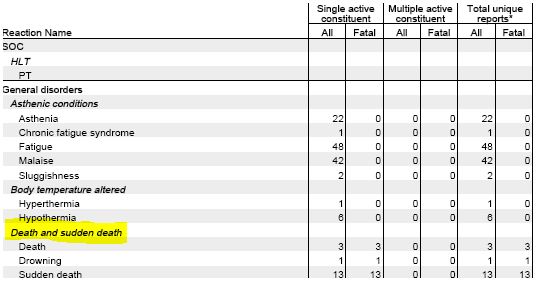
This doesn't mean that 87 patients killed themselves whilst on Remeron, to look at the deaths one has to look further into the MHRA's drug analysis prints. [DAP's]

Remeron, it appears, is associated with 10 cardiac disorders that led to the patient dying, 18 deaths are listed as "general disorders" 13 deaths listed as "injuries", whilst 21 are listed as "psychiatric disorders".

Apart from cardiac disorders these explanations are rather vague, don't you think?

Digging a little deeper into the Remeron DAP we can see it get even more confusing.

Fig 1 shows that there were 3 deaths reported, 1 drowning and 13 "sudden deaths".

Fig 1
This has confused me somewhat, so much so that I Googled 'Sudden Death'. The Merriam medicine dictionary defines sudden death as "unexpected death that is instantaneous or occurs within minutes or hours from any cause other than violence."

So, given that there have been 13 sudden deaths reported to the MHRA why then are the 3 deaths listed above not 'sudden'?

Are we to assume that the 3 deaths were prolonged deaths as opposed to sudden? I would have thought that any death is sudden, wouldn't you?

Again, I referred to the Merriam medicine dictionary, it defines death as "the irreversible cessation of all vital functions especially as indicated by permanent stoppage of the heart, respiration, and brain activity : the end of life."

It becomes even more confusing when we see there have been 12 adverse reactions reported regarding overdose. [fig 2] Overdose is, just like death, split into three categories, namely; intentional overdose, overdose and prescribed overdose. No deaths were reported for prescribed overdose but there was 10 reported for overdose and 2 for intentional overdose.

Fig 2


Are we to assume that 'overdose' actually means accidental overdose? If so, how can we determine whether or not an overdose is accidental? If 10 patients on Remeron died as a result of overdose then it could be deemed as suicide, could it not? It could also mean that these 10 patients overdosed not by their own choice, was it homicide then? Were these 10 patients killed by someone slipping large amounts of Remeron into food?

It's bizarre that the MHRA don't add 'accidental' given that they add 'prescribed' and 'intentional' to the other categories.

Remeron is considered to be relatively safe in the event of an overdose. [1] The figures from the MHRA database would suggest otherwise. 41 overdose and survived. 10 overdosed and died - I wouldn't call that relatively safe, would you?

Further into the DAP we learn that the 21 psychiatric disorders I mentioned earlier are all listed as 'completed suicide.' [Fig 3] So, is completed suicide a psychiatric disorder?

87 deaths attributed to Remeron in Britain alone, 21 of those deaths were by suicide but the MHRA, in what I can only describe as a cover your ass tactic, decide to mask these suicides by labeling them as "psychiatric disorders".

Fig 3


They fail to mention exactly what these psychiatric disorders were. One can only assume that anyone who takes their own life has a psychiatric disorder of some sort... I mean, it couldn't have possibly been the Remeron that caused these 21 patients, Tony Scott and Tooker Gomberg to take their lives, right?

The Remeron product monograph [Merck] treads carefully.

Adults and Pediatrics: Additional Data
"There are clinical trial and post-marketing reports with SSRIs and other newer antidepressants, in both pediatrics and adults, of severe agitation-type adverse events coupled with self-harm or harm to others. The agitation-type events include akathisia, agitation, disinhibition, emotional lability, hostility, aggression and depersonalization.
"In some cases, the events occurred within several weeks of starting treatment.
Rigorous clinical monitoring for suicidal ideation or other indicators of potential for suicidal behaviour is advised in patients of all ages. This includes monitoring for agitation-type emotional and behavioural changes."

Merck cleverly omit the brand Remeron from this important piece of information for the consumer. Other pharmaceutical companies use this tactic too. It's designed to lump all the group of antidepressants together, it's then the job of the Remeron rep to convince a doctor that Remeron is safer than the other antidepressants on the market, they do this with company written documents, lavish dinners, gifts and payments [disguised as consulting fees] for doctors.

You'll note that Merck also list emotional lability as an "agitation-type event."

I first came across the term "emotional lability" when I read through the infamous Paxil 329 study.  GlaxoSmithKline used this term to hide the 5 attempted suicides that had occurred during the clinical trials of Paxil.

In fact, all of the agitation-type events Merck list for Remeron are precursors to suicide. Remember they are not talking about an illness here, they are talking about a drug that can induce these thoughts... something the MHRA adverse reports for Remeron fail to do.

Tony Scott and Tooker Gomberg both took Remeron, both killed themselves by leaping to their deaths. Family and friends will tell you that they were completely shocked by their acts.

Keeping an eye out... or monitoring patients on these drugs is nigh on impossible. Suicide is impulsive and these types of drugs inhibit emotion.  Fear is an emotion inhibited by these drugs and if we, as humans, do not fear death then we will embrace it.

The makers of Remeron have a lot to answer for as do the makers of other groups of antidepressants.


Bob Fiddaman.


[1] Relative safety of mirtazapine overdose.
Velazquez C, Carlson A, Stokes KA, Leikin JB. - http://www.ncbi.nlm.nih.gov/pubmed/11757992

Sunday, May 13, 2012

Paxil [Seroxat] Withdrawal


Anger, aggression belligerent, irrational, self-harm, suicidal, weight gain, personality change, strange behaviour.

All of the above became apparent during Paxil increase and withdrawal.

Paxil is the US brand name for paroxetine.

It is known as Seroxat in the UK and Europe.

Seroxat is marketed and sold by GlaxoSmithKline.

GlaxoSmithKline deny allegations that Seroxat has caused a significant amount of litigants withdrawal problems.

Now...

...watch and learn...


Related


GlaxoSmithKline/MHRA - When Ignorance Turns To Bliss - Part I of IV

GlaxoSmithKline/MHRA - When Ignorance Turns To Bliss - Part II of IV - Witness For The Defence

GlaxoSmithKline/MHRA - When Ignorance Turns To Bliss - Part III of IV - Expert Statistician

GlaxoSmithKline/MHRA - When Ignorance Turns To Bliss - Part IV - The Colour of Money


MHRA To 'Re-educate' UK Doctor's on SSRi's Part I

MHRA To 'Re-educate' UK Doctor's on SSRi's Part II "Keeping A Stiff Upper Lip"
 
MHRA To 'Re-educate' UK Doctor's on SSRi's Part III - MHRA's Ghosts In The Machine

MHRA In Buck-Passing Specialist Cahoots

SEROXAT/PAXIL WITHDRAWAL GUIDANCE - FIDDAMAN 2011


Fid

ORDER THE PAPERBACK 'THE EVIDENCE, HOWEVER, IS CLEAR...THE SEROXAT SCANDAL' By Bob Fiddaman US and CANADA HERE OR UK HERE

AUSTRALIAN ORDERS HERE


Sunday, February 26, 2012

Antidepressants for Takers - New Paper From Healy, Lenoury and Dee Mangin


I feel I must share the following paper with you, it would be silly not to.

Dr David Healy has re-emerged on the Internet, a regularly updated blog, a website and a book [currently reading] have all got people talking.

It's good to see academics posting on the Internet on a regular basis, the more, the merrier, I say.

Healy's latest offering caught my attention, more so because it was a 'call for papers', an interaction, if you will.

Healy writes:

"One of the purposes of this blog is to invite colleagues to add to the knowledge base on drug groups. To submit a paper or to provide your comments, please do so on the form on the Join the Conversation page.
 "I’ll start the ball rolling with the following draft Data Based Medicine (DBM) papers:"

Two papers are then offered as downloads, one for 'takers' of antidepressants, the other for 'prescribers'. Not being a prescriber I chose to read the 'takers', a paper drawn up by Healy, Dr. Jo Lenoury and Dr. Dee Mangin.

It does not disappoint.

In a nutshell, it's everything you really wanted to know about antidepressants, if they actually work, if they are safe, if they cause severe withdrawal, birth defects and other adverse events. It's the paper that should have been drawn up by the regulators of the drugs you and I take, alas they were either too afraid to do it or it would have been frowned upon by the pharmaceutical industry, who fund the likes of the British drug regulator, the MHRA.

Healy not only asks the questions, he gives you the answers - no beating around the push with exemption laws or stonewalling - just straight answers.

Those, like myself, who have been banging the drum about antidepressant use won't be surprised by this paper, it pretty much echoes what we have been saying for years on various blogs, books and in the media.

The beauty of this paper is that it does not target one specific SSRi, it pretty much targets them all and Healy explains, in layman's terms, how these drugs are granted a licence, when in fact they shouldn't be. The whole issue of transparency in clinical trials is explained in simple, yet astute, terms and the Q&A section is a must read for anyone researching antidepressant medication, particularly if they have just been prescribed it by their healthcare physician.

Some key points from the paper that we should all ponder are:

  • As of 2006, the trials that had been done for antidepressants involving over 100,000 patients showed more deaths in those on antidepressant than on placebo.
  • There is some evidence that antidepressants may make future episodes of depression more likely.
  • If you are chronically depressed, the treatments are more likely to give you side effects than do anything useful. In general for moderate depression, the drug is more likely to produce side effects than benefits. Many side effects are livable with but some could cost you your life, your marriage or your job.
  • Many publications state that 5 out of 10 people respond to antidepressants and 4 out 10 respond to placebo, giving the impression that the effects of antidepressants are all in the mind.They aren't. What this data shows is that many of us get better without medication or therapy.
  • Most people who are “depressed”, nervous or anxious, have a condition that clears up in 12-16 weeks whether treated or not.


Healy also explodes the myths about antidepressants and juxtaposes the company lines thrown out by pharmaceutical companies, key opinion leaders and regulators, the most striking of which is shown by the following:


Depression causes birth defects.
This is completely untrue but is used to scare women who are pregnant into taking antidepressants against their better judgment.  Antidepressants increase rates of birth defects, miscarriages, and development delay in children.

Antidepressants take several weeks to work.
This is completely untrue. These drugs produce benefits and harms within hours or days of first taking them. It may take several weeks for a clinical syndrome to lift but this is something quite different. The argument that the drug takes time to work is trotted out as part of the defense against claims that an antidepressant has triggered suicide or violence.

Antidepressants do not cause Addiction
Many antidepressants cause people to be hooked to them – it becomes impossible to stop because of how bad the person feels on stopping and the relief from restarting treatment. Some drugs are worse than others. Because companies have denied there is any problem, it is difficult to know which drugs are the worst offenders and how to manage the problem. Companies and their experts refer to discontinuation syndromes – another term for withdrawal or being hooked – in attempt to avoid the stigma of withdrawal. But even national regulators now concede it may be impossible to stop certain antidepressants.

It's a paper that merits attention, it's a paper that is long overdue, it's a paper you should print off and show your doctor.

Kudos to Healy, Lenoury and Dee Mangin for getting it out there.

Paper can be downloaded as a PDF HERE.


Fid


ORDER THE PAPERBACK 'THE EVIDENCE, HOWEVER, IS CLEAR...THE SEROXAT SCANDAL' By Bob Fiddaman US and CANADA HERE OR UK HERE


AUSTRALIAN ORDERS HERE


Saturday, January 21, 2012

NUMB DVD - Paxil [Seroxat] Documentary Now On Sale.


It gives me great pleasure to announce that the documentary GlaxoSmithKline don't want you to see is now available to purchase on DVD.

Filmmaker Phil Lawrence, who, for 6 months, filmed a fly on the wall documentary about his Paxil [Seroxat in UK] withdrawal, kindly sent me a screener of his movie back in July, review can be read HERE

I have a huge respect for Phil Lawrence. To put one's life on camera in an attempt to educate the masses about the horrific withdrawal problems Paxil causes takes a tremendous amount of courage. Society owes Phil Lawrence a great debt.

The DVD, Numb, can be ordered via the Numb website HERE

If I was Phil I'd send a copy to GlaxoSmithKline...their highly paid defence attorney's too.


Here's a teaser


Monday, January 16, 2012

Tamiflu: Yet More Side-Effects


It's being reported that the swine-flu drug, Tamiflu, is under scrutiny as more and more side-effects have been reported to the MHRA. The Daily Star is claiming that 14 new adverse reactions were added to the drug’s profile in November including back, joint and muscle aches, fever, menstrual pain, herpes, sinusitis and earache.

A small price to pay to fend off a killer virus, which was basically a different strain of the flu.

The MHRA, the agency that regulate the drugs you and I take, have claimed that the benefits of taking Tamiflu outweigh any risks, a standard response when their regulation is put into question.

Swiss pharmaceutical giant Roche, who manufacture Tamiflu, are themselves the subject of an investigation regarding claims that they withheld vital data about the effectiveness of Tamiflu from scientists.

The Cochrane Collaboration, an independent watchdog who are not funded by the pharmaceutical industry [unlike the MHRA] have announced that a report, to be published on January 18 shows how their investigation was hindered by Roche’s refusal to provide full clinical data. The Bureau of Investigative Journalism writes:

This claim was made public today by one of the founders of the Cochrane Collaboration at a British Medical Journal conference held in London.
 Other Cochrane reviewers are to reassert this claim in a further article due to be published by the Public Library of Science (PLoS). In the article, three of the Cochrane reviewers write:
‘In December 2009, after we voiced serious concerns in the BMJ about Tamiflu’s alleged ability to reduce compliations, Roche wrote that it was ‘very happy to have its data reviewed by the appropriate authority or individuals’ and publicly pledged to release 10 ‘full study reports’ in the ‘coming days’”. They went on to state that “despite extensive correspondence over the next year and a half Roche refused to provide any more than portions of the clinical study reports.’
The MHRA were recently in the news for failing to respond quickly enough to faulty PIP breast implants. They have also been criticised for sending out information to UK healthcare professionals regarding SSRi withdrawal and, it appears, have informed doctor's of the existence of SSRi withdrawal "specialists" when no such specialists actually exist. [LINK]


Fid

ORDER THE PAPERBACK
'THE EVIDENCE, HOWEVER, IS CLEAR...THE SEROXAT SCANDAL' By Bob Fiddaman
US & CANADA HERE OR UK FROM CHIPMUNKA PUBLISHING

AUSTRALIAN ORDERS HERE


Please contact me if you would like a guest post considered for publication on my blog.