Zantac Lawsuit


Researching drug company and regulatory malfeasance for over 16 years
Humanist, humorist
Showing posts with label Paroxetine. Show all posts

Tuesday, October 17, 2023

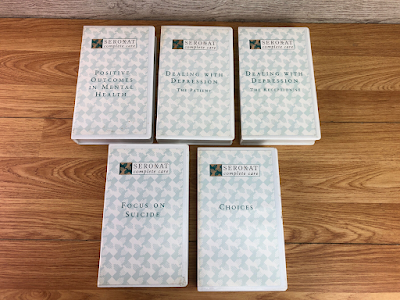
Seroxat Complete Care VHS Set ~ Choices


Fig 1


The following is number 1 in a series of 5 blog posts where I will aim to exclusively post 5 videos that have came into my possession.

The videos, which run for approximately 12-15 minutes, were produced by Dragon Communications Limited (now dissolved) on behalf of SmithKline Beecham Pharmaceuticals (Now known as GSK). They were all part of an attempt by GSK to educate GP's in the UK back in 1992. Seroxat, by the way, was first licenced in the UK in 1990.

Although the brand name 'Seroxat' isn't mentioned in the videos, we can see by the accompanying VHS cases (Fig 1) how GSK subliminally and, it has to be said, successfully, convinced prescribing GPs in the UK that Seroxat should be the 'choice' of drug when treating depression, anxiety, and sleep disorders.

Dragon Communications Limited, as mentioned above, have now dissolved. They and GSK also teamed up to create a Hepatitis-B educational video. The video, published in 1986, was called, 'Hepatitis-B : it doesn't happen here'.

They also wrote a 4-volume book for Pfizer regarding Inflammation and arthritis. When I say 'wrote' they probably just wrote what Pfizer told them to.

The 5-set videos were purchased on Ebay by my very good friend, Brian Daniels of CCHR UK. He, in turn, converted them into a digital format so I could, firstly, watch them and, secondly, distribute them so others  could draw their own conclusions.

Remember, it was 1992 in the UK when GP practices would have received these videos. At the time, Prozac had a stranglehold on the UK antidepressant market and GSK were desperately trying to knock it off the perch. It was also a time when Tricyclic antidepressants were coming to their end because of side-effects associated with them, something GSK really drive home in the 'Choices' video below.

Since 1992, Seroxat has been the subject of many lawsuits, it's been through the courts (in the US) and evidence has come to light that it causses severe withdrawal problems, suicidal thinking, suicidal actions and birth defects. There are links at the foot of this post that I've covered previously on my blog.

Okay, without further ado, here's the video. Be sure to pay attention to the clever marketing tricks they use without crossing the line. They are all but telling GPs that depressed and anxious people have a chemical imbalance...without actually uttering the term. The 'sciency' type graphics in the video were, I believe, created as a distraction when you listen to the narrative played over them.

Terms such as:

"It is thought"

"It may"

"Likely to be of importance"

"The theory provides support"

"Are thought to be important"

"Could increase"

"May result"

"Sleep and wakefulness are thought to be controlled..."

"It's thought that serotonergic neurons..."

"The role of serotonin in depression, anxiety and sleep disorder, suggest..."

"May be a useful approach"

"It seems evident"

"Various minds of evidence" 

Anyway, here's the video. I make no apologies for the acting performances.


Seroxat and homicide

Saturday, April 25, 2020

Study 352 - Paxil & Bipolar Documents Released


Dozens of newly-publicised documents now give the full story of GSK’s ghostwriting campaign for a Paxil (paroxetine) clinical trial report on Study 352.


Charles "Bling Bling" Nemeroff

What is Study 352?

A Double-Blind, Placebo-Controlled, Comparison of Imipramine and Paroxetine in the Treatment of Bipolar Depression. The lead 'author' on the study was Charles B. Nemeroff, a psychiatrist who had close ties to GlaxoSmithKline and other drug companies.

Anyone familiar with GlaxoSmithKline and Paxil will know all about the Paxil 329 study where they [Glaxo] hired a PR firm to draft and, later, persuaded key thought leaders, mainly child psychiatrists to endorse and promote Paxil (paroxetine) at any given opportunity. The 329 study has been dissected by many who are in agreement that it's a piece of fraud. Read more about the Paxil 329 study here.

Not content with one study doing the rounds in various journals and paediatric clinics Glaxo, in their infinite wisdom, hired the services, once again, of a ghostwriting team to pimp out a paroxetine bipolar trial, known as Study 352.

"Study 352" was published in the American Journal of Psychiatry (158:906-912; June 2001) and suggested that Paxil may be beneficial in the treatment of bipolar depression. The study, as mentioned above, cited Charles B. Nemeroff as the lead author. The name Nemeroff is synonymous in the ghostwriting and kickback field. He's made a lucrative living out of speaker fees and pharmaceutical roundtables, although this is classed as 'honoraria' [ex gratia payment]

Glaxo hired the same PR outfit, Scientific Therapeutics Information, [STI] to misrepresent information from Study 352. STI also drafted the original Paxil 329 study, specifically Sally Laden. I've wrote extensively about Laden in the past, see here, here & here.

Just like Study 329, Study 352 also made unsubstantiated efficacy claims and downplayed the adverse event profile of Paxil.


Dr. Karl Rickels

The original 352 study made the following acknowledgement:

This study was conducted with the participation of the following collaborating investigators and sites: Jay D. Amsterdam, M.D. (University of Pennsylvania School of Medicine, Philadelphia)

Amsterdam was asked by Dr. Karl Rickels if he could help out a junior colleague, Laszlo Gyulai, on the study. Rickels had been working on pharmacological treatments for mental health since the 1950's and had previously worked alongside Amsterdam.

Rickels had also previously served in the German army under Rommel. He was captured and brought to America as a POW. After the war he completed medical school and postgraduate training in Germany. When a psychiatric residency position opened at a mental hospital in Iowa, Rickels accepted the opportunity and immigrated to the United States. Later he founded the Mood and Anxiety Disorders Section at the University of Pennsylvania.

Amsterdam, who accepted Rickels offer to work alongside Gyulai, was no stranger to industry sponsored studies. According to Peter Simons, a science writer for Mad in America, "Amsterdam was also on industry panels for over a dozen pharmaceutical companies, giving sponsored talks. It wasn’t until the early 2000s that industry representatives began urging him to deviate from his prepared talks. Once he began to experience pressure to “spin” his results in favor of the drug, he said, “I stopped giving talks.”"

Study 352 Newly-Publicised Documents

According to Los Angeles based attorneys, Baum Hedlund Aristei & Goldman, "Amsterdam was an investigator who treated the largest number of patients in Study 352. However, he was intentionally left off from the review of the data and the drafting of the manuscript because the study sponsor, GSK, and the other “so-called authors” knew Dr. Amsterdam’s professional ethics would not allow him to lend his name to a ghostwritten work, and more importantly, he refused to participate in the alteration and manipulation of data for the sake of marketing Paxil.

"In 2011, Dr. Amsterdam lodged a formal scientific misconduct complaint with the U.S. Department of Health and Human Services’ Office of Research Integrity.

"In the 2011 complaint, Dr. Amsterdam alleged the individuals named above allowed their names to be added to a manuscript that was drafted by a “medical communications company” (STI) hired by SmithKline Beecham (now GSK) and misrepresented information from Study 352, which was funded by GSK and the National Institute of Health (NIH).

"The published 352 article falsely concluded that paroxetine therapy is effective in bipolar depression without any meaningful manic or other side effects. According to Dr. Amsterdam’s complaint, the published results were manipulated and manufactured by GSK and STI employees."

Amsterdam alleged that Guylai, had taken his data from the 352 study in which he had recruited the majority of patients, and that Guylai and a team were about to publish an analysis of the data under their own names. In response, Karl Rickels, chief of the mood disorders section of the UPenn Medical Center, told Amsterdam GlaxoSmithKline (then SmithKline Beecham) was in charge of the study and that the authors hadn't even seen the manuscript (CBS News)


Baum Hedlund Aristei & Goldman has now released new documents pertaining to Amsterdam's complaint which include:

  • Sally Laden of Scientific Therapeutics Information Inc. (STI), a consulting firm hired by GSK, was the ghostwriter of a Paxil clinical trial report for Study 352 (and Study 329), which effectively spun negative study results into positive results. GSK paid academics to lend their names to the clinical trial report, published as “Double-Blind, Placebo-Controlled Comparison of Imipramine and Paroxetine in the Treatment of Bipolar Depression” by the American Journal of Psychiatry. GSK wrote and reviewed the report before any of the “official” named authors were contacted for their input. The article has never been retracted despite overwhelming evidence of scientific manipulation.

  • An American Journal of Psychiatry editor with financial ties to GSK abetted the alleged fraud by intervening to ensure “Double-Blind, Placebo-Controlled Comparison of Imipramine and Paroxetine in the Treatment of Bipolar Depression” was published after the manuscript was initially rejected.

  • The University of Pennsylvania, which employs two of the study’s “official” authors, continues to further stonewall investigation into the malfeasance of its faculty in this matter despite numerous attempts on our part to conduct a thorough investigation. The correspondence letters posted on the Baum Hedlund Aristei & Goldman site between the firm, the U.S. Department of Health and Human Services’ Office of Research Integrity (ORI) and the University of Pennsylvania trace the history of events surrounding the alleged scientific fraud of Study 352. It is unclear whether Penn actually submitted the new evidence to ORI as their responses to Baum Hedlund Aristei & Goldman have been ambiguous. Baum Hedlund Aristei & Goldman believe that had ORI reviewed the evidence contained in the 40 STI documents, rather than having relied upon Penn’s investigation, ORI would have come to the conclusion that the academic consultants involved in the 352 trial committed serious scientific misconduct and would have decided in favor of Dr. Amsterdam’s complaint.

Once such document shows how the PR firm, Scientific Therapeutics Information, [STI] has worked on approximately 100 Paxil related projects for GlaxoSmithKline. Another shows a letter from Sally K. Laden to Cornelius (Neil) Pitts who, in 2001, was the Assistant Director, Clinical Research Development at GlaxoSmithKline. In this particular document we see Laden set out the cost of STIs work on the project. The final invoice for ghostwriting Study 352, according to Laden, was $13,286,81.

This letter from Laden to Nemeroff, the nominated lead 'author' for Study 352, shows how Nemeroff would liaise with GlaxoSmithKline whenever Study 352 was criticised.

If you don't feel sick yet then wait until you read the correspondence between Baum Hedlund Aristei & Goldman and the Office of the General Counsel at the University of Pennsylvania, who, it appears, deny there is any wrong-doing!

"The University recognized 
that the authors collaborated with professional writers when drafting the paper and the University concluded that such collaboration in 2001 did not constitute research misconduct. "

All new documents can be found here, GSK Paxil Clinical Trials | Court Documents.

Fid Rant


Sally K. Laden

Regular readers already know my thoughts on GlaxoSmithKline, Charles "Bling Bling" Nemeroff and Sally K. Laden. Three subjects whom, I feel and believe, are totally void of empathy when it comes to the safety of patients.

Payments from GlaxoSmithKline to Nemeroff run into millions of dollars, he is, in my opinion, nothing more than a despicable human being who cares only about the size of his bank balance, he, seemingly, cares not a jot about the safety of patients. Money, and lots of it, has blinkered his rational.  Jay D. Amsterdam, on the other hand, saw the light. He saw how money influenced decisions and put patients at risk. He did the right thing by turning his back on the never ending supply of dollar bills that ultimately meant turning something shit into something smelling of roses.

Laden, and her team at STI, should hang their heads in shame. The 352 Study, which she and her team spun from shit to roses, has been cited many times and used as some kind of half-arsed informed consent to prove that Paxil is safe and effective in the treatment of Bipolar, when in actual fact Laden, at least, knew there were problems. Remember, this isn't the first time Laden has turned Glaxo's shit into roses. She and her team have been paid handsomely time and time again. She has never learned from her mistakes and, like Nemeroff, was never able to see passed the Benjamins. For that sole reason, and the fact that she and her STI team continued to work on projects with GSK, I hold her in complete contempt.

If GSK, Nemeroff and Laden are rotten eggs then what of the University of Pennsylvania? After reading their denials of any wrong-doing, I, personally, have to put them in the same boat as the aforementioned. Protecting their prestigious University name seems to be the issue here, once again it's all, seemingly, about the image rather than protecting the safety of patients.

Drug companies have also paid institutions, such as the University of Pennsylvania, in the past. Pfizer's disclosure report for the University of Pennsylvania, for example, shows Pfizer-sponsored research, totaling $1,199,378. Karl Rickels, who remember persuaded Amsterdam to work alongside Gyulai, on the 352 study, was listed as the principal investigator for a research project with a cash payment of $73,791.

Although there is no evidence to suggest Rickels worked with GlaxoSmithKline on Study 352, it does leave me with my jaw on the floor that a former German POW works amongst the field where patient safety should be paramount.

According to his memoirs, Rickels claims he had no choice but to join the German military. This may be true but having bore witness to one catastrophic event, be it after the event or not, he, seemingly stood by and watched another catastrophic event unfold. It was Rickels who told Amsterdam that GlaxoSmithKline was in charge of the study and that "the authors hadn't even seen the manuscript."

For the second time in his life he, seemingly, stood back and said/did nothing.

GlaxoSmithKline, of course, are the main culprit here but as long as individuals and entities such as Laden, Nemeroff, Rickels and departments within the University of Pennsylvania
 have a desire for money rather than a desire for patient safety, Glaxo and other drug companies will always be able to turn shit into roses.

It's all rather incestuous isn't it.

Bob Fiddaman


Tuesday, April 30, 2019

Seroxat UK Litigation Day 1


Today was an interesting day regarding litigation against GSK and its brain pellet, paroxetine.  GSK markets this product as Seroxat in the UK and Paxil in the US. It is also sold by GSK using other names to include Aropax n Australia and New Zealand. It's likely that pharma companies benefit by giving the same product different names in various countries because it makes it more difficult for consumers to search for and find relevant adverse drug effects as experienced by users across the globe. The average Aussie likely had no idea that Aropax is Paxil in the US, etc.

But back to the paroxetine court cases. Today the Supreme decided to hold off making their decision regarding the Dolin case. A previous case, Merck, Sharp & Dohme Corp. v. Albrecht has similarities to Dolin v GSK. That is, Merck's defence, like GSK's is that the FDA is responsible for changes in the labelling and not drug companies.

In the Dolin vs. GSK case, a Chicago court found in favour of Wendy Dolin in 2017. Not only did the jury determine that GSK failed to warn of the risks posed by paroxetine, they determined paroxetine caused Stewart Dolin's suffering and demise. An Illinois Seventh Circuit court later overturned the jury's decision and that decision was appealed to the Supreme Court where it now remains. It's never easy going up against GSK, despite the fact that they are officially criminals (See The United States Justice Department). I assume that the Supreme Court has decided to hold their decision on Dolin v GSK until the Merck matter is sorted.

Here in the UK, the long-awaited group action trial against GSK kicked off more than a decade after it was filed. The trial is estimated to last three months. I am one of more than 100 plaintiffs and will not be reporting on the trial just yet. But, stay tuned because I'm certain there will eventually be much to say when the dust settles.

As many of you know, I've been writing about GlaxoSmithKline and Seroxat for more than 13 years. Restrictions prevent me from writing about the current trial but I can still write about GSK's not-so-pretty sordid history, which I intend to do over the coming three months.

I will be attending some of the trial and will surely take notes because one never knows if there's another book I might write, my previous book, The Evidence, However, is Clear, the Seroxat Scandal, is quite old now and much has happened since I wrote it some 8 years ago.

For all of those who have contacted me today, these are the reasons why I am not covering the case as it presently unfolds.

It's frustrating given that Truthman and I likely know more about GSK's shady business and their Seroxat-labelled brain pellets than anyone else on the planet.

For now, we will both remain silent.

For now.

Bob Fiddaman.


Monday, October 22, 2018

GSK Study 356 - The Truth is Out - 25 years Too Late!


Regular readers of the Fiddaman blog may have been keeping a close eye on an old study from the early 90's (08 Apr 1993 – 25 Oct 1994) that I've recently found via GSK's clinical trial registry website.

The study, known as GSK Study 356, reported 7 suicide attempts (2 of which were completed suicides). However, these attempts at suicide are not mentioned within the documents GSK has made public. Moreover, the actual number of suicide attempts in Study 356 was 9. (2 of which were completed suicides)

How do we know this?

Documents obtained from the Australian drug regulator, the TGA, show us this but strangely do not tell us in which group the attempts at suicide occurred...until now.

For those who are unfamiliar with the study, it was, to my knowledge, an attempt at finding which of the two antidepressants, namely Prozac and Paxil, were better at treating major depression. The study was sponsored by GSK.

After posting two blogs on the subject, GSK Study ID - 29060/356 - The Missing Suicide Attempts and No Action to be Taken Against GSK for Hiding Suicide Data, the TGA have written to me in efforts to clarify what was revealed by me last month.

However, rather than trying to add clarity to my previous two blogs, the TGA has opened a pretty big can of worms.

In asking them why GSK failed to report the missing suicide attempts they told me the following. It makes for very interesting reading.

Good Afternoon Mr Fiddaman

I have followed up your enquiry about the presentation of information about the Clinical Trial - GSK Study ID - 29060/356 on the GSK study website.

The nine events you have referred to were discussed with investigators at a meeting on November 26th 1993, whilst the study was still ongoing and blind.  Seven of those same events were also included in the Dear Investigator Letter which went out to investigators in August 1993. Of the nine events that were discussed with the investigators five events were subsequently coded to the WHO preferred term of drug abuse, through the methodology applied at that time. On the trial summary these are presented as cases of “Drug Abuse (Overdose)”. There were two of these recorded for paroxetine (patients 139 and 147) and three of them recorded for fluoxetine (patients 18, 76 and 144) 

The remaining four cases were coded to the WHO preferred term of “Suicide Attempt”. On the trial summary two of these events are listed as “Suicides” (in the fatal SAE section) with one for paroxetine (patient 92) and one for fluoxetine (patient 122). The two other cases are presented as “Suicide attempt”, both for fluoxetine (patients 87 and 142).

The information as presented in the clinical trial summary accords with the safety information as provided in the full study report.

I trust that the information provided is of assistance.

Regards

Bernadette Barton 
Assistant Director
Adverse Event and Medicine Defect
Pharmacovigilance and Special Access Branch

Therapeutic Goods Administration
Department of Health
PO Box 100
Woden ACT 2606 Australia

--

So, there you have it, folks. The missing suicide attempts were coded as "drug abuse." They did this, according to the TGA, because this was the preferred term, at the time, used by the World Health Organisation (WHO)

So, breaking down the 9 who attempted suicide we have 6 from the Prozac group and 3 from the Paxil group. (1 patient from each of the groups completed suicide)

It's a head-scratcher for me - why would WHO use such a system?

The medical definition of "suicide attempt" and "drug abuse" differ somewhat.

Suicide Attempt
A non-fatal, self-directed, potentially injurious behavior with an intent to die as a result of the behavior; might not result in injury

Prescription Drug Abuse
Taking medication in a manner or dose other than prescribed

This begs the question: How many other GSK sponsored studies buried suicide attempts in the drug abuse category?

Study 356 was carried out in the early 90's. By the late 90's there was growing concerns regarding Prozac, the concerns surrounding Paxil came later.

Here's a Guardian article from 1999. I'll just post the sub-heading and the link:

It was too good to be true. Prozac, the wonderdrug hailed as the answer to the war against depression and taken by some 37 million people worldwide, is not as harmless as we've been led to believe. Disturbing evidence has now emerged, showing that, after the initial relief and euphoria of the first dose, Prozac can push some patients into so agitated a state of mind that they are a danger not only to themselves, but to others, too. (Full Article)

One has to remember here that Study 356 was sponsored by GSK, the manufacturers of Paxil who, at the time, wanted Paxil to be the blockbuster drug that Prozac already was.

Would doctors have prescribed Prozac knowing that there was a high ratio of suicides in a clinical trial - personally, I think they would have. The marketing for these two drugs was heavy and included incentives for doctors to prescribe them. Eli Lilly reps dining and dashing', whilst GSK reps would persuade doctors at strip bars, amongst other places.

Now we know. It's taken the best part of 12 months to get to the bottom of this study, a study that is almost 25 years old!, and I couldn't have done it without the help of Kathy, who is the moderator of the Facebook page,  Australian Antidepressants Class Action & Awareness and an administrator for the Australians For Safe Medicines Facebook page.

Special thanks to the TGA too. They seem a little bit more transparent than their counterparts, the FDA and MHRA.

The British, American, and, indeed, Australian media are disinterested.

Bob Fiddaman


Sunday, September 16, 2018

No Action to be Taken Against GSK for Hiding Suicide Data


Earlier this month I posted previously unseen documents that clearly showed how GlaxoSmithKline (GSK) hid 9 suicide attempts from the results of a 1993 clinical trial posted on their website. See - GSK Study ID - 29060/356 - The Missing Suicide Attempts

The documents were sent to me by 'Kathy', who is the moderator of the Facebook page,  Australian Antidepressants Class Action & Awareness and an administrator for the Australians For Safe Medicines Facebook page.

After publishing my findings, Kathy wrote to the Therapeutic Goods Administration (TGA) and asked if they would be taking action against GSK for failing to report the 9 suicide attempts in the Aropax clinical trials, known as GSK Study #356.

The TGA's response is staggering, to say the least.

Dear Kathy

Thank you for emailing the Therapeutic Goods Administration (TGA). I acknowledge your concerns about the GSK clinical trial (A double-blind, multicentre study to compare paroxetine and fluoxetine in the treatment of patients with major depressive disorder with regard to antidepressant efficacy, effects on associated anxiety and tolerability) that was conducted in 1993-1994.  However, the TGA is unable to comment about the clinical trial as it was completed twenty four years ago.

As has been explained to you previously, the TGA’s safety monitoring is based on rigorous pre-market assessment and then the post-market signal investigation area of the TGA monitors the safety of medicines, to contribute to a better understanding of their possible adverse effects when they are used outside the controlled conditions of clinical trials.

Thank you for your interest in medicine safety.

Regards

Bernadette Barton
Assistant Director
Adverse Event and Medicine Defect
Pharmacovigilance and Special Access Branch

--

On the 'About TGA' section of their website, they state: "TGA's approach to therapeutic product vigilance is to continually monitor and evaluate the safety and efficacy (performance) profile of therapeutic products and to manage any risks associated with individual products.

Just to be clear, the results of GSK Study #356 failed to mention 9 suicide attempts, moreover, they failed to say which group these 9 suicide attempts pertained to. Study #356 had two active drugs, namely paroxetine and fluoxetine, both of which are selective serotonin reuptake inhibitors (SSRIs). There was no placebo group in the study.

As a regulator who claims to "manage any risks associated with individual products" I am utterly gobsmacked by their response above.

Surely a regulator should be asking GSK why they failed to include these 9 suicide attempts. Surely they should be telling GSK to publish the correct statistics and not a watered down version of what actually occurred during the study.

In essence, the TGA is saying, we don't care if the public doesn't know how many suicide attempts occurred in either the paroxetine or fluoxetine group. We don't care that GSK failed to report that the percentage of suicide attempts was a staggering 11.11%. We don't wish to manage these risks, even though we claim on our website that we do. We don't care the public isn't armed with this information when visiting their doctor or psychiatrist. We don't think 9 suicide attempts in a clinical trial is important.

I find the last line of the email kind of ironic: "Thank you for your interest in medicine safety."

Are they taking the piss?

Bob Fiddaman


Tuesday, September 04, 2018

GSK Study ID - 29060/356 - The Missing Suicide Attempts


Fluoxetine - AKA Prozac
Paroxetine - AKA Aropax, Seroxat, Paxil

Study ID - 29060/356
A double-blind, multicentre study to compare paroxetine and fluoxetine in the treatment of patients with major depressive disorder with regard to antidepressant efficacy, effects on associated anxiety and tolerability.


Snapshot was taken 3rd September 2018

Study ID - 29060/356/_1
Extension phase for a double-blind, multicentre study to compare paroxetine and fluoxetine in the treatment of patients with major depressive disorder with regard to antidepressant efficacy, effects on associated anxiety and tolerability.

Both studies appear on the GSK Study Register website, the second study is a continuation (extension) of the first.

As you can see, both studies were double-blind, which means neither the patient or investigator knew what drug they were taking/prescribing. After the trials have been completed, GSK can break the code and find out on which drug the adverse events occurred. In this case, one suicide in the paroxetine group and one in the fluoxetine group; no suicide attempts in the paroxetine group, and; two in the fluoxetine group, one of which was a completed suicide. In both groups, there was one suicide each, both were women.

According to recently obtained documents from the Therapeutic Goods Administration (TGA), the #356 trial reported 7 suicide attempts* (2 of which were completed suicides). However, there is no mention of the 5 attempted suicides on the GSK Study Register website, at least not for paroxetine. They do, however, cite two suicide attempts for patients taking fluoxetine during the trial, one of which was a completed suicide.

*Further, more documents show that there were in fact 9 suicide attempts in Study #356, however, there is no mention of this on the GSK Study Register website.

Masking the suicide attempts
GSK report that there were 6 subjects with non-fatal serious adverse events (SAEs) in the paroxetine group and 10 in the fluoxetine group. A total of five (2 paroxetine, 3 fluoxetine) are in the Drug Abuse (Overdose) category.

Drug overdoses
Could these be deemed as attempted suicides or were the overdoses unintentional? If, indeed, they were attempts at ending one's own life, then why is it not reported as such? Well, according to recently obtained documents, no suicide attempts were made by overdose.

Therapeutic Goods Administration (TGA)
Who are the TGA?

The TGA  is Australia's regulatory authority for therapeutic goods. They carry out a range of assessment and monitoring activities to ensure therapeutic goods available in Australia are of an acceptable standard. They are the American equivalent of the FDA and British equivalent of the MHRA.

The Previously Unseen Documents for Study ID - 29060/356
These were obtained under the Freedom of Information Act and forwarded to me by 'Kathy' who runs the Australian Antidepressants Class Action & Awareness Facebook page. Kathy copied me in on a lot of the correspondence between herself and the TGA. The process of obtaining the following documents took a considerable amount of time; I'd estimate the best part of a year. Kathy's tenacity and doggedness paid off.

After initially requesting payment for the documents, the TGA apparently had a change of heart and released many documents pertaining to Study #356, most of which make for very interesting reading. Before I publish them, it's important you understand the reasons why there are many redactions (black-outs) in the documents. According to the Australian Freedom of Information Act 1982, there are a number of exemptions where certain information may be redacted. They include: protecting patient privacy; irrelevant material; documents disclosing trade secrets or commercially valuable information and; documents subject to legal professional privilege.

Human Research Ethics Committees (Australia)
It may be unethical for a researcher to continue a trial if:

(a) there are or have been substantial deviations from the trial
protocol;
(b) side effects of unexpected type, severity, or frequency are
encountered

National Statement on Ethical Conduct in Research Involving Humans

You'll hear more about the Human Research Ethics Committees (HREC) in the documents below.

First off, the two suicides...

32-year-old female 
Causality: "Possible"
Outcome: Death, maybe drug


46-year-old female
Causality: "Possible"
Outcome: Death, maybe drug


Attempted Suicides

According to the study posted on the GSK website, there were only two suicide attempts, both of which occurred in the fluoxetine group. One of these was fatal. However, the documents obtained from the TGA say something quite different. There is a contradiction as to exactly how many suicides attempts occurred. Firstly, according to a Paroxetine Clinical Study Meeting, Dr Sykes claimed there were 9 reported suicide attempts, two of which were completed suicides.

The study meeting, according to the document, was held on Friday the 26th of November, 1993


However, 4 months prior to Dr Sykes' claims, GSK, then SmithKline Beecham, sent a letter to all investigators involved in the trial. They stated, "...we have now received reports of 7 suicide attempts (including two deaths) for the 356 study comparing paroxetine to fluoxetine."

The letter, below, goes on to state how confident they are that, "the number of suicide attempts in this study is within that expected as a consequence of the depressive illness per se."

In other words, it wasn't the drug, it was the illness.


In between these two letters, we have a document from a Professor (dated September 1993). The letter was sent to the Research Ethics Committee.

GSK had made contact and told him about the suicides and suicide attempts. Here it gets interesting because it gives us the number of those enrolled (63). The Professor states, "...there have been seven suicide attempts including two deaths in the first 63 patients included in this Australian multicentre study." (11.11%)

The letter,, signed off by an Associate Professor at the School of Psychiatry, goes on to say how he had researched data and had found no evidence that either paroxetine or fluoxetine increase suicide rate or ideation in depressed patients. Remember, this was 1993 - no lawsuits had yet revealed the extent of those who had died or attempted suicide on paroxetine, or indeed Prozac.


In November 1993, the Research Ethics Committee ceased enrollments for the study because of the "reported cases of suicidal gestures'.  A review of the attempted suicides was needed before #356 could proceed.


#356 was halted and, it seems, an independent review of the study took place one year later. The independent review clarifies that there were actually nine suicide attempts, two of which were successful. In all, according to the review, there were 100 patients enrolled. The review, however, found no reason why the study shouldn't continue. (Attempted suicides = 9%)

Of the 91 patients who did not attempt suicide, the review states, "26 either withdrew or were withdrawn prematurely from the trial."  No reason is given for this.

According to the review, no suicide attempts were made by means of a drug overdose.

Here is the 25-page Independent Report.

Comment

Where are these missing suicide attempts? Why are they not reported on the GSK Study Register website?

There were 7 suicide attempts when 63 patients were enrolled (11.11%) . Surely this figure should have raised a red flag?

There were 9 suicide attempts when 100 patients were enrolled (9%) . Even this figure is astronomically high.

Investigators and review panels didn't really have much to go on back in 1993/94, apart from, of course, GSK's own information and published literature that was mainly ghostwritten by PR companies hired by GSK.

From the early onset of this study, GSK made it abundantly clear to investigators (prescribers) that there was no supporting evidence that suggested paroxetine could induce suicidal ideation. The study was double-blind so the patients and investigators didn't know what drug was being used.

Today, on the GSK Study Register website we see that since the study completion, GSK broke the code (so they could see what patient took what drug). They admit to having one suicide in the paroxetine group and one in the fluoxetine group. What they don't do, and they've had 25 years to rectify, is show us what drug caused the suicide attempts. According to the findings, we see no attempts in the paroxetine group and 2 (one completion) in the fluoxetine group. This would suggest that they also broke the code for the suicide attempts but only showed 2 (both in the fluoxetine group) when the documents obtained from the TGA show that there were 7 attempts when 63 patients were enrolled and 9 attempts when the enrollment reached 100.

The 356 Study that sits on the GSK website today doesn't really raise any red flags in its current format. With documents I've published today should we have a need to be concerned?

It is unknown in what group the non-fatal suicide attempts occurred. For all we know they could have all occurred in the fluoxetine group. I'm unsure why GSK have omitted such important data but I can speculate.

It leaves me wondering that if such a trial was carried out today, would the review board still claim there is no link between either paroxetine or fluoxetine and suicidal ideation?

Since the year of this #356 study (1993) GSK has paid $390 million for suicides or attempted suicides said to be linked to paroxetine. This has included an average of $300,000 to resolve 300 attempted suicide cases and an average of $2 million for 150 suicide cases. (Source)

The most recent paroxetine suicide case involves former corporate lawyer Stewart Dolin, whose life ended when he jumped in front of a Chicago Transit Authority train on July 15, 2010, while taking a generic version of Paxil. On April 20, 2017, an Illinois federal jury found GSK liable for Stewart Dolin’s death and ordered the pharmaceutical company to pay $3 million to Wendy Dolin. However, on August 22, 2018, the Seventh Circuit Court of Appeals overturned the verdict claiming, "GSK had presented sufficient evidence time and again through the proceedings – before, during and after trial – to demonstrate it had no control of the drug labeling at the center of the case. Therefore, they said, the lawsuit should have been dismissed." Further, they added, "Court judges erred when they allowed to go to trial a lawsuit brought by Stewart Dolin's widow (Wendy Dolin)"

By 2000, Eli Lilly had reportedly paid more than $50 million to settle more than 30 Prozac (fluoxetine) lawsuits related to murders or suicides. There were also undisclosed settlements. While Prozac suicide lawsuits spiked in the 1990s, Lilly faced less litigation after the drug lost patent in 2001 and generics flooded the market. An FDA-required black box warning for suicide ended all “failure to warn” lawsuits. (Source)


Bob Fiddaman

Special thanks to 'Kathy' of the Australian Antidepressants Class Action & Awareness Facebook Group

Kathy is also an administrator for the Australians For Safe Medicines Facebook page.

She is now in the process of requesting suicide information from Venlafaxine trials in Australia.


Thursday, August 23, 2018

Judge Hamilton & Co Toss $3M Dolin Verdict


Yesterday's decision from the Seventh Circuit declared "the drugmaker (GSK) can’t be sued under Illinois law for insufficiently warning of suicide risk on a drug’s label, when that label’s language was set by federal regulators."

Read on...

pre·con·ceived
adjective
(of an idea or opinion) formed before having the evidence for its truth or usefulness.


Mayor Larry Vaughn (left)

Jaws Synopsis

During a beach party at dusk on Amity Island, New England, a young woman, Chrissie Watkins, goes skinny dipping in the ocean. While treading water, she is violently pulled under. The next day, her partial remains are found on shore. The medical examiner's ruling that the death was due to a shark attack leads police chief Martin Brody to close the beaches. Mayor Larry Vaughn overrules him, fearing that the town's summer economy will be harmed. The medical examiner now concurs with the mayor's theory that Watkins was killed in a boating accident.


Seventh Circuit Judge David Hamilton


On May 30, 2018, the Seventh Circuit Court of Appeals heard a plea from GSK with regard to reasons why they don't feel they shouldn't pay a $3million fine handed down to them last year. During the oral arguments, Seventh Circuit Judge David Hamilton (Pictured above) repeatedly voiced doubts over the issue of so-called “innovator liability,” or the theory that the original makers of a drug – the “innovator” – should be held liable for the effects caused by others’ imitation product. Hamilton stated that it could significantly harm the pharmaceutical industry, and consumers and patients who rely on the medications invented and manufactured by the industry.

Ironically, the actor who played Mayor Larry Vaughn in the movie Jaws, Murray Hamilton, shares the same surname as Seventh Circuit Judge David Hamilton. To my knowledge, they are not related.

I've been a fan of Jaws, particularly the screenplay, for many years. It bears so many striking similarities to the pharmaceutical industry (the shark) and the advocates that try to highlight wrong-doings, Quint, Brody, and Hooper. 

Yesterday's decision from the Seventh Circuit declared "the drugmaker can’t be sued under Illinois law for insufficiently warning of suicide risk on a drug’s label, when that label’s language was set by federal regulators."

Seventh Circuit Judge David Hamilton. Circuit Chief Judge Diane P. Wood and Circuit Judge Diane Sykessaid, said, "GSK had presented sufficient evidence time and again through the proceedings – before, during and after trial – to demonstrate it had no control of the drug labeling at the center of the case. Therefore, they said, the lawsuit should have been dismissed." Further, they added, "Court judges erred when they allowed to go to trial a lawsuit brought by Stewart Dolin's widow (Wendy Dolin)"


Former Glaxo CEO, JP Garnier

"There is a legal right for us to go directly to the public"

Nowhere in the Seventh Circuit's panel conclusion does it state that paroxetine wasn't responsible for Stewart Dolin's induced suicide, in fact, it suggests that it did, but claims GSK did enough to warn Stewart, even though the FDA didn't heed that warning. The ruling failed to mention the deposition, shown at the 2017 Dolin trial, by former Glaxo CEO, JP Garnier, in which, when asked, "You can change your label without even getting approval from the FDA, there's a law that allows you to do that, correct?", he answered, "Yes...it's considerably disrupting, that's why most companies go through the FDA first, in practice, but you are right, there is a legal right for us to go directly to the public."

In response to the ruling, Michael Baum, senior partner at Baum, Hedlund, Aristei & Goldman, stated “We are surprised and disappointed with the court’s ruling and respectfully disagree. We will be exploring Ms Dolin’s options.”

"You go in the cage, cage goes in the water, you go in the water. Shark's in the water, our shark."

The FDA has remained silent throughout. They are, it appears, answerable to nobody. With an admission by GSK's former CEO that there is a legal right for GSK to go to the public, ergo, they can bypass the FDA, the question still remains, why didn't they?

GSK, and other pharmaceutical companies are, as we know, in bed with each other. It's a sick, incestuous relationship that puts everyone who ingests a pharmaceutical product or who uses a medical device, at harm - the same harm that Seventh Circuit Judge David Hamilton used in his defence of the pharmaceutical industry. It would appear that they can be protected from harm but the same rules do not apply to consumers, we simply go in the cage, cage goes in the water, we then go in the water. Remember that next time you pick up your next prescription, folks!

The pharmaceutical and regulatory pools are infested with sharks!

Afterword:

A Japanese submarine slammed two torpedoes into our side, Chief. We was comin' back from the island of Tinian to Leyte, just delivered the bomb. The Hiroshima bomb. Eleven hundred men went into the water. Vessel went down in twelve minutes. Didn't see the first shark for about a half an hour. Tiger. Thirteen-footer. You know how you know that when you're in the water, Chief? You tell by lookin' from the dorsal to the tail. What we didn't know... was our bomb mission had been so secret, no distress signal had been sent. Heh.

They didn't even list us overdue for a week. Very first light, Chief, sharks come cruisin'. So we formed ourselves into tight groups. Y'know, it's... kinda like ol' squares in a battle like, uh, you see in a calendar, like the Battle of Waterloo, and the idea was, shark comes to the nearest man and that man, he'd start poundin' and hollerin' and screamin', and sometimes the shark'd go away... sometimes he wouldn't go away. Sometimes that shark, he looks right into ya. Right into your eyes. Y'know the thing about a shark, he's got... lifeless eyes, black eyes, like a doll's eyes. When he comes at ya, doesn't seem to be livin'... until he bites ya. And those black eyes roll over white, and then... oh, then you hear that terrible high-pitch screamin', the ocean turns red, and spite of all the poundin' and the hollerin', they all come in and they... rip you to pieces.

Y'know, by the end of that first dawn... lost a hundred men. I dunno how many sharks. Maybe a thousand. I dunno how many men, they averaged six an hour. On Thursday mornin', Chief, I bumped into a friend of mine, Herbie Robinson from Cleveland- baseball player, boatswain's mate. I thought he was asleep, reached over to wake him up... bobbed up and down in the water just like a kinda top. Upended. Well... he'd been bitten in half below the waist. Noon the fifth day, Mr. Hooper, a Lockheed Ventura saw us, he swung in low and he saw us. The young pilot, a lot younger than Mr. Hooper. Anyway, he saw us and come in low and three hours later, a big fat PBY comes down and start to pick us up. Y'know, that was the time I was most frightened, waitin' for my turn. I'll never put on a life jacket again. So, eleven hundred men went into the water, three hundred sixteen men come out, and the sharks took the rest, June the 29th, 1945.

Bartholomew Marion Quint ~ Amity Island, MA

--

Bob Fiddaman


Backstories in chronological order:


Sunday, June 17, 2018

Dutch Court Rules for Plaintiff - Seroxat (Paxil) Psychological Damage


Gerard Eggebeen (32)


**UK Exclusive**

GlaxoSmithKline, whose headquarters are in London, England, has been found guilty in the Rechtbank Midden-Nederland, in Utrecht for the damage suffered by a claimant caused by the use of Seroxat, known as Paxil in the US and Canada.

The Decision
"he attempted suicide six times."

In 2001, Gerard Eggebeen (32) was first prescribed Seroxat at the age of 14. His GP, according to court documents, prescribed it to him due to family trauma. Eggebeen had, at the age of 12, witnessed his father suffer a fatal heart attack, a result of which saw him suffer trauma and depressive episodes for the next two years. Because of this, his mother sent him to see a doctor who prescribed Eggebeen, who was 14 at the time, a whopping 50mg of Seroxat.

At school he started to behave more and more hostile to fellow pupils and teachers, he sometimes waved a knife, was suspended several times and was finally expelled from school.

During the course of his life, Eggebeen has attempted suicide six times. He now resides at Emergis, a clinic for mental health care, where still suffers from the prolonged side effects of Seroxat, even though he hasn't taken it since the age of 18.

In 2015, Eggebeen, like most people, stumbled on articles relating to Seroxat use in children. He was aghast and filed suit against GlaxoSmithKline (GSK). GSK argued, unsuccessfully, that Eggebeen was 'out of time', a more common phrase meaning he did not meet the Statute of Limitations.

In the Nederlands, a limitation period of five years applies after the injured party has become aware of both the damage and the person liable for it, and in any case by the lapse of twenty years after the event causing the damage.

Looking at the online Court document, it appears that the Judge ruled for plaintiff because "GSK knew from about the year 2000 that paroxetine for children and adolescents (under 18) was not effective", also, GSK knew that Seroxat "had serious side effects, including (in short) suicidal behavior." Furthermore, GSK "had to make that knowledge public at the time, and they did not. If they had done so, Eggebeen would not have been prescribed it in 2001."

The conclusion of the trial found, "GlaxoSmithKline has acted in violation of the due care that, according to an unwritten law, is common in society, and therefore unlawful. This is unlawful towards the users of Seroxat, who (without warning) were exposed to the risks, so also against [the plaintiff]. The statement of entitlement can therefore be assigned."

Amsterdam psychiatrist, Dr. Bram Bakker, who was consulted as an expert during the trial, told the Dutch media, "there are still doctors who prescribe the drug to young people. If they think it is necessary, they will write it, that's how it goes." He added, "I'm afraid that under the influence of paroxetine an unknown number of murders have been committed."  Bakker refers, among other cases, to the 'axe killings', in which a former KLM stewardess, known only as Elzelien K (64), axed her husband and daughter to death at their home in Badhoevedorp. She then tried to kill herself by driving her car into a tree. She was, as expected, found guilty but in sentencing her to 7 years in prison the court considered her acts to have been brought on by the drug she was taking at the time, namely Seroxat. (1)

Further, in 2014,  asylum seeker, only known as 'Alasam S' (29), was sentenced to six years in prison after being found guilty of killing his girlfriend and a policeman in 2011. (2) What's interesting about this case is that a year previously he was sentenced to 28 years in prison, upon appeal, however, the court heard how Alasam had developed psychosis the day before the killings as a result of the use of the antidepressant Seroxat.

One other related case pertaining to the Nederlands is that of the Sierre bus disaster, a case that I have covered previously on this blog. There were 52 on board, 28 people perished, 22 of them were children. The other 24 pupils, all aged between 10 and 12, were injured, including three who were hospitalized with severe brain and chest injuries.

A full investigation into the crash was carried out by Swiss Chief Prosecutor Olivier Elsig, the results of which were inconclusive. He ruled out the involvement of a third party, shortcomings in the road surface or the tunnel infrastructure. Excessive speed, alcohol or technical problems with the vehicle were also ruled out. He, at no point, could determine whether or not Geert Michiels carried out an act of homicide/suicide with the vehicle. In fact, the final report leaves more questions than it does answers.

The autopsy of the bus driver, Geert Michiels, revealed traces of Seroxat in his system. Michiels had been taking Seroxat for several years, he had been prescribed it as, at the time, he was going through a divorce. However, he was, at the time of the bus crash, in the process of tapering off. (3,4,5)

David Slew Goliath

The verdict, in favor of Eggebeen, can be seen as a victory for David over Goliath - the ruling condemned GSK to compensate Eggebeen because of the psychological damage caused by Seroxat. The judgment was passed down by Mr. AE The-Kouwenhoven, Mr. P. Krepel and Mr. MWV van Duursen.

Because of the verdict, Eggebeen has now formed the Seroxat Claim Foundation. The lawyer of the foundation is Ron Lensen and because of the 'time limitations' ruling against GSK he is now looking for other victims of Seroxat (Link)

Of the verdict, Lensen said, "The verdict of the court opens the door to more damages in this affair. This goes further than just Mr. Eggebeen. This statement against GlaxoSmithKline is, in fact, usable for everyone in a similar position. The foundation can act as a representative for a group of injured parties. GSK is bound by this court judgment to all interested parties. "

In a statement, GlaxoSmithKline said, "GSK does not agree with the decision of the court in Utrecht and will carefully consider the next steps. For that reason, we can not now respond substantively to the verdict."

Bob Fiddaman

Hat-tip - Olga Leclercq


--

(1) Criminal-law side effects: Increased chance of committing a murder?

(2) Alasam S. gets six years in prison and TBS for manslaughter girlfriend and agent in Baflo

(3) Did Seroxat Trigger the Fatal Sierre 2012 Bus Crash?

(4) Sierre Bus Crash Revisited

(5) The Bus Disaster in Sierre

Please contact me if you would like a guest post considered for publication on my blog.