Zantac Lawsuit


Researching drug company and regulatory malfeasance for over 16 years
Humanist, humorist
Showing posts with label Akathisia. Show all posts

Thursday, February 08, 2024

Joey Marino: Trapped in a Living Hell


The following is a guest post from author and researcher, Beverley Thomson.

Bev has featured on this blog in the past, here and here.

--

I wrote this article for Joey Marino some time ago and Joey and I intended to publish it. It was never the intention it would be following the news of his passing away on January 14th, 2024.

Joey Marino loved life. He always had hope until the doctors so willing to prescribe the drugs had finally given up on their victim. “You have a one percent chance of getting better. There is nothing we can do. It is incurable.” “It” was incurable iatrogenic damage caused by legally prescribed medication. Joey’s hours and hours of voice messages and our conversations convinced me his life must be a lesson to us all; most importantly that one prescription for a psychiatric medication can lead to a life ruined by poly-drugging and entrapment in a mental health system unfit for purpose. In what kind of health system can patients become so vulnerable that every living hour of every day is a constant fight to stay alive? Joey Marino did not want to die and if anyone asks, it was peacefully, in his sleep. What actually killed him should be a lesson to us all.

--

March, 2023

At 63, Joey Marino is trapped in a living hell. His body is controlled by Tardive Dyskinesia and Akathisia. Constant involuntary repetitive body movements like jerking, writhing, grimacing, sticking out his tongue and the smacking of his mouth and lips are the result of eight years of poly-drugging with psychiatric medications. “How I am alive I do not know”, he tells me. It started with a prescription for Prozac during a period of situational anxiety. He became suicidal within days, something he had never previously experienced. “I don’t think my body will hold up much longer, but I don’t want to die. To be or not to be that is the question” he told me in a recent voice message.

This resonated for so many reasons and took me back to my school days when I studied Hamlet. "To be or not to be"; is the first line of a famous soliloquy from William Shakespeare’s play Hamlet. Prince Hamlet thinks about life, death, and suicide. He wonders whether it might be preferable to commit suicide to end one's suffering and to leave behind the pain and agony associated with living. However, he quickly changes his tune when he considers that nobody knows for sure what happens after death, namely whether there is an afterlife and whether this afterlife might be even worse than life. This realization is what ultimately gives Hamlet (and others, he reasons) "pause" when it comes to action. Hamlet fears the uncertainty dying brings and is tormented by the possibility of ending up in Hell—a place even more miserable than life.

Joey Marino describes his life now as “one in hell” and like Hamlet, his troubles are numerous and unending. For years he was judged to be mentally ill because no professional picked up on the fact it was the medications causing adverse reactions and making him increasingly debilitated. Repeatedly abruptly withdrawn from drugs, reinstated, dosages increased, given cocktails of antidepressants, benzodiazepines, antipsychotics and never any acknowledgement it was iatrogenic harm. He was Gaslit by professionals and family and made to feel guilty for his understandable anger and resolute inability to forgive those who have harmed him.

Joey is an actor and lives in California. He worked for years on the successful TV drama ER. He tells me he was previously obsessed with true emotion. He was a storyteller, communicator, a connector who lived life spontaneously, always taking care of himself mentally and physically.

Many people think these cases are rare…they are not. No one knows how a drug will affect them until they take it. Why do we often not remember life gives us the opportunity to be our true authentic self, unharmed and undamaged by unnecessary drugs. We all have the choice to learn about these drugs and the harm they have the potential to cause. We all have the right to take them if we wish but we should be informed there are no guarantees they will not change the course of our life. The number of suicides caused by akathisia is undoubtedly hidden, often willfully by the powers that be. If suicide prevention organizations truly wish to reduce suicide rates, then prescription drug-induced suicide is an issue they must address. Whether it be because of relentless thoughts of suicide or the intolerable physical adverse effects, in some cases prescription medications are killing us. It is very easy to find many celebrities who have perhaps ended their lives due to akathisia.

“Creatives are sensitive souls” Joey tells me. “This does not need to happen to people, and it is happening every day. Neurologists have nothing to offer when the harm is done.” At this time, I agree, though there appears to be a new generation of professionals who seem to make spurious claims about regeneration of our brains and nervous system. We must wonder if the damage, in some cases is ever repairable. Time will tell.

I like Joey Marino and feel privileged to know him. The nine-hour time difference between us has done nothing to prevent me understanding his true selfless and charming character. I hope we can find someone who can help him…I hope someone is out there. I hope we learn from his courageous suffering.

Few of us will have the opportunity to play Hamlet……every one of us has the chance to become Joey. Don’t let it be you.

--

Joey passed away on January 14th, 2024.

--

Beverley Thomson is a writer, researcher and speaker with a focus on psychiatric medication including antidepressants, benzodiazepines and ADHD drugs; their history, how the drugs work, adverse effects, dependence, withdrawal and development of patient support services. Her aim is to help inform and empower the patient to make informed choices about medication. She has a particular interest in withdrawal management and prescription drug-induced suicide. In the past 10 years, she has worked with organizations such as the British Medical Association, the Scottish Government (as part of a working group addressing the issue of prescribed drug harm and dependence in Scotland), the UK Council for Evidence-Based Psychiatry (writing evidence-based summaries to be used by professionals and the general public), and the UK All Party Parliamentary Group for Prescribed Drug Dependence. She has contributed to articles in the British Medical Journal (BMJ) and mainstream media including TV and radio.

Tuesday, April 19, 2022

Akathisia Awareness Rolls Out on The Tube


New adverts on the London Underground fuelled a Twitter storm about akathisia and related psych drug harms. The campaign is sponsored by MISSD, a non-profit that raises awareness of akathisia. MISSD was founded in 2011 by Wendy Dolin after the tragic death of her husband, Stewart, who died six days after taking Seroxat (called Paxil in the US). Akathisia isn't a garden variety "side effect." Akathisia can precipitate your death. 

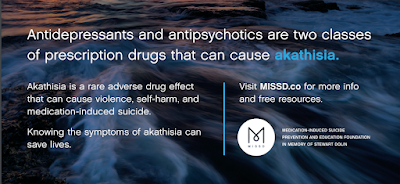
The current campaign consists of more than 1,000 train posters informing passengers that antidepressants and antipsychotics can cause akathisia which can cause self-harm, violence, and suicide. It's fitting that these adverts are on the Tube, given that both akathisia and the London Underground System have been around for more than 100 years. Tube trains rolled out in 1863, and akathisia was first identified in 1902. Yet, judging by recent tweets, it seems that several psychiatrists have been asleep longer than Rip Van Winkle when it comes to akathisia awareness. (More on this below.)

More importantly, the Tube is an appropriate place for these posters because Tube stations close to psychiatric hospitals tend to have a higher incidence of suicide (Farmer et al., 1991; O'Donnell and Farmer, 1994). Suicide prevention charities, like the Samaritans, are probably aware of this since they also run Tube adverts. It's quite poignant then that these adverts, rigorously scrutinized by the advertising company's review team that works closely with Committees of Advertising Practice (CAP), are running on the Tube. 

Spot the Difference 

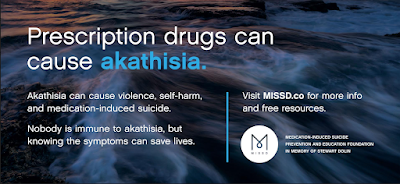
The original Tube advert MISSD submitted to the advertising review team/CAP is not the same as today's advert. You can spot the differences below. 

Original Poster

CAP Approved Poster 

MISSD has run mass transit adverts in the US without ever needing to change the copy for approval. But the UK's rules and regulators are different from those in the US. If MISSD didn't make the changes, these akathisia awareness posters would never run on the Tube. The changes include:

1. Target antidepressants and antipsychotics by explicitly naming them;

2. Add the word "rare," and;

3. Remove the phrase "Nobody is immune to akathisia." 

The specific mention of antidepressants doesn't bother me. SSRIs harm thousands of people, and SSRIs often induce akathisia. Withdrawal akathisia is also one of many components people can experience when suffering from Protracted Withdrawal Syndrome. 

But what does trouble me is baseless censorship by the powers that be. We'll never know who comprises the advertising review team/CAP. Are medical professionals reviewing the adverts? If so, what institutions are they from, and do they have financial or ethical conflicts of interest with the pharmaceutical industry?  

Many different drugs do cause akathisia. Psych drugs aren't the only culprits. Could the advertising review team/CAP explain to these moms why the akathisia risks posed by Roaccutane are less worthy of publicizing?

While they're at it, maybe the advertising reviewers can also explain what research they used to insist on the word, rare. Most logical people would not state that 50% and 80% are rare occurrences.

While MISSD prefers their standard advert that runs in the US, the non-profit decided it was better to run the current London campaign, which directs viewers to MISSD.co for more info, than no England awareness campaign. I agree. Medical organizations, suicide prevention charities, and many doctors have worked to keep akathisia risks in the dark. (Kind of like the recent sodium valproate story, a controversy that broke a few days ago yet has been known by British drug regulators for many years.)

Twitter Storm and Feigned Concern 

The majority of tweets sparked by the MISSD advert supported the awareness campaign. One advocate on Twitter who supports MISSD's mission did share her discomfort regarding the word "violence." But honest discussions about iatrogenic harms should include violence when it is a drug-induced effect. The parents of these 22 children who died in a school bus crash in Switzerland could share their thoughts on SSRI-induced violence. So, too, could the surviving relatives of these ten families. 

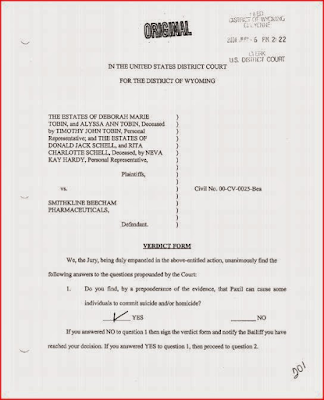
I suspect pharma has settled SSRI homicide cases out of court, but we'll never hear about those. However, one case that was made public was against GSK (then SmithKline Beecham). Donald Schell, 60, took two Paxil tablets before shooting his wife, their daughter, his granddaughter and himself to death on Feb. 13, 1998. A jury returned the following verdict:


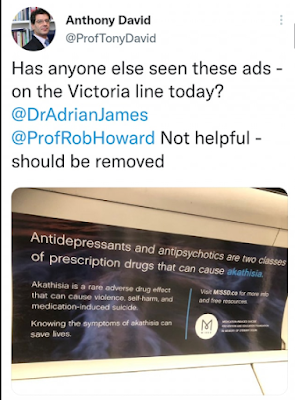
Speaking of pharma brings me to this photo taken by Professor Anthony David, who saw MISSD's poster when he was riding on the Victoria line. David tweeted the adverts are "not helpful and should be removed." 

In 2018, David was appointed Director and Sackler Chair of the new UCL Institute of Mental Health. The Sackler Trust is the "charitable giving" arm created by the Sackler family--the same family responsible for Purdue Pharma's "uncharitable taking" of hundreds of thousands of lives lost due to the company's illegal opioid promotion.

Given the immense harm the Sackler family yielded for profit, it's inconceivable that UCL continues its financial relationship with the Sackler Trust. Moreover, I can't help but wonder if David is proud to carry the "Sackler Chair" title? Is he also proud of all the other money he's taken from other pharmaceutical companies who prescribe the types of drugs that can cause akathisia? They include Janssen, Eli Lilly, and Novartis.

Judging from his tweet, it's challenging to believe David cares about akathisia awareness and prescribed harm any more than the universities that continue taking Sackler's blood money and advertising their crime family partnerships. 

David's tweet invoked many responses from akathisia experts by experience and families whose relatives died avoidable akathisia-induced deaths. The tweet has had more than 230 responses, 99% of which criticise David's proclamation that the adverts should be removed.

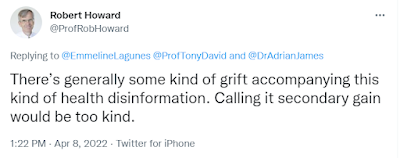
One of David's colleagues at UCL, Prof Robert Howard, opined the poster was "Uninformative, confusing and frightening." Howard added the defamatory comment, "There's generally some kind of grift accompanying this kind of health disinformation. Calling it secondary gain would be too kind."

For those who don't know, 'Grift' is slang for "a group of methods for obtaining money falsely through the use of swindles, frauds, dishonest gambling." (UPDATE AT END OF POST)


Howard also tweeted that MISSD's website has "a lot of disinformation," but when asked to point out what was disinformation, he failed to respond. Further, neither Howard nor David have ever explained why they feel the poster is uninformative, unhelpful, and should be removed. They also haven't suggested ways their profession can increase awareness of this critical adverse drug effect. Howard's defamatory comments remain on Twitter today. 

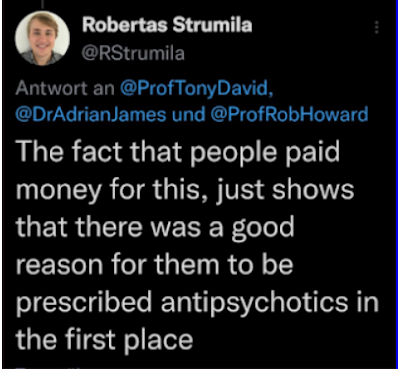
Another Psychiatrist, Robertas Strumila, really scraped the bottom of the barrel when he responded to David's original tweet with this:


Strumila, based in Montpellier, France, later deleted his tweet after a backlash of comments from the prescribed harm community, many of whom have experienced debilitating side effects from antipsychotics. Strumila has never apologised, and Howard and David have never condemned his tweet.

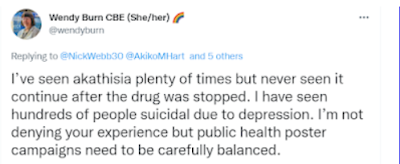
Former Royal College of Psychiatrist President Wendy Burn, also tweeted about MISSD's adverts. Burn criticised them and tweeted, "Most people don't know what akathisia is." 


Um, FYI: Awareness-raising means making people conscious of a problem or issue. This fact, however, seems lost on Burn.

There are four types of akathisia, one of which is actually called Withdrawal Akathisia. MISSD covered this when presenting to RCPsych's International Congress in 2019, a conference session in which Burn herself introduced MISSD to the audience. Withdrawal akathisia has also been discussed in medical journal articles and research papers. The onset of akathisia can start when the dose of the drug is increased or decreased or the drug is stopped. That Burn didn't know you can suffer from akathisia after stopping these drugs is likely one of the reasons she states she hasn't seen it in her practice. Maybe her time needs to be "carefully balanced" between Twitter and taking the 1-hour MISSD Akathisia 101 course that can help her better recognize akathisia.

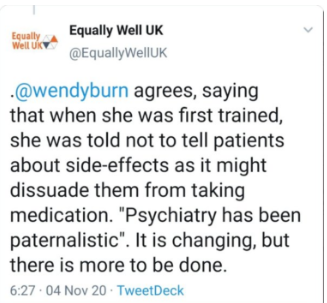
That assumes, of course, that Burn and other doctors want to recognize and warn patients about akathisia and other adverse drug effects. Lest we forget that in 2020, Burn made a startling revelation to Equally Well UK, an initiative that states it seeks to promote and support collaborative action to improve physical health among people with mental health challenges. 


According to the field of psychiatry, psychotic disorders are severe mental disorders that cause abnormal thinking and perceptions.

Answer me this, what can be more abnormal than one human failing to warn another human that a product may cause harm or, even death?

UPDATE: Prof Rob Howard decided to remove the defamatory post and has now issued a fauxpology on Twitter.

Bob Fiddaman

Poster Ad story in the media


Remember, akathisia can be caused by many different categories of drugs, not just antidepressants and antipsychotics, but also antibiotics, anti-hypertensives and many others.

If you are a doctor, pharmacist, coroner, journalist, or member of the public, and you wish to learn more about akathisia, take the FREE online accredited course here.


Monday, March 07, 2022

GUEST POST: P-450 Test and Multiple Chemical Sensitivity


I've heard many stories over the years regarding the troubles people have experienced whilst taking brain pellets marketed as 'antidepressants.' Kerri's guest post (below) is yet another example of how patients are pushed from pillar to post, often having to find their own way to resolve matters relating to brain pellet adverse events because of a severe lack of knowledge from prescribing physicians.

The three pellets featured in Kerri's story were, at a point in time, blockbuster products raking in billions of dollars for the drug companies who marketed and manufactured them, namely Lilly (Prozac) and GlaxoSmithKline (Paxil) and Pfizer (Zoloft). Three apparent drugs that are supposed to help but, as is my experience, cause more problems than the original 'illness' they are prescribed for. They all, allegedly, work in pretty much the same way. Drug company reps will tell you that A is better than B and C because, well, because that's what they are paid to do. They have no scientific evidence that one is more tolerable and causes less side-effects than the other.

I find it difficult to believe that neither Lilly, GlaxoSmithKline or Pfizer  knew nothing about the problems caused by the three products mentioned below, moreover, the journeys many millions face when taking them.

This is just a small part of Kerri's journey. She writes to warn others and to create an awareness that all is not lost if you, or someone you know, suffers the same fate as she.

Bob Fiddaman

--

I was taught to trust the doctors. I was taught to trust the prescriptions.  I was taught to trust the assessments I received from hospitals. And I did…but, this trust of these medical recommendations nearly killed me.

My name is Kerri Lynn and I was born in Long Beach CA, but was raised in the upper Midwest. I grew up in a dysfunctional home and early on, I gravitated towards addictive tendencies.  I strived to make good choices at this time, however, my best efforts to live life on life’s terms were mostly self-destructive.

"I was restless, irritable and discounted all the time being newly sober and I needed help facing life, or so I thought." 

At 13, I discovered drinking.  I partied all the time until my addiction stopped working for me.  I chased other self-destructive behaviors and relationships.  My out-of-control nature led to an ultimatum from loved ones: I had to find a solution how not to be self-destructive.

Pain and circumstances drove me to seek help from 12-Step Recovery.  This was really a challenge and about 60 days into this sober journey, I sought help from my family doctor.  I was restless, irritable and discounted all the time being newly sober and I needed help facing life, or so I thought.  My first prescription was for 20 mg of Prozac. 3 Days into this first prescription, I was unable to walk or talk.  I was severely anxious and my brain was racing and telling me to do delusional things like run outside naked.  I experienced Homicidal and Suicidal Ideation (I have come to understand that these are the symptoms of Serotonin Syndrome/Akathisia). I was panicking due to my reaction to this prescription, though I had no awareness that it was the prescription that was causing these symptoms.  I had to reach out to a former counselor to sorts things out.

I met with my former counselor the following Monday. I finally revealed I was taking Prozac, and he immediately called my prescribing physician to get me off this prescription.  This was the beginning of a 13-year nightmare with prescribed medications.

40mg of Paxil was my next prescription.  A year into taking this antidepressant, I woke up one morning and could not emotionally feel anything. I was terrified.  I called my doctor again and he tried yet another substitute of Zoloft.  At that point, all hell broke loose.  My doctor tried Paxil one more time and this sent me to the hospital.  Between 2000 and 2006, I was Hospitalized on 3 separate occasions due to drug toxicity or cold turkey drug withdrawal. 

"I exhausted every potential care and specialty option locally."

During these nightmare days, I was entertained with my expanded medical vocabulary.  I learned words like suicidal ideation, disassociation, delusion, hallucination, profuse night-sweats, rapid irregular heartbeats and agoraphobia.  We must not forget the bladder loss or rectal haemorrhaging, nor the black outs that would last more than 24 hours, when they would randomly introduce new medications.  And my favorite suffering were the overwhelming panic attacks.

Sadly, my entire investment in the “healing process” to this point only led to my condition becoming more and more dire.  The medical assessments only were dealing with a random set of symptoms that were mostly caused by the prescription and I could not break the cycle, no matter what I did or took.  Almost every diagnosis made things worse and added to my growing list of “untreatable symptoms.”  I exhausted every potential care and specialty option locally.  I even spent 2 weeks at the world renown Mayo Clinic only to achieve an inaccurate diagnosis once again of Visceral Extreme Hypersensitivity.  When I return to my home, I felt defeated and my local hospital would no longer allow me to make appointments, unless first reviewed by management over the phone.  These doctors thought I was crazy.

It is always darkest before the dawn.  I was under the care of many physicians.  Many were a significant part of the problem and few were graciously a part of what would be my life-changing solution.   I was blessed to be introduced to the Cytochrome P-450 test which analyses DNA and genetic strengths and deficiencies.  From this accurate genetic assessment, it was discovered that I have both fast and slow processes in my liver and kidneys.  This finally expressed a causality between reception and rejection of various medications.  It was also determined accurately that I am missing the GSTM-1/ Glutathione Gene.   It was finally determined that my true ailment was Multiple Chemical Sensitivity and all previous diagnoses actually placed me in grave risk by triggering my symptoms. The synthetic nature of the drugs being prescribed to me were actually poisoning me and triggered my multiple chemical sensitivity.  During the course of 13 years of prescriptions, my body has been damaged so that I will most likely be significantly chemically sensitive for the remainder of my days. 

"It is my hope that my story can guide people to new strategies so that nobody ever has to suffer like I did."

My hope is that by sharing my story that we can come to a new responsibility about how we seek and receive diagnoses.  The medical profession has a mission statement of seeking to do no harm.  This is not always the case.  From my experience, a measured suspicion is the best approach.  I now take the responsibility of doing my own medical research.  I trust my instincts and I am my own advocate.  Through my difficult journey my local provider actually became the first hospital in the country to study the P-450 genetic test.  I strongly recommend this assessment be the starting point.  Don’t utilize the P-450 as a last resort.

I am now 11-years medication free and stable.  I have to live the rest of my life being critically aware of my environment and surroundings due to my chemical sensitivity. However, today I have a strategy for living that works. It is my hope that my story can guide people to new strategies so that nobody ever has to suffer like I did.

~ Kerri Lynn

---

You can listen to Kerri's story in her own words here via the brilliant Akathisia Stories, a co-production of MISSD and Studio C.

You can read more about Cytochrome P450 (CYP450) tests here

Footnote:

Test limitations

Although they have potential, CYP450 tests have limitations:

Tests are available for only certain medications. Also, each test is specific to only one medication, so a change in medication may require another test.

Testing can't predict which medication will work best for you — it can only provide clues.

Not all insurance companies cover the costs of these tests.


Tuesday, November 23, 2021

Podcast with Akathisia Stories


Akathisia Stories, a co-production of MISSD and Studio C, is a podcast series that features interviews and news concerning the adverse drug reaction akathisia and medication-induced suicide. 

MISSD, the Medication-Induced Suicide Prevention and Education Foundation in Memory of Stewart Dolin, is a unique non-profit organization dedicated to honouring the memory of Stewart and other victims of akathisia by raising awareness and educating the public about the dangers of akathisia. MISSD aims to ensure that people suffering from akathisia's symptoms are accurately diagnosed so that needless deaths are prevented. The foundation advocates truth in disclosure, honesty in reporting, and legitimate drug trials.

On this episode, we hear from author, blogger, researcher, and self-described humanist and humourist Bob Fiddaman.  His eponymously titled blog has focused on drug company and regulatory malfeasance since making its debut in 2006.  At the time, Bob, an Englishman living in Birmingham, was taking himself off of Seroxat, a GlaxoSmithKline-produced antidepressant known here in America as Paxil.  After making a protracted attempt at tapering off of the drug, he eventually decided to go cold turkey, a course of action he strongly advises against. 

Full show here

Podcast extra here


Bob Fiddaman


Friday, September 10, 2021

#WorldSuicidePreventionDay


Today is #WorldSuicidePreventionDay

A subject that has, seemingly, been forgotten about during the times we live in. 

For some, suicide was a choice, a means to end their misery. For others, it was out of their control, pushed over the edge by prescription drug-induced #Akathisia.

Today, many suicide prevention orgs will be calling for more mental health screening, a route by where a depressed person can unknowingly agree to the very same treatment that can cause akathisia. 

These suicide prevention orgs are, in the main, supported and funded by the corporation's that manufacture these types of drugs. 

Create awareness wherever you are. Look out for your loved ones and your neighbours. Research the term 'Akathisia' and make it a household name.

https://missd.co/

Bob Fiddaman


Sunday, July 26, 2020

Akathisia - The Taboo Terminology


Earlier this week the Royal College of Psychiatrists (RCPsych) published an updated report on suicide prevention. The report was put together by a so-called 'Patient Safety Group' (see image above) and other 'contributors', one of whom is the current President of RCPsych, Dr Adrian James.

The report focuses on adult suicides and, according to RCPsych, "provides new, practice-focused guidance for psychiatrists and other mental health professionals on suicide and self‑harm that examines what interaction is now needed between these topics."

Woe Is Me

I found the following finding quite striking. It's a contradictory statement that, on one hand, highlights the failings of the psychiatric profession's choice of treatment, whilst on the other hand calls for more help for those prescribers who experience patients dying by suicide whilst under their care:

"There is evidence that most psychiatrists have experienced the death of a patient by suicide during their career, a large number of them more than once. Half of them described increased stress in the weeks following the suicide, and a sizeable minority reported a change in their practice, including more referrals to colleagues and requests for admission. The evidence suggests that there is a lack of structured support for psychiatrists and psychiatric trainees following a death by suicide."

It's remarkable isn't it. A report on the prevention of suicide highlighting the stress of prescribers who may have contributed to the suicide by prescribing antidepressants that increase the risk of suicide.

What RCPsych seem to be doing here is telling their members, "don't worry, we have your backs and we will help you through the tough times when one of your patients kill themselves whist on the 'life-saving' antidepressant you prescribed them."

Akathisia - The Taboo Terminology

Whilst the new report references the apparent safety and efficacy of antidepressants, it makes no mention of their role in inducing self-harm, suicidal thinking and suicide completion, all three of which that appear on current patient information leaflets as 'warnings'.

There is also no mention of the taboo word, 'akathisia', a condition caused by the very same drugs that RCPsych members prescribe to patients.

They Know About Akathisia 

Last July (2019) Wendy Dolin, founder of The Medication-Induced Suicide Prevention and Education Foundation in Memory of Stewart Dolin (MISSD), flew from Chicago to London to present suicide prevention information to the then President of RCPsych, Wendy Burn, and RCPsych audience members. The presentation highlighted akathisia and included a promotional video on how to spot signs of akathisia. Dolin wasn't the only safety advocate there that day who spoke about akathisia. Dr Lade Smith also spoke about this mind-crippling condition, she was even promoted by Burn who tweeted the following:


It seems a tad strange that the latest Suicide Prevention Report fails to mention akathisia, so I asked one of the 'Patient Safety Group members, Alys Cole-King, why. Cole-King had tweeted, back in March 2020, that "akathisia matters too."

Here's her reply to me (in two parts)


Appleby Ever After

The current UK Suicide Prevention expert is Prof Louis Appleby, he too is referenced throughout the new report although I am unsure of his input.

Appleby, to me at least, is a strange one. He has blocked many voices of the #PrescribedHarm community on Twitter (myself included) but back in October last year made a startling revelation regarding akathisia and the suicide prevention plan. According to Appleby he claimed, "When we came to update the strategy a few years ago, the Government wanted as few changes as possible. We were keen to add something about antidepressants after hearing from families who felt strongly about this."

What actually ended up the the suicide prevention strategy was "There are also risks in the early stages of drug treatment when some patients feel more agitated." (page 27).

Nothing about akathisia, surprising given Appleby's own personal thoughts that akathisia "can make people feel desperate and suicidal."

So, no suicide prevention warning about akathisia in a prevention strategy and no suicide prevention warning about akathisia in RCPsych's new Patient Safety Report.

Something is amiss here.


Why are Appleby and RCPsych, seemingly, afraid to address this elephant in the room?

Answers on a postcard please.

Bob Fiddaman

Tuesday, March 03, 2020

UK NATIONAL SUICIDE PREVENTION STRATEGY: An Open Letter


Between us all, we look back now on years and years of trying to raise awareness of the risks associated with SSRI/SNRI drugs - and all that seems to have happened is that prescribing of these drugs has continued to soar exorbitantly. Many of us have lost family members and friends and have seen for ourselves the terrible consequences of the effects of SSRI/SNRIs. Others have experienced for themselves the horrific adverse effects of these drugs and are desperately trying to warn others and to pass on their own expert experience. Many of us have voluntarily undertaken huge amounts of research and made significant contributions - and want to share what we have learned and are learning. Peter Gordon's 'Timeline of |Missed Opportunities' film summarises what has happened since 2002 - and how the National Suicide Prevention Strategy is deeply flawed by the flagrant disregard for the known (and heavily suppressed) risks of these mass-prescribed drugs.

Having been repeatedly ignored, 'blocked' and fobbed off by those with whom we have tried to communicate - we felt a need to share what we now can, and however we can, as a means of public safety education. If those in authority won't do what they are ostensibly employed to do - then we will do whatever we can do ourselves.

Lead author, Marion Brown, is a retired psychotherapist & mediator. Her late husband was a GP, who ran into severe medication difficulties himself (after 20+ yrs on Seroxat) and ended his life in 2011.


OPEN LETTER TO UK GOVERNMENT DEPARTMENTS OF HEALTH & SOCIAL CARE & ALL THOSE RESPONSIBLE FOR PUBLIC HEALTH & SAFETY
ENGLAND, SCOTLAND, N IRELAND & WALES


3 March 2020

UK NATIONAL SUICIDE PREVENTION STRATEGY:  SSRIs/SNRIs and AKATHISIA risks

We write to express extreme alarm at the way our concerns – expressed over more than a decade to a considerable number of individuals and groups, representing various committees, specialities, institutions and departments in the UK – have been, and are being, apparently quashed.

Current ‘expert’ advice on suicide prevention, which is now accepted government policy, is that SSRI/SNRI drugs are prescribed to any patient who indicates they may be feeling suicidal or have suicidal thoughts. Our concern is that SSRI/SNRI drugs can themselves cause such suicidal thoughts/impulses - and also a very serious adverse drug reaction called AKATHISIA, the symptoms of which are so unbearable that they can lead people to end their own lives. This fact is not recognised by governments, the NHS or the public, and is not mentioned in the national ‘Suicide Prevention Strategy’, despite our efforts to draw this important issue to the attention of responsible individuals and departments. Many people ARE INDEED dying avoidable deaths by iatrogenic suicide – when suffering known and/or extreme and unrecognised adverse prescribed drug effects.

Our efforts have been extensive, and most recently resulted in the online publication of a short film compiled by Peter Gordon, retired NHS psychiatrist, with input from several contributors: ‘A Timeline of Missed Opportunities’. This has already been widely shared on Social Media.

Please watch this short film - and also read the Replies/Comments section (found at the foot of the blogpost) where further correspondence has been added, including a letter dated 28 Feb 2020 from the UK Department of Health and Social Care (Ref: DE-1204751).

We are sharing this open letter on social media and with the press as we consider this to be a very serious matter indeed – where the lives of countless people are being knowingly and recklessly put at risk by national ‘Suicide Prevention Strategy’ and ‘Policy’. The public – and indeed prescribers - are being cruelly misled. 

We ask specifically that the KNOWN RISKS of SSRI/SNRI drugs in particular (and indeed other medications which can cause akathisia) be fully recognised NOW - and action taken by Governments cascaded to EDUCATE all prescribers, healthcare professionals and the public on how to avoid or mitigate these risks.

Examples of our appeals can be found in this collection of letters published by the BMJ a few months ago. https://www.bmj.com/content/366/bmj.l5102/rapid-responses 

Signed
Marion Brown, Beverley Thorpe Thomson, Peter Gordon, Millie Kieve, Jo Watson, John Read, Peter Gotzsche, Catherine Clarke, Janette Robb, Stevie Lewis, James Moore, Bob Fiddaman, Dierdre Doherty, Kristina Gehrki, Fiona French, Alyne Duthie

--


Further Reading

UK Suicide Expert: Akathisia Can Make People Suicidal

Louis Appleby Knew About Prescription Drug-Induced Akathisia in 2004

Suicide Expert Embroiled in Twitter Controversy

Akathisia Accredited 101 Course (Free sign-up and course)

MISSD (The Medication-Induced Suicide Prevention and Education Foundation in Memory of Stewart Dolin)

Akathisia Alliance

SSRI - Induced Extrapyramidal Side-Effects and Akathisia (J Psychopharmacol.1998;12(2):192-214.review)


Saturday, February 08, 2020

Jordan Peterson - Akathisia


Jordan Peterson (above) is a Canadian clinical psychologist and a professor of psychology at the University of Toronto.

Peterson was prescribed a low dose of a benzodiazepine a few years ago for anxiety following an extremely severe autoimmune reaction to food, according to his daughter, Mikhaila.

Last year, when his wife, Tammy, was diagnosed with terminal cancer, the dose of the benzo, believed to be clonazepam, was increased. Clonazepam is a sedative used to treat seizures, panic disorder, and anxiety. The National Center for Biotechnology Information (NBCI) also suggests that clonazepam is effective in managing neuroleptic-induced akathisia.

After Peterson's dose was increased he began to suffer. His daughter, Mikhaila, on her YouTube channel, tells viewers:

"It became apparent that he was suffering from both a physical dependency and a paradoxical reaction to the medication. A paradoxical reaction means the drugs do the opposite of what they’re supposed to." Mikhaila added that her father experienced akathisia, which she explains as a condition “where the person feels an incredible, endless, irresistible restlessness, bordering on panic, and an inability to sit still. The reaction made him suicidal.”

She's correct. Akathisia is a precursor to suicide and drug companies have known about this for a long time and failed to warn either prescribing physicians or the consuming public about this dangerous condition.

In 1998, Dr Roger Lane, who, until early 2001, was the Medical Director of the Zoloft Product Strategy Team at Pfizer, wrote about the association and risk of violence and suicide for all SSRI drugs. As Dr Lane writes, these conditions are sometimes hard to detect and diagnose, although not so hard to treat. E.g. “SSRI-induced akathisia is a relatively rare event but is frequently unrecognized when it does occur . . . In addition to the obvious motor (objective) manifestations of ‘inability to sit still’, most researchers agree that akathisia has a strong psychological component. The most outstanding feature of akathisia is subjective distress.

Lane warned, "It may be less of a question of patients experiencing fluoxetine-induced suicidal ideation, than patients feeling that ‘death is a welcome result’ when the acutely discomforting symptoms of akathisia are experienced on top of already distressing disorders.” For this reason, is it imperative that both physicians and their patients be forewarned and alerted about this serious risk."

Lanes article, “SSRI-Induced Extrapyramidal Side-Effects and Akathisia; Implications for Treatment”, appeared in the Journal of Psychopharmacology (J Psychopharmacol. 1998;12(2):192-214.)

Mikhaila currently has two videos posted on YouTube. The first, from September 2019 and an update which was uploaded yesterday.

In the February update, Mikhaila tells viewers:

"After several failed treatment attempts in North American hospitals, including attempts at tapering and micro-tapering, we had to seek an emergency medical benzodiazepine detox, which we were only able to find in Russia. It was incredibly gruelling and was further complicated by severe pneumonia which we’ve been told he developed in one of the previous hospitals. He’s had to spend 4 weeks in the ICU in terrible shape, but, with the help of some extremely competent and courageous doctors, he survived.  The decision to bring him to Russia was made in extreme desperation when we couldn’t find any better option. The uncertainty around his recovery has been one of the most difficult and scary experiences we’ve ever had."

Between them, both videos have amassed over one and a half million views.

I'd like to thank Mikhaila for raising awareness on this issue, which, only last week, was played down by two high profile psychiatrists on Twitter. (See 'Two Psychiatrists Explain Akathisia')

For more information on akathisia and the numerous drugs that can cause it (over 500) please visit and take the Akathisia 101 online accredited course. You might just save a life!

Here are Mikhaila's two videos, after which is an educational video from MISSD (The Medication-Induced Suicide Prevention and Education Foundation in Memory of Stewart Dolin)


Bob Fiddaman


Wednesday, February 05, 2020

Natalie Gehrki 7 Years


Tomorrow marks the death anniversary of 19-year-old Natalie Gehrki who, on February 6, 2013, was compelled to end her young life.

In 2003, Natalie became somewhat anxious and shy and after a visit to see a psychiatrist she started on her spiral of decline. Prozac, an SSRI, was recommended. Neither Natalie or her mother, Kristina, were provided with informed consent. In fact, Kristina, in an article she wrote some years later, said, "The doctor skipped over risks vs. benefits."

In 2003 there were no black box warnings on SSRIs so neither Natalie or her parents knew anything much about it. Shortly after taking Prozac Natalie became increasingly anxious and agitated, withdrawn and apathetic, she also developed new fears and obsessions. By the middle of 2004, she had started to self-harm, light cuts to her arm were evidence of this. Her prescriber, instead of withdrawing the drug, increased the Prozac dosage.

Earlier that year (March 2004) the FDA had advised all doctors that SSRIs pose life-threatening risks to children. Neither Natalie or her parents were given this information from Natalie's prescriber.

This from her mother:

"Natalie also lost her ability to participate in physical activities. Her fifth-grade diary reflects she felt uncoordinated, “couldn’t catch a ball,” and was often “the last person picked” for sports teams. This was significant given that Natalie previously showed excellent fine motor skills and happily out-climbed friends at the rock climbing wall.

"Natalie’s doctor started offering new diagnostic guesses. They included borderline personality disorder, emotional lability, OCD and manic depression. She diligently updated her charts, but didn’t update us with new Prozac information. Natalie’s symptoms were far more serious than her original presenting symptom of anxiety."

In the summer of 2005, Natalie was instructed by her prescriber to take a "medication holiday”. The prescriber wanted to see how Natalie would fair when not taking Prozac. There was no tapering regime offered, just an abrupt stop.

Days after stopping Prozac Natalie told her mom that she wanted to kill herself. One has to bear in mind that at this point Natalie was just an 11-year-old girl. Terrified, her mother took her to hospital. After a brief consultation with the hospital psychiatrist, it was recommended that Natalie needed to restart her Prozac, in addition, she needed more drugs. Risperdal, an antipsychotic was thrown into the mix. Once again, no informed consent was given to either Natalie or her parents.

The horror-train ride wasn't over for Natalie - some years down the line Zoloft, an SSRI, came into play. Natalie's behaviour changed, she became unusually problematic in her behaviour. Her mother informed the prescriber of the change in Natalie. Despite this, Natalie remained on Zoloft.

More agitation and anxiety ensued and Natalie's self-harming was getting worse. On hearing this her prescriber added Valium, an anxiolytic and sedative, to Natalie's regime.

Good grades at school turned into bad grades and Natalie, not being able to sit in her chair at school, opted instead to wander around the classroom.

Between 2010-2013 her mother believed the Zoloft was causing the problems. She writes:

"I believed the 100 mg of Zoloft should be stopped and that perhaps it was prescribed at too high a dose. I asked about metabolism and noted Natalie’s petite size (under 5 feet tall and 110 pounds). The psychiatrist retorted dosage has “nothing to do with metabolism.”

"We explained Natalie’s adverse reaction to Prozac and offered to provide all medical records. The doctor didn’t want the records, declaring, “I make my own diagnosis.”

The prescriber reassured Natalie and her mother that Zoloft was okay. During this period Natalie continued to take Zoloft and her mother recalls that Natalie's faulty cognitive reasoning, memory loss, and destructive, risky behaviour all became worse.

In November of 2012, Natalie's Zoloft dosage was increased from 100mg to 150mg, shortly after this increase Natalie's gait changed and she started shuffling her feet as she moved. She also started skin-picking, something her prescriber put down to possible 'Obsessive-compulsive disorder' (OCD)

I'll leave the last words to her mom:

"One week later, Natalie had a scheduled therapy appointment. She was feeling ill, complained of “swollen throat glands” had a fever and headache. She thought she had the flu. Natalie tried to sleep but had terrible insomnia. She called the doctor to cancel her appointment. The doctor suggested they have telephone therapy instead. During their phone call, Natalie said she had been vomiting, discussed her “increasing OCD symptoms,” and Natalie cried. I later learned the psychiatrist instructed Natalie—without ever seeing her—to start taking 200 mg of Zoloft. Again, no informed consent, no risks vs. benefits, and caregivers left in the dark. Abductor Number Four doubled Zoloft the last 12 weeks of Natalie’s life. The doctor scheduled a follow-up appointment in two weeks. This is not close monitoring.

"Two days after taking the maximum Zoloft dose as prescribed, Natalie was dead. She had valiantly raged against the dying light for nearly half her life but was no match for 200 mg of Zoloft. She died of a violent self-sustained injury, but did not die by her own hand: She was chemically tortured, suffered and died at the hands of her doctors. Their negligence was medical violence. As is typical of akathisia-induced death, Natalie, who was born a gentle soul, did not go gently into that good night."

Kidnapped: Natalie’s Story is in two parts. You can read them here and here.

Kristina can be reached via Twitter here.

--

Blog Commentary

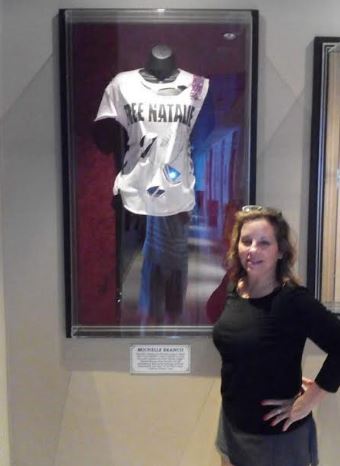
Two years ago, Kristina and I spent time together at the Hard Rock Cafe in Panama City, Panama. On the eve of Natalie's death anniversary, we wandered around the hotel in search of any AC/DC memorabilia. As our search was coming to an end, I noticed a T-Shirt in a glass cage. The shirt once belonged to Dixie Chicks singer/songwriter, Natalie Maines.

I find this comforting as it was the Dixie Chicks that helped me through my severe Seroxat withdrawal. I mention this in my book, 'The Evidence, However, is Clear: The Seroxat Scandal.'

I believe that Kristina's daughter somehow guided Kristina to this, just to let her know that she was now free from suffering.

The message on the front of the T-Shirt reads: "Free Natalie."


Bob Fiddaman

Monday, February 03, 2020

Two Psychiatrists Explain Akathisia


Remember the names, folks.

On the left, we have Tyler Black, MD, Suicidologist and expert in emergency psychiatry. On the right, George Dawson, Psychiatrist, addiction psychiatrist, neuropsychiatrist, physician.

These two professionals have opened a can of worms on Twitter after claiming that they have both suffered akathisia. Miraculously, they claim, the akathisia was brought on by strenuous exercising!

This is a first, folks as every medical book or piece of literature regarding akathisia may have to now be re-written.

Up until their claims (Fig1), it was thought that akathisia was a condition caused by the adverse effects of treatment with many prescribed and over-the-counter drugs. To develop akathisia one can only ingest a drug, there is no other way of developing it. Dawson and Black's claims change all that.

Fig1


Dawson and Black's comments caused outrage amongst Twitter users, a selection of which are below.

One concerned patient advocate, Kristina Gehrki, whose daughter, Natalie, died an iatrogenic death brought on by akathisia, felt compelled to tweet The Royal College of Psychiatrists President, Wendy Burn, whose response did nothing but fan the flames.


Burn, as per usual, completely missing the point.

Shortly after the critiques of Dawson and Black's assertions that akathisia can be caused by exercise, Black somewhat retracted his statement with:

The Medication-Induced Suicide Prevention and Education Foundation in Memory of Stewart Dolin (MISSD) reached out to Dawson, their tweet and his reply can be seen here.

Dawson's claim of being an expert in diagnosing akathisia and movement disorders is deeply worrying given his earlier claims that he developed 'acute akathisia' after strenuous exercise. How can one claim to be an expert in diagnosing akathisia when one falsely claims akathisia can be brought on through exercise?

It really is a wrong message to send out, particularly as exercise is often used to combat depressive episodes. By Dawson and Black claiming exercise can cause akathisia, they may be scaring people who want to use this route rather than a medicalised one. Quite why they have done this is anyone's guess.

Dawson and Black seem to be fully supported by the President of RCPsych, who, back in November endorsed Black's account to her followers, this too is deeply concerning. Burn's advice to Black, well, mute people, "You don't have to hear what they are saying about you."

What a wonderful legacy she is leaving behind!


There's nothing like a psychiatrist who ignores voices of those harmed by the very same drugs they've prescribed.

For more information on the **REAL** causes of akathisia please take the free, accredited Akathisia101 Course here.

Bob Fiddaman


Wednesday, November 06, 2019

Louis Appleby Knew About Prescription Drug-Induced Akathisia in 2004


Louis Appleby Knew About Prescription Drug-Induced Akathisia in 2004

Following on from my previous post, UK Suicide Expert: Akathisia Can Make People Suicidal, it has come to light that the UK's 'expert' on suicide prevention, Prof. Louis Appleby, was warned about prescription drug-induced akathisia many years ago. Just as he does today, he ignored the akathisia and suicide links.

In 2004, Millie Kieve, founder of the APRIL Charity, called the Manchester Coroner's office as there has been a recent Roaccutane suicide. Millie was, and still is, concerned about the reaction of Professor Louis Appleby and why he fails to warn about medicines causing akathisia and suicide risk for some people. Back in 2004, Millie had written to Appleby but he had pretty much ignored her.

Millie recorded the conversation with the Manchester Coroner's office and tells them of her struggles with Louis Appleby. She also tells them that the 2004 suicide strategy plan, headed by Appleby, had no mention of prescription drug-induced suicides or indeed prescription drug-induced akathisia. She tells the Manchester Coroner's office that Appleby's office 'fobbed her off', claiming that "people might get more energy to kill themselves when they take antidepressants."

The call to the coroner sees Millie raise concerns about Appleby, SSRI drugs and other drugs, including Roaccutane, Dianette and Lariam.

This is a huge concern, so much so that MISSD (The Medication-Induced Suicide Prevention and Education Foundation in Memory of Stewart Dolin) an American non-profit organization dedicated to honouring the memory of Stewart Dolin and other victims of akathisia, has now reached out to Appleby on Twitter and have urged him to save lives.


Listen to the 14-minute phone conversation here

Bob Fiddaman


Monday, October 28, 2019

UK Suicide Expert: Akathisia Can Make People Suicidal


"When we came to update the strategy a few years ago, the Government wanted as few changes as possible." - UK's leading Suicide Prevention expert, Louis Appleby

I've previously written about the UK's leading Suicide Prevention expert, Louis Appleby, here. It's important you read my previous post first, particularly if you are unfamiliar with the issues raised.

Appleby had been embroiled in controversy after he seemingly joined forces with former UKIP press secretary, Jasna Badzak. Appleby had retweeted Badzak's claim that drug safety advocates enquiring about iatrogenic deaths and akathisia are nothing more than, "a dangerous cult".

He has since removed the offending post from his timeline but offered no apology to those he offended.

Appleby has also been repeatedly asked by drug safety advocates on both Twitter and via email to investigate iatrogenic deaths. He's either ignored these requests or blocked those asking the question.

Patient advocate, Dee Doherty, 43, Wexford, recently emailed Appleby and the correspondence is jaw-dropping.

Dee has kindly passed on the emails to me and they are published here for the first time.

Appleby can complain that they are private emails if he wishes but he is a public figure and the public has a right to know his claims regarding antidepressant use, suicide prevention and the UK government.

What is immediately striking, to me at least is that Appleby passes the buck and asks a patient advocate to do what he should be doing. Maybe I'm misreading what he is relaying to Dee Doherty in these series of emails, but you can be the judge.

It is also striking his final admittance, albeit privately, that SSRIs can cause akathisia which, in his own words, "can make people feel desperate and suicidal." If this is the case then why is he advising a patient safety advocate to contact the departments he should be contacting?

Contrast his private statement to Dee to the one he made publicly in the Suicide Prevention Interim Report (2016-17)

“Whilst we heard concerns in some written submissions about the role of drug treatments and suicide, the evidence we heard from Professor Louis Appleby, Chair of the Government’s suicide prevention advisory group, and Professor Carmine Pariante of the Institute of Psychiatry was that there is greater risk from not using medication where appropriate, provided that this is following evidence-based guidelines.”

Did Appleby raise the issue of akathisia back then or, indeed, did he stress that akathisia "can make people feel desperate and suicidal."?

Reading through the 26-page draft it appears that neither he or Professor Carmine Pariante raised the issue of antidepressant-induced akathisia making people feel desperate and suicidal.

Pariante, in 2017, claimed that he told  Suicide Prevention Interim Report committee members, "In a nutshell, there is evidence that some antidepressants may increase the risk of suicidality, especially in children and adolescents, but there is no evidence that antidepressants increase the risk of suicide, neither in adults nor in children and adolescents." Parianted added, "Suicide is the act of purposely ending one's life. Suicidality is a set of thoughts and behaviours that are related to suicide but are less likely to be lethal; it includes thoughts and preoccupations about suicide as well as acts of self-harm such as cutting." (Source)

Bizarrely, in 2019 Pariante told me in an interview, "I accept that it is possible that some patients might have died as a consequence of taking antidepressants, and my heart goes to them and to their families." (See here)

Louis Appleby

Why is Appleby saying one thing behind closed doors (in a private email) and another thing publically? Why is he blocking patient safety advocates on Twitter who raise the issue of antidepressant-induced akathisia? Could it possibly be that he doesn't want to talk about this issue under public scrutiny because he will be asked why he is, seemingly, failing to reduce the UK's suicide statistics?

Appleby needs to open up to the government and the public about his stance on antidepressant use. He needs to publically declare what he has told Dee Doherty in the series of emails below. Because he hasn't, I feel I should. Keeping akathisia and antidepressant-induced suicides 'in-house' shows signs of incredible weakness. It also puts the public at risk.

I'd like to take this opportunity to thank Dee Doherty for passing the correspondence on to me so we, the public, can finally get a window into how the UK government and, indeed, Louis Appleby, are steering the ship, or not, as the case may be.

We should all applaud patient advocates like Dee Doherty. Her tenacity in getting to the truth is highly commendable and by going public she is very brave.

*Emphasis has been added by me in some of Appleby's email replies.

Here are the emails...

--

Deirdre Doherty <xxxxxxxxxx@gmail.com> Mon, Sep 23, 2019 at 7:10 PM
To: Louis.Appleby@manchester.ac.uk, rebeccahilsenrath@equalityhumanrights.com

Dear Professor Appleby,

I am writing to you and the Human Rights Ombudsman regarding your position as UK Head of Suicide Prevention and how, as the Head of Suicide Prevention in the UK, a paid Public Official, Informed Consent and Human Rights laws must pertain to the role.

Where a Head of  Suicide Prevention must   be   aware   that   likely   over   500   medications  including SSRIs, antipsychotics, some antibiotics, acne medications, heart medications – and in rising prescription rates for these drugs can cause the Adverse Drug Effect akathisia which can cause self-harm or suicide even in healthy people, I am providing some literature on akathisia for others who may be less well versed.

Further, at a time when ADRS more generally are the 4th leading cause of death ‐ in hospitals alone and where there is someone to observe.

www.einnews.com/pr_news/496883426/international-akathisia-awareness-day-spotlights-criticaladverse-drug-effects

rxisk.org/akathisia

rxisk.org/500-drugs-that-cause-depression-and-suicide-aka-akathisia/

https://missd.co/

https://missd.learnupon.com/users/sign_in?next=%2Fdashboard

Briefly, I am a former teacher, published writer, and a potentially litigating Seroxat victim now disabled.

Prior to a needless and catastrophic prescription for Seroxat in 1999 in Belfast, I was healthy, generally happy by nature, well educated, highly qualified and highly ambitious.

As pertains, I suffered from akathisia a few times without warning & almost lost my life to it. Twenty years later my stepdaughter, a teenager, was prescribed Sertraline – also without Informed Consent to her parents regarding the possibility of akathisia – much less what to do that may save her life in this event.

Non-blood related, you can imagine my horror to see the child agitated, pacing, waling, unable to sit still or even in the same room, and demanding her parents help her kill herself: after missing one pill.

Both bewildered parents witnessed this “scare”.

It took me some time to process. Not least that 20 years later this could happen, and to a child, without warning nor remotely adequate training in doctors to recognise this potentially life-threatening, under-recognised Adverse Drug Effect.

To be clear, I am not in any way anti‐medications. This is often claimed, of many apparent tactics, to avoid addressing critical evidence-based issues costing lives.

After suffering many horrific Informed Consent and Human Rights abuses which caused irreparable damage to me as a young adult, I am however Pro-Informed Consent and Human Rights as established in UK Courts, Supreme Courts, and in accordance with Medical Council Directives. And as I would have assumed a Head of Suicide Prevention would be also.

Yet I believe both the UK Head of Suicide Prevention and the Head of the Royal College of Psychiatrists have repeatedly refused to answer a respectfully made simple Informed Consent and Human Rights question by Bob Fiddaman and Kristina K Gerhki, who lost a child to iatrogenic suicide, as to whether SSRIs can cause self-harm and suicide?

Other bereaved parents are compassionately respected by you.

I am dismayed that the leads in Suicide Prevention are happy to allow preventable deaths, and in children, to a rarely warned of, under-recognised, but treatable Adverse Drug Effect of likely 500 medications.

The continued negligence and, despite the evidence, appeals to reason and humanity, are surely bordering on intent at this stage and in rising rates of self-harm and suicide in the young.

Further where there exists a Free Accredited Course in Akathisia to reduce preventable deaths to akathisia for doctors, psychiatrists, parents, carers, patients. And where patients, some doctors and some trainee doctors have said to the Royal College that they would like to be more educated in this ADR towards saving lives and preventing misdiagnosis.

Also, a time when severe withdrawal from SSRIs, which alone raises the risk of suicide beyond the raised risk of akathisia, has now been somewhat recognised in the UK.

Beyond the wilful refusal of a Head of Suicide Prevention to answer a simple Informed Consent question respectfully made to him many times by a mother bereaved to iatrogenic suicide, adding to her suffering as you have added  to mine, and  that of many other Informed Consent and Patient Safety advocates, a new low in professionalism, ethics, and morality was also reached yesterday.

On a post by the UK Head of Suicide Prevention on Twitter yesterday, it was alleged that it was not owing to the topic that you blocked so many valid and well-evidenced concerns about what you were doing to prevent iatrogenic suicides also. But that you had done so as you wished to protect distressed bereaved parents (excluding the iatrogenically bereaved), for abuse & harassment (of you presumably), their behaviour.

I personally believe that avoiding critical issues and valid evidence-based concerns regarding a known cause of self-harm and suicide which is not being responsibly addressed in rising rates of self-harm and suicide rates, by pitting bereaved parents against bereaved parents is unconscionable. I don’t know what you were referring to but I believe this allegation was well addressed by others in other relevant threads.

Sufficiently distressed and concerned for my teen stepdaughter, neither did I engage in any of the behaviours you have used as an excuse to block me and my concerns also I assume.

I hope a Court may consider any anger and dismay at your refusal to recognise Informed Consent and Human Rights laws or to do anything to also help prevent Iatrogenic suicides in rising rates of suicide and under your remit, regarding your role and behaviour, as legitimate.

Both my stepdaughter and I were only lucky to have survived akathisia.

We are just one family.

With likely over 500 medications which can cause akathisia or drug-induced suicide and in rising prescription rates for these drugs, I, like too many who suffered this torture, remain kept awake at night wondering God knows how many people, including children, you are allowing to die agonising preventable deaths every day – correlative with accessed data and Independent Evidence-Based Studies, data from many Independent sources.

Up to eight people will be heavily impacted by every suicide. And further for families of iatrogenic suicide by no validation, no compassion nor support for people like Dr Peter Gordon by his own colleagues. Nor for Antony who died after suffering from akathisia and severe withdrawal from Seroxat. Nor for his bereaved mother burying him next week and who had requested recognition.

https://holeousia.com/2019/09/04/antony/

Further to blocking me and others with valid complaints and concerns for other families, you then justified doing publicly so by posting a tweet from a woman (had you done your research) who had been reported for wilfully misrepresenting and abusing an iatrogenically disabled Senior Citizen recognised Patient Safety Advocate.

Not least as “anti‐medicine”, “the Leader of an Anti‐Medicine Cult”, a “Scientologist”, “bots”, “stupid”, “idiots” etc, for many weeks before the Head of Suicide Prevention in the UK decided to repost this woman’s attitude towards bereaved and harmed Informed Consent and Patient Safety advocates with valid and well-evidenced concerns on his own account. And as justification for his own misleading and shameful behaviour.

This woman had been fact-checked regarding medical myths she perpetuated and regarding false allegations made to no avail and had been reported a week prior. I am unsure if she remains a convicted fraud.

More generally, you will be more than aware that the disabled, including the iatrogenically disabled, are also at greater risk of suicide.

You will also be well aware that disbelief, invalidation, stigma, social isolation, and marginalisation,  re‐victimisation, particularly by trusted bodies, also raises suicide risks. Further where many have already suffered disability owing to a lack of Informed Consent, inadequate concerns for Patient safety, loss of career, relationships, finances, trust ‐ already raised known suicide risks.

In rising rates of self-harm and suicide in the young, many contributory causes, of course, no doubt, common sense and your job would dictate that all causes of self-harm and suicide must be considered and that the aim must be to reduce self-harm and suicide and iatrogenic self-harm and iatrogenic suicide if rates are to be reduced.

Avoiding this long-overdue critical issue causing preventable deaths any longer, whatever the motivation, must by now surely be bordering on Human Rights abuses: if it didn’t already. Not least akathisia, no one immune, Russian Roulette, is recognised as a form of mental torture.

Common sense and compassion would also dictate that all bereaved parents, all traumatised survivors of suicide attempts, be they non-iatrogenically or iatrogenically caused, are afforded equal compassion and equal rights.

Our confusion and despair, on the evidence, and well over twenty years after well-documented warnings of akathisia risks and of withdrawal risks extend to despair for science, humanity, human rights, the  “caring” profession with a duty of care.

We will have to continue, unpaid and both my stepdaughter and I now on Disability, grateful and indebted to the extraordinary hard work of so many organisations and advocates you ignore, or you have blocked, for saving my own life from iatrogenic suicide. And for educating me sufficiently to be able to educate the parents of my stepdaughter where her doctors did not, of the risk of akathisia ‐ and what we should do in this event.

Where Informed Consent and Human Rights laws exist, it was already a terrible indictment on you that we and so many affected and bereaved feel compelled to do so at all.

I trust we may be afforded a response where distress has already been caused ‐ and specifically to each issue raised here.

If not and whatever the motivation of a Head of Suicide Prevention may be to refuse to also help to prevent the needless loss of life, including children’s lives, to an under-recognised but treatable ADR of hundreds of common medications, it cannot be the case  that you are above Informed Consent laws, Human Rights laws, Medical Directives, or your paid for by the public job description.

As this issue should be paramount in many declared Public Health Crises and in rising self-harm and suicide rates, I hope there will be an enquiry regarding potential Human Rights abuses and that this may be found. And where you do use your Twitter account to keep the public abreast of Suicide related issues and Suicide Prevention news.

Yours Sincerely,

Deirdre Doherty

--

Louis Appleby <Louis.Appleby@manchester.ac.uk> Mon, Sep 30, 2019 at 10:30 AM
To: Deirdre Doherty <xxxxxxxx@gmail.com>

Dear Mrs Doherty

I want to let you know I’ve deleted that tweet, given your concern about it. After all, my comment on it was actually about ensuring a positive atmosphere on my timeline.

I can assure you the safety of antidepressants is seen as an important issue in suicide prevention.

Caution over suicide risk is in NICE guidance and the side effect of restlessness is referred to in the national suicide prevention strategy.

With best wishes

Louis Appleby

--

Deirdre Doherty <xxxxxxxx@gmail.com> Mon, Sep 30, 2019 at 11:43 PM
To: Louis Appleby <Louis.Appleby@manchester.ac.uk>

Dear Professor Appleby,

I, with great distress caused to my family and others, no responsibility taken; no apology; no addressing all the issues; no unblocking (unless you have evidence that I was distressing bereaved families, harassed and abused bereaved families – or you?) Will I at least be reassured that you don't think of myself and my teen stepdaughter (aware that I was reaching out to you with her concern for herself and for others after her experience of missing one Sertraline pill) and of others - as part of a "dangerous cult"?

More crucially, I do not understand your response on the far more critical issue of akathisia at all, particularly in rising rates of Self Harm and Suicide?

This remains urgent, and for my family:

Despite the fact that I was a Study 329 victim, the mother of my teen stepdaughter thinks I'm a Conspiracy Theorist.

The child is now withdrawing, not with me, and I am very concerned after her previous experience upon missing one pill - already related to you in my letter.

Can SSRIs (along with many other medications) induce death by self-harm so the teen’s mother may take it from you, whom I had sought confirmation from?

I don’t want to have to keep asking this valid question also.

Please imagine if it were your child.

Sincerely,

Deirdre Doherty

--

Deirdre Doherty <xxxxxxxxxx@gmail.com> Tue, Oct 1, 2019 at 12:55 PM
To: Louis Appleby <Louis.Appleby@manchester.ac.uk>

Dear Professor Appleby

My apologies, I neglected to request where "restlessness" as a side effect appears and regarding SSRIs, in the Govt Suicide Prevention Strategy and this has been requested by others.

As I struggle with cognitive impairments direction or sharing would be great. I am very confused and with different information from the FDA in 2007 and Montgomery Informed Consent Laws.

Thank you and for any appreciation of our family circumstances,

Deirdre Doherty

--

Louis Appleby <Louis.Appleby@manchester.ac.uk> Wed, Oct 2, 2019 at 7:19 PM
To: Deirdre Doherty <xxxxxxxx@gmail.com>

Dear Mrs Doherty

Thanks for replying. I want to try to answer your questions in the most helpful way, so it makes sense to start with my understanding of the main issue you have raised.

SSRI antidepressants can cause akathisia. I have seen many patients with akathisia, caused by different drugs, and it is an extremely unpleasant condition that at its most severe can make people feel desperate and suicidal.

It's hard to estimate how often it causes suicide or self-harm, partly because what makes people suicidal is often a mixture of problems - it is rarely caused by one thing. However, the risk is sufficiently concerning for us to be cautious at all times, especially when starting or stopping treatment. It's essential that the doctor who prescribes SSRIs should inform the patient about this risk, as you say, though I do understand that doctors don't want to put a patient off taking treatment & getting the balanced message of risks and benefits right can be hard.

On the national suicide prevention strategy, I need to explain a little of the background. When we came to update the strategy a few years ago, the Government wanted as few changes as possible. We were keen to add something about antidepressants after hearing from families who felt strongly about this and we thought it was best done in the section on treatment of depression in primary care which was mainly about the risks of getting no treatment. So we added a line to the key messages of this section, as follows:

"There are also risks in the early stages of drug treatment when some patients feel more agitated." (page 27).

This may not sound a lot but at the time it seemed an important and unusual acknowledgement to appear in a Government strategy. We used "agitated" because it was a document for the general public rather than clinical guidance for doctors - that's the job of NICE - or information for patients, which is overseen by the regulator, the MHRA. Current NICE guidance says something more specific about the need for careful monitoring in the early period of treatment, especially in younger people, because of suicide risk.

I'm sorry to hear about the difficulties your step-daughter has faced. If she has had severe akathisia on withdrawal, it's an important point of safety to withdraw more slowly, to avoid the distress I've mentioned. Most people can come off antidepressants if it's done over the right time period, and that can vary for different people.

I hope I've answered what you were asking about your step-daughter but if I've misunderstood please feel able to come back to me. Of course, I've "unblocked" you - happy to do this - but being in touch by email is a lot better than twitter.

With best wishes

Louis Appleby

--

Deirdre Doherty <xxxxxxxxxxxx@gmail.com> Fri, Oct 4, 2019 at 4:04 PM
To: Louis Appleby <Louis.Appleby@manchester.ac.uk>

Dear Prof. Appleby,

From what I can understand, and of UK legislation, especially as akathisia is an adverse drug effect of so many increasingly prescribed medications and as suicide rates may be reduced with greater awareness both of the signs of suicide and of the signs of akathisia, would you kindly support an Informed Consent & Patient Safety petition regarding the material risk of akathisia?

The petition would go something like this:

We, the undersigned, were aghast to learn via recent communication with Prof. Louis Appleby, a UK Suicide Prevention expert, that the government are restricting safety information in suicide prevention strategies. We find this incomprehensible, given the admittance by Prof. Appleby that "SSRI antidepressants can cause akathisia." Adding further, "it is an extremely unpleasant condition that at its most severe can make people feel desperate and suicidal."

Do we have your backing on this, Prof. Appleby?

Thanks for taking this very seriously,

Deirdre Doherty

--

Louis Appleby <Louis.Appleby@manchester.ac.uk> Wed, Oct 9, 2019 at 6:43 PM
To: Deirdre Doherty <xxxxxxxx@gmail.com>

Dear Mrs Doherty

I'm approaching this in a slightly different way but I hope it's helpful.

The problem of petitioning the Government is that they will see this as a clinical issue, something that falls within NICE's independent remit. I think it would be better to go direct to NICE - they are the main source of guidance to GPs and other health professionals. I've been in touch with them about the best way for you to do this, as they are still working on their depression guideline.

NICE depression guidance currently advises careful monitoring when people, especially young people, first start antidepressants because of suicide risk but it doesn't link this risk to agitation or akathisia. The depression guidance for children & adolescents, 18 & younger, is very cautious about the use of antidepressants at all and stresses the importance of patients being fully informed, and keeping a written record of this.

Given the points you've raised with me, your request to NICE could be that (1) it could include a reference to agitation/akathisia as a warning sign of suicide risk (2) the recording of informed consent could be extended to cover young adults in the adult guidance.

One way to do this is to write to NICE at this email, either personally or via any organisation you work with, to say that you want to provide information about safety:

DepressionInAdultsUpdate@nice.org.uk

The other thing is to open a NICE account to receive information & comment on guidelines when they are out for consultation. Link here: https://accounts.nice.org.uk

It may sound a bit bureaucratic but all this is part of NICE being strictly independent, doing everything by the book.

If you find you aren't getting the right response, come back to me & I'll contact them again.

With best wishes

Louis Appleby

--

Louis Appleby <Louis.Appleby@manchester.ac.uk> Thu, Oct 10, 2019 at 10:49 AM
To: Deirdre Doherty <xxxxxxx@gmail.com>

Dear Mrs Doherty

I meant to add that the other way to approach this is via the Royal College of General Practitioners who oversee training for GPs. They are the main prescribers of SSRIs and getting your messages into their training would reach a lot of people. Let me know if you want to follow this up.

I'm conscious this is taking you into the way the various national health care bodies work & that can seem complicated if it is unfamiliar. Come back to me if you want me to clarify any of this.

With best wishes

Louis Appleby

--

Deirdre Doherty <xxxxxxxxx@gmail.com> Thu, Oct 10, 2019 at 4:28 PM
To: Louis Appleby <Louis.Appleby@manchester.ac.uk>

Dear Professor Appleby

Thank you for all these different suggestions to follow up. Yes, I am understandably confused about how these different processes work but I’m happy you will help me help others be more aware of the suicide risks related to akathisia. My family was left in the dark and we are lucky we survived akathisia at its worst.

It’s not good for me or our efforts that I appear like a lone wolf in wanting to clearly communicate akathisia and the big differences between akathisia and agitation. I would feel more comfortable following up on your suggestions if I can talk with someone who is already familiar with your previous efforts to add akathisia to the national suicide prevention strategy. Can you please give me the names and contact info of those who you previously spoke with when you tried to make these changes so I can also seek their support?

Akathisia awareness has really increased since you last worked with the government to add akathisia info and related suicide risks to the national strategy. I don’t think the word akathisia should continue to be left out because of some out-dated, false assumption that it is too clinical a word for families to understand. I will do my best to work with you and other professionals in this field to make these needed changes to the national strategy, to NICE and to all doctors’ training. Other families need to be better informed than my family was.

I feel sorry that you’ve received so much negative flak on Twitter given that I now know you made previous efforts to include akathisia risks in the national strategy. I think the best way forward is to petition the government and include the dilemmas you faced when trying to improve suicide prevention strategy. If the public can see the government are not supporting a suicide prevention expert, more people will probably support a petition. Also, since I’m still suffering from adverse drug effects, I’m hopeful a petition will bring new people with different skills who can work with us towards these goals.

Best wishes,

Deirdre Doherty

--

Louis Appleby <Louis.Appleby@manchester.ac.uk> Thu, Oct 17, 2019 at 10:43 AM
To: Deirdre Doherty <xxxxxxxxx@gmail.com>

Dear Mrs Doherty

Sorry not to reply before now, I've been away.

To clarify, the Government doesn't make decisions about clinical practice or training. It delegates these issues to expert bodies that are independent and have the necessary expertise. NICE are the body that puts out clinical guidance to health professionals. Royal Colleges oversee training. These are the organisations that can change practice in the way you want.

It was quite unusual for the national strategy to include a specific clinical point. In that sense the Dept of Health supported me, it wouldn't be correct to suggest otherwise. A national strategy is an overall statement about the importance of an issue such as suicide prevention, intended to support and inform the NHS, local authorities, etc. It doesn't instruct them on what to do - that is decided in each local area.

I can see you would like to influence the Government on the issue of akathisia but their response is likely to be that this is the role of NICE. Of course, it's your decision how to proceed - I'm just concerned you could put a lot of effort into pursuing this in a way that would, in the end, be frustrating for you.

In the meantime, I'll assume you want me to approach the RCGP, as I mentioned in my previous email, and I'll now do this.

With best wishes

Louis Appleby

--

Deirdre Doherty <xxxxxxxx@gmail.com> Thu, Oct 17, 2019 at 4:10 PM
To: Louis Appleby <Louis.Appleby@manchester.ac.uk>

Dear Professor Appleby,

I will organise the Petition with my original wording.

Can you confirm in writing that you support the Petition or are you now saying the Government never imposed restrictions?

I'm confused.

We, the undersigned, were aghast to learn via recent communication with Prof. Louis Appleby, a UK Suicide Prevention expert, that the Government are restricting Safety Information in Suicide Prevention strategies. We find this incomprehensible, given the admittance by Prof. Appleby that "SSRI antidepressants can cause akathisia." Adding further, "it is an extremely unpleasant condition that at its most severe can make people feel desperate and suicidal."

We learned that the Suicide Strategy Plan is severely lacking in concise information. Prof Appleby, via correspondence, told us, "When we came to update the strategy a few years ago, the Government wanted as few changes as possible."

We urge the Government to rethink their stance and demand to know why they feel few changes are needed.

Best wishes,

Deirdre Doherty

--

Louis Appleby <Louis.Appleby@manchester.ac.uk> Sun, Oct 20, 2019 at 8:24 PM
To: Deirdre Doherty <xxxxxxx@gmail.com>

Dear Mrs Doherty

I'm very willing to help but there's a misunderstanding here about the role of the Government. It might help if I explained a bit more.

The Government at that time had a policy of supporting local independence, so it wasn't keen on national strategies which were seen as "top-down", ie telling local people what their priorities should be. We did get agreement to relaunch the national suicide prevention strategy but it had to be an update, not a new strategy.

It's very important to know what a strategy like this is for. It is a broad statement of how we should approach a problem, it is not a detailed list of actions that people should take. Organisations like the NHS or local government are expected to respond by providing the detail for their staff. It isn't the role of the national strategy to issue clinical advice to doctors - that is for NICE or the regulator, the MHRA.

So the Government did not restrict safety advice or fail to support me. In fact, it went beyond its remit by allowing me to refer to the risk on starting treatment for depression after people had raised this with me. I told you about this so that you would know that their concerns, which are similar to yours, were not ignored.

My advice is to focus on what matters most to you, the problem of akathisia and the importance of informed consent, where you are making a powerful point. The main issue could get lost if the petition is about the Government.

Of course, it's your decision. The help I can give is more about how to get through to the organisations that actually influence prescribing practice, such as NICE and the Royal Colleges. I can also advise you on how our complex health system works - I do understand it must seem confusing.

With best wishes

Louis Appleby

--

CORRESPONDENCE ENDS

Bob Fiddaman


Further Reading

Platonic Lies ~ Louis Appleby responds to mother regarding the death of her son.
Akathisia and suicide ~ Email from Dr Peter Gordon to Louis Appleby and Wendy Burn.
National Suicide Prevention Strategy ~ Louis Appleby makes claims of feeling 'threatened'.
Suicide Prevention: ~ Oral evidence given to the House of Commons by Louis Appleby and Carmine Pariante
Kindness, attention and respect ~ Appleby, Gerada, Wessley all singing from the same hymnsheet
Q&A with Carmine Pariante ~ Communication breakdown


Please contact me if you would like a guest post considered for publication on my blog.