Zantac Lawsuit


Researching drug company and regulatory malfeasance for over 16 years
Humanist, humorist
Showing posts with label Royal College of Psychiatrists. Show all posts

Tuesday, April 19, 2022

Akathisia Awareness Rolls Out on The Tube


New adverts on the London Underground fuelled a Twitter storm about akathisia and related psych drug harms. The campaign is sponsored by MISSD, a non-profit that raises awareness of akathisia. MISSD was founded in 2011 by Wendy Dolin after the tragic death of her husband, Stewart, who died six days after taking Seroxat (called Paxil in the US). Akathisia isn't a garden variety "side effect." Akathisia can precipitate your death. 

The current campaign consists of more than 1,000 train posters informing passengers that antidepressants and antipsychotics can cause akathisia which can cause self-harm, violence, and suicide. It's fitting that these adverts are on the Tube, given that both akathisia and the London Underground System have been around for more than 100 years. Tube trains rolled out in 1863, and akathisia was first identified in 1902. Yet, judging by recent tweets, it seems that several psychiatrists have been asleep longer than Rip Van Winkle when it comes to akathisia awareness. (More on this below.)

More importantly, the Tube is an appropriate place for these posters because Tube stations close to psychiatric hospitals tend to have a higher incidence of suicide (Farmer et al., 1991; O'Donnell and Farmer, 1994). Suicide prevention charities, like the Samaritans, are probably aware of this since they also run Tube adverts. It's quite poignant then that these adverts, rigorously scrutinized by the advertising company's review team that works closely with Committees of Advertising Practice (CAP), are running on the Tube. 

Spot the Difference 

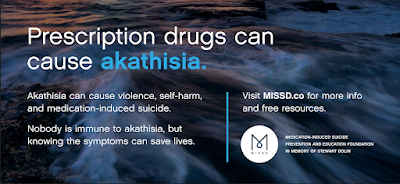
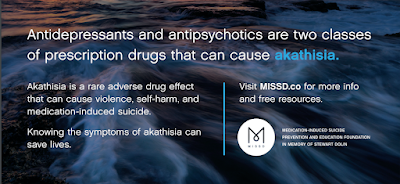
The original Tube advert MISSD submitted to the advertising review team/CAP is not the same as today's advert. You can spot the differences below. 

Original Poster

CAP Approved Poster 

MISSD has run mass transit adverts in the US without ever needing to change the copy for approval. But the UK's rules and regulators are different from those in the US. If MISSD didn't make the changes, these akathisia awareness posters would never run on the Tube. The changes include:

1. Target antidepressants and antipsychotics by explicitly naming them;

2. Add the word "rare," and;

3. Remove the phrase "Nobody is immune to akathisia." 

The specific mention of antidepressants doesn't bother me. SSRIs harm thousands of people, and SSRIs often induce akathisia. Withdrawal akathisia is also one of many components people can experience when suffering from Protracted Withdrawal Syndrome. 

But what does trouble me is baseless censorship by the powers that be. We'll never know who comprises the advertising review team/CAP. Are medical professionals reviewing the adverts? If so, what institutions are they from, and do they have financial or ethical conflicts of interest with the pharmaceutical industry?  

Many different drugs do cause akathisia. Psych drugs aren't the only culprits. Could the advertising review team/CAP explain to these moms why the akathisia risks posed by Roaccutane are less worthy of publicizing?

While they're at it, maybe the advertising reviewers can also explain what research they used to insist on the word, rare. Most logical people would not state that 50% and 80% are rare occurrences.

While MISSD prefers their standard advert that runs in the US, the non-profit decided it was better to run the current London campaign, which directs viewers to MISSD.co for more info, than no England awareness campaign. I agree. Medical organizations, suicide prevention charities, and many doctors have worked to keep akathisia risks in the dark. (Kind of like the recent sodium valproate story, a controversy that broke a few days ago yet has been known by British drug regulators for many years.)

Twitter Storm and Feigned Concern 

The majority of tweets sparked by the MISSD advert supported the awareness campaign. One advocate on Twitter who supports MISSD's mission did share her discomfort regarding the word "violence." But honest discussions about iatrogenic harms should include violence when it is a drug-induced effect. The parents of these 22 children who died in a school bus crash in Switzerland could share their thoughts on SSRI-induced violence. So, too, could the surviving relatives of these ten families. 

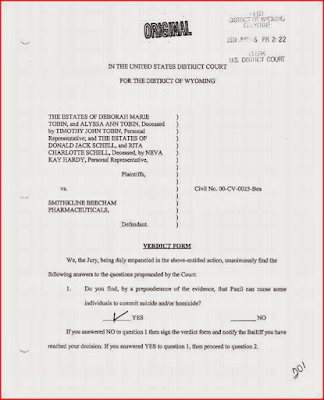
I suspect pharma has settled SSRI homicide cases out of court, but we'll never hear about those. However, one case that was made public was against GSK (then SmithKline Beecham). Donald Schell, 60, took two Paxil tablets before shooting his wife, their daughter, his granddaughter and himself to death on Feb. 13, 1998. A jury returned the following verdict:


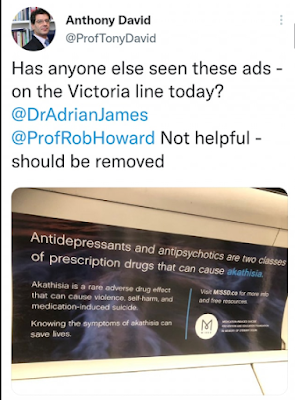
Speaking of pharma brings me to this photo taken by Professor Anthony David, who saw MISSD's poster when he was riding on the Victoria line. David tweeted the adverts are "not helpful and should be removed." 

In 2018, David was appointed Director and Sackler Chair of the new UCL Institute of Mental Health. The Sackler Trust is the "charitable giving" arm created by the Sackler family--the same family responsible for Purdue Pharma's "uncharitable taking" of hundreds of thousands of lives lost due to the company's illegal opioid promotion.

Given the immense harm the Sackler family yielded for profit, it's inconceivable that UCL continues its financial relationship with the Sackler Trust. Moreover, I can't help but wonder if David is proud to carry the "Sackler Chair" title? Is he also proud of all the other money he's taken from other pharmaceutical companies who prescribe the types of drugs that can cause akathisia? They include Janssen, Eli Lilly, and Novartis.

Judging from his tweet, it's challenging to believe David cares about akathisia awareness and prescribed harm any more than the universities that continue taking Sackler's blood money and advertising their crime family partnerships. 

David's tweet invoked many responses from akathisia experts by experience and families whose relatives died avoidable akathisia-induced deaths. The tweet has had more than 230 responses, 99% of which criticise David's proclamation that the adverts should be removed.

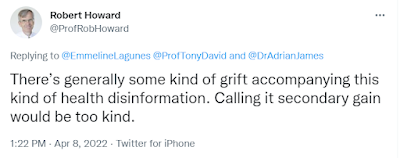
One of David's colleagues at UCL, Prof Robert Howard, opined the poster was "Uninformative, confusing and frightening." Howard added the defamatory comment, "There's generally some kind of grift accompanying this kind of health disinformation. Calling it secondary gain would be too kind."

For those who don't know, 'Grift' is slang for "a group of methods for obtaining money falsely through the use of swindles, frauds, dishonest gambling." (UPDATE AT END OF POST)


Howard also tweeted that MISSD's website has "a lot of disinformation," but when asked to point out what was disinformation, he failed to respond. Further, neither Howard nor David have ever explained why they feel the poster is uninformative, unhelpful, and should be removed. They also haven't suggested ways their profession can increase awareness of this critical adverse drug effect. Howard's defamatory comments remain on Twitter today. 

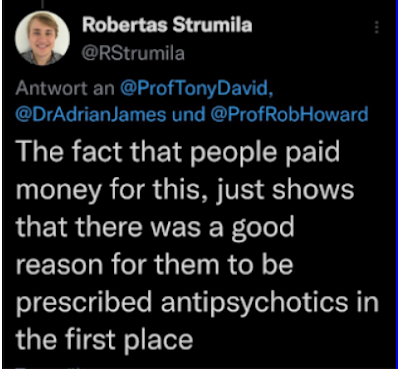
Another Psychiatrist, Robertas Strumila, really scraped the bottom of the barrel when he responded to David's original tweet with this:


Strumila, based in Montpellier, France, later deleted his tweet after a backlash of comments from the prescribed harm community, many of whom have experienced debilitating side effects from antipsychotics. Strumila has never apologised, and Howard and David have never condemned his tweet.

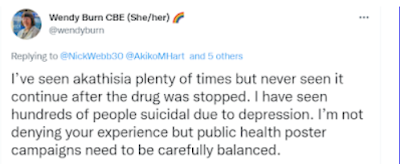
Former Royal College of Psychiatrist President Wendy Burn, also tweeted about MISSD's adverts. Burn criticised them and tweeted, "Most people don't know what akathisia is." 


Um, FYI: Awareness-raising means making people conscious of a problem or issue. This fact, however, seems lost on Burn.

There are four types of akathisia, one of which is actually called Withdrawal Akathisia. MISSD covered this when presenting to RCPsych's International Congress in 2019, a conference session in which Burn herself introduced MISSD to the audience. Withdrawal akathisia has also been discussed in medical journal articles and research papers. The onset of akathisia can start when the dose of the drug is increased or decreased or the drug is stopped. That Burn didn't know you can suffer from akathisia after stopping these drugs is likely one of the reasons she states she hasn't seen it in her practice. Maybe her time needs to be "carefully balanced" between Twitter and taking the 1-hour MISSD Akathisia 101 course that can help her better recognize akathisia.

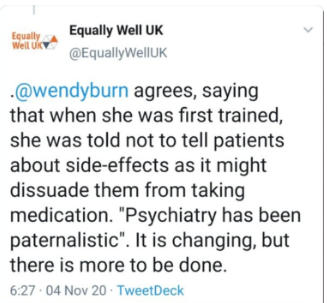
That assumes, of course, that Burn and other doctors want to recognize and warn patients about akathisia and other adverse drug effects. Lest we forget that in 2020, Burn made a startling revelation to Equally Well UK, an initiative that states it seeks to promote and support collaborative action to improve physical health among people with mental health challenges. 


According to the field of psychiatry, psychotic disorders are severe mental disorders that cause abnormal thinking and perceptions.

Answer me this, what can be more abnormal than one human failing to warn another human that a product may cause harm or, even death?

UPDATE: Prof Rob Howard decided to remove the defamatory post and has now issued a fauxpology on Twitter.

Bob Fiddaman

Poster Ad story in the media


Remember, akathisia can be caused by many different categories of drugs, not just antidepressants and antipsychotics, but also antibiotics, anti-hypertensives and many others.

If you are a doctor, pharmacist, coroner, journalist, or member of the public, and you wish to learn more about akathisia, take the FREE online accredited course here.


Sunday, July 26, 2020

Akathisia - The Taboo Terminology


Earlier this week the Royal College of Psychiatrists (RCPsych) published an updated report on suicide prevention. The report was put together by a so-called 'Patient Safety Group' (see image above) and other 'contributors', one of whom is the current President of RCPsych, Dr Adrian James.

The report focuses on adult suicides and, according to RCPsych, "provides new, practice-focused guidance for psychiatrists and other mental health professionals on suicide and self‑harm that examines what interaction is now needed between these topics."

Woe Is Me

I found the following finding quite striking. It's a contradictory statement that, on one hand, highlights the failings of the psychiatric profession's choice of treatment, whilst on the other hand calls for more help for those prescribers who experience patients dying by suicide whilst under their care:

"There is evidence that most psychiatrists have experienced the death of a patient by suicide during their career, a large number of them more than once. Half of them described increased stress in the weeks following the suicide, and a sizeable minority reported a change in their practice, including more referrals to colleagues and requests for admission. The evidence suggests that there is a lack of structured support for psychiatrists and psychiatric trainees following a death by suicide."

It's remarkable isn't it. A report on the prevention of suicide highlighting the stress of prescribers who may have contributed to the suicide by prescribing antidepressants that increase the risk of suicide.

What RCPsych seem to be doing here is telling their members, "don't worry, we have your backs and we will help you through the tough times when one of your patients kill themselves whist on the 'life-saving' antidepressant you prescribed them."

Akathisia - The Taboo Terminology

Whilst the new report references the apparent safety and efficacy of antidepressants, it makes no mention of their role in inducing self-harm, suicidal thinking and suicide completion, all three of which that appear on current patient information leaflets as 'warnings'.

There is also no mention of the taboo word, 'akathisia', a condition caused by the very same drugs that RCPsych members prescribe to patients.

They Know About Akathisia 

Last July (2019) Wendy Dolin, founder of The Medication-Induced Suicide Prevention and Education Foundation in Memory of Stewart Dolin (MISSD), flew from Chicago to London to present suicide prevention information to the then President of RCPsych, Wendy Burn, and RCPsych audience members. The presentation highlighted akathisia and included a promotional video on how to spot signs of akathisia. Dolin wasn't the only safety advocate there that day who spoke about akathisia. Dr Lade Smith also spoke about this mind-crippling condition, she was even promoted by Burn who tweeted the following:


It seems a tad strange that the latest Suicide Prevention Report fails to mention akathisia, so I asked one of the 'Patient Safety Group members, Alys Cole-King, why. Cole-King had tweeted, back in March 2020, that "akathisia matters too."

Here's her reply to me (in two parts)


Appleby Ever After

The current UK Suicide Prevention expert is Prof Louis Appleby, he too is referenced throughout the new report although I am unsure of his input.

Appleby, to me at least, is a strange one. He has blocked many voices of the #PrescribedHarm community on Twitter (myself included) but back in October last year made a startling revelation regarding akathisia and the suicide prevention plan. According to Appleby he claimed, "When we came to update the strategy a few years ago, the Government wanted as few changes as possible. We were keen to add something about antidepressants after hearing from families who felt strongly about this."

What actually ended up the the suicide prevention strategy was "There are also risks in the early stages of drug treatment when some patients feel more agitated." (page 27).

Nothing about akathisia, surprising given Appleby's own personal thoughts that akathisia "can make people feel desperate and suicidal."

So, no suicide prevention warning about akathisia in a prevention strategy and no suicide prevention warning about akathisia in RCPsych's new Patient Safety Report.

Something is amiss here.


Why are Appleby and RCPsych, seemingly, afraid to address this elephant in the room?

Answers on a postcard please.

Bob Fiddaman

Tuesday, September 10, 2019

PHE Review Dilutes SSRI Problem


Firstly, I'd like to thank everyone who worked hard to get this review to the table. The list is extensive, you all know who you are.

This post is dedicated to three warriors who were active within the prescribed harm community, they all recently died by prescription drug-induced suicide.

Thank you for fighting the cause:


Jo Dennison
Kata Balint
Shelley Johnson 

This post is in two parts. Part one is about the recent PHE review regarding the evidence for dependence on, and withdrawal from, prescribed medicines in the UK. Part two is about the current suicide 'expert' in the UK, Prof. Louis Appleby, and the president of the Royal College of Psychiatrists, Wendy Burn. Both parts are intertwined, one is about dependency, the other is about self-harm fatalities. I'll also be calling upon the current suicide prevention minister, Nadine Dorries, to carefully consider the serious issues raised here.

Report of the review of the evidence for dependence on, and withdrawal from, prescribed medicines.

Today is World Suicide Prevention Day and Public Health England (PHE) released a public health evidence review of available data and published evidence on the problems of dependence and withdrawal associated with some prescribed medicines.

Coincidence?

PHE review expert reference group members included Yasir Abbasi, Navjot Ahluwalia and Louis Appleby.

Abbasi has received honorarium for advisory board meetings or travel and accommodation for conferences from Indivior Pharma, Martindale Pharma, Bite Medical Pharma and Mundi Pharma.

Indivior market and manufacture Opioid addiction treatment drugs. Martindale, now known as Ethypharm, manufacture a whole host of drugs, including, but not limited to, painkillers. A Google search of Bite Medical Pharma shows no such company, but Bite Medical Consulting do exist. It appears as though they are a communications company. Safe to say that this means they ghostwrite. Some of their clients include Abbot and Lilly, both drug companies who market and manufacture brand and/or generic antidepressants. Mudi manufacture and market addiction medicines.

Ahluwalia carries out expert witness work and is the Executive Medical Director and Consultant Psychiatrist for Rotherham, Doncaster and South Humber NHS Foundation Trust

Appleby is a Professor of Psychiatry who leads the National Suicide Prevention Strategy for England and directs the National Confidential Inquiry into Suicide and Homicide by People with Mental Illness. More about Appleby later.

The Review

The review covered many aspects of prescription drugs, in particular, the withdrawal and dependency problems people face when trying to come off them. There was, however, a mixed message for the SSRI family of drugs.
Benzodiazepines, z-drugs, opioid pain medicines and gabapentinoids are associated with a risk of dependence and withdrawal.
Antidepressants are associated with withdrawal
PHE found that dependency exists on benzos, z-drugs, opioids and gabapentinoids but not antidepressants (SSRIs).

The 152-page review includes a definition of dependence. PHE writes:
Dependence ~ An adaptation to repeated exposure to some drugs and medicines usually characterised by tolerance and withdrawal, though tolerance may not occur with some. Dependence is an inevitable (and often acceptable) consequence of long-term use of some medicines and is distinguished here from addiction.
I'm confused?

Are SSRIs addictive or do people become dependent upon them, or is it neither?

On withdrawal, PHE defines it as: Physiological reactions when a drug or medicine that has been taken repeatedly is removed.

I'm still confused.

Confusion aside, it's nice to see they recognised the daily stigma patients, former patients and drug safety advocates face on a daily basis whenever they publicly share their adverse experiences withdrawing from SSRIs.


The recommendations made by PHE are as follows:

1 ~ Increasing the availability and use of data on the prescribing of medicines that can cause dependence or withdrawal to support greater transparency and accountability and help ensure practice is consistent and in line with guidance.

2 ~ Enhancing clinical guidance and the likelihood it will be followed.

3 ~ Improving information for patients and carers on prescribed medicines and other treatments, and increasing informed choice and shared decision-making between clinicians and patients.

4 ~ Improving the support available from the healthcare system for patients experiencing dependence on, or withdrawal from, prescribed medicines.

5 ~ Further research on the prevention and treatment of dependence on, and withdrawal from, prescribed medicines.

(1) You don't have the data, the drug companies have it. You will never be allowed to see any of the raw data.

(2) You cannot guide if you don't have the data


(3) Where will this information come from?

(4) Improving? This would imply that support is already in place and just needs tweaking. It isn't. It never has been!

(5) Research is meaningless without the raw data


For what it's worth, recommendations are meaningless words. I've written about this terminology before, it gives people false hope and allows those in charge to continue as they were, so to speak. It's not a law, it's not a rule, it's not punishable if prescribers fail to adhere. Call me cynical, but I dare say meaningless recommendations also serve to help systems stall buy some more time to avoid real action.

Back in 2010, a jury at the inquest of Canadian teen, Sara Carlin, returned a list of 17 recommendations. Sara died a violent, akathisia-induced death after ingesting an SSRI known as Paxil in Canada, better known as Seroxat in the UK. These iatrogenic deaths from drug-induced delirium and self harm are typically labeled suicides by coroners. So it is possible Prof. Appleby and organizations purported to reduce suicides could recognize the loss of Sara today. But it is improbable that will happen given Sara's death doesn't help them promote more drugs ("treatments").

Today, nine years after Sara's death, guess how many of those 17 recommendations have been implemented?

None.

Nada.

Zilch.

Sara's death was a kick in the butt for me personally. It made me rethink why I became an advocate/activist. People are dying as a result of taking SSRIs and whilst withdrawal/dependency/addiction (delete where necessary) are important topics, I feel iatrogenic deaths also need to be immediately addressed.

The SSRI withdrawal issue will never be resolved as long as there is no alternative drug in the pipeline waiting to be promoted. In the meantime, the public will continue to be informed of recommendations that are little more than token gestures. These gestures may serve to keep some advocates quiet and give med organizations and rampant prescribers a break from public scrutiny and accountability. As I tweeted early this morning, barbiturates were viewed as having no problems until benzos arrived on the scene. Benzos were viewed as having no problems until SSRIs arrived on the scene. SSRI risks will be played down until a different class of drug arrives on the scene to take a lucrative centre stage.

Don't worry, folks, that may happen sooner than you think. A new way of administering depression treatment is already on the market. Spravato (esketamine) is used as a nasal spray to treat treatment-resistant depression (TRD)

TRD is basically a term used when all else fails or when the drugs a person is currently taking stop working. Janssen, the drug manufacturer, provided the FDA with modest evidence it worked and then only in limited trials. It presented no information about the safety of Spravato for long-term use beyond 60 weeks. Now get this, three patients who received the drug died by suicide during the clinical trials, compared with none in the placebo group. But hey, this never stopped the FDA from granting it a licence.

Come back to this blog of mine in 10 years and you'll probably see me writing, "I told you so."

Eventually, and if they have their way, drugs like esketamine will flood the market. Then, and only then, will prescribers speak out en masse about the terrible dependency SSRIs cause.

The Apple That Burns

Earlier I mentioned the three PHE review expert reference group members. The third, Louis Appleby, leads the National Suicide Prevention Strategy for England. He is failing on a grand scale.

A few weeks ago Appleby chastised a member of the prescribed harm community on Twitter. Appleby was soon joined by the Royal College of Psychiatrists leader, Wendy Burn in the condemnation of the website host of antidepaware. The website promotes awareness of the dangers of antidepressants and includes links to reports of inquests held in England and Wales since 2003. The antidepaware author lost a son to SSRI-induced suicide in 2009 and since the creation of the website, in 2014, has tried to make the public aware of the dangers that are, in the main, dismissed by prescribers.

Appleby and Burn were wrong to target a fellow-advocate, particularly given antidepaware has done more than what they have to reduce the ever-increasing rate of suicide in the UK. Many other advocates threw their support behind antidepaware. Appleby, the man who apparently takes all forms of suicide seriously, responded by blocking them. He even blocked parents whose children have died as a result of SSRI-induced suicide.

With this in mind, I threw out a question to both Appleby and Burn on Twitter, a straightforward question that neither has answered despite being asked by me in nine repeated tweets. I have also sent both an email, and both have failed to respond. Here's the question they refuse to answer, or even acknowledge: "Can SSRIs induce death by self-harm?"

One has to ask why Appleby and Burn are refusing to answer a simple, relevant question. Burn in the past has claimed how important informed consent is but when push comes to shove she cannot provide me, or the public for that matter, with an answer regarding whether SSRIs can induce death by self-harm. Instead, Burn's Twitter timeline has been full of Lithium promotion, cat photos, and Play-Doh images.

Both Appleby and Burn need to resign. Appleby's treatment of those who inquire about SSRI-induced deaths has been abhorrent to watch from the sidelines. Burn's failure in recognising the SSRI withdrawal problem also needs to be condemned, as does both of their silence stances surrounding informed consent.

Shortly, I'll be writing to the current suicide prevention minister, Nadine Dorries, to voice my concerns regarding Appleby and Burn. I've written to ministers before and they've been pretty useless in their responses. I don't expect Dorries will intervene but I have an ethical obligation to try.

Suicide Prevention Day is about prevention. By refusing to speak with safety advocates and the bereaved just because their children, wives, husbands, brothers or sisters died iatrogenic deaths does nothing to reduce suicides and increase awareness of adverse drug effects that precipitate these violent, avoidable deaths.

If you want to prevent something from happening, you cover all bases and not just the ones that suit your blinkered views. Shame on Burn and shame on Appleby for keeping me, and others, in the dark regarding informed consent. Informed consent is a basic human right. Without accurate info, there can be no real medical freedom of choice.

On a final note, I want to also condemn Wendy Burn's college in general. On the day when suicide prevention was the paramount message they tweeted the following:


Those online resources they refer to include medications that are associated with suicidal thoughts and suicidal completion. Shame on them.

If you think all of the above is just the rantings of a conspiratorial mad man then read how Wendy Burn and her colleagues treated a fellow psychiatrist when he brought to their attention the dangers of Seroxat, a drug, that after many years he is still trying to withdraw from.

"You’d think that my colleagues would be generally sympathetic. However, I have been marginalised, ignored and vilified as a troublemaker — and a leading member of the RCPsych even wrote to my employer questioning my sanity." ~ Peter Gordon, Psychiatrist

Full story here

Bob Fiddaman


Thursday, May 30, 2019

Royal College of Psychiatrists in Dubious U-Turn


"I can read you like a book. And not a very good book. Certainly not 'Bravo Two Zero' by Andy McNab. Which actually improves with every read." ~ Alan Partridge

Many of us have read today's news articles published in several "mainstream" media outlets. Backslapping has ensued amongst those responsible for this apparent "U-turn". Today's media exposĂ© isn't really an exposĂ©, not when adverse effects, which include suicidality and suicide have intentionally been omitted in today's articles and in the Royal College of Psychiatrists (RCPsych) new "position paper."

Stop the backslaps. This is no volte-face, as you will see.

For years the stance of the Royal College of Psychiatrists (RCPsych) has been that what I call brain pellets and they call "antidepressants" are safe, effective and cause only minimal problems when patients try to stop taking them. RCPsych's stance has been documented for many years on their website, in their strategically placed media articles and on social networking sites.

Today RCPsych published a 29-page document on its website with emphasis regarding people who have, and still are, struggling with brain-pellet withdrawal. How long this document will remain on RCPsych's website is anyone's guess given RCPsych has a habit of removing evidence of withdrawal problems from its website (1)

The 29-page document, a "Position statement on antidepressants and depression", is a buck-passing exercise. Nothing more, nothing less. The diligent media (Guardian, The Times, The Mirror, Daily Mail) are doing what they often do best: providing RCPsych and the field of psychiatry with a free mouthpiece for positive PR.

The position paper gives RCPsych an opportunity to harp on about depression and how serious it is and gently--almost as a sidenote--slip in, "Oh, by the way, some people may struggle coming off the drugs we prescribe."

Why So Cynical?

Back in 2011, the British drug regulator, the MHRA, unleashed the SSRI Learning Module. This 'module' was aimed at prescribing physicians who, according to the MHRA, needed to learn more about antidepressant withdrawal problems, particularly from the SSRI class of drugs such as Zoloft, Prozac, Seroxat, etc.

The move back then is identical to what we see today: A gesture to try and stifle patients' voices, promote the drugs as a safe and effective treatment for depression, and appease, in some small way, advocates who have for many years accurately pointed out the truth. Previous denials by RCPsych and MHRA regarding this public health crisis made possible the prescribed harm and deaths of countless people. But these facts weren't really mentioned in today's media outlets.

As I typically do after any MHRA announcement, I reviewed their module and found some glaring omissions. Lot's of talk, but no real action. RCPsych's paper is similar. To learn more about the MHRA's SSRI Learning Module read here, here and here.

Next, read the emails I sent the MHRA regarding their claim that experts are on hand to help people struggling withdrawal problems.

So here we are 8 years later and we awake to another announcement, this one from the prescribers and RCPsych. The announcement is littered with contradictions. Moreover, the serious prescribing problems are barely addressed and played down all the while supposed benefits are emphasized. The old message still comes through loud and clear despite its newfound, quietly sly delivery: That is, "The product benefits outweigh the risks." 

I've often struggled with the benefits vs risks claim because I've never actually seen a list of these so-called benefits yet I have seen an ever-increasing list of risks.

For years we have been told the benefits outweigh the risks but when we question these benefits and ask what they are, exactly, there is no meaningful answer. The empty replies often parroted include "Depression is a serious illness." and "These drugs save lives." Interesting to note that data proving such claims never seems to be provided by RCPsych and prescribers who otherwise like to stress the importance of scientific data. RCPsych's press release and today's news articles also seem to omit the fact that SSRIs are often prescribed off-label for reasons unrelated to "depression." Such discussions and concerns regarding people who were prescribed these drugs NOT for depression is glaringly absent despite that these people also suffer from withdrawal and drug-induced akathisia (which can create anxiety and depression as an adverse drug effect). Those who died avoidable SSRI-induced akathisia deaths are also apparently invisible ghosts.

Despite today's announcements, little has changed since 2016 when I asked the MHRA to provide me with the benefits of Prozac. The only benefit MHRA could muster was that Prozac "raises the level of the neurotransmitter, serotonin, in the brain which can improve symptoms of depression." (2)

Yes, they really did state such meaningless nonsense. If Prozac (and presumably other SSRIs) help rectify a chemical imbalance then, that's the one and only benefit according to the British drug regulator. The fact that the chemical imbalance theory/marketing spin has been debunked and no longer touted by RCPsych didn't seem to matter to the MHRA, who, incidentally, are fully funded by drug companies.

RCPsych released their position statement on products marketed as antidepressants because they have come under fire on Twitter from many drug safety advocates too numerous to individually mention here. RCPsych President, Wendy Burn, has claimed she never knew how bad the withdrawal problem is until she joined Twitter. Most would agree that the implications of this admission are staggering. For more than 30 years brain pellets have been on the market, and Burn and her colleagues have been prescribing them to elderly patients and children, two groups who are most at-risk for experiencing adverse effects to any drugs, not just SSRIs. What astounds me most about today's news is the messages Burn has been receiving on Twitter, some of which are from drug safety advocates thanking her. Yes, thanking her! Let's all send thanks to the drug companies, whilst we're at it. For years they denied withdrawal problems when, like Burn, were forced to change warnings about brain pellet withdrawal. How can you thank someone who has been forced to admit the truth by those damaged by the very same drugs Burn has continuously defended? The mind boggles.

RCPsych's position paper calls for more education for prescribers. RCPsych should start with its own president who has previously maintained that for years she has never seen withdrawal. I don't think Burn's admission is rare among prescribers. People have difficulty seeing what they don't want to see. People have difficulty recognizing and identifying what they believe seldom exists and/or doesn't exist at all. Lastly, like the drug companies, prescribers who don't want to know the honest answers to relevant questions--questions that will likely reduce prescribing, reduce product sales and increase public knowledge of product risks--choose not to ask certain questions.

Some might call this blog cynical but I've been writing about the withdrawal problem for more than 13 years and have witnessed endless ignorance, collusion and denial by drug companies, regulators and prescribers. RCPsych's publicly announced U-turn today will likely create little if any meaningful change. The only thing it does accomplish is to show RCPsych with egg on its face, an egg that will quickly be wiped clean as RCPsych continues to claim 1) They didn't previously know about serious withdrawal problems and 2) The benefits of "antidepressants" still outweigh the risks.

Evidence of RCPych's tactical position was seen just hours after the media announced their apparent U-turn. Dr Adrian James, a Forensic Psychiatrist with Devon Partnership NHS Trust and Registrar Royal College of Psychiatrists, was a guest on BBC Radio 4 show. He was there to discuss today's headlines. Here's what he said.

"...withdrawal was mild and self-limiting and not the real story, the real story was not enough people are getting antidepressant drugs."

As I said, the position paper just allows them to promote the use of brain pellets. The only upshot of James' torrid PR today presented by BBC radio is that the public is increasingly starting to see right through this shameless drug promotion and call it out for what it is.

I'd be more impressed if RCPsych were to hassle drug companies for the raw data regarding brain pellets, without which they can never give fully informed consent. Never.

Let us not forget those who have died as a result of medical "professionals" instructing patients to stop SSRIs cold turkey, or lowered brain pellet dosages too quickly or, wrongly increased SSRI dosages in response to symptoms that were actually SSRI-induced akathisia. Many of these men, women and children were prescribed brain pellets by average GP's who took their advice from RCPsych. Don't expect to see any remorse or apologies for the dead and/or for those who currently live lives with permanently prescribed harms. Do expect more of the same from the RCPsych fundamentalists.

There are too many captains at RCPsych, all of whom are blindly steering their ship into an iceberg. We, the patients, are the passengers. Some of us have already perished thanks to the stance of RCPsych. My heart, today, goes out to all those who have died as a result of the incompetence and ignorance of the Royal College. It goes out further to the families of those who will lose loved ones in the future due to RCPsych's tactical games. Trust me, there will be more deaths. And RCPsych knows it.

I held talks with the MHRA back in 2008. Recommendations were made by the MHRA. They promised to consult with the British National Formulary (BNF) and NICE. Nothing came of it (3)

Plus ça change, plus c'est la mĂªme chose.


Bob Fiddaman


(1) RCP Remove Damning Antidepressant Document From Website
(2) Prozac - Benefits Vs Risks - MHRA Correspondence
(3) Guidance on the Management of Withdrawal from Seroxat (Paroxetine) and Other SSRIs 


Sunday, May 05, 2019

Hashtag Backfires on Twitter


Wendy Burn: President of the Royal College of Psychiatrists

Twitter can be an effective resource for sharing research links, personal experiences and public opinions. It can also highlight the personalities of people with strongly held views.

On May 1st Hattie Gladwell, a journalist and columnist, tweeted the following:


At first glance, I perceived this tweet as just another tired attempt to try and silence those who've been harmed by pharmaceutical products and prescribers. It appeared Gladwell was trying to imply those who take pharma products marketed for mental health are, somehow, stigmatized by others. While I don't buy this PR spin, I do believe organizations and media work together to silence and stigmatize drug safety advocates and those who share their own experiences of prescribed harm. While I don't know if Gladwell and/or her publication is supported by pharma money/resources, her tweet actually sparked a Twitter storm that spotlights the black hole of dangerous prescribing.

Reading some of the replies made my jaw drop as people started posting the various drug cocktails they currently take. I've included a few examples below and have redacted the tweeters' names because some of these people likely didn't consider possible issues surrounding such public proclamations.

The below tweet was retweeted by the Royal College of Psychiatrists President, Wendy Burn. Burn didn't offer any warning regarding the cocktail of drugs this tweeter was taking.

Any patient concerned about the interactions of drugs they are taking can visit drugs.com, a database whereby a user adds the names of multiple drugs they are on to see if the drugs interact with one another. There are many similar databases available on the internet.

Here is what drugs.com reports about the interactions of Lithium, Quetiapine, Venlafaxine, and Mirtazipine:


The tweeter thanked me for bringing this to her attention and said she would speak with her doctor.

Many other tweeters, from public health and safety advocates to those who support the pharma/psych industry, joined the conversation by using the hashtag, #ITakeMedsForMyMental Health.

The Royal College President continued to retweet those tweets she perceived to support her whilst dismissing those tweets about adverse effects. I suppose this is Burn's prerogative and I can't blame her for trying to support her own field.

However, several of her retweets are cause for concern. Many of her retweets were from patients who are taking several different drugs that have major interactions. Burn continued to retweet them and some members of the prescribed harm community perceived Burn's tweets to be an exercise in goading.

I implored Burn to stop as, I felt, she was putting patients in danger by not pointing out the dangerous interactions among some of the drugs these tweeters were taking. She ignored my request and continued retweeting.

One such retweet had me perplexed.


For Burn to retweet this after her college, back in August 2017, finally debunked the chemical imbalance myth, is astounding.


RCP reaffirmed this again in June 2018


Burn also retweeted, seemingly in support of Paxil, a product known as Seroxat in the UK and one that is currently the subject of litigation in London. Paxil cases have been won and settled in the US with regard to causing severe withdrawal problems, birth defects and even death!


Understandably, Burn came under a lot of fire for retweeting in support of a chemical imbalance, particularly after her own college has twice debunked this marketing ploy.

Burn took umbrage to the criticism and bizarrely tweeted the following:


Many people responded to Burn to ask why she thought trying to educate people regarding drug interactions could be deemed threatening. She never replied. Some 24 hours later, Burn blocked me and many others.


Understandably, her refusal to engage in critical conversations about adverse drug interactions has enraged many service users.


Burn is no stranger to controversy. Back in February 2018, she, along with fellow Royal College member, David Baldwin, came under fire for stating publically that, "We know that in the vast majority of patients, any unpleasant symptoms experienced on discontinuing antidepressants have resolved within two weeks of stopping treatment."  (Image above)

This statement was in sharp contrast to a previous study ("Coming Off Antidepressants") carried out by the Royal College that showed at least 63% of respondents reported difficulties withdrawing from the SSRI drugs. 

When this was pointed out to her by drug safety advocate, James Moore, the college pulled the study from their website stating that it was "out of date". (Back Story)

Complaints were made to the college but they were quickly dismissed.

The Twitter controversy continues today and many are dumbfounded that the RCP president is not warning patients about the life-threatening drug interactions she is witnessing and then publicly communicating via her Twitter page.

In my opinion, the hashtag that started this debate was a good one. I don't believe people are being stigmatized because they take drugs, but the hashtag certainly publicized the serious problems posed by polypharmacy. This recent Twitter storm shows me that there is a lack of duty and care among many prescribers and their professional organizations.

Being blocked by Burn doesn't really bother me. But it does highlight how the president of RCP, and RCP itself, continues to put PR above patient safety.


Bob Fiddaman

Related

“what we believe in” by Peter J Gordon

Wednesday, March 06, 2019

Life-Saving Evidence


Last month the Q & A between myself and Carmine Pariante broke down. For those who don't know, Pariante is a professor of biological psychiatry at the Institute of Psychiatry at King's College, London, and consultant perinatal psychiatrist at the South London and Maudsley NHS Trust. He apparently has no sway in whatever the Royal College of Psychiatrists (RCP) say or do yet always seems to speak on their behalf.

Pariante was interviewed on BBC Radio 4 today after the subject of brain pellet withdrawal once again made the news in the New York Times. He was introduced as someone "from the Royal College" and proceeded to carefully and selectively bang the drum regarding the safety of brain pellets, so much so that even RCP were tweeting his quotes from the show (Fig1). Quite why Pariante is the College spokesperson is anyone's guess.


Check out the use of the word 'most'.

What irks me more than anything with the above tweet is that features a certain unproven claim in that brain pellets save lives. There will be many who claim that they do, I for one, find this ludicrous given that nobody can prove this. Sure, we get those people who claim, I would have killed myself if it wasn't for Prozac, Paxil etc but they cannot be 100% certain that they would have gone on to complete suicide, even if previously they had experienced suicidal thoughts.

This "life-saving" claim really has no substance and shouldn't be allowed, or at the very least should be preceded by, "they can induce suicide in people." One thing I've noticed about high profile shrinks such as Pariante is that they never ever talk about brain pellets inducing suicide, at least not on radio or TV shows, and certainly not in the mainstream media.

During my Q&A with Pariante last month he had this to say to me about brain pellet-induced deaths:

"I accept that it is possible that some patients might have died as a consequence of taking antidepressants, and my heart goes to them and to their families. But these, as tragic and sad as they are, are very rare events."

No mention of this in today's BBC show though.

Pariante was invited to speak today after the show had previously aired Daily Mail columnist, Sarah Vine, who spoke about her own troubles trying to withdraw from brain pellets. Adding their voices were Prof John Read and Patient safety advocate James Moore. Everything they said was pretty much undone with Pariante's 'life-saving claim'.

I'm getting sick to the back teeth of this outlandish claim and it beggars belief why nobody ever presses these key opinion leaders for evidence.

If, as both Pariante and Vine suggested, brain pellets save lives don't you think this would be a huge marketing advantage for the drug companies? I've read through every single leaflet in brain pellet boxes (SSRIs) not once do the drug companies claim that their product can save your life, so why does Pariante et al claim otherwise? If drug companies had evidence that their product was, in fact, a miracle pill, don't you think they would have used this as a major selling point?

What does Pariante know that we don't?

The radio show was, for me at least, disappointing. Why is nobody asking these shrinks how they can prescribe brain pellets when they have never seen the full safety data of the said brain pellets? Has journalism become so poor that the newer breed of writers have not grasped how to ask for supporting evidence when someone makes outlandish claims, or have they not grasped how to get to the root of a problem with decent questions?

If prescribers, such as Pariante do not have the full safety data then they know very little about withdrawal. They have no withdrawal data from drug companies either unless they care to trawl through countless pages of files released in drug company litigation. The evidence is there, they're just too lazy or pig-shit ignorant to read it.

Brain pellets do not save lives, to suggest that they do is a real kick in the teeth for those who have lost loved ones to brain pellet-induced suicide. It's a carefully crafted piece of PR spin, it's a trump card that they hold because (they claim) they have seen many patients saved by SSRIs.

Quite strange then, that these same shrinks have, for nearly 40 years not witnessed 'anyone in their clinical practice' suffering from severe brain pellet withdrawal. They see what they want to see, or what they are paid to see.

That not so nice acronym, N.I.C.E, was mentioned in the BBC show. They claim they are working on developing new guidelines for prescribers - they, just like every man and his dog, have never seen the full safety data that the drug companies hold, they, just like every man and his dog, are assuming that the evidence supports brain pellet use because they have published papers to prove this. What they don't tell you is the published papers are ghostwritten by the drug companies who pay key opinion leaders to add their names to these shoddy publications.

Here's a thought to ponder on. Why do you think drug companies don't say "THESE DRUGS WILL SAVE YOUR LIFE" on the insert in the box that accompanies brain pellets? Would it be something to do with making fraudulent claims?

Have you ever heard of anyone suing drug companies because the brain pellets didn't save their loved one's life? Of course not, because drug companies don't make this absurd claim.

Meantime, these brain pellets are responsible for endless misery, be it through the mourning of a loss of a loved one or watching a loved one's personality change as he/she tries to cope with the horrendous withdrawal effects these toxic chemicals cause.

I'm reminded of a quote from the late, great, Christopher Hitchens:

"What can be asserted without evidence can also be dismissed without evidence."

Pariante has, in the past, received funding from brain pellet manufacturers, Johnson & Johnson, GlaxoSmithKline, Lundbeck and Pfizer (source)

Bob Fiddaman


Tuesday, September 25, 2018

Spin Doctor or Bullying Victim?


David Baldwin Alleges Harassment

Spin Doctor

a person (such as a political aide) responsible for ensuring that others interpret an event from a particular point of view.

Extra, extra, read all about it!

Today's headlines in The Times and Daily Mail were designed to attract attention. Their headlines suggest their articles are about a government advisor being bullied online. Like many headlines, I believe these two are misleading.

The Times runs with, "Drugs adviser David Baldwin quits after being branded ‘worse than Hitler’ in online abuse row." The Daily Mail uses, "Government drugs advisor QUITS after sustained campaign of abuse that saw him branded 'worse than Hitler' over his stance on antidepressants."

It's important to note that both newspapers omitted the word "alleged."

They have stated Baldwin's claims as fact.

Baldwin's Hitler claim caught my attention as I was once threatened by GSK's attorneys when I wrote these exact words regarding a GSK employee back in 2008. Today I was struck by Baldwin's claim because 1.Baldwin quoted a phrase from 2008 that was identical to the one I said about a former GSK employee and 2. There is no evidence that anyone on social media or any blogger has said this about Baldwin.** (Update at foot of post)

Baldwin, who is no stranger to controversy, claimed pressure from bloggers and social media forced him to resign from the Prescribed Drug Dependence and Withdrawal Panel for the forthcoming Public Health England review. Baldwin would have represented the Royal College of Psychiatrists.

One would think Baldwin had a stronger backbone given his profession freely assigns labels to all and sundry. What's good for the goose, huh? I, and other advocates are often labelled "conspiracy theorists" and "pill-shamers" for speaking out about drug safety and efficacy. Apparently, we must have stronger backbones given we don't throw hissy-fits and quit.

What's worse, having your behaviour elicit the label "pharma-whore" or being subjectively labelled "mentally ill"? The first label suggests one takes money from drug companies to peddle their products, the second emphatically declares is not of sound mind. I know which label I find more offensive.

However, the alleged name calling isn't really the issue here. Baldwin's bullying claim is a sneaky tactic used by Baldwin and RCP to deflect attention from the real issue: Taking drug money while promoting the drugs. Undoubtedly, if Baldwin had been brave enough to sit on the panel he would defend these products to infinity.

Smoke & Fire

Did Baldwin really quit because he didn't like the names he was being labelled? In the field of public relations, false reasons are often given when a person resigns or quits. Perhaps, Baldwin quit because where there's smoke there's fire. It's bad enough his pockets are lined with unethical drug money. It's possible further enquiries would uncover more conflict of interest.

Bullying Those Who Suffer

Earlier this year, Baldwin and RCP President, Wendy Burn gaslighted all who have suffered adverse drug effects from the pills they promote as "antidepressants." They said, "We know that in the vast majority of patients, any unpleasant symptoms experienced on discontinuing antidepressants have resolved within two weeks of stopping treatment." (Fig 1)


(Fig 1)

Baldwin now claims this statement is supported by the National Institution of Clinical Excellence (NICE). It would be interesting to learn just how many patients NICE see on a daily basis.

To quiet the critics of this joint statement, Burn has somewhat retreated. She now claims in her "clinical experience" she has not seen problems with discontinuing drugs marketed as antidepressants. Burn states via Twitter she treats and prescribes these drugs to patients over the age of 60. She has received drug company money in the past but doesn't take it anymore. In a conversation with blogger, The Truthman, she told him, "I stopped taking money because I saw how it looked…" It's a pity she couldn't have relayed this to Baldwin.

The keywords in the above statement are "vast majority." Most people who suffer adverse drug effects don't appreciate having their prescribed harm diminished by doctors. Both Burn and Baldwin have had plenty of time to retract their statement and apologize. For whatever reason, they choose not to.

Super sleuth and podcaster James Moore queried the Times comment as it didn't tally with RCP's own study carried out and published on their own website. In that study, RCP learned that 63% of people suffered from antidepressant withdrawal. Once Burn was contacted by Moore, RCP removed the study from their website claiming, "It was out of date." However, due to the marvels of the Internet, the results of RCPs own study can be seen here.

Pharma-Whore

It is unknown when the term 'Pharma-Whore' was first introduced. It's been used many times to describe someone who takes money from drug companies and then promotes drug company products. Sometimes this promotion is through prescribing and sometimes it is through biased research and spin doctoring.

Why Baldwin feels his salary isn't enough for him to live on is beyond me. He is responsible for his unethical conflict.

In a 2003 article in The Guardian, Baldwin declared a personal interest in Lundbeck. The company makes the"antidepressant" called Citalopram, also known as Celexa in the US. Baldwin has also participated in advisory boards for SmithKline Beecham (Seroxat, Wellbutrin), and Eli Lilly (Prozac).

The Truthman wrote an interesting blog on Baldwin entitled, "Professor David Baldwin’s Lovefest With The Pharmaceutical Industry. Truthman said Baldwin was "instrumental in the promotion of Seroxat in the late 90’s." In 1998 Baldwin stated, "it (Seroxat) was one of the safest drugs ever made." Professor David Baldwin was also the lead coordinator of the European trial on paroxetine (Seroxat) for “social anxiety disorder.”

The Bloody Aftermath

Baldwin and Burn would have been wise to apologize and retract their joint statement. People are dying violent, bloody deaths that are due to drug withdrawal. This is not my opinion, violence against oneself and others is often precipitated by akathisia. There are four types of akathisia to include withdrawal.

After their joint comment in The Times, a formal complaint, headed by Dr John Read, a psychologist and mental health researcher, was lodged to the RCP. The complaint was dismissed by RCP without a full investigation and with no right of appeal. A new complaint was then sent to the new Secretary of State for Health and Social Care. It informed that “the Royal College of Psychiatrists is currently operating outside the ethical, professional and scientific standards expected of a body representing medical professionals.” It's presently unknown if the Secretary of State replied.

The spin-doctoring from Baldwin is regrettable when you consider human lives hang in the balance.


Bob Fiddaman

** The 2018 'worse than Hitler' claim reportedly came from a comment left on a blog post. (Not this blog, I hasten to add)

Back Stories


Other "Conspiracy theorists" and "Pill-shamers" discussing David Baldwin can be viewed at the following links.

GSK Licence to [Kill]

Hole Ousia

Mad In America

Mad in the UK


Please contact me if you would like a guest post considered for publication on my blog.