Zantac Lawsuit


Researching drug company and regulatory malfeasance for over 16 years
Humanist, humorist
Showing posts with label Antidepressant withdrawal. Show all posts

Thursday, October 29, 2020

Discussion: Medicating Normal - Flowers of Scotland


W
henever I see the words 'Perth' and 'Angus' mentioned in the same sentence I'm reminded of my favourite rock band. Perth (Australia) being the final resting place of former AC/DC vocalist, Bon Scott, and Angus being the guitar rock God that he is. AC/DC's roots are, in the main, from Scotland. Bon, Angus, and his brother, Malcolm, being born there.

Anyway, I digress.

PLUS Perth, Angus Voices and the Dundee Healthy Minds Network have recently been involved in a discussion after each watching the critically acclaimed documentary/film, Medicating Normal (See review here)

The discussion panel consisted of representatives from the above mentioned, namely; Beverley Thomson, writer, speaker and researcher; Dr. Dan Fisher, psychiatrist and person with lived experience of recovery from schizophrenia; Dr. Dainius Pūras, Professor of Child Psychiatry and Public Mental Health at Vilnius University; Susan Scott, development manager at Plus Perth, Mick Rattray, musician, and Angela Peacock, who appears in Medicating Normal. The discussion was moderated by Nicole Lamberson.

It's not easy listening to how lives have been shattered but one does come accustomed to it. Being a blogger and researcher for over 16 years, I've heard/read many first hand accounts, many similar to my own experiences on, and withdrawing from, GSK's 'miracle pill', Seroxat (Paxil)

Groups such as those featured in the video (below) have so many commonalities. They were brought together because they encountered similar experiences. They, after years of being told they had something wrong with them, all reached a point of Eureka after researching the prescribed drugs they were given, some by choice, some by accident. They are part of a club that has grown considerably over the years as more and more laypeople question the efficacy and safety of psychiatric drugs (brain pellets).

It's a tragedy, that despite there being thousands upon thousands of similar stories, people who have never experienced brain pellet harm, be it personally or witnessing a loved one going through withdrawal hell, seem apathetic to the problem. Medicating Normal isn't a movie being directed toward those who sing from the same hymn book, it's directed at those who choose, for whatever reason, to shrug their shoulders and continue about their daily routines of posting photos of their dinner on Facebook and Twitter.

So, how can we tap into the psyche of the apathy crowd? - Making movies about personal experiences is one way, writing blogs is another, forming groups that put these horrendous accounts into the public domain and also discussions. Talk, talk, talk! Write, write, write! Eventually the apathy crowd, which includes prescribers, coroners and pharmacists, will have to sit up and pay attention.

There has been quite a campaign in recent years to stifle the voices of those harmed by brain pellets. Those who prescribe after assessing patients refuse to see the damage they are doing - prescribed harm is often dismissed as anecdotal or conspiracy - the latest trend, on Twitter at least, is that those who speak out about their experiences on brain pellets are part of an antipsychiatry cult.

It's quite laughable but a normal human reaction, I guess. I mean, who wants to go to bed at night knowing they may have caused suffering to another human being? A defence mechanism kicks in and those that do wrong convince themselves that they are doing right. With no logical explanation, they create a façade in the hope that others in their profession will promote. It buries the problem and clears the conscience of the problematic pill-pushers.

The discussion below hits home in so many ways for me. Patient has depression - Patient is given brain pellet - Patient still depressed - Patient given another brain pellet brand. Patient develops side effects - Patient told it's another disorder - Patient given another brand of brain pellet - and so the cycle continues.

Polydrugging is papering over the mistakes made by the prescriber, nothing more, nothing less.

The quote, "The definition of insanity is doing the same thing over and over and expecting different results", is often attributed to Einstein.

When we hear or read about experiences of those harmed by drugs on top of drugs, it's quite easy to see who the insane ones are. It certainly isn't the flowers of Scotland featured in this video.

I salute you all.

Here's the discussion: 


Bob Fiddaman


Thursday, May 30, 2019

Royal College of Psychiatrists in Dubious U-Turn


"I can read you like a book. And not a very good book. Certainly not 'Bravo Two Zero' by Andy McNab. Which actually improves with every read." ~ Alan Partridge

Many of us have read today's news articles published in several "mainstream" media outlets. Backslapping has ensued amongst those responsible for this apparent "U-turn". Today's media exposé isn't really an exposé, not when adverse effects, which include suicidality and suicide have intentionally been omitted in today's articles and in the Royal College of Psychiatrists (RCPsych) new "position paper."

Stop the backslaps. This is no volte-face, as you will see.

For years the stance of the Royal College of Psychiatrists (RCPsych) has been that what I call brain pellets and they call "antidepressants" are safe, effective and cause only minimal problems when patients try to stop taking them. RCPsych's stance has been documented for many years on their website, in their strategically placed media articles and on social networking sites.

Today RCPsych published a 29-page document on its website with emphasis regarding people who have, and still are, struggling with brain-pellet withdrawal. How long this document will remain on RCPsych's website is anyone's guess given RCPsych has a habit of removing evidence of withdrawal problems from its website (1)

The 29-page document, a "Position statement on antidepressants and depression", is a buck-passing exercise. Nothing more, nothing less. The diligent media (Guardian, The Times, The Mirror, Daily Mail) are doing what they often do best: providing RCPsych and the field of psychiatry with a free mouthpiece for positive PR.

The position paper gives RCPsych an opportunity to harp on about depression and how serious it is and gently--almost as a sidenote--slip in, "Oh, by the way, some people may struggle coming off the drugs we prescribe."

Why So Cynical?

Back in 2011, the British drug regulator, the MHRA, unleashed the SSRI Learning Module. This 'module' was aimed at prescribing physicians who, according to the MHRA, needed to learn more about antidepressant withdrawal problems, particularly from the SSRI class of drugs such as Zoloft, Prozac, Seroxat, etc.

The move back then is identical to what we see today: A gesture to try and stifle patients' voices, promote the drugs as a safe and effective treatment for depression, and appease, in some small way, advocates who have for many years accurately pointed out the truth. Previous denials by RCPsych and MHRA regarding this public health crisis made possible the prescribed harm and deaths of countless people. But these facts weren't really mentioned in today's media outlets.

As I typically do after any MHRA announcement, I reviewed their module and found some glaring omissions. Lot's of talk, but no real action. RCPsych's paper is similar. To learn more about the MHRA's SSRI Learning Module read here, here and here.

Next, read the emails I sent the MHRA regarding their claim that experts are on hand to help people struggling withdrawal problems.

So here we are 8 years later and we awake to another announcement, this one from the prescribers and RCPsych. The announcement is littered with contradictions. Moreover, the serious prescribing problems are barely addressed and played down all the while supposed benefits are emphasized. The old message still comes through loud and clear despite its newfound, quietly sly delivery: That is, "The product benefits outweigh the risks." 

I've often struggled with the benefits vs risks claim because I've never actually seen a list of these so-called benefits yet I have seen an ever-increasing list of risks.

For years we have been told the benefits outweigh the risks but when we question these benefits and ask what they are, exactly, there is no meaningful answer. The empty replies often parroted include "Depression is a serious illness." and "These drugs save lives." Interesting to note that data proving such claims never seems to be provided by RCPsych and prescribers who otherwise like to stress the importance of scientific data. RCPsych's press release and today's news articles also seem to omit the fact that SSRIs are often prescribed off-label for reasons unrelated to "depression." Such discussions and concerns regarding people who were prescribed these drugs NOT for depression is glaringly absent despite that these people also suffer from withdrawal and drug-induced akathisia (which can create anxiety and depression as an adverse drug effect). Those who died avoidable SSRI-induced akathisia deaths are also apparently invisible ghosts.

Despite today's announcements, little has changed since 2016 when I asked the MHRA to provide me with the benefits of Prozac. The only benefit MHRA could muster was that Prozac "raises the level of the neurotransmitter, serotonin, in the brain which can improve symptoms of depression." (2)

Yes, they really did state such meaningless nonsense. If Prozac (and presumably other SSRIs) help rectify a chemical imbalance then, that's the one and only benefit according to the British drug regulator. The fact that the chemical imbalance theory/marketing spin has been debunked and no longer touted by RCPsych didn't seem to matter to the MHRA, who, incidentally, are fully funded by drug companies.

RCPsych released their position statement on products marketed as antidepressants because they have come under fire on Twitter from many drug safety advocates too numerous to individually mention here. RCPsych President, Wendy Burn, has claimed she never knew how bad the withdrawal problem is until she joined Twitter. Most would agree that the implications of this admission are staggering. For more than 30 years brain pellets have been on the market, and Burn and her colleagues have been prescribing them to elderly patients and children, two groups who are most at-risk for experiencing adverse effects to any drugs, not just SSRIs. What astounds me most about today's news is the messages Burn has been receiving on Twitter, some of which are from drug safety advocates thanking her. Yes, thanking her! Let's all send thanks to the drug companies, whilst we're at it. For years they denied withdrawal problems when, like Burn, were forced to change warnings about brain pellet withdrawal. How can you thank someone who has been forced to admit the truth by those damaged by the very same drugs Burn has continuously defended? The mind boggles.

RCPsych's position paper calls for more education for prescribers. RCPsych should start with its own president who has previously maintained that for years she has never seen withdrawal. I don't think Burn's admission is rare among prescribers. People have difficulty seeing what they don't want to see. People have difficulty recognizing and identifying what they believe seldom exists and/or doesn't exist at all. Lastly, like the drug companies, prescribers who don't want to know the honest answers to relevant questions--questions that will likely reduce prescribing, reduce product sales and increase public knowledge of product risks--choose not to ask certain questions.

Some might call this blog cynical but I've been writing about the withdrawal problem for more than 13 years and have witnessed endless ignorance, collusion and denial by drug companies, regulators and prescribers. RCPsych's publicly announced U-turn today will likely create little if any meaningful change. The only thing it does accomplish is to show RCPsych with egg on its face, an egg that will quickly be wiped clean as RCPsych continues to claim 1) They didn't previously know about serious withdrawal problems and 2) The benefits of "antidepressants" still outweigh the risks.

Evidence of RCPych's tactical position was seen just hours after the media announced their apparent U-turn. Dr Adrian James, a Forensic Psychiatrist with Devon Partnership NHS Trust and Registrar Royal College of Psychiatrists, was a guest on BBC Radio 4 show. He was there to discuss today's headlines. Here's what he said.

"...withdrawal was mild and self-limiting and not the real story, the real story was not enough people are getting antidepressant drugs."

As I said, the position paper just allows them to promote the use of brain pellets. The only upshot of James' torrid PR today presented by BBC radio is that the public is increasingly starting to see right through this shameless drug promotion and call it out for what it is.

I'd be more impressed if RCPsych were to hassle drug companies for the raw data regarding brain pellets, without which they can never give fully informed consent. Never.

Let us not forget those who have died as a result of medical "professionals" instructing patients to stop SSRIs cold turkey, or lowered brain pellet dosages too quickly or, wrongly increased SSRI dosages in response to symptoms that were actually SSRI-induced akathisia. Many of these men, women and children were prescribed brain pellets by average GP's who took their advice from RCPsych. Don't expect to see any remorse or apologies for the dead and/or for those who currently live lives with permanently prescribed harms. Do expect more of the same from the RCPsych fundamentalists.

There are too many captains at RCPsych, all of whom are blindly steering their ship into an iceberg. We, the patients, are the passengers. Some of us have already perished thanks to the stance of RCPsych. My heart, today, goes out to all those who have died as a result of the incompetence and ignorance of the Royal College. It goes out further to the families of those who will lose loved ones in the future due to RCPsych's tactical games. Trust me, there will be more deaths. And RCPsych knows it.

I held talks with the MHRA back in 2008. Recommendations were made by the MHRA. They promised to consult with the British National Formulary (BNF) and NICE. Nothing came of it (3)

Plus ça change, plus c'est la même chose.


Bob Fiddaman


(1) RCP Remove Damning Antidepressant Document From Website
(2) Prozac - Benefits Vs Risks - MHRA Correspondence
(3) Guidance on the Management of Withdrawal from Seroxat (Paroxetine) and Other SSRIs 


Monday, March 18, 2019

BBC Fail on Antidepressant Mythology


Every time there's a chance to air the truth about brain pellets we fail, and we fail miserably.

Take a radio interview on the BBC2 radio show hosted by Jeremy Vine as a classic example.

Guests included Sarah Vine, Daily Mail columnist and wife of Conservative Member of Parliament, Michael Gove and also TV and social media health spokesperson, Dr Sarah Jarvis.

Sarah Vine has been quite vocal of late about her struggles with depression, moreover, with her prescription brain pellet, Cymbalta, prescribed to combat her depression.

Yes, it's great when a high profile name discusses the difficulties of withdrawing from a particular brain pellet, but it's not so great when that person doesn't really have a clue about the history of the said brain pellet. Quite who made Sarah Vine a spokesperson for the prescribed harm community remains a mystery. No doubt having a husband who is a high-profile politician helps.

Sarah Vine is not the right person to be talking about brain pellets, let's just make that abundantly clear. Her performance on Jeremy Vine's (no relation) radio show proved this.

I feel for her. Her withdrawal sounds bad, particularly with a brain pellet that comes in capsule form with beads of a toxic substance. Quite how she tried to withdraw is unknown as Cymbalta is particularly difficult to taper from as it has no liquid version nor can you cut it in half due to the capsule being full of beads reminiscent to the hundreds and thousands one places on top of an ice-cream.

Sarah Vine experienced brain zaps, tinnitus, joint pains and irritability when trying to stop Cymbalta - her tapering regime is, however, unknown as she never went into detail about this. She did, however, claim that Cymbalta helped with her depression. Speaking with Jeremy Vine and Sarah Jarvis, she told them, "I understand depression is chemical as well as circumstantial and I think that they (brain pellets) do redress the chemical imbalance."

I can only assume that Sarah Vine lives in a posh part of London with her MP husband and not in some hut on the planet Zog. I would assume that she has done her research on these brain pellets by trawling through drug company or psychiatry-based websites.

Hey Sarah, guess what? You're so wide of the mark?

Sarah Vine went on to say that, "For the majority of people the benefits outweigh the risks". Again, this is the mantra of drug companies and psychiatry.

Be nice to know if this journalist/columnist has evidence of this?

The resident doctor, Sarah Jarvis, played down the claim regarding a recent study that highlighted how the majority who take brain pellets have withdrawal effects by stating, "That was a study which was ONLY (her emphasis) identifying patients through a questionnaire.

The host, Jeremy Vine, never once asked the resident doctor if she had ever seen the full safety data for brain pellets.

Memo to Jeremy Vine - talk to people who can, at the very least, put the professionals in an uncomfortable position.

Journalism - a fucking dying art.

The interview can be heard approx halfway through the Jeremy Vine show.


Bob Fiddaman


Wednesday, March 06, 2019

Life-Saving Evidence


Last month the Q & A between myself and Carmine Pariante broke down. For those who don't know, Pariante is a professor of biological psychiatry at the Institute of Psychiatry at King's College, London, and consultant perinatal psychiatrist at the South London and Maudsley NHS Trust. He apparently has no sway in whatever the Royal College of Psychiatrists (RCP) say or do yet always seems to speak on their behalf.

Pariante was interviewed on BBC Radio 4 today after the subject of brain pellet withdrawal once again made the news in the New York Times. He was introduced as someone "from the Royal College" and proceeded to carefully and selectively bang the drum regarding the safety of brain pellets, so much so that even RCP were tweeting his quotes from the show (Fig1). Quite why Pariante is the College spokesperson is anyone's guess.


Check out the use of the word 'most'.

What irks me more than anything with the above tweet is that features a certain unproven claim in that brain pellets save lives. There will be many who claim that they do, I for one, find this ludicrous given that nobody can prove this. Sure, we get those people who claim, I would have killed myself if it wasn't for Prozac, Paxil etc but they cannot be 100% certain that they would have gone on to complete suicide, even if previously they had experienced suicidal thoughts.

This "life-saving" claim really has no substance and shouldn't be allowed, or at the very least should be preceded by, "they can induce suicide in people." One thing I've noticed about high profile shrinks such as Pariante is that they never ever talk about brain pellets inducing suicide, at least not on radio or TV shows, and certainly not in the mainstream media.

During my Q&A with Pariante last month he had this to say to me about brain pellet-induced deaths:

"I accept that it is possible that some patients might have died as a consequence of taking antidepressants, and my heart goes to them and to their families. But these, as tragic and sad as they are, are very rare events."

No mention of this in today's BBC show though.

Pariante was invited to speak today after the show had previously aired Daily Mail columnist, Sarah Vine, who spoke about her own troubles trying to withdraw from brain pellets. Adding their voices were Prof John Read and Patient safety advocate James Moore. Everything they said was pretty much undone with Pariante's 'life-saving claim'.

I'm getting sick to the back teeth of this outlandish claim and it beggars belief why nobody ever presses these key opinion leaders for evidence.

If, as both Pariante and Vine suggested, brain pellets save lives don't you think this would be a huge marketing advantage for the drug companies? I've read through every single leaflet in brain pellet boxes (SSRIs) not once do the drug companies claim that their product can save your life, so why does Pariante et al claim otherwise? If drug companies had evidence that their product was, in fact, a miracle pill, don't you think they would have used this as a major selling point?

What does Pariante know that we don't?

The radio show was, for me at least, disappointing. Why is nobody asking these shrinks how they can prescribe brain pellets when they have never seen the full safety data of the said brain pellets? Has journalism become so poor that the newer breed of writers have not grasped how to ask for supporting evidence when someone makes outlandish claims, or have they not grasped how to get to the root of a problem with decent questions?

If prescribers, such as Pariante do not have the full safety data then they know very little about withdrawal. They have no withdrawal data from drug companies either unless they care to trawl through countless pages of files released in drug company litigation. The evidence is there, they're just too lazy or pig-shit ignorant to read it.

Brain pellets do not save lives, to suggest that they do is a real kick in the teeth for those who have lost loved ones to brain pellet-induced suicide. It's a carefully crafted piece of PR spin, it's a trump card that they hold because (they claim) they have seen many patients saved by SSRIs.

Quite strange then, that these same shrinks have, for nearly 40 years not witnessed 'anyone in their clinical practice' suffering from severe brain pellet withdrawal. They see what they want to see, or what they are paid to see.

That not so nice acronym, N.I.C.E, was mentioned in the BBC show. They claim they are working on developing new guidelines for prescribers - they, just like every man and his dog, have never seen the full safety data that the drug companies hold, they, just like every man and his dog, are assuming that the evidence supports brain pellet use because they have published papers to prove this. What they don't tell you is the published papers are ghostwritten by the drug companies who pay key opinion leaders to add their names to these shoddy publications.

Here's a thought to ponder on. Why do you think drug companies don't say "THESE DRUGS WILL SAVE YOUR LIFE" on the insert in the box that accompanies brain pellets? Would it be something to do with making fraudulent claims?

Have you ever heard of anyone suing drug companies because the brain pellets didn't save their loved one's life? Of course not, because drug companies don't make this absurd claim.

Meantime, these brain pellets are responsible for endless misery, be it through the mourning of a loss of a loved one or watching a loved one's personality change as he/she tries to cope with the horrendous withdrawal effects these toxic chemicals cause.

I'm reminded of a quote from the late, great, Christopher Hitchens:

"What can be asserted without evidence can also be dismissed without evidence."

Pariante has, in the past, received funding from brain pellet manufacturers, Johnson & Johnson, GlaxoSmithKline, Lundbeck and Pfizer (source)

Bob Fiddaman


Tuesday, September 25, 2018

Spin Doctor or Bullying Victim?


David Baldwin Alleges Harassment

Spin Doctor

a person (such as a political aide) responsible for ensuring that others interpret an event from a particular point of view.

Extra, extra, read all about it!

Today's headlines in The Times and Daily Mail were designed to attract attention. Their headlines suggest their articles are about a government advisor being bullied online. Like many headlines, I believe these two are misleading.

The Times runs with, "Drugs adviser David Baldwin quits after being branded ‘worse than Hitler’ in online abuse row." The Daily Mail uses, "Government drugs advisor QUITS after sustained campaign of abuse that saw him branded 'worse than Hitler' over his stance on antidepressants."

It's important to note that both newspapers omitted the word "alleged."

They have stated Baldwin's claims as fact.

Baldwin's Hitler claim caught my attention as I was once threatened by GSK's attorneys when I wrote these exact words regarding a GSK employee back in 2008. Today I was struck by Baldwin's claim because 1.Baldwin quoted a phrase from 2008 that was identical to the one I said about a former GSK employee and 2. There is no evidence that anyone on social media or any blogger has said this about Baldwin.** (Update at foot of post)

Baldwin, who is no stranger to controversy, claimed pressure from bloggers and social media forced him to resign from the Prescribed Drug Dependence and Withdrawal Panel for the forthcoming Public Health England review. Baldwin would have represented the Royal College of Psychiatrists.

One would think Baldwin had a stronger backbone given his profession freely assigns labels to all and sundry. What's good for the goose, huh? I, and other advocates are often labelled "conspiracy theorists" and "pill-shamers" for speaking out about drug safety and efficacy. Apparently, we must have stronger backbones given we don't throw hissy-fits and quit.

What's worse, having your behaviour elicit the label "pharma-whore" or being subjectively labelled "mentally ill"? The first label suggests one takes money from drug companies to peddle their products, the second emphatically declares is not of sound mind. I know which label I find more offensive.

However, the alleged name calling isn't really the issue here. Baldwin's bullying claim is a sneaky tactic used by Baldwin and RCP to deflect attention from the real issue: Taking drug money while promoting the drugs. Undoubtedly, if Baldwin had been brave enough to sit on the panel he would defend these products to infinity.

Smoke & Fire

Did Baldwin really quit because he didn't like the names he was being labelled? In the field of public relations, false reasons are often given when a person resigns or quits. Perhaps, Baldwin quit because where there's smoke there's fire. It's bad enough his pockets are lined with unethical drug money. It's possible further enquiries would uncover more conflict of interest.

Bullying Those Who Suffer

Earlier this year, Baldwin and RCP President, Wendy Burn gaslighted all who have suffered adverse drug effects from the pills they promote as "antidepressants." They said, "We know that in the vast majority of patients, any unpleasant symptoms experienced on discontinuing antidepressants have resolved within two weeks of stopping treatment." (Fig 1)


(Fig 1)

Baldwin now claims this statement is supported by the National Institution of Clinical Excellence (NICE). It would be interesting to learn just how many patients NICE see on a daily basis.

To quiet the critics of this joint statement, Burn has somewhat retreated. She now claims in her "clinical experience" she has not seen problems with discontinuing drugs marketed as antidepressants. Burn states via Twitter she treats and prescribes these drugs to patients over the age of 60. She has received drug company money in the past but doesn't take it anymore. In a conversation with blogger, The Truthman, she told him, "I stopped taking money because I saw how it looked…" It's a pity she couldn't have relayed this to Baldwin.

The keywords in the above statement are "vast majority." Most people who suffer adverse drug effects don't appreciate having their prescribed harm diminished by doctors. Both Burn and Baldwin have had plenty of time to retract their statement and apologize. For whatever reason, they choose not to.

Super sleuth and podcaster James Moore queried the Times comment as it didn't tally with RCP's own study carried out and published on their own website. In that study, RCP learned that 63% of people suffered from antidepressant withdrawal. Once Burn was contacted by Moore, RCP removed the study from their website claiming, "It was out of date." However, due to the marvels of the Internet, the results of RCPs own study can be seen here.

Pharma-Whore

It is unknown when the term 'Pharma-Whore' was first introduced. It's been used many times to describe someone who takes money from drug companies and then promotes drug company products. Sometimes this promotion is through prescribing and sometimes it is through biased research and spin doctoring.

Why Baldwin feels his salary isn't enough for him to live on is beyond me. He is responsible for his unethical conflict.

In a 2003 article in The Guardian, Baldwin declared a personal interest in Lundbeck. The company makes the"antidepressant" called Citalopram, also known as Celexa in the US. Baldwin has also participated in advisory boards for SmithKline Beecham (Seroxat, Wellbutrin), and Eli Lilly (Prozac).

The Truthman wrote an interesting blog on Baldwin entitled, "Professor David Baldwin’s Lovefest With The Pharmaceutical Industry. Truthman said Baldwin was "instrumental in the promotion of Seroxat in the late 90’s." In 1998 Baldwin stated, "it (Seroxat) was one of the safest drugs ever made." Professor David Baldwin was also the lead coordinator of the European trial on paroxetine (Seroxat) for “social anxiety disorder.”

The Bloody Aftermath

Baldwin and Burn would have been wise to apologize and retract their joint statement. People are dying violent, bloody deaths that are due to drug withdrawal. This is not my opinion, violence against oneself and others is often precipitated by akathisia. There are four types of akathisia to include withdrawal.

After their joint comment in The Times, a formal complaint, headed by Dr John Read, a psychologist and mental health researcher, was lodged to the RCP. The complaint was dismissed by RCP without a full investigation and with no right of appeal. A new complaint was then sent to the new Secretary of State for Health and Social Care. It informed that “the Royal College of Psychiatrists is currently operating outside the ethical, professional and scientific standards expected of a body representing medical professionals.” It's presently unknown if the Secretary of State replied.

The spin-doctoring from Baldwin is regrettable when you consider human lives hang in the balance.


Bob Fiddaman

** The 2018 'worse than Hitler' claim reportedly came from a comment left on a blog post. (Not this blog, I hasten to add)

Back Stories


Other "Conspiracy theorists" and "Pill-shamers" discussing David Baldwin can be viewed at the following links.

GSK Licence to [Kill]

Hole Ousia

Mad In America

Mad in the UK


Tuesday, May 01, 2018

Royal College of Psychiatrists Dig Deep Abyss


Back in March, I reported on a letter that was sent to the Royal College of Psychiatrists (RCP) regarding a statement made in The Times newspaper by their two employees, Wendy Burn and David Baldwin.

The statement irked many, myself included, as it was deeply misleading and dangerous. Burn and Baldwin claimed that "We know that in the vast majority of patients, any unpleasant symptoms experienced on discontinuing antidepressants have resolved within two weeks of stopping treatment."

It was James "Scooby" Moore who rumbled the RCP when he confronted Wendy Burn on Twitter shortly after the statement was printed in The Times. You see, the RCP had previously carried out their own study into antidepressant withdrawal and even published the results. It was found that withdrawal symptoms generally lasted for up to 6 weeks. A small percentage of symptoms lasted longer than this. A quarter of the group surveyed by RCP reported anxiety lasting more than 12 weeks.

When Moore pointed this out, the study was removed from the RCP website and RCP claimed they removed it because it "was out of date." ~ Copies of the study were, however, copied by James Moore, you can see the pages here.

On March 9th, 2018, a formal complaint of misleading the public on a matter of public safety was lodged with the RCP against Burn and Baldwin. The complaint was signed by Professor John Read of the University of East London, on behalf of many psychiatrists and victims of antidepressant withdrawal.

Today, John Read and co have published the response from the RCP and it's priceless!

I don't want to spoil your fun by summarizing segments on my blog, you really need to read it in its entirety. (LINK)

If reading isn't your thing then you can listen to a special 9-minute podcast with Professor John Read here. In it, he describes how the RCP are conveniently cherry-picking selective quotes to justify what Burns and Baldwin initially said. It's jaw-dropping!

And I thought the MHRA were the best bricklayers in the UK!

Bob Fiddaman

How it all unfolded

Media Frenzy - Antidepressants Are Safe!

Royal College of Psychiatrists - 63%

Scooby and Those Pesky Tweeters Rumble Psychiatry


Thursday, April 19, 2018

Stop It!


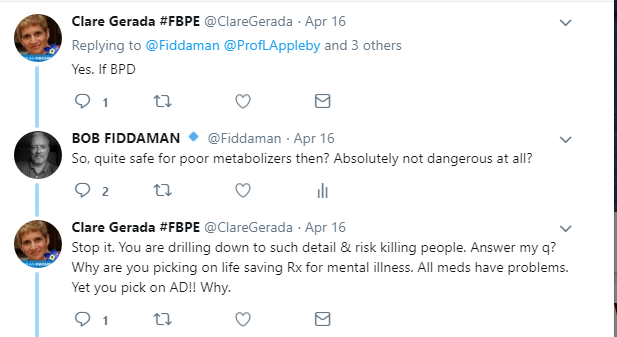
Dr. Clare Gerada ~ "Stop it"

Louis Appleby, Government Advisor on the prevention of suicide, opened a can of worms on Twitter last month when he tweeted:


What followed were some jaw-dropping tweets from, Clare Gerada, the person Appleby was promoting.

Who is Clare Gerada?

Clare Gerada is one-half of a psych drug promotion pair. She's married to Simon Wessely, a psychiatrist and professor of psychological medicine at the Institute of Psychiatry, King's College London. Gerada was the chairperson of the Council of the Royal College of General Practitioners from 2010 to 2013. She is also a partner in the Hurley Group which runs a number of GP practices and walk-in centers across London. She was made a Member of the Order of the British Empire in the 2000 Birthday Honours "for service to medicine and to drug misusers"

Nice.

Now let's take a look at Clare's attempts to stifle conversation about the side effects surrounding 'antidepressants'.

First up to tweet opposition to her views was Australian Army Major Stuart McCarthy. He joined the Australian Army in 1988 and in 1999 deployed to Bougainville, Papua New Guinea where he served as commander of a multi-national patrol in the Peace Monitoring Group.

Towards the end of McCarthy’s Bougainville deployment, he became a subject in an unethical drug trial for the antimalarial drug tafenoquine. In 2001, he spent six months as the deputy force engineer in the United Nations Mission in Ethiopia and Eritrea. While there he was prescribed mefloquine and experienced a variety of adverse drug effects including depression.

Despite recurrent major depression and other debilitating neurological symptoms that he now realises are the result of the undiagnosed neurotoxic brain injury he sustained in 2001, McCarthy served in the Army for 16 additional years.

His full bio is at the foot of this blog post.

McCarthy's April 16th tweet to Gerada asked her three questions. The resulting twitter exchange was priceless despite that Gerada's "responses" were dreadfully predictable.

Click on Twitter images to enlarge.


Undeterred, Major McCarthy pressed Gerada for some answers. Once again, she tried to silence the respected veteran:


I then tweeted Gerada a question asking if she would concede that, for some, they (drugs labeled antidepressants) could be dangerous? Her reply, if you could call it such, was quite puzzling:

So, now she was using her same line on me, Gerada ordered me to "stop it."

Minutes later she made a claim that these drugs save lives and told me to read the 500 clinical trials that prove it. Ahem, I hated to break the following to her:


Gerada could not answer my question because the fact is there have been no clinical trials for drugs labeled antidepressants that supported the claim Gerada made. There are no clinical trials that have found any evidence that taking these drugs saves lives. If there were, pharmaceutical companies would have already printed this bold proclamation on their product packaging. Pharma would never let such a sales and promotional opportunity slip by.

After running face first into a brick wall, Gerada's next tweet was equally lame but more bizarre:

I've previously written about how critics of patient safety advocates throw out the PR stigma line. You can read all about it here.

I then pointed out Gerada's strawman arguments and her shady goal to suppress and shame those harmed by drugs labeled antidepressants. Fiona French, who has been seriously damaged by benzo prescribing, joined the twitter conversation. What is astounding here is the way Gerada diagnoses French.


The conversation seemed to end there, but the following morning Gerada tweeted something even more delusional.

My answer was short and sweet. "Stop it", I said.

Coming late to the twitter round was Kristina Gehrki. Her tweets appeared to have ended Gerada's nonsense. Perhaps Gerada was too busy the last days with her googling "Who is Florence Nightingale?"


**STOP PRESS**

Remarkably, just minutes ago, Gerada felt the need to chip in again. This time, responding to a parent whose son died in an 'antidepressant' induced death. Telling a parent whose child died as a result of a prescription that they are 'wrong' is an affront to public health. Her reply also shows an appalling lack of human compassion.

Here's the tweet.


Gerada has now blocked me on Twitter.

Bob Fiddaman


Sunday, April 08, 2018

The NYT Addresses Antidepressant Withdrawal Issues


The Lame Defense

You'll hear many lines when discussing the problem of withdrawing from drugs labeled "antidepressants." They include the following:

"These drugs save lives."
"Without them, I wouldn't be here."
"Antidepressants benefit millions of people worldwide."
"They help people get through their daily routine."

While it's not for me to rebut all the above claims, the real issues are that none of the above lines have any relevance into discussing the challenges of "antidepressant" drug withdrawal. Comments such as the above are designed to get people to focus on the purported benefits of "antidepressants" and reduce discussion and/or dismiss discussion about the known risks. These lines are spouted by pharmaceutical companies, pharma-funded "health" and suicide organizations, drug regulators, doctors and consumers of "antidepressants." Some consumers, simply don't care about others who struggle with horrendous and life-threatening adverse drug reactions (ADRs). Perhaps these consumers of "antidepressants" are too frightened to look at the statistics for if they did, many would try to get off these drugs and would then find themselves gaining first-hand experience with SSRI ADRs.

Shifting the blame

If the above illogical responses don't work then the same people use the "shifting the blame" tactic. Some of these tactics include:

"Talk to your doctor."
"You're obviously not ready to come off them yet."
"It's not withdrawal, it's a return of your mental illness."
"Don't believe everything you read on the internet."
"Stop pill-shaming."
"You're a conspiracy theorist."
"Don't you think if these drugs were dangerous someone would have spoken up about them?"

I've heard all these retorts and imagine you've heard some, too. Once again, these retorts are thrown out willy-nilly in an illogical attempt to reduce honest discussion and purposeful action to solve the withdrawal problem caused by drugs labeled "antidepressants." It's an illogical argument and a selfish "I'm alright, Jack" response.

Many people who chant the above retorts state ADRs only happen to a "handful" of people. Even if this were true, how would the claims above help those suffering from severe "antidepressant" ADR's? Does society believe there is a certain magic number of victims that have to be reached before wanting to reduce avoidable suffering? How many people have to die from SSRI ADRs before it is deemed a public health issue worthy of positive action? Are some lives more important than other lives? Considering children and the elderly are two groups most at risk for ADRs, is this a sign our society cares less about children and the elderly?

Do we have to wait until we have inconclusive evidence that shows antidepressants cause severe ADRs in more than half of those who take them?

Time for Broader Discussions

Yesterday, the New York Times published an article entitled, "Many People Taking Antidepressants Discover They Cannot Quit." It's a decent article and the authors, Benedict Carey and Robert Gebeloff, seem to have done their homework with one exception. They stated, "withdrawal has never been a focus of drug-makers or government regulators." This is not accurate and I'll tell you why:

The Yugoslavia Trials 

The Yugoslavia Trials did, indeed, flag the issue of withdrawal surrounding paroxetine (Paxil, Seroxat).

In summary, in 1988 GSK, then SmithKline Beecham (SKB) sponsored clinical trials in Yugoslavia. The purpose of the trials was to show how paroxetine could, when stopped, cause a relapse in depression. SKB never took into account that those relapsing (after stopping paroxetine) could have been suffering withdrawal symptoms.With the results they wanted, SKB then provided the FDA with apparent evidence that showed patients staying on Paxil continued to enjoy a normal, "depression free" life, but that those abandoning the drug would suffer relapse back into a depressive state.

One thing that irked SKB was that they had to convince the FDA that relapses shown in the study were not simply patients suffering withdrawal.
(You can read my coverage of the Yugoslavia trials at the foot of this post.)

Buck-Passing

Further, back in 2011, the British equivalent of the FDA, the MHRA, launched an "innovative" SSRI Learning Module for prescribing doctors. In it, they stated...
"Symptoms after sudden SSRI discontinuation usually last about one to two weeks and then resolve spontaneously, but they can persist for longer in some patients. Close clinical observation is required to ensure that withdrawal symptoms are not getting worse. Severe cases may call for specialist advice and possible switch to an SSRI with longer half-life before gradual tapering."
I was interested in the "specialist advice" they were recommending to doctors who had patients suffering from worsening withdrawal symptoms. I, therefore, wrote to them and asked for a list of these "specialists." I asked them what training do these specialists have, where do they get this training and by whom?

Despite many weeks of emails back and forth and the usual game of semantics played by the MHRA, they could not provide me with one specialist. The links to the launch of the SSRI Learning Module are below.

Now that is has been more than 7 years since I asked MHRA for a list of specialists and they couldn't list a single one, I pose the question again: Can MHRA provide a list of specialists who are trained to help patients safely withdraw from drugs labeled as "antidepressants."?  I also pose the same question for patients suffering from benzo withdrawal.

The New York Times article is long overdue but I suspect it may well be wrapping up someone's fish & chips tomorrow because that's how this works. Pleas for help go unanswered because the strategy from the psych and pharma industry is to shift blame and change the conversation. They aim to avoid honest discussion of these serious medical issues despite that discussion and awareness would reduce suffering and save lives.

If the Yugolslavia trials don't show you how corrupt this system is, your definition of corrupt is far different than Webster's

Bob Fiddaman


Yugoslavia Trial

The Seroxat/Paxil Yugoslavia Trial Part I

The Seroxat/Paxil Yugoslavia Trial Part II

SSRI Learning Module

MHRA To 'Re-educate' UK Doctor's on SSRi's Part I 

MHRA To 'Re-educate' UK Doctor's on SSRi's Part II "Keeping A Stiff Upper Lip" 

MHRA To 'Re-educate' UK Doctor's on SSRi's Part III - MHRA's Ghosts In The Machine 

MHRA In Buck-Passing Specialist Cahoots 

MHRA - More on the Mysterious "Ghost Specialists" 

MHRA Wishing To Call The Shots


Friday, March 09, 2018

Scooby and Those Pesky Tweeters Rumble Psychiatry


I've stood back in amazement whilst watching psychgate unfold. It's been fun to watch the Royal College of Psychiatrists (RCP) crumble over the past few weeks. Back in February, they were rejoicing about the release of a "new" study proclaiming antidepressants work better than placebo and that they now have evidence to prove it. Wow!

Remarkable, 30 years after the launch of Prozac and we are being told we now have evidence that it, and other SSRIs, are actually better than placebo!

Reading between the lines of the study and the flurry of tabloid headlines and you'll see the results have been known for many years - RCP just put a different spin on it, along with the Science Media Centre, of course. Drugs marketed as "antidepressants" appear to possibly be better than placebo ONLY for sufferers of Major Depressive Disorder (MDD). And this result was limited only to a drug trial lasting 8 weeks. It's not known if "antidepressants" are better than placebo after 8 weeks and these drugs were never meant for long-term consumption despite that many psychiatrists lucratively prescribe them permanently to uninformed patients.

Anyway, I've pointed out the flaws in past blogs.

Moving on to more recent events

As I reported previously, Wendy Burn and David Baldwin, both of the RCP, landed themselves in hot water when they co-authored a letter to The Times newspaper. They claimed, "We know that in the vast majority of patients, any unpleasant symptoms experienced on discontinuing antidepressants have resolved within two weeks of stopping treatment."

One has to dissect the above comment to understand its meaning. Not only did they claim a majority of patients, they claimed a "vast majority." By saying "vast majority" they are implying it's at the high end of the spectrum. So, not just a majority, but a 'vast' one.

In actuality, both Burn and Baldwin were hideously wrong, their figures, or rather their estimation, was plucked out of thin air, in much the same way that is a diagnosis. When asked for evidence of their hideous claim, both Burn and Baldwin have failed to show any. The comment remains and no effort of a retraction has been made, nor an apology for getting it catastrophically wrong.

It was James Moore who set the ball in motion when he confronted Wendy Burn on Twitter. The correspondence (tweets) can be seen here. I shall now refer to James as Scooby as he's the brains behind the exposing of Burns and Baldwin. (Ugh, what a horrible thought, Burns, and Baldwin exposing themselves.)

I jest, and I shouldn't really, because this is a very serious subject. Proclaiming withdrawal symptoms are resolved within 2 weeks is dangerous and throws further stigma onto those experiencing withdrawal problems. In essence, Burns and Baldwin are saying anyone who experiences severe withdrawal after 2 weeks is either a liar or is merely imagining the horrific, debilitating withdrawal effects. Nice, huh?

It appears Burns and Baldwin have messed with the wrong people. They may feel they have the weight of the profession behind them but you should never mess with patient safety advocates such as Moore (ahem, Scooby).

Today a formal complaint of misleading the public on a matter of public safety has been lodged with RCP against Burn and Baldwin. The complaint, signed by Professor John Read of the University of East London, on behalf of many psychiatrists and victims of antidepressant withdrawal can be read here.


Scooby Scoop

Scooby wouldn't be Scooby without a perfect ending. So, what does Scooby do? Well, he interviews the complainer, John Reed.

Reed comes across as someone who knows his onions. His utter dismay of recent events shines through in this short interview. He also has actual evidence that Burn and Baldwin are wrong as he conducted his own study into withdrawal effects from antidepressant drugs. Listen and share. It will have you whooping and shouting screams of approval, or disapproval, depending on which side of the fence you sit, the side with evidence, or the side without.

Credit to James Moore for starting the snowball and for continuing to roll it.

Zoinks!


Bob Fiddaman


Thursday, March 01, 2018

Royal College of Psychiatrists - 63%


As many of you already know, Professor Wendy Burn, President – Royal College of Psychiatrists, and Professor David Baldwin, Chair, Psychopharmacology Committee – Royal College of
Psychiatrists have been sent a letter regarding recent remarks in an opinion piece published by The Times newspaper. The letter, sent to Burn and Baldwin, is calling for the pair to publicly retract, explain and apologise for the statement.

The opinion piece to The Times was signed off by both Burn and Baldwin and it caused quite a stir amongst users, and former users of antidepressants. Burn and Baldwin wrote, "We know that in the vast majority of patients, any unpleasant symptoms experienced on discontinuing antidepressants have resolved within two weeks of stopping treatment."

Many outraged present and former patients took to Twitter to confront Wendy Burn where she was told that her opinion did not tally with a 2014 study posted on the Royal College of Psychiatrists website. It was a study that was due to be revised in Oct 2017, however, it appears, that it never was.

The study showed that 63% of people suffered from antidepressant withdrawal. The most common side effect listed by the Royal College of Psychiatrists, was Anxiety (70%).  Electric shocks, better known as 'head-zaps' was seen in 48% of those who participated in the study. Imagine that, a drug gave 70% of patients symptoms of anxiety during withdrawal!

Burn, who often prescribes antidepressants claims that she never witnesses withdrawal in the majority of her patients. Let's assume 70% of her patients suffer anxiety during withdrawal - it's probably safe to say that Burn diagnoses them with such and re-introduces the antidepressant - and round and round the patient goes. It beggars belief - if an antidepressant can induce anxiety then (ahem) treat that anxiety with an antidepressant!

When the survey was pointed out to Burn on Twitter, she claimed she never knew of it. 24 hours later the survey was taken down and now many feel it was removed because it didn't tally with the comments made by Burn and Baldwin in The Times.


Carmine Pariante, who is often a spokesperson for The Royal College of Psychiatrists, claimed on Twitter that he had been told: "The leaflet expired in 2016 and should have been revised then. @rcpsyc will produce a revised leaflet with an updated evidence-base and with input from patients and GPs."

However, a video which seems to accompany the survey was uploaded in 2015 to youtube. Remarkably, there is no mention of the 63% who suffered withdrawal effects, nor is there any mention that a quarter of those surveyed experienced withdrawal effects for 12 weeks or longer (as was stipulated in the original survey (here)

The video, which claims that "Most people don't have troublesome side effects when coming off antidepressants," once again, goes against their own study findings. More bizarrely, the video contradicts the above claim with, "Most people said that their symptoms lasted up to six weeks."

If that doesn't confuse you then I don't know what will!

To add more confusion to the pot they claim that the side effects may just be your depression returning ("You may have some physical symptoms or your depression may return.")

Moreover, the video still remains in the public domain - for whatever reason, it has not been taken down by the Royal College of Psychiatrists. One can only presume that the findings in the video haven't 'expired' and the Royal College of Psychiatrists have no plans for an updated 'evidence-base and with input from patients and GPs.'

It seems to me that the Royal College of Psychiatrists are having their cake and eating it here.

Anyway, here's the video that was published on YouTube on Jun 26, 2015. A backup copy has been made just in case the Royal College of Psychiatrists decide to move this video too.


Backup


Bob Fiddaman


Tuesday, February 27, 2018

RCP Remove Damning Antidepressant Document From Website


"Figures Don't Lie, but Liars Figure" ~ Mark Twain

As soon as Wendy Burn and David Baldwin pass their remedial maths exam, they have some serious explaining to do.

In a recent letters to the editor publication in the British media (pic below), Burns, president of the Royal College of Psychiatry (RCP) and Baldwin, RCP psychopharmacology chair, claimed: "We know that in the vast majority of patients, any unpleasant symptoms experienced on discontinuing antidepressants have resolved within two weeks of stopping treatment." Yet, their own survey shows at least 63% of respondents reported difficulties withdrawing from the SSRI drugs Wendy and David frequently defend.


Click on image to enlarge

I'm unsure what type of maths training one needs to become a doctor, but it appears Burns and Baldwin skipped the maths requirement as both believe 63% is not a "majority."

Their claim prompted many questions from people on Twitter who 1) know how to count and 2) have struggled to withdraw from drugs marketed as "antidepressants."

Burn went wild on Twitter with her frequent tweets claiming antidepressants work and people using them shouldn't be 'shamed'. (Fig 1) Though it makes for a well-orchestrated PR tactic to try and muster the troops by claiming unknown others are trying to attack and "shame" them for drug consumption, I've yet to see anyone publicly shaming others for following doctors' orders.


Fig 1

Burn went on to claim "most people can stop them without problems." She backed up her claim by adding a link to a 2003 paper entitled, "Relapse prevention with antidepressant drug treatment in depressive disorders: a systematic review."

Enter James Moore, creator of the popular Facebook forum, "Let's Talk Withdrawal" and host of Mad In America's successful podcast series. Moore pointed out that Burn's claim did not jive with RCP's own "Coming Off Antidepressants" leaflet featured on RCP's website. Despite being president of RCP, Burn is apparently clueless regarding her organization's public information. (Fig 2)


Fig 2

After regurgitating a 2003 study in desperate attempt to back her claims, Burn later backtracked stating...


Burn then quickly vanished from the conversation.

Less than 24 hour hours later, RCP had removed its "Coming Off Antidepressants" leaflet from its own website despite RCP's claim "We hope that you find the information given in this leaflet useful"

Thanks to Moore's quick thinking, he had already downloaded RCPs damning leaflet that contradicts the claims made by RCP's president and psychopharmacology committee chair.

Last week we frequently heard Burns and other RCP spokespersons, such as Carmine Pariante, shouting from the rooftops "Extra, extra, read all about it: 'groundbreaking' study shows antidepressants work better than placebo." Pariante further claimed that the findings 'put to bed' the controversy surrounding antidepressants. For most, the controversy has never been whether or not they figured better than placebo in clinical trials. The controversy is whether or not they can cause severe withdrawal problems, psychosis, and both suicidal thinking and completed suicide.

Back to RCP's own antidepressant withdrawal survey and today's abrupt removal of their website leaflet.

The survey, carried out by RCP in 2014 and last reviewed in 2017, showed a staggering 63% of respondents experienced withdrawal when stopping drugs marketed as "antidepressants."

Of their findings, RCP wrote:
"People in our survey reported that the symptoms generally lasted for up to 6 weeks. A small percentage of symptoms lasted longer than this. A quarter of our group reported anxiety lasting more than 12 weeks."
In all, 866 people participated in the survey, a quarter of which equates to 216. Contrast this figure to the article penned by RCP's president and psychopharmacology committee chair who state, "We know that in the vast majority of patients, any unpleasant symptoms experienced on discontinuing antidepressants have resolved within two weeks of stopping treatment."

Some questions we need to ask RCP include:

 1. Why does a study published by the RCP in 2014 and reviewed in 2017 bear no significance when RCPs President and psychopharmacology chair address the media?

 2. Do Wendy Burn and David Baldwin suffer from amnesia or do they merely fail to understand basic mathematics? i.e.; 63% is more than half.

 3. Why did RCP recently remove this survey and accompanying leaflet from its website days after announcing the "controversy surrounding antidepressants has now been put to bed" and 24 hours after James Moore showed Burn that her claims did not tally with her own organization's findings?

4. Most importantly, RCP's leaflet regarding SSRI withdrawal stated: "We hope that you find the information given in this leaflet useful." Given that only yesterday RCP believed its info for those suffering from SSRI withdrawal was important, why did RCP remove its useful info today? Is there a new study published in the last 24 hours that shows zero percent of the population suffers from SSRI withdrawal? I don't think so.

Doctors take a Hippocratic Oath to First Do No Harm. Although 63% of people who suffer from SSRI withdrawal is clearly a majority, the point is that even if this figure were only 1%, does RCP not feel an ethical obligation to help all its members help all their patients? The Hippocratic Oath is not based on majority percentages; rather, it is based on individual doctor/patient relationships.

Here's the 4-page leaflet...


For a bit of fun, I've put together five songs I feel Messrs Baldwin and Burn may like to listen to.

Don't Try To Hide It - J. Geils Band

Thick As A Brick - Jethro Tull

Here Today, Gone Tomorrow - The Ramones

Add It Up - The Kinks

Clearly Quite Absurd - Deep Purple


Bob Fiddaman
Special thanks to James Moore


**UPDATE**

Back stories


Please contact me if you would like a guest post considered for publication on my blog.