Published: April 15, 2020
Multidisciplinary research priorities for the COVID-19 pandemic
The Lancet
I've read it.
It's based around one word.
Here are my thoughts.
A psychiatrist claims to focus on and treat symptoms originating in the brain that lead to abnormal voluntary functions, i.e; human behaviours, whereas neurologists focus on and treat symptoms originating in the brain that produce abnormal involuntary functions.
Confused? I was at first until I looked closer.
One treats symptoms that "lead" to abnormal voluntary functions whilst the other treats symptoms that "produce" abnormal involuntary functions.
So, a psychiatrist treats something that isn't fully manifested whereas neurologists treat something that has manifested. They do this by using technology, usually in the form of Computed tomography (CT) or computer-assisted tomography (CAT) scans, magnetic resonance imaging (MRI), electroencephalography (EEG), nerve conduction studies and electromyography (NCS/EMG), and lumbar puncture (LP) for cerebral spinal fluid analysis.
Most psychiatrists use the Diagnostic and Statistical Manual of Mental Disorders, Fifth Edition (DSM-5) to diagnose mental health disorders. (3)
The word in the above sentence you are looking for is "might."
The published Lancet article hinges on this one little word, a word that sees authors push for more funding. It's a bit like you or I going to the bank for a loan and telling the bank manager that we wish to borrow money for an investment that may or may not (might) bear some fruit.

The common theme running throughout the Lancet paper seems evident, to me at least.
Imagine, if you will, the scene from Oliver Twist. You all know the one, right?
'Please Sir, I want some more'
(Lancet references to funding)
It's based around one word.
Here are my thoughts.
What the published authors claim:
We explore the psychological, social, and neuroscientific effects of COVID-19 and set out the immediate priorities and longer-term strategies for mental health science research.
What this blog has found:
What this blog has found:
Mental health 'scientists' claim:
"As scientists continue to investigate the brains of people who have mental illnesses, they are learning that mental illness is associated with changes in the brain's structure, chemistry, and function and that mental illness does indeed have a biological basis." (1)
"As scientists continue to investigate the brains of people who have mental illnesses, they are learning that mental illness is associated with changes in the brain's structure, chemistry, and function and that mental illness does indeed have a biological basis." (1)
What the published authors claim:
"We urge UK research funding agencies to work with researchers, people with lived experience, and others to establish a high-level coordination group to ensure that these research priorities are addressed, and to allow new ones to be identified over time."
What this blog has found:
What this blog has found:
Prediction published March 30, 2020 (2 weeks prior to the Lancet paper being published)
It will be claimed that many have detachment-type disorders and new phobias. Mourning the loss of loved ones will continue to be deemed as a mental disorder if that mourning process goes beyond two weeks. Psychiatric 'medication' prescriptions will increase as will cases of autoimmune diseases, ironically caused by some of 'medications' prescribed. (2)
What the published authors claim:
"Discovery, evaluation, and refinement of mechanistically driven interventions to address the psychological, social, and neuroscientific aspects of the pandemic are required."
What this blog has found:
A distinction must be made here between what a psychiatrist does and what a neurologist does.
A psychiatrist claims to focus on and treat symptoms originating in the brain that lead to abnormal voluntary functions, i.e; human behaviours, whereas neurologists focus on and treat symptoms originating in the brain that produce abnormal involuntary functions.
Confused? I was at first until I looked closer.
One treats symptoms that "lead" to abnormal voluntary functions whilst the other treats symptoms that "produce" abnormal involuntary functions.
So, a psychiatrist treats something that isn't fully manifested whereas neurologists treat something that has manifested. They do this by using technology, usually in the form of Computed tomography (CT) or computer-assisted tomography (CAT) scans, magnetic resonance imaging (MRI), electroencephalography (EEG), nerve conduction studies and electromyography (NCS/EMG), and lumbar puncture (LP) for cerebral spinal fluid analysis.
Most psychiatrists use the Diagnostic and Statistical Manual of Mental Disorders, Fifth Edition (DSM-5) to diagnose mental health disorders. (3)
The DSM is a manual whereby 'mental health diseases' are voted on by panel members. No technology, such as those used by neurologists, are ever used.
What the published authors claim:
What the published authors claim:
"Severe acute respiratory syndrome coronavirus 2 (SARS-CoV-2), the virus that causes COVID-19, might infect the brain or trigger immune responses that have additional adverse effects on brain function and mental health in patients with COVID-19."
What this blog has found:
The above looks impressive until you read that they had to add one word. If you blink you'll miss it. It's a word often used in the field of psychiatry and basically means one of two things - [1] It does [2] It doesn't. It covers both bases but only ever talks about one of them.
The word in the above sentence you are looking for is "might."
The published Lancet article hinges on this one little word, a word that sees authors push for more funding. It's a bit like you or I going to the bank for a loan and telling the bank manager that we wish to borrow money for an investment that may or may not (might) bear some fruit.

The common theme running throughout the Lancet paper seems evident, to me at least.
Imagine, if you will, the scene from Oliver Twist. You all know the one, right?
'Please Sir, I want some more'
(Lancet references to funding)
Like all good articles in the media do, they start off with the main message and finish reiterating that message. This Lancet publication is no different.
"New funding will be required to meet these priorities, and it can be efficiently leveraged by the UK's world-leading infrastructure."
"New funding will be required to meet these priorities, and it can be efficiently leveraged by the UK's world-leading infrastructure."
"Research funders and researchers must deploy resources to understand the psychological, social, and neuroscientific effects of the COVID-19 pandemic."
"We propose a framework for the prioritisation and coordination of essential, policy-relevant psychological, social, and neuroscientific research, to ensure that any investment is efficiently targeted to the crucial mental health science questions as the pandemic unfolds."
"We propose a framework for the prioritisation and coordination of essential, policy-relevant psychological, social, and neuroscientific research, to ensure that any investment is efficiently targeted to the crucial mental health science questions as the pandemic unfolds."
"Given the need to develop the research priorities rapidly to inform immediate funding priorities."
(Final paragraph) "New funding will be required to meet these priorities, and it can be efficiently leveraged by the UK's world-leading neuroscience and mental health research infrastructure. The UK must connect with international funders and researchers to support a global response to the mental health and neurological challenges of this pandemic."
If the begging bowl references don't alarm you then the published piece, you'll find, is littered with words and phrases that are designed to scaremonger, more so than the media are doing with reference to Covid19.
It's quite shocking to see some of the tactics used in this paper based on something that may or may not ever happen (might)
It's quite shocking to see some of the tactics used in this paper based on something that may or may not ever happen (might)
Here's just a small example of scare tactics used by the authors:
"The need to maintain high-quality research standards is imperative."
"An immediate priority."
"The need to maintain high-quality research standards is imperative."
"An immediate priority."
"There is an urgent need."
"Must deploy resources."
"The research community must act rapidly."
"Growing threats to mental health."
"Clear immediate priorities."
"Need to be repeated more rigorously."
"A risk that prevalence of clinically relevant numbers of people with anxiety, depression, and engaging in harmful behaviours (such as suicide and self-harm) will increase."
"The potential fallout of an economic downturn on mental health is likely to be profound."
"A major adverse consequence of the COVID-19 pandemic is likely to be increased social isolation and loneliness (as reflected in our surveys), which are strongly associated with anxiety, depression, self-harm, and suicide attempts across the lifespan."
"The immediate research priorities are to monitor and report rates of anxiety, depression, self-harm, suicide, and other mental health issues both to understand mechanisms and crucially to inform interventions."
"Data will be vital to determine causal mechanisms associated with poor mental health."
"The digital response is crucial."
"Paramount importance."
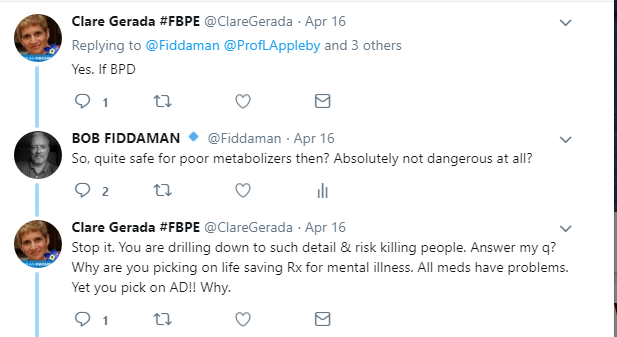
Now, if you, like me, have received criticism on Twitter from members of the Royal College of Psychiatrists for raising awareness about the "interventions" they speak of in this Lancet paper, you'll understand why I'm bringing all of the above to the attention of my readers.
This paper is designed to grab funding. Unlike poor young Oliver Twist, they haven't even said, "please."
The covid crisis has been an eye-opener for someone like me. I am fascinated by people-watching. I tend to watch a lot before engaging, I like to weigh up a person. There have been many media reports of people cashing-in during this crisis, you know, local shopkeepers hiking the prices of toilet paper and hand sanitizer. Many people who are ignoring government guidelines are also in the news.
What I've seen from the mental health field is no better than those selfish idiots and greedy shopkeepers as they push their agendas that covid can cause mental health problems. Nope, it will just cause behavioural problems as people adjust to their new normal. It's not a brain disorder nor will it manifest into one. Mental Health big-wigs have seized this opportunity with both hands, hence the need for them to create a problem that isn't there and then try to convince people that it may happen and to tackle it they need funding.
Oliver only wanted more porridge because he was hungry. Mental Health, it appears, want more, much more, to feed their egotistical appetites.
Hey, don't get me wrong, I'm all for sticking someone under a scanner to determine if their brain is or isn't working properly, I just don't think one can determine a brain default by box-checking a guide that was voted on by a bunch of white-coated men who "might" have just been influenced by drug company money.
Multidisciplinary research priorities for the COVID-19 pandemic: a call for action for mental health science can be read here.
The covid crisis has been an eye-opener for someone like me. I am fascinated by people-watching. I tend to watch a lot before engaging, I like to weigh up a person. There have been many media reports of people cashing-in during this crisis, you know, local shopkeepers hiking the prices of toilet paper and hand sanitizer. Many people who are ignoring government guidelines are also in the news.
What I've seen from the mental health field is no better than those selfish idiots and greedy shopkeepers as they push their agendas that covid can cause mental health problems. Nope, it will just cause behavioural problems as people adjust to their new normal. It's not a brain disorder nor will it manifest into one. Mental Health big-wigs have seized this opportunity with both hands, hence the need for them to create a problem that isn't there and then try to convince people that it may happen and to tackle it they need funding.
Oliver only wanted more porridge because he was hungry. Mental Health, it appears, want more, much more, to feed their egotistical appetites.
Hey, don't get me wrong, I'm all for sticking someone under a scanner to determine if their brain is or isn't working properly, I just don't think one can determine a brain default by box-checking a guide that was voted on by a bunch of white-coated men who "might" have just been influenced by drug company money.
Multidisciplinary research priorities for the COVID-19 pandemic: a call for action for mental health science can be read here.
Only one of the authors (panel members), Prof Clive Ballard, PhD, reports grants and personal fees ~ from Acadia and Lundbeck; personal fees from Roche, Otsuka, Biogen, Eli Lilly, Novo Nordisk, AARP, and Exciva; and grants from Synexus
Bob Fiddaman