Zantac Lawsuit


Researching drug company and regulatory malfeasance for over 16 years
Humanist, humorist
Showing posts with label MHRA. Show all posts

Tuesday, October 11, 2022

'Chemical Imbalance' FOIA - "Psychiatry adopted the 'chemical imbalance' term"


It took longer than normal but the MHRA have finally responded to a FOIA I sent to them earlier this year.

The request strove to seek information regarding SSRI patient information leaflets, moreover, the terminology written on them that pertains to a "chemical imbalance".

I asked the MHRA when the marketing authorisation holders (MAH) of five SSRIs changed the labelling and patient information leaflets with regard to any reference referring to a "chemical imbalance" and what was the reason/evidence for this change.

For those that don't know, a systematic umbrella review regarding the serotonin theory of depression was widely publicised in journals and the mainstream media. The review found there is no evidence to support the idea that depression is caused by disturbance of the brain’s serotonin system.

This is something I've known for quite a long time, I even raised this lack of evidence for supporting the 'chemical imbalance' theory in my 2012 book, 'The Evidence, However, Is Clear, The Seroxat Scandal'.

After the review, authored by Joanna Moncrieff, Ruth E. Cooper, Tom Stockmann, Simone Amendola, Michael P. Hengartner & Mark A. Horowitz, hit the mainstream news, many psychiatrists took to social media to announce that they've never believed the chemical imbalance was true.

I found this surprising given the blog, 'Demand Chemical Imbalance Redaction' highlights many psychiatrists who still publicly refer to mental illness being caused by a chemical imbalance. Adrienne Nagy, who is the board president of NAMI Athens, Ohio, for example, said in 2020, "What that means is education about mental illness. We're continually trying to educate the public to know that mental illness is an illness like any other illness—it's a biochemical imbalance in the brain. It's no different than diabetes or heart failure."

This wasn't just a throwaway comment from Nagy, this was actually publicised in The Post, an independent, award-winning student-run news publication on Ohio University’s campus.

If Nagy is telling students in a widely read campus publication that mental illness is a biochemical imbalance in the brain, then, to me, that suggests Nagy wants those students to believe that what she is saying is true and factual.

NAMI, by the way, is the acronym for the National Alliance on Mental Illness, the USA's largest grassroots mental health organization.

So, back to the FOIA:

I asked the same question for all SSRI patient information leaflets (PILs)

The MHRA response throws up a rather interesting reply with regard to 'the psychiatry scientific literature'. Remember, most psychiatrists claim to have never used the 'chemical imbalance' theory when talking to patients.

Here's the MHRA response in full. You'll note that they are boxing clever here. They seem to be saying the term 'chemical imbalance' is rarely used in PILs but other references to imbalances and low serotonin are. They seem okay with that. They are also saying the terms used are for patients to understand the literature, which they suggest is 'complex'.

I don't know about you but being told I have a chemical imbalance, low serotonin or a disturbance of chemistry in my brain kind of tells me that my brain is broken and thus needs fixing. I think this would apply to anyone confronted with this terminology.


It appears, the MHRA are, indeed, suggesting scientific literature from the field of psychiatry adopted the 'chemical imbalance' term.

We all know who they adopted it from, right?

On the MHRA's summary response, let's take a closer look at what the PILs say:

1/ Cipramil "is a Selective Serotonin Reuptake Inhibitor (SSRI) and belongs to a group of medicines known as antidepressants. These medicines help to correct certain chemical imbalances in the brain that are causing the symptoms of your illness"

2/ Escitalopram: "These medicines act on the serotonin-system in the brain by increasing the serotonin level. Disturbances in the serotonin system are considered an important factor in the development of depression and related diseases."

3/ Fluoxetine: "Everyone has a substance called serotonin in their brain. People who are depressed or have obsessive-compulsive disorder or bulimia nervosa have lower levels of serotonin than others. It is not fully understood how Fluoxetine and other SSRIs work but they may help by increasing the level of serotonin in the brain."

4/ Paroxetine: "Everyone has a substance called serotonin in their brain. People who are depressed or anxious have lower levels of serotonin than others. It is not fully understood how Paroxetine and other SSRIs work but they may help by increasing the level of serotonin in the brain."

5/ Sertraline: No mention of how and why they work but a strong warning of what they may cause.
"If you experience agitation, confusion, diarrhoea, high temperature and blood pressure, excessive sweating and rapid heartbeat. These are symptoms of Serotonin Syndrome."

Source - The electronic medicines compendium (emc) 


Bob Fiddaman


Tuesday, August 23, 2022

CHEMICAL IMBALANCE - PATIENT INFORMATION LEAFLETS FOIA TO MHRA


For the record, I emailed the MHRA earlier with the following request:

To whom it may concern,

According to UK legislation, [Regulation 267 of the Human Medicines Regulations 2012] it requires that marketing authorisation holders (MAH) of UK MAs and article 126a authorisations inform the competent authority of all changes to the labelling and patient information leaflets which are not connected with changes to the Summary of Product Characteristics (SmPC).

With this in mind, I hereby request the following information:

1. When did the marketing authorisation holders (MAH) of citalopram change the labelling and patient information leaflets with regard to any reference referring to a "chemical imbalance" and what was the reason/evidence for this change.

2. When did the marketing authorisation holders (MAH) of escitalopram change the labelling and patient information leaflets with regard to any reference referring to a "chemical imbalance" and what was the reason/evidence for this change.

3. When did the marketing authorisation holders (MAH) of fluoxetine change the labelling and patient information leaflets with regard to any reference referring to a "chemical imbalance" and what was the reason/evidence for this change.

4. When did the marketing authorisation holders (MAH) of paroxetine change the labelling and patient information leaflets with regard to any reference referring to a "chemical imbalance" and what was the reason/evidence for this change.

5. When did the marketing authorisation holders (MAH) of sertraline change the labelling and patient information leaflets with regard to any reference referring to a "chemical imbalance" and what was the reason/evidence for this change.

Sincerely,

Bob Fiddaman


Wednesday, January 19, 2022

Yellow Card Reporting System Shown the Red Card


In football (Soccer), a yellow card is used by the referee to discipline players for misconduct or failing to follow the rules.

The Yellow Card Reporting Scheme (MHRA) is supposed to provide an early warning that the safety of a medicine or a medical device may require further investigation. In other words, whatever you report will be assessed and logged by the MHRA.

Up until today, I didn't think there were any caveats, imagine my surprise when I open an email from Brian Burch, Signal Assessor, Vigilance Risk Management of Medicines, MHRA, who tells me reporters of adverse events can now decide whether or not they think the medicine, device or, indeed, vaccine, caused that adverse event. Upon doing so the MHRA will then take the relevant action to reflect this on their database.

So, in a nutshell, you or I could take a vaccine and some weeks later suffer with heart problems. After talking with a GP or a heart specialist we can then decide if the vaccine played a part in the heart problem or not.

We don't, it seems, even have to talk to a healthcare professional. We can make our own minds up whether we think the vaccine caused the heart problem or whether the heart problem appeared out of nowhere and isn't vaccine related.

The MHRA will accept our final word on the matter...but only if we don't wish to lay blame on the vaccine.

If we think the vaccine did cause the adverse event, the MHRA, according to Burch, will try to determine whether the reported vaccine was causal, contributory or simply coincidental.

Here's the rub (straight from the written word of Burch)

"In any individual case it is very difficult, if not impossible, to determine whether the reported drug or vaccine was causal, contributory or simply coincidental."

Yet, they will accept a patient or healthcare professional report that suggests it wasn't vaccine related.

If it's 'very difficult, if not impossible' for the MHRA to determine a casual, contributory or coincidental link, why do they assume a layperson, such as you or I, can determine if a vaccine caused or contributed to an adverse event?

Nonetheless, you or I can do the job of the MHRA (probably after speaking with our 'pro-vax' healthcare professional) - Do we have a large number of healthcare professionals who would support our inkling that the vaccine, they may have administered, caused us injury?

One has to ask, if this poor system of reporting vaccine adverse events should be shown the red card.

Anyway, here's the FOIA follow-up response Burch sent to me earlier. It comes on the back of their original reply which can be viewed here.

--

From: Pharmacovigilanceservice <Pharmacovigilanceservice@mhra.gov.uk>

To: Bob Fiddaman

Subject: GENQ-00150010

Follow up questions

Dear Mr Fiddaman,

Thank you for your recent correspondence where you asked the following:

1. Is a follow-up question/s sent to every single person who reports (via the yellow-card reporting system) an adverse reaction to the vaccine?

2. Is it the position of the MHRA that a UK citizen can determine whether or not an injury was caused by a pharmaceutical product?

Follow up questions are not sent to every single individual who reports a suspected adverse reaction to a Covid-19 vaccine. The MHRA assesses Yellow Card reports using an internal follow up algorithm to determine whether any additional information such as test results, other drugs and/or medical history is required. The MHRA will then contact the original reporter, where contact details are available and permission is granted, to request this information.

The nature of Yellow Card reporting means that reported events are not always proven side effects. The MHRA accepts reports of any suspected adverse reactions as determined by the reporter of the Yellow Card. In any individual case it is very difficult, if not impossible, to determine whether the reported drug or vaccine was causal, contributory or simply coincidental. Should a reporter of a Yellow Card, upon reflection or receipt of additional information, no longer suspect that the drug or vaccine was the cause of the adverse reaction(s) reported the MHRA accepts this information and will take the relevant action to reflect this on our database.

I hope this information is of use, please do not hesitate to contact me if I can be of any further assistance.

Yours sincerely,

Brian Burch

Signal Assessor

Vigilance Risk Management of Medicines

MHRA

--


Bob Fiddaman


Monday, January 03, 2022

MHRA FOIA REGARDING VACCINE INJURIES AND DEATHS


The following is an email response from the MHRA regarding a series of questions I posed them about vaccine injuries and deaths. Their answers (below) have prompted a follow-up email to them which is also included in this blog post.

Subject: Freedom of Information Act Request

From: Bob Fiddaman 

To: info@mhra.gov.uk

According to your weekly records, accessed 21 Dec, 2021 -

https://www.gov.uk/government/publications/coronavirus-covid-19-vaccine-adverse-reactions/coronavirus-vaccine-summary-of-yellow-card-reporting

As of 8 December 2021, for the UK, 141,866 Yellow Cards have been reported for the COVID-19 Pfizer/BioNTech Vaccine, 239,314 have been reported for the COVID-19 Vaccine AstraZeneca, 22,270 for the COVID-19 Vaccine Moderna and 1,333 have been reported where the brand of the vaccine was not specified.

For the COVID-19 Pfizer/BioNTech Vaccine, COVID-19 Vaccine AstraZeneca and COVID-19 Vaccine Moderna the overall reporting rate is around 3 to 7 Yellow Cards per 1,000 doses administered.

In the week since the previous summary for 1 December 2021 we have received a further 2,603 Yellow Cards for the COVID-19 Pfizer/BioNTech Vaccine, 673 for the COVID-19 Vaccine AstraZeneca, 1,750 for the COVID-19 Vaccine Moderna and 26 where the brand was not specified.


*1.* Of the 141,866 Yellow Cards have been reported for the COVID-19

Pfizer/BioNTech Vaccine, how many have been:

A: Fatal

B: How many of the fatal reports did the MHRA follow-up with the reporter

C: What test, if any, was carried out to determine whether or not the

vaccine was the cause of death or not


*2.* Of the 239,314 that have been reported for the COVID-19 Vaccine

AstraZeneca, how many have been:

A: Fatal

B: How many of the fatal reports did the MHRA follow-up with the reporter

C: What test, if any, was carried out to determine whether or not the

vaccine was the cause of death or not


*3.* Of the 22,270  that have been reported for the COVID-19 Vaccine

Moderna, how many have been:

A: Fatal

B: How many of the fatal reports did the MHRA follow-up with the reporter

C: What test, if any, was carried out to determine whether or not the

vaccine was the cause of death or not


*4.* Of the 26 that have been reported where the brand was not

specified,  how many have been:

A: Fatal

B: How many of the fatal reports did the MHRA follow-up with the reporter

C: What test, if any, was carried out to determine whether or not the

vaccine was the cause of death or not

-- 

*Bob Fiddaman*

Author/Blogger/Researcher

--

From: Pharmacovigilanceservice <Pharmacovigilanceservice@mhra.gov.uk>

To: "fiddamanwork@gmail.com" <fiddamanwork@gmail.com>

CC: MHRA Customer Services <MHRACustomerServices@mhra.gov.uk>, FOI_Policy <FOI_Policy@mhra.gov.uk>

Subject: RE: FOI 21/1342 CSC 81313 Freedom of Information Act Request

Dear Mr Fiddaman,

Thank you for your FOI request dated 21st December 2021.

The number of fatal reports is included in the Vaccine Analysis Prints published each week. Please note that a report of a suspected ADR to the Yellow Card scheme does not necessarily mean that it was caused by the vaccine, only that the reporter has a suspicion it may have. Underlying or previously undiagnosed illness unrelated to vaccination can also be factors in such reports. The relative number and nature of reports should therefore not be used to compare the safety of the different vaccines. All reports are kept under continual review in order to identify possible new risks.

https://www.gov.uk/government/publications/coronavirus-covid-19-vaccine-adverse-reactions

All Yellow Card reports we receive are promptly entered onto the MHRA's Adverse Drug Reaction (ADR) database so that they are available for a process called signal detection. During signal detection, reports are evaluated, together with additional sources of evidence, by a team of safety experts to identify any new safety issues or side effects. We apply statistical techniques that can tell us if we are seeing more events than we would expect to see, based on what is known about background rates of illness in the absence of medication or vaccination. This aims to account for factors such as coincidental illness. We also look at the clinical characteristics to see if new patterns of illness are emerging that could indicate a new safety concern.

For the COVID-19 vaccines, we supplement this form of safety monitoring with other epidemiology studies, including data analysis on national vaccine usage, anonymised GP-based electronic healthcare records, and other healthcare data to proactively monitor safety. These combined safety data enable the MHRA to detect side effects or safety issues associated with COVID-19 vaccines. As well as confirming new risks, an equally important objective of monitoring will be to quickly rule out risks - in other words, to confirm that the vaccine is not responsible for a suspected side effect and to provide reassurance on its safety. We also take into account the international experience based on data from other countries using the same vaccines. For further information on how we use the data we collect, please view our COVID-19: vaccine surveillance strategy.

As with any serious suspected ADR, reports with a fatal outcome are fully evaluated by the MHRA to consider whether the medicine or vaccine may have caused the event or whether the event and fatal outcome were likely to be purely coincidental and due to underlying illness. To ensure the comprehensive assessment of fatal reports, we follow-up all fatalities where necessary for further information.

As mentioned above, for all the fatal reports concerning COVID-19 vaccines, a follow-up letter is sent to the reporter to request further information, including a copy of the Post Mortem (PM) report and the certified Cause of Death. Once we receive this follow up information, it may change the classification of the case. In some instances, the reporter may not consider the death to be related to the COVID-19 vaccine. The classification of these cases would therefore be amended within our database and these updates reflected in the following weekly Coronavirus ADR publication.

Kind regards,

FOI Team

Vigilance and Risk Management of Medicines Division

Medicines and Healthcare Products Regulatory Agency

10 South Colonnade, Canary Wharf, London E14 4PU

---

Follow-Up response

From: Bob Fiddaman 

To: Pharmacovigilanceservice <Pharmacovigilanceservice@mhra.gov.uk>

Thank you for this information.

As a follow-up question, I am interested in the following paragraph you wrote me:

"As mentioned above, for all the fatal reports concerning COVID-19 vaccines, a follow-up letter is sent to the reporter to request further information, including a copy of the Post Mortem (PM) report and the certified Cause of Death. Once we receive this follow up information, it may change the classification of the case. In some instances, the reporter may not consider the death to be related to the COVID-19 vaccine." "The classification of these cases would therefore be amended within our database..."

Questions under the terms of the FOIA

1. Is a follow-up question/s sent to every single person who reports (via the yellow-card reporting system) an adverse reaction to the vaccine?

2. Is it the position of the MHRA that a UK citizen can determine whether or not an injury was caused by a pharmaceutical product?

Sincerely,

Bob Fiddaman


--

I'll let you know when/if they respond


Bob Fiddaman


Tuesday, November 23, 2021

Podcast with Akathisia Stories


Akathisia Stories, a co-production of MISSD and Studio C, is a podcast series that features interviews and news concerning the adverse drug reaction akathisia and medication-induced suicide. 

MISSD, the Medication-Induced Suicide Prevention and Education Foundation in Memory of Stewart Dolin, is a unique non-profit organization dedicated to honouring the memory of Stewart and other victims of akathisia by raising awareness and educating the public about the dangers of akathisia. MISSD aims to ensure that people suffering from akathisia's symptoms are accurately diagnosed so that needless deaths are prevented. The foundation advocates truth in disclosure, honesty in reporting, and legitimate drug trials.

On this episode, we hear from author, blogger, researcher, and self-described humanist and humourist Bob Fiddaman.  His eponymously titled blog has focused on drug company and regulatory malfeasance since making its debut in 2006.  At the time, Bob, an Englishman living in Birmingham, was taking himself off of Seroxat, a GlaxoSmithKline-produced antidepressant known here in America as Paxil.  After making a protracted attempt at tapering off of the drug, he eventually decided to go cold turkey, a course of action he strongly advises against. 

Full show here

Podcast extra here


Bob Fiddaman


Friday, May 29, 2020

The GSK Covid Vaccine: Will We Be Safe?


Media reports suggest GSK, the British based pharmaceutical giant, are close to producing 1 billion doses of a coronavirus vaccine booster in 2021. Little is known about the ingredients of the vaccine, at least in the mainstream media.

GSK have merged with the French multinational pharmaceutical company, Sanofi.

Between them, GSK and Sanofi have paid out $5,063,939,512 in violation fines, GSK paying $4,422,266,058 (billion) whilst Sanofi come in at $641,673,454 (million)

GSK, who rolled out the Pandemrix vaccine for the last global pandemic, are set to make a pretty penny if they and Sanofi can get the coronavirus vaccine booster past the regulators - this process has been made easier for them due to global drug regulators giving drug companies a rapid path by allowing them to bypass animal testing.

Animal tests are a critical step in vaccine and drug development. Normally, a new vaccine can take anything between 5 to 20 years to develop before it can be made available to the public. Animal tests are carried out to determine safety and efficacy at preventing the disease in question. Regulators, such as the MHRA in the UK and the FDA in the US, usually require that a manufacturer shows a product is safe in animals before it goes into people. 

This from the European Medicines Agency:

"The regulatory workshop was held virtually on 18 March 2020 in the context of the ongoing COVID-19 pandemic. It brought together delegates from 17 different countries, representing more than 20 medicines regulatory authorities globally, as well as experts from the World Health Organization and the European Commission, to share their views on the development of vaccines against COVID-19. The meeting was co-chaired by EMA and the US Food and Drug Administration (FDA)."

The summary report of that meeting can be found here.

Pandemrix: The Swine Flu Vaccine

Research published in the BMJ in 2013 suggested a possible link between the swine flu vaccine given to children in the UK and Europe during the epidemic in 2009 and 2010 and a rare condition called narcolepsy, which causes people to fall asleep suddenly without any warning and at any time of the day.

A further report, also published in the BMJ in 2018, asked the question, 'Pandemrix vaccine: why was the public not told of early warning signs?'

In 2019, an Irish woman, Aoife Bennett, 27, who received the Pandemrix vaccine in school in 2009 as part of a state campaign against swine flu. sued the government after developing narcolepsy shortly after receiving GSK's Pandemrix. The case was settled for an undisclosed amount of compensation to the victim.

This from The Guardian:

"Bennett told RTE on Wednesday that she was active and athletic until being vaccinated in December 2009. About two weeks later the side-effects began, she said. “Things changed very drastically.” She felt “like a sloth” and became fatigued, disoriented and prone to collapse.

"She expressed dismay that it took seven years of legal proceedings to obtain compensation.

"The defendants in the case were GlaxoSmithKline Biologicals, the health service executive, the minister for health and the health products regulatory authority, formerly the Irish medicines board."

Further, in 2017, the UK high court rejected a British government appeal to withhold payments to dozens of British children who developed the sleeping disorder after swine flu vaccines. Six million people in Britain, and more across Europe, were given the Pandemrix vaccine made by GlaxoSmithKline during the 2009-10 swine flu pandemic, but the jab was withdrawn after doctors noticed a sharp rise in narcolepsy among those receiving it.

It all seems pretty clear then that GSK's Pandemrix vaccine caused narcolepsy in some who were administered it. A way to keep such news at bay is to make settlements with those who file lawsuits.

When we look into the Swine Flu pandemic, we can see similarities into what is panning out today in 2020. The same questions should be asked about the safety of any potential Covid-19 vaccine and we shouldn't have to wait until people suffer a severe adverse reaction to it as we did with the GSK's swine flu vaccine.

Incidentally, what do GSK have to say about their product, Pandemrix, causing narcolepsy? Well, only yesterday, in efforts to convince the public that there will be no problem with their new vaccine for Covid, they claimed its previous flu pandemic vaccine, (Pandemrix) which used some of the same ingredients as Covid-19 vaccines currently under development, was not linked to a rise in cases of the sleep disorder narcolepsy

This from RTE:

"A spokesman for GSK said the "science has moved on" since concerns were raised about links between narcolepsy and its H1N1 vaccine, called Pandemrix, which was developed during the flu pandemic 10 years ago. 

"He said evidence now suggests the link is to the H1N1 flu virus itself, not the vaccine. 

"In a statement to Reuters, the company said available scientific data suggest that "the rare occurrence of narcolepsy during the 2009/10 flu pandemic was triggered by the body confusing a protein in the wild type H1N1 flu virus with a human protein relevant in regulating the sleep cycle." 

In 2010, The Daily Mail, a British newspaper, reported on how Drug firms cashed in on scare over swine flu. Dr Wolfgang Wodarg, who at the time was head of health at the Council of Europe, branded the swine flu pandemic as 'one of the greatest medical scandals of the century.'

The 2010 Daily Mail article, which is like a version of Groundhog day playing out, also highlights how Sir Roy Anderson, a scientist who advised the UK Government on swine flu outbreak, held  a £116,000-a-year post on the board of GlaxoSmithKline.

One of the current Covid scientific advisers to the UK government, Patrick Vallance, is the former head of GlaxoSmithKline's vaccine division.

Déjà vu anyone?

Finally, although I cannot prove the authenticity of the claims in  a video that was recently uploaded to YouTube,  an independent journalist claims he has recently been contacted by a GSK whistleblower who  told him vaccines trialled out on women contained an antigen that was shown to cause a 97% increase in infertility. The antigen also allegedly makes men sterile.

The video has since been removed by YouTube but can still be accessed here.

Bob Fiddaman


Sunday, April 08, 2018

The NYT Addresses Antidepressant Withdrawal Issues


The Lame Defense

You'll hear many lines when discussing the problem of withdrawing from drugs labeled "antidepressants." They include the following:

"These drugs save lives."
"Without them, I wouldn't be here."
"Antidepressants benefit millions of people worldwide."
"They help people get through their daily routine."

While it's not for me to rebut all the above claims, the real issues are that none of the above lines have any relevance into discussing the challenges of "antidepressant" drug withdrawal. Comments such as the above are designed to get people to focus on the purported benefits of "antidepressants" and reduce discussion and/or dismiss discussion about the known risks. These lines are spouted by pharmaceutical companies, pharma-funded "health" and suicide organizations, drug regulators, doctors and consumers of "antidepressants." Some consumers, simply don't care about others who struggle with horrendous and life-threatening adverse drug reactions (ADRs). Perhaps these consumers of "antidepressants" are too frightened to look at the statistics for if they did, many would try to get off these drugs and would then find themselves gaining first-hand experience with SSRI ADRs.

Shifting the blame

If the above illogical responses don't work then the same people use the "shifting the blame" tactic. Some of these tactics include:

"Talk to your doctor."
"You're obviously not ready to come off them yet."
"It's not withdrawal, it's a return of your mental illness."
"Don't believe everything you read on the internet."
"Stop pill-shaming."
"You're a conspiracy theorist."
"Don't you think if these drugs were dangerous someone would have spoken up about them?"

I've heard all these retorts and imagine you've heard some, too. Once again, these retorts are thrown out willy-nilly in an illogical attempt to reduce honest discussion and purposeful action to solve the withdrawal problem caused by drugs labeled "antidepressants." It's an illogical argument and a selfish "I'm alright, Jack" response.

Many people who chant the above retorts state ADRs only happen to a "handful" of people. Even if this were true, how would the claims above help those suffering from severe "antidepressant" ADR's? Does society believe there is a certain magic number of victims that have to be reached before wanting to reduce avoidable suffering? How many people have to die from SSRI ADRs before it is deemed a public health issue worthy of positive action? Are some lives more important than other lives? Considering children and the elderly are two groups most at risk for ADRs, is this a sign our society cares less about children and the elderly?

Do we have to wait until we have inconclusive evidence that shows antidepressants cause severe ADRs in more than half of those who take them?

Time for Broader Discussions

Yesterday, the New York Times published an article entitled, "Many People Taking Antidepressants Discover They Cannot Quit." It's a decent article and the authors, Benedict Carey and Robert Gebeloff, seem to have done their homework with one exception. They stated, "withdrawal has never been a focus of drug-makers or government regulators." This is not accurate and I'll tell you why:

The Yugoslavia Trials 

The Yugoslavia Trials did, indeed, flag the issue of withdrawal surrounding paroxetine (Paxil, Seroxat).

In summary, in 1988 GSK, then SmithKline Beecham (SKB) sponsored clinical trials in Yugoslavia. The purpose of the trials was to show how paroxetine could, when stopped, cause a relapse in depression. SKB never took into account that those relapsing (after stopping paroxetine) could have been suffering withdrawal symptoms.With the results they wanted, SKB then provided the FDA with apparent evidence that showed patients staying on Paxil continued to enjoy a normal, "depression free" life, but that those abandoning the drug would suffer relapse back into a depressive state.

One thing that irked SKB was that they had to convince the FDA that relapses shown in the study were not simply patients suffering withdrawal.
(You can read my coverage of the Yugoslavia trials at the foot of this post.)

Buck-Passing

Further, back in 2011, the British equivalent of the FDA, the MHRA, launched an "innovative" SSRI Learning Module for prescribing doctors. In it, they stated...
"Symptoms after sudden SSRI discontinuation usually last about one to two weeks and then resolve spontaneously, but they can persist for longer in some patients. Close clinical observation is required to ensure that withdrawal symptoms are not getting worse. Severe cases may call for specialist advice and possible switch to an SSRI with longer half-life before gradual tapering."
I was interested in the "specialist advice" they were recommending to doctors who had patients suffering from worsening withdrawal symptoms. I, therefore, wrote to them and asked for a list of these "specialists." I asked them what training do these specialists have, where do they get this training and by whom?

Despite many weeks of emails back and forth and the usual game of semantics played by the MHRA, they could not provide me with one specialist. The links to the launch of the SSRI Learning Module are below.

Now that is has been more than 7 years since I asked MHRA for a list of specialists and they couldn't list a single one, I pose the question again: Can MHRA provide a list of specialists who are trained to help patients safely withdraw from drugs labeled as "antidepressants."?  I also pose the same question for patients suffering from benzo withdrawal.

The New York Times article is long overdue but I suspect it may well be wrapping up someone's fish & chips tomorrow because that's how this works. Pleas for help go unanswered because the strategy from the psych and pharma industry is to shift blame and change the conversation. They aim to avoid honest discussion of these serious medical issues despite that discussion and awareness would reduce suffering and save lives.

If the Yugolslavia trials don't show you how corrupt this system is, your definition of corrupt is far different than Webster's

Bob Fiddaman


Yugoslavia Trial

The Seroxat/Paxil Yugoslavia Trial Part I

The Seroxat/Paxil Yugoslavia Trial Part II

SSRI Learning Module

MHRA To 'Re-educate' UK Doctor's on SSRi's Part I 

MHRA To 'Re-educate' UK Doctor's on SSRi's Part II "Keeping A Stiff Upper Lip" 

MHRA To 'Re-educate' UK Doctor's on SSRi's Part III - MHRA's Ghosts In The Machine 

MHRA In Buck-Passing Specialist Cahoots 

MHRA - More on the Mysterious "Ghost Specialists" 

MHRA Wishing To Call The Shots


Monday, December 11, 2017

British Medicines Watchdog Announce New Partnership


First off, watch the short announcement from the MHRA's CEO, Dr. Ian Hudson.


He looks almost apologetic, don't you think? Either that or he is embarrassed?

Before taking his role as CEO of the British Medicines Watchdog (MHRA), Hudson was the agency’s licensing director, responsible for the majority of its medicines licensing activities. Prior to that, he was the World Safety Officer for GlaxoSmithKline. He can be seen here defending Paxil, also known as Seroxat, (under oath) during a one-hour video deposition that was aired during the Tobin Vs GlaxoSmithKline case. A case which saw the Jury return a verdict against GlaxoSmithKline and, indeed, Paxil. (Fig 1)


Fig 1


Who Are The Gates Foundation?

Better known as the Bill & Melinda Gates Foundation, it was launched in 2000 and one of its primary aims is to "enhance healthcare and reduce extreme poverty."

What Are They Currently Involved In?

Well, aside from teaming up with the MHRA and having a say on the safety monitoring of medicines in low and middle-income countries, they are also embroiled in serious issues regarding a vaccine study they sponsored that was carried out in India in 2009.

Bill and Melinda's foundation funded the Program for Appropriate Technology in Health (PATH) to carry out the studies in which 5 young girls died after receiving the Human Papilloma Virus (HPV) vaccine, Gardasil, manufactured by Merck.

According to The India Times, "...consent for conducting these studies, in many cases, was taken from the hostel wardens, which was a flagrant violation of norms. In many other cases, thumbprint impressions of their poor and illiterate parents were duly affixed onto the consent form. The children also had no idea about the nature of the disease or the vaccine "

In 2015, Judges in India's Supreme Court demanded answers regarding the violations. An investigation carried out by the British newspaper, The Daily Mail, found that "children as young as nine suffered side-effects after being used as unwitting human guinea pigs for the new drug."

The Daily Mail adds:
An investigation by an Indian parliamentary committee had previously concluded that the trials amounted to a serious breach of trust and medical ethics amounting to child abuse and 'a clear cut violation of the human rights of these girl children and adolescents'.
The committee's report said it had been established that clinical trials of the vaccines had been carried out 'under the pretext of an observation/demonstration project' in violation of all laws and regulations laid down by the government for such trials.
GSK is also embroiled in the controversy. Shortly after the Gardasil debacle, two more deaths were reported from Vadodara, Gujarat, where tribal children were also vaccinated with another brand of HPV vaccine, GSK's Cervarix.

Earlier this year, things got so bad that India's health ministry decided to take over funding responsibility for the immunization program backed by the Bill & Melinda Gates Foundation. The reason? "A possible conflict of interest arising from the foundation's tied to pharmaceutical companies." (Business Standard)

MHRA

So now, we seem to have gone full circle with today's MHRA announcement from Dr. Ian Hudson, who claims...
"We are delighted to be involved in such an important global initiative. New drugs and vaccines are being brought to the market for the first time in public health programmes in settings where the safety monitoring and regulatory systems need strengthening. The expertise we can bring to the project will help national safety monitoring centres identify risks and benefits early and take appropriate regulatory action to support global health."
So, let's get this straight. Bill and Melinda Gates funded an immunization program in India. That program kills a number of children and the protocol was found to be 'a clear-cut violation of the human rights of children'. Next, Ian Hudson, the former World Safety Officer at GSK, announces that Bill and Melinda Gates will be teaming up with the MHRA to strengthen "the safety monitoring and regulatory systems."

Someone pinch me.

If this hasn't got you thinking outside of the box, ladies, and gentlemen, then maybe this will?

An article published in 2012 entitled, 'The Gates Foundation connection to the Glaxo drug fraud scandal', is a fascinating read. It highlights, amongst many things, that Tachi Yamada, former head of global health for the Bill & Melinda Gates Foundation was formerly the head of research and development for GSK.

Yamada, while he was head of global health for the Gates Foundation, was accused in a U.S. Senate hearing of bullying a scientist to not publish negative findings of a GSK diabetes drug called Avandia. The same drug that Glaxo failed to report important data to the FDA showing that it increased heart risks in patients by 43%. Despite agreeing to a misdemeanour count in 2012, GSK still maintains "the civil settlement is not an admission of any liability or wrongdoing in the selling and marketing of Avandia." However, they agreed to pay $3 billion imposed on them by The Department of Justice for failure to report Avandia safety data.

I'm sure Ian Hudson knows of the links between GSK and the Gates Foundation. Probably why his announcement (in the video at the top of this post) looks like it's being delivered by someone who has soiled his underpants. Either that or he has become nauseous after being trapped in the incestuous revolving door at the MHRA!

Bob Fiddaman


Friday, November 24, 2017

MHRA Promote Broken System


Yellow Card System Remains a Red Flag

This weekend the British drug regulators, MHRA, are using Twitter to promote their broken Yellow Card ADR reporting system. The Yellow Card is MHRA's initiative whereby prescribers and patients can report adverse drug events regarding prescription drug use.

Here are some recent MHRA tweets:


One would think the MHRA are finally starting to acknowledge that reported adverse drugs reactions can improve patient safety and product warnings. However, the MHRA refuses to follow up on Yellow Card reports. Thus, reporting adverse drug reactions (ADRs) has little to no value in improving public health.

MHRA should follow up Yellow Card reports by contacting doctors and/or consumers to seek relevant info regarding the reported adverse drug event so that MHRA can then determine what role ADRs played in causing harm.

Let's say Mr. Smith loses his wife to suicide. After conducting independent research, Mr. Smith learns the drug his wife was prescribed may have contributed to her demise. He then submits a Yellow Card report to the MHRA.Upon receipt of his report, the MHRA will add the adverse event to a database. MHRA won't bother following up. They won't contact Mr. Smith to ask pertinent questions such as, "Did Mrs. Smith's mood worsen when she was talking the drug?" or "Was Mrs. Smith warned by her prescriber that the product is known to create suicidal thoughts and actions?"  Instead, the MHRA will merely add the adverse event to their database where it will sit for infinity without further investigation.

When consumers alert the MHRA that the adverse event might have possible causation, the MHRA routinely claims, "correlation does not equal causation." I say routinely because the MHRA failed to follow up Yellow Card submissions and can, therefore, continue to claim there's "no correlation."

As a patient advocate, I have, in the past, alerted the MHRA that there were 79 reported cases of suicidal and self-injurious behaviours on the same drug. (Paxil) If Paxil was the product Mrs. Smith was taking at the time of her death, the MHRA would again parrot their "correlation does not equal causation" line. Mrs. Smith's ADR then becomes just another suicide that has very little to do with the drug she was taking.

By promoting the Yellow Card reporting system on Twitter, the MHRA is asking prescribers and consumers to continue sending reports that the MHRA will never follow up. Even if the suicidal and self-injurious behaviours statistic for a particular drug increase, the MHRA will always be able to claim that just because people die of self-inflicted injury whilst taking a prescription drug, it doesn't mean the drug caused the suicide.

This works well for the MHRA but doesn't work to protect consumers. The MHRA responds by repeatedly claiming consumers are dying by suicide because of mental health challenges. They will further stress that patients should continue taking their prescriptions and talk to their doctors if new or worsening symptoms occur.

And so it is: The MHRA's new Twitter campaign promotes consumers as guinea pigs on a dizzying carousel ride. Round and round we go on a cheap carnival ride with faulty rivets and a drunken operator. Similar to the banking industry responsible for the financial demise of countless hardworking citizens, the MHRA knows there's a systemic problem and that it is the public who will pay the price for MHRA's willful indifference to critical drug safety.

Just as the banks sold dodgy mortgages, the MHRA peddle dodgy promises to further the myth that they exist to promote health and safety. In truth, they don't. Their protocol for managing dangerous drugs will always benefit the pharmaceutical companies who pay their wages. The MHRA is fully-funded by the industry who make the products noted in Yellow Card reports. Hence, the MHRA won't follow up Yellow Card reports.

MHRA's new tagline should be "correlation does not equal causation." At least this would help alert unsuspecting consumers that with MHRA at the helm, there is grave danger.

I've been banging the drum about this problem for years. Here's a recent Podcast I did that highlights this.


Bob Fiddaman


MHRA 'Yellow Card' Related

My Meeting With The MHRA - (PDF) September 2, 2008

MHRA To 'Re-educate' UK Doctor's on SSRi's Part I - November 26, 2011

MHRA To 'Re-educate' UK Doctor's on SSRi's Part II "Keeping A Stiff Upper Lip" - November 27, 2011

MHRA To 'Re-educate' UK Doctor's on SSRi's Part III - MHRA's Ghosts In The Machine - November 28, 2011

MHRA In Buck-Passing Specialist Cahoots - December 07, 2011

MHRA: Follow-Up Rate at a Price - September 29, 2015

MHRA: "We Now Consider This Request Closed" - October 20, 2015

The Mechanics of the MHRA - December 03, 2016

SSRI Deaths in Clinical Trials - May 05, 2017

MHRA Seek Payment For Info on Deadly Drugs - June 05, 2017

MHRA: No Deaths in Pediatric Trials, But What About Adults? - July 17, 2017

Danny Lee-Frost of the MHRA - July 20, 2017


EXCLUSIVE: MHRA Asked Sky News to Remove Antidepressant Reference - July 25, 2017


Thursday, August 10, 2017

Making Sense About Science Media Centres


I'm worried.

I feel kind of deflated.

I've been blogging for over 11 years and met with many people, most of whom have lost loved ones to antidepressant-induced deaths. I've watched blogs come and go, campaigners who had a fire in their bellies slowly fade away because sometimes it all can get to be too much.

Earlier this week I was alerted to a post on David Healy's popular blog regarding the Science Media Centre. (SMC) I'd never heard of them before so read Healy's 'Honey I Shrunk the Shrinks' with great interest.

As a writer and researcher, I rarely take one post at face value. I always research the subject in question. During my research of the SMC, I became increasingly concerned that this is something we should all be looking into. To say it's alarming is an understatement.

The SMC is like something you would read in a Dan Brown novel. It's the type of organisation that one sees pop up on their daily news feeds on Facebook, usually accompanied by a link that directs you to websites that claim the earth is flat or man has never walked on the moon, you know the type.

What's different about the SMC, however, is they don't hide what they do, nor do they hide who funds them.  Maybe this is a purposeful act, one that shows the minorities that SMC has muscle?

Without naming all their financial backers (there's too many, past and present) I've picked out some of those that cause me great concern.

Present funders include:

Royal Pharmaceutical Society
Institute of Psychiatry, Psychology & Neuroscience (IoPPN)
Medicines and Healthcare Products Regulatory Agency (MHRA)
Merck Sharp & Dohme (MSD) Limited
Association of the British Pharmaceutical Industry (ABPI)
British Pharmacological Society
National Institute for Health and Clinical Excellence (NICE)
Royal College of Psychiatrists (RCP)
AstraZeneca
GlaxoSmithKline (GSK)

Previous funders include:

Daily Express
Eli Lilly & Company
Institute of Mental Health
Mental Health Foundation
Mental Health Research Network
Mental Health Research Network Cymru
News International Ltd
Pfizer Limited
Rethink
Scottish Mental Health Research Network
World Health Organisation (WHO)
Wyeth

There are many more pharmaceutical companies that are or have funded the SMC. I've just focused on those that market and manufacture antidepressants.

So, who exactly are the SMC?

They were formed in 2000 after the House of Lords Select Committee on Science and Technology's third report on "Science and Society." This report claimed there was a better need for more experts in the field of science to offer expert information in the media.

So, why should we be worried?

Well, one doesn't have to go too far back to see an example of the SMC in action, in fact, we only have to go back a couple of weeks to July 26, 2017, just one day before Panorama's 'A Prescription For Murder' was shown on British TV screens. The eagerly awaited programme was dismissed as 'scaremongering' and 'stigmatizing' 24 hours before it aired. The MHRA and the RCP (highlighted above) took to Twitter on the morning of the 26th.

RCP tweets included:
#BBCPanorama claims irresponsible and unfounded. Scaremongering title alone shows real stigma people taking #antidepressants face.
and
More #antidepressant prescriptions=more people getting help. Not more potential murderers. Don't stigmatize people needing help #BBCPanorama 

Whereas the MHRA tweeted:
SSRIs have been used to effectively treat millions of people worldwide & like all medicines, the safety is continually monitored.

More on the MHRA later.

All above board and predictable, one would think, until you dig deep into the SMC and what it is they actually do. It all becomes clear when you read their blurb:
The Science Media Centre’s ultimate goal is to facilitate more scientists to engage with the media. We provide support for scientists to engage with the media when their area hits the headlines, offering expertise of a team with over 10 years’ experience in science media relations. We have an ever expanding database of experts and have strong connections with UK universities, industry, learned societies and scientific institutions.
The SMC also runs off-the-record brainstorms to discuss how the scientific community can effectively coordinate its media relations on controversial issues within science. Occasionally the SMC will run subject-focused advisory sessions in anticipation of big controversial stories.
No surprise then that stories appeared in the British media before and after the airing of Panorama. Most, if not all, the articles featured an "expert" who claimed Panorama was stigmatizing and scaremongering. They were also stating that drugs, such as sertraline, which was heavily featured in the programme, do not cause people to go out and commit murder.

In defence of all these claims I, along with Kristina Gehrki, wrote a blog post entitled 'Panorama: Prescription For Stigma?' It proved to be popular and was shared many times on social media, particularly in the first 24 hours.

Around 8 hours after I went live with my co-written piece, MQ, a mental health website, ran with an eerily similar headline, 'A Prescription For Stigma: Why Evidence Matters.' The article was written by Ed Sykes who, coincidently, is Head of Mental Health and Neuroscience at the Science Media Centre.

In not supporting Panorama's efforts to increase awareness, Sykes wrote something quite striking:
The main evidence the programme seemed to be giving us, alongside the case studies, was the result of a Freedom of Information request to the Medicines & Healthcare products Regulatory Authority (MHRA). The MHRA is responsible for many aspects of healthcare, including a Yellow Card system that records all the bad side-effects linked to any drugs. The Panorama team informed us that their investigation had unearthed 28 cases linking antidepressants to murder and 32 to murderous thoughts. The show did point out that these were just reports, not conclusions that the drugs had caused murder. But what they failed to mention was that these reports to the MHRA can be made by anyone. You or I could go on their website right now and make a report, it doesn’t necessarily mean it was a medical professional who reported it or that the report was supported by strong evidence. 
What Sykes, in his efforts to play down the 28 cases linking antidepressants to murder, failed to mention is the follow-up that the MHRA do when they receive a Yellow Card report. It was a question I put to them back in 2015. Their reply was the bog-standard game of semantics they have played with me for the past 11 years or so, further, they asked for payment to release the information. You can see the correspondence here and here.

Ed Sykes really should have done his homework before throwing out the 'correlation does not equal causation' line.

Before finishing my introduction to the SMC, I'd like to congratulate Prof. Sir Mike Rawlins, former Chairman of NICE (highlighted above) who, a month ago, was honoured by the Queen for his services to the safety of medicines, healthcare and innovation.

Oh, something else: Prof. Sir Mike Rawlins is the current Chairman for the MHRA. Prof. Sir Mike Rawlins also sits on the Board of Trustees at, you've guessed it, the Science Media Centre.

Now, who was it that coined the term 'revolving door'?

Bob Fiddaman


Tuesday, July 25, 2017

EXCLUSIVE: MHRA Asked Sky News to Remove Antidepressant Reference


The controversy and confusion created last week by MHRA and their Sky News article continues. In the interview, MHRA enforcement officer, Danny Lee-Frost, stated, “...sleeping pills and antidepressants are a lot more dangerous. People have committed suicide as the ultimate resort to try to get off them. They are fiercely addictive.”

The original article aired on the Sky News website at 10:14 am on Thursday, July 20.

I wrote to Lee-Frost approximately an hour later asking:
Is it now the position of the MHRA that antidepressants are addictive and that "people have committed suicide as the ultimate resort to try and get off them?"
Can you clarify that this is a personal belief or one of the MHRA?
Lee-Frost promptly responded:
Dear Mr Fiddaman
Thank you for your enquiry regarding the article commissioned by Sky News on the dangers of buying medicines online.
I work in the Enforcement group and my role is concerned with investigating illegal activity involving medicines. I am not medically qualified and therefore matters of clinical diagnosis are not in my area of expertise.
The focus of this piece was the online sale and supply of medicines and the increased use of Facebook as a medium of sale.
Part of the interview concerned sleeping tablets and I referred to Zopiclone and Diazepam specifically.
We have seen an increase in the number of websites offering both of these medicines for sale. Sky presented evidence that both were available on Facebook and I asked for details of the sites they had found in order to make further enquiries.
We also discussed the dangers of purchasing large quantities of these medicines from websites without medical supervision and the increasing amounts that we are seizing as part of our enforcement activities.
My reference to suicides was in relation to a case that the MHRA is aware of involving addiction to Zopliclone.
Sky did not include the interview in its entirety in their piece.
Regards
Danny Lee-Frost MSc
Head of Operations
Enforcement Group 
What's striking here is the timeline of events.

At 3.15 pm Sky News edited its original version and omitted part of Lee-Frost's original statement. The statement had been changed to, "The sleeping pills and antidepressants are a lot more dangerous. Sleeping pills particularly, they can be addictive. People have committed suicide as the ultimate resort to try and get off them. These are fiercely addictive."

However, the video of Lee-Frost's original statement remained on the Sky News website.
Screenshots, with Sky News provided subtitles, are found below:


The original video can be viewed here, with Lee-Frost's 18-second segment here.

Puzzled as to why Sky News would change Lee-Frost's direct quotes and make edits after publication, I inquired:

Stephanie Jones, Sky News PR Manager, states:
"The changes were made after MHRA got in touch to clarify Frost's comments. They made the point that antidepressants shouldn't be included with sleeping pills."
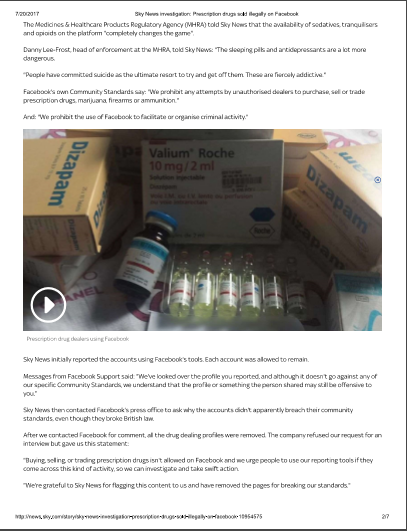
Hmm...MHRA and Lee-Frost's original statements couldn't possibly be referring to ads such as this, now could they?


All ads still remain on Facebook today.

Lee-Frost's Email Response

Let's look at the email Lee-Frost sent me, in particular, his statement:

"My reference to suicides was in relation to a case that the MHRA is aware of involving addiction to Zopiclone."

This new info is troubling as nowhere on the product labeling does it suggest Zopiclone can be addictive. Moreover, the SPC label does not mention suicide being a result of withdrawing from Zopiclone.

The  SPC-DOC_PL 41684-0003.PDF is hosted on the MHRA website and was last updated on 02/06/2017

If Zopiclone is or can be addictive as soon as you start taking it, as Lee-Frost suggests (see video) then why does MHRA omit this info on its website? Moreover, if Zopiclone is a drug where "people have committed suicide as the ultimate resort to try to get off them," why is this relevant information not included by MHRA in the SPC?

The SPC for the other drug mentioned  in Lee-Frost's  reply, Diazepam, does not support Lee-Frost's two claims that:

1) withdrawal can lead to suicide and
2) is "fiercely addictive once you start taking them"

On the subject of dependency (addiction), the Patient Information Leaflet for Diazepam states:
Dependence: When taking this medicine there is a risk of dependence (a need to keep taking the medicine). The risk increases with the dose and length of treatment period.

As you see, the Patient Information Leaflet clearly states the risk of addiction increases with the length of the treatment period. It does not state it "can be addictive as soon as you start taking it." Therefore, it's safe to assume MHRA believes neither Zopiclone or Diazepam can cause addiction as soon one starts taking them, nor can they cause people to carry out "suicide as the ultimate resort to try to get off them" as Lee-Frost claimed.

According to MHRA's public documents, Lee-Frost's claims are false. So why would Lee-Frost believe differently than his employer, the MHRA? (Remember, Lee-Frost is the head Enforcement Officer of the MHRA!)

Why would he make repeated statements that antidepressants can be addictive and cause suicide upon withdrawal if he did not know this to be true?

Why would he later claim he was speaking about Zopiclone and Diazepam instead of antidepressants as he said in his original article?

Why would MHRA contact Sky News and direct them to change their Enforcement Officer's own statement?

I think I know why and my readers likely know why, too. I believe in his Sky News interview, Lee-Frost was speaking about antidepressants as a whole. He subconsciously told the truth, something MHRA didn't appreciate. I believe MHRA knows that drugs labeled "antidepressants" are addicting. It appears MHRA also knows "antidepressant" withdrawal is such torture that some people would rather die than suffer these drug side effects. Hence, sufferers end their lives. I don't prefer to call these drug-induced deaths "suicides" as they are iatrogenic.

Stay tuned: Next week the saga continues with the MHRA and Lee-Frost responses.

Lee-Frost now claims the suicide related to Zopiclone withdrawal he referred to in his first email to me, was simply "anecdotal."

an·ec·do·tal
[ˌanəkˈdōdl]

ADJECTIVE
(of an account) not necessarily true or reliable, because based on personal accounts rather than facts or research

Bob Fiddaman


Thursday, July 20, 2017

Danny Lee-Frost of the MHRA


UPDATE HERE

A u-turn, a misquote, a mistake?

Call it what you will but the MHRA's head of enforcement, Danny Lee-Frost, pictured above, has been quoted by Sky News today in an article about prescription drugs being sold illegally on Facebook.

Frost said,  "The sleeping pills and antidepressants are a lot more dangerous. People have committed suicide as the ultimate resort to try and get off them. These are fiercely addictive." He added, "...we are now seeing a lot more sleeping tablets, seeing a lot more anti-anxieties, diazepam and benzo-diazepam, those types of products, being available. The sleeping pills and antidepressants are a lot more dangerous, they're a lot more addictive."

Is this finally an admittance from the MHRA that antidepressants are addictive?

I wrote the following to Frost and various departments within the MHRA. I will let you know should I get a reply.

Dear Mr. Frost,

Is it now the position of the MHRA that antidepressants are addictive and that people have committed suicide as the ultimate resort to try and get off them?

I ask, because you have been quoted on Sky News today in the article here. (See update below)

Can you clarify that this is a personal belief or one of the MHRA.

Many thanks.

Bob Fiddaman

**Update**
The original article was posted on Sky News at 10.14am

I contact the MHRA aand Danny Lee-Frost at 11.38am

Sky News change their page with edits at 3.15pm


OLD PAGE - posted on Sky News at 10.14am
Click to enlarge.
Video evidence after the pictures.

And here's a video of Mr. Lee-Frost confirming that "sleeping pills and antidepressants are a lot more dangerous. People have committed suicide as the ultimate resort to try and get off them."


UPDATE HERE

Please contact me if you would like a guest post considered for publication on my blog.