I've heard many stories over the years regarding the troubles people have experienced whilst taking brain pellets marketed as 'antidepressants.' Kerri's guest post (below) is yet another example of how patients are pushed from pillar to post, often having to find their own way to resolve matters relating to brain pellet adverse events because of a severe lack of knowledge from prescribing physicians.
The three pellets featured in Kerri's story were, at a point in time, blockbuster products raking in billions of dollars for the drug companies who marketed and manufactured them, namely Lilly (Prozac) and GlaxoSmithKline (Paxil) and Pfizer (Zoloft). Three apparent drugs that are supposed to help but, as is my experience, cause more problems than the original 'illness' they are prescribed for. They all, allegedly, work in pretty much the same way. Drug company reps will tell you that A is better than B and C because, well, because that's what they are paid to do. They have no scientific evidence that one is more tolerable and causes less side-effects than the other.
I find it difficult to believe that neither Lilly, GlaxoSmithKline or Pfizer knew nothing about the problems caused by the three products mentioned below, moreover, the journeys many millions face when taking them.
This is just a small part of Kerri's journey. She writes to warn others and to create an awareness that all is not lost if you, or someone you know, suffers the same fate as she.
Bob Fiddaman
--
I was taught to trust the doctors. I was taught to trust the prescriptions. I was taught to trust the assessments I received from hospitals. And I did…but, this trust of these medical recommendations nearly killed me.
My name is Kerri Lynn and I was born in Long Beach CA, but was raised in the upper Midwest. I grew up in a dysfunctional home and early on, I gravitated towards addictive tendencies. I strived to make good choices at this time, however, my best efforts to live life on life’s terms were mostly self-destructive.
"I was restless, irritable and discounted all the time being newly sober and I needed help facing life, or so I thought."
At 13, I discovered drinking. I partied all the time until my addiction stopped working for me. I chased other self-destructive behaviors and relationships. My out-of-control nature led to an ultimatum from loved ones: I had to find a solution how not to be self-destructive.
Pain and circumstances drove me to seek help from 12-Step Recovery. This was really a challenge and about 60 days into this sober journey, I sought help from my family doctor. I was restless, irritable and discounted all the time being newly sober and I needed help facing life, or so I thought. My first prescription was for 20 mg of Prozac. 3 Days into this first prescription, I was unable to walk or talk. I was severely anxious and my brain was racing and telling me to do delusional things like run outside naked. I experienced Homicidal and Suicidal Ideation (I have come to understand that these are the symptoms of Serotonin Syndrome/Akathisia). I was panicking due to my reaction to this prescription, though I had no awareness that it was the prescription that was causing these symptoms. I had to reach out to a former counselor to sorts things out.
I met with my former counselor the following Monday. I finally revealed I was taking Prozac, and he immediately called my prescribing physician to get me off this prescription. This was the beginning of a 13-year nightmare with prescribed medications.
40mg of Paxil was my next prescription. A year into taking this antidepressant, I woke up one morning and could not emotionally feel anything. I was terrified. I called my doctor again and he tried yet another substitute of Zoloft. At that point, all hell broke loose. My doctor tried Paxil one more time and this sent me to the hospital. Between 2000 and 2006, I was Hospitalized on 3 separate occasions due to drug toxicity or cold turkey drug withdrawal.
"I exhausted every potential care and specialty option locally."
During these nightmare days, I was entertained with my expanded medical vocabulary. I learned words like suicidal ideation, disassociation, delusion, hallucination, profuse night-sweats, rapid irregular heartbeats and agoraphobia. We must not forget the bladder loss or rectal haemorrhaging, nor the black outs that would last more than 24 hours, when they would randomly introduce new medications. And my favorite suffering were the overwhelming panic attacks.
Sadly, my entire investment in the “healing process” to this point only led to my condition becoming more and more dire. The medical assessments only were dealing with a random set of symptoms that were mostly caused by the prescription and I could not break the cycle, no matter what I did or took. Almost every diagnosis made things worse and added to my growing list of “untreatable symptoms.” I exhausted every potential care and specialty option locally. I even spent 2 weeks at the world renown Mayo Clinic only to achieve an inaccurate diagnosis once again of Visceral Extreme Hypersensitivity. When I return to my home, I felt defeated and my local hospital would no longer allow me to make appointments, unless first reviewed by management over the phone. These doctors thought I was crazy.
It is always darkest before the dawn. I was under the care of many physicians. Many were a significant part of the problem and few were graciously a part of what would be my life-changing solution. I was blessed to be introduced to the Cytochrome P-450 test which analyses DNA and genetic strengths and deficiencies. From this accurate genetic assessment, it was discovered that I have both fast and slow processes in my liver and kidneys. This finally expressed a causality between reception and rejection of various medications. It was also determined accurately that I am missing the GSTM-1/ Glutathione Gene. It was finally determined that my true ailment was Multiple Chemical Sensitivity and all previous diagnoses actually placed me in grave risk by triggering my symptoms. The synthetic nature of the drugs being prescribed to me were actually poisoning me and triggered my multiple chemical sensitivity. During the course of 13 years of prescriptions, my body has been damaged so that I will most likely be significantly chemically sensitive for the remainder of my days.
"It is my hope that my story can guide people to new strategies so that nobody ever has to suffer like I did."
My hope is that by sharing my story that we can come to a new responsibility about how we seek and receive diagnoses. The medical profession has a mission statement of seeking to do no harm. This is not always the case. From my experience, a measured suspicion is the best approach. I now take the responsibility of doing my own medical research. I trust my instincts and I am my own advocate. Through my difficult journey my local provider actually became the first hospital in the country to study the P-450 genetic test. I strongly recommend this assessment be the starting point. Don’t utilize the P-450 as a last resort.
I am now 11-years medication free and stable. I have to live the rest of my life being critically aware of my environment and surroundings due to my chemical sensitivity. However, today I have a strategy for living that works. It is my hope that my story can guide people to new strategies so that nobody ever has to suffer like I did.
~ Kerri Lynn
---
You can listen to Kerri's story in her own words here via the brilliant Akathisia Stories, a co-production of MISSD and Studio C.
You can read more about Cytochrome P450 (CYP450) tests here
Footnote:
Test limitations
Although they have potential, CYP450 tests have limitations:
Tests are available for only certain medications. Also, each test is specific to only one medication, so a change in medication may require another test.
Testing can't predict which medication will work best for you — it can only provide clues.
Not all insurance companies cover the costs of these tests.
Tomorrow marks the death anniversary of 19-year-old Natalie Gehrki who, on February 6, 2013, was compelled to end her young life.
In 2003, Natalie became somewhat anxious and shy and after a visit to see a psychiatrist she started on her spiral of decline. Prozac, an SSRI, was recommended. Neither Natalie or her mother, Kristina, were provided with informed consent. In fact, Kristina, in an article she wrote some years later, said, "The doctor skipped over risks vs. benefits."
In 2003 there were no black box warnings on SSRIs so neither Natalie or her parents knew anything much about it. Shortly after taking Prozac Natalie became increasingly anxious and agitated, withdrawn and apathetic, she also developed new fears and obsessions. By the middle of 2004, she had started to self-harm, light cuts to her arm were evidence of this. Her prescriber, instead of withdrawing the drug, increased the Prozac dosage.
Earlier that year (March 2004) the FDA had advised all doctors that SSRIs pose life-threatening risks to children. Neither Natalie or her parents were given this information from Natalie's prescriber.
This from her mother:
"Natalie also lost her ability to participate in physical activities. Her fifth-grade diary reflects she felt uncoordinated, “couldn’t catch a ball,” and was often “the last person picked” for sports teams. This was significant given that Natalie previously showed excellent fine motor skills and happily out-climbed friends at the rock climbing wall. "Natalie’s doctor started offering new diagnostic guesses. They included borderline personality disorder, emotional lability, OCD and manic depression. She diligently updated her charts, but didn’t update us with new Prozac information. Natalie’s symptoms were far more serious than her original presenting symptom of anxiety."
In the summer of 2005, Natalie was instructed by her prescriber to take a "medication holiday”. The prescriber wanted to see how Natalie would fair when not taking Prozac. There was no tapering regime offered, just an abrupt stop.
Days after stopping Prozac Natalie told her mom that she wanted to kill herself. One has to bear in mind that at this point Natalie was just an 11-year-old girl. Terrified, her mother took her to hospital. After a brief consultation with the hospital psychiatrist, it was recommended that Natalie needed to restart her Prozac, in addition, she needed more drugs. Risperdal, an antipsychotic was thrown into the mix. Once again, no informed consent was given to either Natalie or her parents.
The horror-train ride wasn't over for Natalie - some years down the line Zoloft, an SSRI, came into play. Natalie's behaviour changed, she became unusually problematic in her behaviour. Her mother informed the prescriber of the change in Natalie. Despite this, Natalie remained on Zoloft.
More agitation and anxiety ensued and Natalie's self-harming was getting worse. On hearing this her prescriber added Valium, an anxiolytic and sedative, to Natalie's regime.
Good grades at school turned into bad grades and Natalie, not being able to sit in her chair at school, opted instead to wander around the classroom.
Between 2010-2013 her mother believed the Zoloft was causing the problems. She writes:
"I believed the 100 mg of Zoloft should be stopped and that perhaps it was prescribed at too high a dose. I asked about metabolism and noted Natalie’s petite size (under 5 feet tall and 110 pounds). The psychiatrist retorted dosage has “nothing to do with metabolism.” "We explained Natalie’s adverse reaction to Prozac and offered to provide all medical records. The doctor didn’t want the records, declaring, “I make my own diagnosis.”
The prescriber reassured Natalie and her mother that Zoloft was okay. During this period Natalie continued to take Zoloft and her mother recalls that Natalie's faulty cognitive reasoning, memory loss, and destructive, risky behaviour all became worse.
In November of 2012, Natalie's Zoloft dosage was increased from 100mg to 150mg, shortly after this increase Natalie's gait changed and she started shuffling her feet as she moved. She also started skin-picking, something her prescriber put down to possible 'Obsessive-compulsive disorder' (OCD)
I'll leave the last words to her mom:
"One week later, Natalie had a scheduled therapy appointment. She was feeling ill, complained of “swollen throat glands” had a fever and headache. She thought she had the flu. Natalie tried to sleep but had terrible insomnia. She called the doctor to cancel her appointment. The doctor suggested they have telephone therapy instead. During their phone call, Natalie said she had been vomiting, discussed her “increasing OCD symptoms,” and Natalie cried. I later learned the psychiatrist instructed Natalie—without ever seeing her—to start taking 200 mg of Zoloft. Again, no informed consent, no risks vs. benefits, and caregivers left in the dark. Abductor Number Four doubled Zoloft the last 12 weeks of Natalie’s life. The doctor scheduled a follow-up appointment in two weeks. This is not close monitoring. "Two days after taking the maximum Zoloft dose as prescribed, Natalie was dead. She had valiantly raged against the dying light for nearly half her life but was no match for 200 mg of Zoloft. She died of a violent self-sustained injury, but did not die by her own hand: She was chemically tortured, suffered and died at the hands of her doctors. Their negligence was medical violence. As is typical of akathisia-induced death, Natalie, who was born a gentle soul, did not go gently into that good night."
Kidnapped: Natalie’s Story is in two parts. You can read them here and here.
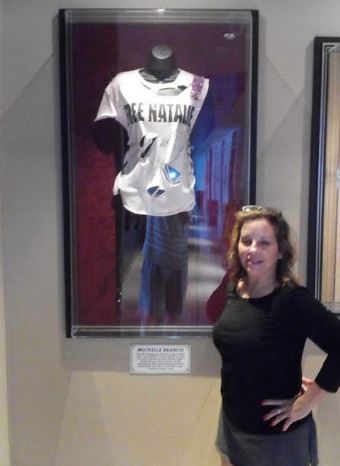
Two years ago, Kristina and I spent time together at the Hard Rock Cafe in Panama City, Panama. On the eve of Natalie's death anniversary, we wandered around the hotel in search of any AC/DC memorabilia. As our search was coming to an end, I noticed a T-Shirt in a glass cage. The shirt once belonged to Dixie Chicks singer/songwriter, Natalie Maines.
Today marks the 12 year anniversary of this blog and with over 2 million views since its conception I find myself posting a recent radio show asking "What can we do?" Over the years I've covered many advocates and their efforts to increase awareness so others might avoid dangerous ineffective drugs. I've covered wrongful death court trials, organizations dedicated to exposing psychiatry and pharma's deceit, tragic losses of life too numerous to count.
Today, I'd like to pose a question to my readers: What can we do? We all have diverse talents, compassion, wisdom that often comes from ADR experiences, and a commitment to positive change. Perhaps there are some great ideas for collaboration out there?
The following interview with Kristina Gehrki went out live on KCAA Radio on Wednesday evening. In it, she explains how she tragically lost her daughter, Natalie (19) to prescription drugs, namely Prozac and Zoloft.
By Bob Fiddaman & Kristina Gehrki This week I watched BBC's eagerly anticipated Panorama documentary, "A Prescription For Murder?" I say 'eagerly anticipated' because on the day it was scheduled to air, organizations that routinely run from public dialogue were tweeting away in the wee morning hours. This includes the Royal College of Psychiatrists (RCP) and the Medicines Healthcare Products Regulatory Agency (MHRA). They took to Twitter long before viewers had an opportunity to view and judge Panorama's programme on its own merits.
MHRA, RCP and other so-called "mental health" organizations, claim the show stigmatized those who use antidepressants. RCP tweets included:
#BBCPanorama claims irresponsible and unfounded. Scaremongering title alone shows real stigma people taking #antidepressants face.
More #antidepressant prescriptions=more people getting help. Not more potential murderers. Don't stigmatize people needing help #BBCPanorama
Professor Louis Appleby later chirped:
A media throwback: sensationalist, exploitative, not even new, with stigma & risk to patients collateral damage.http://www.bbc.co.uk/programmes/b08zjyp1 …
The MHRA's limp-wristed, London-based suits tweeted:
SSRIs have been used to effectively treat millions of people worldwide & like all medicines, the safety is continually monitored. (Notice that MHRA did not state "SSRI drugs do not cause an increase in suicide or homicide.")
I immediately tweeted back:
You forgot to add that your CEO is the former World Safety Officer for @GSK
Many other mental health charities and patients tweeted their disapproval. A majority of complainers seemed annoyed by the documentary's title. I pointed out the title had a question mark after it, ergo it was posing a question, not making a statement. But this obvious fact seemed to be lost on those who bombarded Panorama's Twitter page.
Out With the Old, In With the New
For decades, Big Pharma has made wildly inaccurate claims about everything from the chemical imbalance theory to the legitimacy of their own "science." Today the old chemical imbalance campaign seems to be replaced by the new stigma campaign. It is an emotional appeal to try and convince the public that people who speak on behalf of drug safety are shaming those who consume prescription drugs. The reality is that drug safety advocates only want consumers to know the real risks so they can make an informed personal choice.
Drug companies, regulators and "mental health" organizations aggressively brand drug safety advocates as "stigmatizers." They want the word "stigma" to carry similar emotionally-charged perceptions as the word "racism." This diversion is sickly twisted, but a clever communications tactic nonetheless.
The problem is stigma isn't relevant to drug safety discussions. As Thomas Insel, former director of the National Institutes of Mental Health (NIMH), discusses in the documentary "Letters from GenerationRX," stigma isn't even much of an issue in seeking mental health "treatment." Insel states "The fact is that actually more people are getting more treatment than ever before" and yet the suicide rate "has not come down." The reason, surmises Insel, is "We (the mental health profession) don't know enough."
To see Insel's interview and the tragic SSRI experiences of many families, "Letters from GenerationRX" is available here.
The stigma campaign is designed to create a false public rift to hinder open dialogue about medical freedom of choice and drug safety. Drug companies don't want people to recognize it is a fundamental human right to know the real risks vs. benefits of their product before consumption. Few consumers would consciously choose to forego this right and Pharma, the MHRA, and RCP know it.
Their propaganda is a recipe for disaster. To ignore serious side effects causes thousands of deaths. These organizations create an imaginary enemy and imaginary "war" of sorts. Pit two sides against each other and stir the pot. They then sit back, enjoy the heated conflict, and stealthily pad their pockets.
Brief Summary of "A Prescription For Murder?"
Panorama's hour-long documentary mainly focused on mass murderer James Holmes. It posed the question of whether the SSRI Holmes was prescribed before the Colorado shootings played a role in his actions. The drug Holmes was prescribed in increasing doses is called sertraline, better known by its brand names of Lustral and Zoloft. It is made and marketed by Pfizer Pharmaceuticals. As Pfizer's own scientist, Dr. Roger Lane, has confirmed, Zoloft and other SSRIs can cause akathisia. Lane describes akathisia as "subjective distress" and "unbearable discomfort." He states akathisia sufferers "can feel death is a welcome result" to end their symptoms. (Source) - The source is hosted on Woody Matters, a website created by the wife of Woody Witczak, Kim. Woody died a violent death after taking sertraline for a total of 5 weeks with the dosage being doubled shortly before his death.
Panorama's investigative reporter, Shelley Jofre, interviewed many sources to include Holmes' parents, the prosecuting attorney, and several healthcare professionals. The show also briefly featured two other tragedies, that of Shane Clancy, who experienced adverse drug reactions (ADRs) from citalopram (1) The programme's aim, as I see it, was to explore whether the connection between SSRIs and violence is legitimate.
The documentary, which hasn't yet aired outside the UK, was a year in the making and appeared well-researched. I won't give away too much program info because many people outside the UK haven't yet seen it. Suffice it to say; it was riveting.
(Note: In 2002 Jofre aired "The Secrets of Seroxat." It focused mainly on SSRI withdrawal problems but also shared the tragedy of 60-year-old Don Schell. After taking just two Seroxat tablets he killed his wife, daughter, and infant granddaughter before killing himself. ) Jurors ruled in favor of the man’s relatives and also ruled that taking Seroxat was the proximate cause of all these deaths.
Real Data Linking SSRIs to Violence
The MHRA is, according to the programme, aware of at least 28 homicides associated with SSRIs. Further, 32 additional reports have been sent to them showing an association between homicidal thinking and the use of SSRIs (Fig 1).
Fig 1
Predictably, the MHRA has never followed up these reports as it is not in their financial interests to do so. Therefore, they can then continue to claim that, "although these drugs have been associated with homicide and homicidal acts, it doesn't mean that the drugs caused the acts." It's akin to an airline ignoring reports of loose rivets and refusing to conduct any investigations in response to the reports received. After the plane crashes and innocent people die, the airline officially declares "We can't be certain loose rivets caused the crash."
This week's Panorama documentary further confirmed for me that those who cavalierly promote and push these drugs at alarming rates, while loudly crying "stigma," are actually trying to stigmatize those who have been harmed by the real effects of these drugs. Further, they don't value all human lives equally: those who suffer fatal side effects seem inconsequential.
A publicly-funded PR campaign doesn't exist for those who have suffered and/or died from these drugs. We don't have well-oiled PR machines to spin false data nor journalists ready to write misleading stories in the mainstream press. We don't take drug money in exchange for dishonest research. When we speak truth to medical power, it is we who are negatively labeled by an uncaring profession and corrupt regulators who have personally profited from drug industry ties.
But there is one thing we do have--something priceless that no marketing budget can buy: our honest and real lived experiences. If you're still uncertain about the adverse drug reactions Zoloft and other SSRIs cause, read the diary entries of a barely nineteen-year old girl who unwittingly documented her adverse drug reactions and psychiatric abuse. Natalie Gehrki, barely 5 feet tall and 110 pounds, was prescribed Zoloft in increasing doses. Her final dose was prescribed over the phone without ever being seen by her doctor. The doctor did not inform Natalie's mom that an increase had been directed and since Natalie already had the Zoloft prescription in hand, she simply took the maximum dose as her trusted doctor instructed.
Like Holmes' doctor, Natalie's doctor failed to recognize signs of SSRI-induced akathisia, and she increased the offending drug (Zoloft). Holmes was prescribed 150 milligrams of Zoloft at the time of his psychotic murders spree; Natalie was prescribed 200 milligrams and violence ensued a few days after consumption. Blood tests later showed Natalie was not an efficient metabolizer of SSRI drugs. Oh, well; perhaps the FDA might look into metabolization issues one day so other children might live?
"Netherworld," Natalie's story produced by Miller, is available for free here.
Further SSRI/Homicide related cases
Investigative reporter, Andrew Thibault, has uncovered much more through a series of Freedom of Information requests from the Food and Drug Administration (FDA). Many of the documents were heavily redacted, but all have one thing in common: All patients carried out an act of homicide whilst under the influence of a SSRI. The documents have been made public, and I wrote a series of blog posts about this back in 2016.
Last year I wrote about Andrew Thibault who, just like me, has been at loggerheads with the those who oversee the safety and efficacy of drugs on the market. Thibault has successfully obtained many documents off the FDA, which he has made public at murdermeds.com.
Earlier today a series of tweets peaked my interest. Pharmabuse is a Twitter account that has the tagline, 'Parents Against Pharmaceutical Abuse (PAPA)', and their website, pharmabuse.com is a minefield of information.
Rather brilliantly, Thibault has filed a lawsuit against the FDA because, well, because they don't seem to be playing ball with requests he made to them under the Freedom of Information Act. (Sound familiar?)
Thibault's series of FOIA's involved questions relating to documents that the FDA had in their possession regarding psychiatric medication and homicide, moreover whether or not there was a link to the two.
A 25 page document highlights the FDA's obvious stonewalling of Thibault, a game that drug regulators like to play with anyone who asks for records that may show them in a bad light. The document is a fascinating read and I urge you all to read and share it, if only to see the outcome :-)
So, what has the title of my blog post got to do with the MHRA?
Well, earlier today Thibault made another document publicly available, a document which he obtained under the FOIA from the FDA. It involves two antidepressants, namely setraline (Zoloft) and paroxetine (Paxil/Seroxat). The document is AERS Case Number 6330848 and is just 4 pages in length. It's an adverse event report from an unknown person (it's been redacted) who experienced the following side effects whilst taking both paroxetine and sertraline...
As you will note, there is one adverse event in the list that sticks out like a sore thumb: Homicide.
The causality assessment regarding homicide reads "possible."
When carrying out an assessment of the adverse reaction report the MHRA , according to the tweet I recieved earlier, had this to say about both drugs. Pay particular attention to the last paragraph.
CLICK IMAGE TO ENLARGE
I'm not quite sure what "unlabelled potential side effects" means? According to Pfizer an unlabelled side effect is an unexpected adverse event. Begs the question, how many more have they had?
It's interesting, to me at least, that the MHRA have thrown in the word 'potential' which, in essence, means possible, likely, or probable.
It's quite bizarre that, in its assessment, the MHRA can state quite clearly that agitation
depression, restlessness, suicidal ideation and a suicide attempt were assessed and rated as possibly related to paroxetine use yet, despite this, they claim there is insufficient evidence to assess the causality regarding the homicide, opting instead to label it as an "unlabelled potential side effect." They do pretty much the same in their assessment of sertraline.
When you read this four page adverse event in conjunction with the 25-page court document filed by Thibault all, it seems, becomes crystal clear. In filing his lawsuit Thibault claims that the FDA told him in a telephone conversation the subject matter he had requested "did not make for fun reading", adding that he (Thibault) "should take into account "psychiatric diagnoses of the patients."
It's almost as if they have resigned themselves to the fact that the information is explosive yet, on the same hand, they are guiding Thibault away from the medication causing the adverse events and leading him toward their blame the patient mantra which they have spewed for many years.
Both the FDA and the MHRA maintain that SSRIs do not cause a person to carry out a homicidal act. This despite a large number of high profile cases that implicate many SSRIs. I covered many of Thibault's FOIA documents last year that, to me at least, show a very worrying link. Back stories at the foot of this post.
For years they have covered up the withdrawal problems patients face when taking these drugs, they have covered up the suicide links regarding these drugs. Safe to assume then they are sitting on more information regarding the homicide link with these drugs. But hey ho, I'm just a smeary conspiracy theorist.
Thibault's lawsuit against the FDA can be accessed here.
Well done Mr. Thibault. I salute you, sir.
On Wednesday July 26, 2017 Panorama will air in the UK in an hour long special and will reveal the devastating side effects that can lead to psychosis, violence, possibly even murder.
With exclusive access to psychiatric reports, court footage and drug company data, reporter Shelley Jofre investigates the mass killings at the 2012 midnight premiere of a Batman movie in Aurora, Colorado. 24-year-old PhD student James Holmes, who had no record of violence or gun ownership, murdered 12 and injured 70. Did the SSRI anti-depressant he had been prescribed play a part in the killings?
Panorama has uncovered other cases of murder and extreme violence which could be linked to psychosis developed after the taking of SSRIs- including a father who strangled his 11-year-old son.
Panorama asks if enough is known about this rare side effect, and if doctors are unwittingly prescribing what could be a prescription for murder.
Dan Troy ~ GlaxoSmithKline's Senior Vice President & General Counsel and a member of the Corporate Executive Team
--
The following is a guest post from patient advocate Kim Witczak. I say patient advocate but Kim is much more than that.
Today's guest post is by Kim Witcack. Our paths first crossed back in 2011. Kim was familiar with my advocacy work as I was of hers. Recently we chewed the cud in Chicago at the Dolin Vs GSK Paxil-induced death trial. Though justice doesn't bring back the dead, we are both keen to see justice. We also are intrigued to see how GSK attempts to defend its product and Paxil labeling.
Kim's husband, Woody, died a Zoloft-induced death in 2004. Woody had no history of depression and was prescribed Zoloft, Pfizer's poison pill, for insomnia (rather ironic considering insomnia is one of many listed side effects of Zoloft!). Five weeks later, Woody was hanging from the rafters of their garage. He left no suicide note. Internal Pfizer documents showed its scientists knew akathisia and suicidality was an adverse drug reaction of Zoloft. Apparently, Pfizer forgot to tell Woody and other trusting consumers.
Kim filed a wrongful death suit against Pfizer and has been advocating for drug safety and transparency ever since.
She is a co-organizer at Selling Sickness, an advocacy group dedicated to creating a new partnership model of professionals and advocates to challenge the selling of sickness.
Kim has also been appointed to the voting position of Consumer Representative on FDA Psychopharmacologic Drugs Advisory Committee. The role of the committee is to review and evaluate data concerning the safety and effectiveness of marketed and investigational human drug products for use in the practice of psychiatry and related fields. The committee also makes recommendations to the Commissioner of Food and Drugs.
Kim has been featured in major news media such as Fortune, Readers Digest, Consumer Reports, Wall Street Journal, New York Times as well as the subject of many local and national television news stories and documentaries. She has testified before the US Senate and FDA regarding FDA-related consumer safety issues. Her website, WoodyMatters, shares her families adverse drug reaction tragedy so that others might live.
Kim has a vast knowledge of SSRIs and insipid industry/government ties. Her knowledge about Dan Troy exceeds mine, and I invited her to write a guest post. Troy seems to have mastered the art of collusion and uses the revolving door between government regulators and the pharmaceutical industry to turn a personal profit.
As ever, it's left to those who mourn the death of their loved ones to carry the light that will, eventually, lead people to the truth. I salute you, Kim.
--
Kim Witczak
DEJA VU…The Fox Is Still In The Hen House
Kim Witczak
As I watch the federal trial regarding the Paxil-induced death of Stewart Dolin, I can’t help but ponder the role Dan Troy is playing behind the scenes. Troy, Glaxo’s General Counsel, has long protected the pharmaceutical industry concerning FDA issues and government regulations. Now he's the top dog in GlaxoSmithKline's global legal department. Having personally witnessed Troy's negative impact on consumers' rights and civil lawsuits, I see his fingerprints all over Dolin v GSK.
Long before President Bush appointed Troy as Chief Counsel for the FDA, Troy assisted drug companies and drug-company supported trade groups such as the Washington Legal Foundation. Under his unofficial FDA leadership, he helped modify the generic-drug application process, oversaw reform to the Hatch-Waxman Act, and was chief architect and author of the original preemption argument used against private citizens in litigation. Troy's efforts served to protect pharmaceutical companies and erode consumers' rights and protections.
Preemption and Congressman Hinchey
In the early 2000s, the FDA started filing amicus curiae “friend of the court” briefs intervening on behalf of the pharmaceutical industry. It seemed whenever drug companies faced civil suits regarding their products' harmful side effects--side effects concealed from prescribing physicians and consumers--Troy worked hard to protect drug makers. These FDA briefs argued that because the products were FDA approved, such lawsuits were “preempted” by federal law and should be dismissed. The briefs suggested that, even if drug manufacturer wanted to warn unsuspecting consumers, the FDA wouldn’t let companies update their warning labels if the FDA didn’t agree. Further, these briefs supported the notion that the FDA is the ultimate authority on product safety and effectiveness and related drug labels. Troy's work at the FDA promoted the view that juries and judges should not second-guess decisions made by FDA scientists and experts.
Many civil lawsuits were tossed out by judges across the country who believed the FDA is the final authority on drug labeling. This effort essentially gave drug companies, such as Pfizer, a free pass when their products caused harm and death. In my husband’s case, Witczak v Pfizer, Minnesota Chief Justice James Rosenbaum overturned FDA-supported pre-emption arguments in their entirety stating, “The FDA has no authority to declare, ipse dixit, that a label is false and misleading.” Judge Rosenbaum went on to state, "It is obvious that state failure-to-warn laws do not pressure manufacturers to include false or invalid warnings. Instead, they give drug manufacturers every incentive to warn of real, known risks as soon as they are discovered -- even before any FDA action."
During a December 15, 2003, presentation titled, “The Case for Preemption,” at the annual Drug and Medical Device Litigation conference for in-house counsel and trial attorneys, Troy asked the audience to contact him if they had a case in which the FDA could help. Clearly Troy's "help" was not meant to assist consumers. Fortunately, my talented attorney clandestinely attended Troy's lunchtime presentation long enough to hear Troy declare, “we have to pick our shots so make it sound like a Hollywood pitch."
Of course, considering the FDA is supposed to serve and protect the public, not drug companies, we took Troy's "Hollywood pitch" speech to New York Congressman Maurice Hinchey. Congressman Hinchey then conducted an investigation of Dan Troy. “For the first time in history,” Hinchey said, “FDA’s Chief Counsel is actively soliciting private industrial company lawyers to bring him cases in which FDA can intervene in support of drug and medical device manufacturers.” Hinchey learned that Pfizer was one of Dan Troy’s previous clients at Wiley, Rein, & Fielding and that in the three years before Troy's appointment as FDA Chief Counsel, Pfizer paid the law firm more than $350K for services provided directly by Troy.
Lo and behold, a few years later Malcolm Wheeler, an attorney for Pfizer, called Troy and requested that the FDA get involved in a Zoloft-induced suicide lawsuit filed against them by a private citizen in California. The FDA, through the Department of Justice which represents the FDA in court, filed a brief in support of Pfizer. Together, they stated the plaintiff’s claims were preempted by federal law. This case was then dismissed on preemption. Case in point: money buys influence and power, which is then used against those who have neither.
By 2004 with much damage done, Troy resigned from the FDA and headed straight to the Sidley Austin law firm where he continued working on lucrative pharmaceutical company litigation. Recognizing Troy's long history as a drug company protector, GlaxoSmithKline hired Troy as its top legal General Counsel in 2008. Andrew Witty, GSK’s then chief executive officer, said of hiring Troy, “Dan’s wealth of experience in the regulatory legislative area will be of enormous benefit to us, and ultimately to patients.”
Hmmm...Troy helps patients? Tell that to my friend Wendy Dolin and thousands of other families whose loved ones have suffered or died from Paxil and other SSRIs. Who needs Hollywood movie pitches when the revolving door between pharmaceutical companies and government regulators provides such real-life drama?
With Troy at the helm, it will be interesting to see what arguments GSK has ready to pull out of its back pocket when appealing a verdict for Dolin. Time will tell. But today one thing is certain: The fox continues to guard the hen house.
Back in April this year my blog reached a milestone. It was the ten year anniversary of when I first launched this blog and as part of its 10 year birthday I decided to run a series of Q&A's with fellow advocates and people who have been part of my 10 year journey. Previous Q&A's can be seen at the foot of Kristina's (Pictured above) Q&A session.
I first became aware of Kristina after I had read the history surrounding her daughter, Natalie, whom at the age of 19 took her life, shortly after her dosage of Zoloft was increased over the telephone by her prescribing physician. Kristina has wrote a two part series for David Healy's blog, RxISK. Kristina's two accounts of her daughter were beautifully written, so much so that it prompted me to leave a message in the comment section of RxISK commending her on her excellent writing skills. (Natalie's Story can be read here & here.)
Some months later I opened my email and saw a message in my inbox from Kristina. I knew straight away who she was as her two accounts about Natalie's prescribed death had penciled her name into my subconscious. I am a fan of writers, those who have the ability to paint pictures with words. Kristina has this ability. This prompted me to ask Kristina to write a guest post for my blog, a post which has attracted over 3,000 views to date and one which has been 'liked' and shared on Facebook hundreds of times. See - Guest Post: Let's Bring Akathisia Out of the Darkness.
Today sees the birthday of her daughter, Natalie, she would have been 23. I feel it's fitting to publish Kristina's Q&A today, much of which will astound you if you are unfamiliar with the background of Natalie's treatment by apparent health care 'professionals'.
Pay particular attention to Kristina's explanation of the state of Virginia's negligence laws - I must admit, these laws are absurd given the number of deaths by prescription drugs throughout America these days.
Also, you HAVE to see Kristina's outstanding delivery to members of an FDA Advisory Panel, a delivery that left FDA employees stunned into complete and utter silence - link to the footage is within Kristina's answers below.
We shall be meeting in person soon and both heading off to Chicago for a showdown with a major pharmaceutical company. We're also going to be sharing stories over a pint or two in her hometown of Virginia, hopefully not in a jazz bar though. More on that in a future post.
Anyway, here's Kristina's Q&A. Bob Fiddaman.
--
Full Name: Kristina Kaiser Gehrki Age: 51 Location: Fairfax, Virginia
Natalie
Q: Kristina, Natalie would have been 23 today (Dec 8, 2016), this may be a difficult question, so forgive me if it's painful for you. What is your fondest memory of Natalie?
A: There are so many fond memories it is difficult to choose just one. Natalie was a petite girl with a super-sized laugh and witty sense of humor. Overall, my fondest memory is simply hearing the beautiful sound of my daughter's laughter. It is something I dearly miss.
Natalie often used humor to spotlight the cruel ironies of the world. My fondest specific memory is a letter to the editor she wrote our local paper, the Washington Post. Natalie was sixteen at that time, and the U.S. planned to execute a man whose IQ was so low he was legally “mentally retarded.” Natalie shared her death penalty views and pointed out the absurdity of killing a person who was “mentally retarded.” She said the execution clearly reflected the lowest IQ’s— that of the politicians who made this decision.
I still have her letter and reading it encourages me as I advocate for fully Informed Consent. Informed Consent is a fundamental human right. Consumers have a right to know what they are consuming, whether it’s a genetically-modified tomato or a Black Box drug that can cause violent death. Fully Informed Consent should be provided by prescribing doctors and by pharmacies. It is critical and something we, unfortunately, never received.
Q: What do you say to people who believe that antidepressants are safe and effective?
A: I have several family members who work in the health care field. I am not anti-drug, I am simply pro-information. The fact is “antidepressant” drugs are neither safe nor effective for children. This has, belatedly, been reported in scholarly journals and by some of the few remaining independent journalists. My daughter was prescribed SSRI drugs (Prozac and Zoloft) not for depression but for what the doctor labeled “OCD-like symptoms.” Natalie didn’t receive a specific diagnosis; she was assigned a rather ambiguous billable code that enables doctors to collect insurance money. We asked for a specific diagnosis many times and our questions were often met with excuses. The intense anxiety (Akathisia), confusion, memory loss, change of gait, nausea, etc., Natalie experienced after consuming the products were not presenting symptoms: They were adverse drug reactions.
I’ve learned a lot about unethical pharmaceutical marketing tactics and FDA failures since my daughter’s death. Unfortunately, like many parents who unwittingly gave their children dangerous, ineffective drugs, I learned too many facts far too late, despite that I asked all the right questions I knew to ask. Ironically, my academic and professional background is in communication and marketing. Before Natalie’s death, I presented conference workshops regarding how to communicate crisis and risk. I share this information only to stress that if this tragedy can happen to us, it can happen to anyone. And when I say “tragedy” I am not speaking only of Natalie’s akathisia-induced death. Rather, Natalie was poisoned for many years. Even when she stopped taking the drugs, many of the adverse drug side effects were still present. We simply didn’t recognize then what was happening nor why.
It is difficult if not impossible to recognize signs of adverse drug reactions when consumers are intentionally left in the dark. Several internal memos from Eli Lily (Prozac), Pfizer (Zoloft) and GlaxoSmithKline (Paxil) show these companies knew their respective products were dangerous and no more effective than a sugar pill. The FDA also appears to have known about these risks long before my daughter was ever conceived and before the Black Box warning. Natalie was first prescribed Prozac prior to the Black Box warning. The FDA warning came out while she was taking the drug, but the doctor never informed us. Years later when she was prescribed Zoloft, the doctor assured us "Zoloft is a different drug than Prozac.” This doctor communicated nothing at all about the existence of a Black Box warning. The pharmacy never communicated it. While I believe Black Box warnings have saved lives, I also have spoken to many parents who stated their doctors actively discounted the Black Box warning, claiming the warning is overblown and unnecessary. One doctor dismissed it by telling the parent, whose son later died an SSRI-induced death, “Don’t worry. The FDA puts that label on everything.”
Q: What advice would you give to Coroners faced with suspected suicides of teenagers?
A: It seems many coroners don’t speak for the dead. Too often they seem to protect fellow doctors and the pharmaceutical companies by failing to recognize and/or report adverse drug reactions associated with polypharmacy and metabolism. My daughter died a horrifically violent death one day after first taking 200 mg. of Zoloft, a dose prescribed over the phone, by a doctor who never physically saw Natalie. The doctor never informed me that she had directed such an increase.
After Natalie died, I asked the coroner for blood samples because I wanted my daughter's blood tested for metabolism. The coroner rather casually declared she might not have enough of my child’s blood left after she was done conducting the state’s tests. The state of Virginia would not test for metabolism when I requested it. I was able to obtain a small sample of Natalie's blood which was sent to an independent lab. The results showed Natalie was not a very effective metabolizer of SSRI drugs.
Q: What advice would you give to parents whose children/teenagers are on antidepressant medication?
A: I’ve previously stated it seems our society has gone from one in which “Mother knows best” to “Mother knows nothing.” I believe “modern medicine,” the pharmaceutical and psychiatric industries and government regulators have helped create this paradigm shift. My first advice to mothers is, "Don't be intimidated and coerced. Take back your motherly instinct and parental power. Recognize that it is you who knows your child best. Follow your gut instinct."
My second piece of advice is do not believe the “chemical imbalance” theory, and that so-called “antidepressant” drugs are a safe and effective treatment for children. I now have to live the rest of my days missing my child and feeling profound guilt for having believed such fallacies.
My third piece of advice to parents is to reflect on your child’s presenting symptoms vs. your child’s current symptoms. It is sometimes easy to forget what your child was like before the drugging began, particularly when these adverse drug reactions create more desperation to help your child. Doctors, many of whom are also duped, may convince parents that they are doing a great job parenting because they are actively “treating” their child. My daughter’s personality changed dramatically after consuming these drugs. They robbed Natalie of her soul, her spirit and, in the end, took her very life. It was a slow, painful death.
Lastly, I'd like to encourage parents not to buy into the medicalization of anxiety, sadness and worries. Try safer, more effective ways to reduce such feeling such as exercise, diet, art therapy, etc.
Q: You are in the process of writing a book, can you, without giving too much away, tell me a little bit about the whole process of book writing, and in particular, the difficulties you face as a parent who has lost a child.
A: The book has some similarities to the Diary of Anne Frank, considering it is Natalie, herself, speaking from the dead. She was an intelligent, prolific writer who kept a diary of sorts. You can see some of Natalie's writing in the documentary “Letters From GenerationRx.” She documented many adverse drug reactions without ever knowing she was experiencing and documenting them. She believed what the doctors repeatedly declared: that her physical and mental suffering was a sign of a disease and not signs of drug toxicity. Drug-induced psychosis and akathisia causes extreme anxiety and fear. I’m amazed Natalie did as well as she did for as long as she did considering that, as her side effects worsened, doctors routinely increased the offending drug.
The book is quite difficult for me to write and compile because it requires a careful review of Natalie’s medical records and diaries. These records clearly highlight signs of drug toxicity, yet the doctors repeatedly failed to recognize this reality. I should also add that the psychiatrist responsible for the ultimately fatal 200 mg of Zoloft did not provide us with Natalie’s complete medical records. This psychiatrist stalled, giving us only a few records at a time. Finally, the doctor called and left a voice mail message—a message I still have. She claims an “office flood” destroyed Natalie’s remaining medical records.
Q: You and I have briefly discussed the state of Virginia negligence laws. For the benefit of the readers, can you explain in laypersons terms how difficult it is for residents of Virginia to file suit for negligence?
A: This is an unbelievable injustice and one I learned about only after Natalie's death. Virginia is one of only three states in the U.S. that has an archaic law called contributory negligence. It requires a jury to find the defendant 100% responsible for the outcome or the victim gets nothing. In cases such as Natalie’s it means we must prove her death was 100% the result of the doctor’s negligence and/or the product manufacturer. Given that the general public does not want to believe the truth surrounding SSRI-induced “suicide,” it is extremely difficult to meet the Virginia requirements and also challenging to find attorneys who will take these cases. If I were a doctor, I’d choose to practice medicine in Virginia. And I do mean “practice” in the true sense of the word…
For more information about the contributory negligence law, see: Link.
Q: Would you recommend blogging to parents, or anyone for that matter, who had lost someone dear to them through antidepressant-induced suicide?
A: Bob, I don’t know enough about this to answer here.
Q: Back in September you kindly wrote a guest post for my blog, entitled, 'Let's Bring Akathisia Out of the Darkness.' The post featured a letter you wrote to Christine Moutier, Chief Medical Officer of the American Foundation for Suicide Prevention (AFSP) - Can you tell me what feedback, if any, you have had from the letter you sent them?
A: The American Foundation for Suicide Prevention (AFSP) takes a lot of money from the pharmaceutical companies, and their board of directors contains several people with direct ties to the pharmaceutical industry. These incestuous relationships remind me of the FDA’s revolving-door employment agency. AFSP has never responded to my letter in which I requested they help increase akathisia awareness and reduce drug-induced “suicides.” I put the word “suicide” in quotes because I don’t believe people who die from prescription-drug induced self-harm while suffering from SSRI-induced akathisia have died by their own hand, so to speak. These deaths are sometimes labeled ego-dystonic suicides or suicide beyond one’s will. I simply call it prescripticide.
Q: Have you ever had any correspondence with either Eli Lilly (Prozac) or Pfizer (Zoloft)?
A: No. I learned that Eli Lilly was largely responsible for starting the whole “antidepressant” industry scam by intentionally skewing the real data in their Prozac clinical trials. I consider Eli Lilly my daughter’s first killer. Pfizer comes in next as killer number two as their internal documents show Pfizer knew their product, Zoloft, caused akathisia and suicidality among healthy volunteers in their clinical trials. Glaxo Smith Klein was so impressed by the “Lilly Protocol” deceit that helped gain Prozac FDA approval they then recruited the same employee to conduct similar trials for Paxil. Natalie never was prescribed Paxil, but it is interesting to note how the pharmaceutical industry shares their top talent.
Drug company fraud and corruption—all designed to put profits before people—ought to be made into a Hollywood movie. People might not believe such evil is real. But my daughter went off in a coffin instead of off to college. Her violent death is our reality forever more.
Q: You have met many fellow advocates on your journey, many of whom who have suffered personal tragedies with regard to antidepressant induced death. How has this helped you and do you still keep in contact with this network of fellow advocates?
A: Shortly after Natalie died, I started googling “Zoloft causes suicide” and similar searches. I quickly found stories of many families, such as Woody Witzack, Stewart Dolin and Candace Downing, families whose loved ones also died SSRI-induced deaths. Mathy Downing, who lost her twelve-year-old daughter after Zoloft, told me “Ours is a sad club to belong to, but you will meet a lot of wonderful, caring people.” She was right. I’ve met many wonderful people similarly dedicated to helping others avoid our tragedies. I very much appreciate these fellow advocates and friends.
Q: I was recently privy to witness a speech/statement to you gave to members of an FDA Panel. Can you tell me what that was about and, for the benefit of the readers who never saw this, could you tell me what you said to those panel members? (Footage of Kristina's delivery to the FDA after her answer)
A: I attended the FDA’s recent hearing on “Manufacturer Communications Regarding Unapproved Uses of Approved or Cleared Medical Products.” I had no plans to speak and wasn’t on the speakers’ list. However, after listening to hours of pharmaceutical industry propaganda and industry-funded shills, to include the National Alliance for the Mentally Ill, I felt upset and nauseous. Many of the so-called “patient advocates” were sent to the hearing by the pharmaceutical companies and their funded organizations. Few people can afford to travel to the Washington Metro area and speak up for their loved ones who were harmed or killed. I was glad I did.
I arrived with no prepared speech and simply spoke from my heart. Perhaps I could have been a bit more cordial and succinct, but, really, who can expect parents to be pleasantly deferential when speaking to the government body whose actions and inactions caused the torture and death of their child?
Q: Where do you see yourself in 10 years’ time?
A: Like other people whose loved ones have been harmed and/or killed, I will continue advocating to help prevent this from happening to other families. Losing a child, or any family member, to avoidable death, is terribly painful. However, the best thing we can do to honor our loved ones is to cherish their memory, create happy moments and live our lives with meaningful purpose. Ten years down the road, I will still be advocating, but, hopefully living in a sunny place surrounded by lush greenery and a little garden.
Q: Finally Kristina, some personal questions... 1. What book are you currently reading?
A: Ah, this is a difficult question. I have a large stack of books I want to read, some for pleasure and others for research related to my own book. None of the research related books are happy reads, but the authors--Robert Whitaker, David Healy, and Peter Breggin--are all excellent writers.
2. What was the last CD you listened to (in full)?
A: Vienna Teng’s Waking Hour. She is a talented musician with a beautiful voice. Natalie loved Vienna Teng. Shortly before she died, she downloaded the song “Lullaby for a Stormy Night.” Natalie was suffering from Zoloft-induced psychosis, complained of violent nightmares and insomnia. I doubt she was able to truly understand she was going to die. Akathisia is so overwhelming; perhaps Natalie just wanted to go to sleep. Hence, the lullaby.
3. What is the best movie you have seen this year?
A: The Edge of Seventeen with Woody Harrelson. It’s an entertaining comedy about the awkward challenges of the teenage years. Given that I taught high school marketing for many years, the movie resonated with me. It was realistic and made me laugh. Laughter is a very important part of my life.
4. What country would you most like to visit?
A: While I’ve traveled a lot, I would like to see Ukraine. Given that my grandparents were Ukrainian, I grew up eating Ukrainian food and have fond memories of my grandfather playing the accordion and dancing the polka.
5. If you had the choice of being either a defense or prosecution lawyer, which would you choose and why?
A: I would aim to be proficient at both, but would prefer defense. It seems the U.S. system is increasingly stacking the deck against the “common person” and not just regarding pharmaceutical fraud. Unfortunately, the U.S. imprisons more people at a higher rate than any country. Every person should have the right to adequate legal representation. The notion of the right to a fair trial, along with “anyone can grow up to be president,” are two quaint, Disney-like notions that are U.S. fallacies.
The is the sixth in the Homicide Files series (previous 5 are at the foot of this post)
Today I focus on Zoloft (sertraline), an antidepressant of the selective serotonin reuptake inhibitor family.
Zoloft is manufactured and marketed by Pfizer and is the subject of many lawsuits in the United States, alleging, amongst other things, that Zoloft is ineffective (doesn't work), that it causes birth defects and that it causes violence and suicide. It is known as Lustral in the UK.
The first file today is 99 pages in length and concerns a 27 year-old male. I'm not going to publish all the 99 pages, if you want to view the whole document then you can do so here.
AERS Case Number 4073159 27 year-old male, prescribed 100mg Zoloft per day between 1996-1998. Patient, according to the first page of the document, murdered an acquaintance of his. Moreover, the report says, "Either chronic use or sudden involuntary withdrawal caused a major psychotic event where "patient" murdered an acquaintance of his.
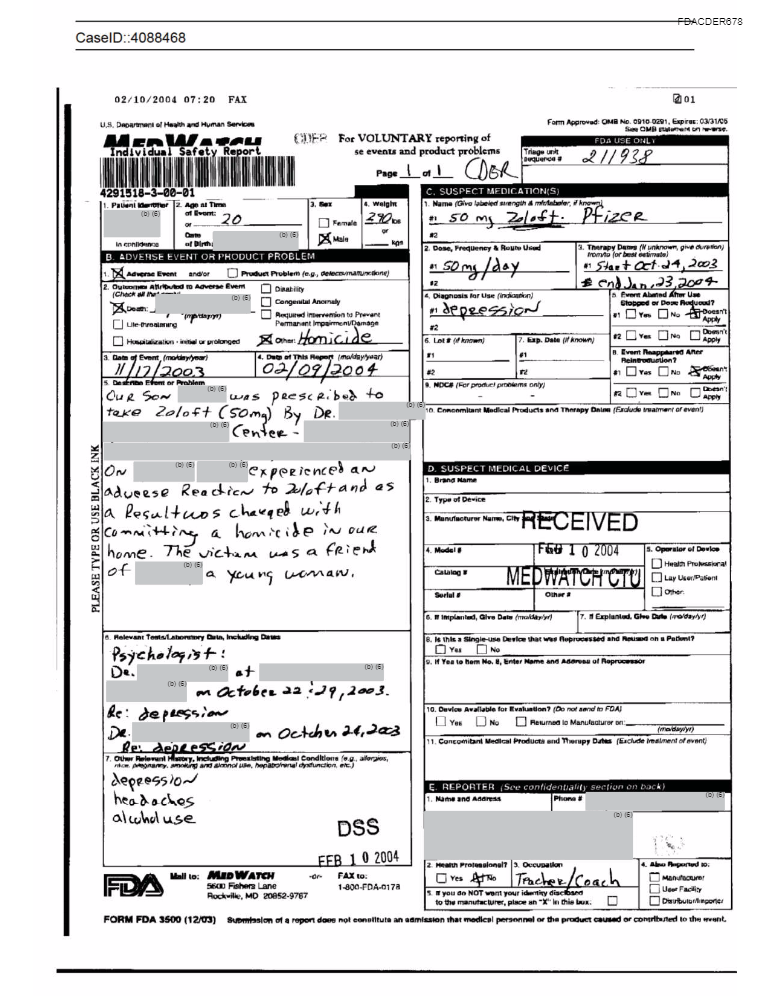
AERS Case Number 4088468 20 year-old male prescribed 50mg of Zoloft per day between Oct 24, 2003 - January 23, 2004. The report was sent to Medwatch by the parents of the 20 year-old who state that their son experienced an adverse reaction to Zoloft and killed a "friend of a young woman" in their home.
AERS Case Number 5838493 19 year-old male. Prescribed Zoloft between 2003-2004. The report was sent in by a psychologist who said, "The patient started taking Zoloft (50mg) for one week then 25mg daily for two weeks." The psychologist also states, "On day 13 of his Zoloft therapy he decided it was not working and stopped taking in for 3 days, then he restarted Zoloft at 25mg daily." Days later he killed someone. His parents said, he committed the murder because of persistent severe agitation and aggression from Zoloft.
AERS Case Number 6100809 Homicide by a 32 year-old female who was taking Zoloft (dosage unknown) because she was having 'mental problems' for 3 to 4 months.
37 year-old female. Prescribed 200mg of Zoloft per day. She killed her son then attempted to kill her daughter. You'll note in this document how the reporter makes claims that the female patient may have been taking another prescription drug at the time of the murder. This, according to the document, was never proven.
70 year old male. Was taking Zoloft (date unknown) - He killed his wife and them himself. The report was sent in by one of the children. It states, "He did not have a history of depression... we all knew it was the drug when this happened"