Zantac Lawsuit


Researching drug company and regulatory malfeasance for over 16 years
Humanist, humorist
Showing posts with label Andrew Thibault. Show all posts

Monday, July 17, 2017

Paxil/Zoloft Homicide - "Unlabelled Potential Side Effects"


Last year I wrote about Andrew Thibault who, just like me, has been at loggerheads with the those who oversee the safety and efficacy of drugs on the market. Thibault has successfully obtained many documents off the FDA, which he has made public at murdermeds.com.

Earlier today a series of tweets peaked my interest. Pharmabuse is a Twitter account that has the tagline, 'Parents Against Pharmaceutical Abuse (PAPA)', and their website, pharmabuse.com is a minefield of information.

Rather brilliantly, Thibault has filed a lawsuit against the FDA because, well, because they don't seem to be playing ball with requests he made to them under the Freedom of Information Act. (Sound familiar?)

Thibault's series of FOIA's involved questions relating to documents that the FDA had in their possession regarding psychiatric medication and homicide, moreover whether or not there was a link to the two.

A 25 page document highlights the FDA's obvious stonewalling of Thibault, a game that drug regulators like to play with anyone who asks for records that may show them in a bad light. The document is a fascinating read and I urge you all to read and share it, if only to see the outcome :-)

So, what has the title of my blog post got to do with the MHRA?

Well, earlier today Thibault made another document publicly available, a document which he obtained under the FOIA from the FDA. It involves two antidepressants, namely setraline (Zoloft) and paroxetine (Paxil/Seroxat). The document is AERS Case Number 6330848 and is just 4 pages in length. It's an adverse event report from an unknown person (it's been redacted) who experienced the following side effects whilst taking both paroxetine and sertraline...

Agitation
Depression
Homicide
Restlessness
Suicidal ideation
Suicide attempt
Tension

As you will note, there is one adverse event in the list that sticks out like a sore thumb: Homicide.

The causality assessment regarding homicide reads "possible."

When carrying out an assessment of the adverse reaction report the MHRA , according to the tweet I recieved earlier, had this to say about both drugs. Pay particular attention to the last paragraph.


CLICK IMAGE TO ENLARGE


I'm not quite sure what "unlabelled potential side effects" means? According to Pfizer  an unlabelled side effect is an unexpected adverse event. Begs the question, how many more have they had?

It's interesting, to me at least, that the MHRA have thrown in the word 'potential' which, in essence, means possible, likely, or probable.

It's quite bizarre that, in its assessment, the MHRA can state quite clearly that agitation
depression, restlessness, suicidal ideation and a suicide attempt were assessed and rated as possibly related to paroxetine use yet, despite this, they claim there is insufficient evidence to assess the causality regarding the homicide, opting instead to label it as an "unlabelled potential side effect." They do pretty much the same in their assessment of sertraline.

When you read this four page adverse event in conjunction with the 25-page court document filed by Thibault all, it seems, becomes crystal clear. In filing his lawsuit Thibault claims that the FDA told him in a telephone conversation the subject matter he had requested "did not make for fun reading", adding that he (Thibault) "should take into account "psychiatric diagnoses of the patients."

It's almost as if they have resigned themselves to the fact that the information is explosive yet, on the same hand, they are guiding Thibault away from the medication causing the adverse events and leading him toward their blame the patient mantra which they have spewed for many years.

Both the FDA and the MHRA maintain that SSRIs do not cause a person to carry out a homicidal act. This despite a large number of high profile cases that implicate many SSRIs. I covered many of Thibault's FOIA documents last year that, to me at least, show a very worrying link. Back stories at the foot of this post.

For years they have covered up the withdrawal problems patients face when taking these drugs, they have covered up the suicide links regarding these drugs. Safe to assume then they are sitting on more information regarding the homicide link with these drugs. But hey ho, I'm just a smeary conspiracy theorist.

The full 4-page document is now available here.

Thibault's lawsuit against the FDA can be accessed here.

Well done Mr. Thibault. I salute you, sir.

On Wednesday July 26, 2017 Panorama will air in the UK in an hour long special and will reveal the devastating side effects that can lead to psychosis, violence, possibly even murder.

The BBC website reads...

With exclusive access to psychiatric reports, court footage and drug company data, reporter Shelley Jofre investigates the mass killings at the 2012 midnight premiere of a Batman movie in Aurora, Colorado. 24-year-old PhD student James Holmes, who had no record of violence or gun ownership, murdered 12 and injured 70. Did the SSRI anti-depressant he had been prescribed play a part in the killings?
Panorama has uncovered other cases of murder and extreme violence which could be linked to psychosis developed after the taking of SSRIs- including a father who strangled his 11-year-old son.
Panorama asks if enough is known about this rare side effect, and if doctors are unwittingly prescribing what could be a prescription for murder.

I, for one, will be watching it.

Bob Fiddaman


Previously in the Homicide Files series.


Monday, May 23, 2016

The Homicide Files: "We Want Our Documents Back"


This is the final post in the series of the Homicide Files, and probably the most important - moreover, it's one that I'd like shared far and wide. Facebook, Twitter, and other social media outlets. If you, like me, are a blogger then please share these very important set of documents, even if you blog about cooking, gardening, music, or whatever it is you happen to be passionate about. Even if you don't quite understand what it all means, just blog or share the files or this blog post. The FDA don't want you to ~ that should be as good a reason as any to share, right?

The following documents are, according to the FDA, not supposed to be made public. They cited an apparent privacy exemption under the Freedom of Information Act (FOIA).

One can see, when looking through the documents, exactly why the FDA have thrown their dummy out of the pram with these documents as they reveal information that the public need to know. Let's face it, the FDA are about as transparent as the MHRA, who, in turn, are about as transparent as a polluted river.

I'm going to highlight just one of those documents and then add links to the others. Please, if sharing on Facebook and Twitter, highlight the importance. The public have just as much right to see these documents as the medicine regulators and pharmaceutical companies do.

It's an embarrassment for the FDA ~ they sent the files to investigative reporter, Andrew Thibault, then relaised they had ballsed up on a humungous scale.

As the Russian wrestler once said, Tufty Shitski.

The following document features the tricyclic antidepressant, Nortriptyline hydrochloride. The information contained within this document shows, without doubt, that the drug caused  a 35 year old female Akathisia, Homicide, Suicidal ideation and Delirium.

The reason she was prescribed this powerful antidepressant wasn't because she had a mental disorder or that she was suffering a breakdown of some kind. She was prescribed it because she was distressed due to husband's drinking.

Let's take a closer look. There's a lot of talk about metabolism, much of which will be explained in a future post by a special guest and friend. (CLICK ON IMAGES TO ENLARGE)


This woman, according to the document, pleaded mental illness, yet, all she had before she was prescribed this antidepressant was distress over her husband's drinking. The Medical Reviewer considered the case to be possibly related to the suspect drug.

Not yet curious as to why the FDA want this particular case file returned and not made public?

Here's the other files they want back from Andrew Thibault.


Do what you can folks and SHARE, SHARE SHARE!

Bob Fiddaman.


Previously in the Homicide Files series.


Sunday, May 22, 2016

The Homicide Files: Age 8 - 17


The following information has been taken from the brilliant Murder Meds database. The database contains over 3,000 documents recently attained from the American drug regulator, the FDA. The documents are adverse events, in particular, where homicide has been committed whilst patients have been on (or withdrawn from) one or more psychiatric drug.

Today I'm focusing on those FDA files where children are concerned, namely 8-17 year-olds. Remember, these are adverse events initially reported to the FDA because a doctor, family or member of the public suspected the homicide may have been caused by the drug/s. There could very well be many more of these types of incidents that have never been sent to the FDA ~ If the FDA had gone public with the documents below then I'm almost certain that they would have been inundated with similar adverse events, which would have been really bad for business, right?

This is drug induced homicide. This is prescripticide.


AERS Case Number 5749577

10 year-old boy. PROZAC

Notice how the FDA allow every adverse event to go unredacted, apart from the death. A description of events has also been redacted by the FDA.


--


12 year-old boy. Prescribed sertraline and paroxetine, better known by their brand names ZOLOFT and PAXIL. The adverse events listed include abnormal behaviour, mania, aggression, restlessness, psychotic disorder, hallucinations and homicide. A description of the homicide has been redcated by the FDA.


--


8 year-old girl. Was taking a cocktail of RISPERDAL, ZOLOFT and PAXIL - these were, according to the document, prescribed to her for "anxiety". Listed in the adverse events, amongst other side effects, are anxiety and homicide. So, here we have an 8 year-old little girl, prescribed mind altering drugs for anxiety and the drugs she was prescribed make her anxious. It appears that the 8 year-old child attempted homicide by picking a knife up. The important part of this actual event has been redacted by the FDA.

The 8 year-old was admitted to a psychiatric unit where they weaned her off her final drug, Zoloft. An update shows that the child, as of Feb 2004, was happy at home and school. Miraculously after stopping all medications her anxiety and homicidal thinking stopped.


--


10 year-old girl. Prescribed VYVANSE for ADHD. Vyvanse (Lisdexamfetamine) is a central nervous system (CNS) stimulant. The report regarding the homicide event have been redacted by the FDA.

During an FDA Pediatric Postmarket Adverse Event Review it was found that... “The majority of the psychiatric adverse events (n=27) were homicidal or suicidal ideation, self-injurious behavior or ideation, or suicide attempt." Begs the question why this young girl was ever prescribed Vyvanse.

Today the Vyvanse website claims...

Vyvanse® (lisdexamfetamine dimesylate) is a prescription medicine used for the treatment of Attention-Deficit/Hyperactivity Disorder (ADHD) in patients 6 years and above.

To date there has been no scientific evidence to prove that he condition, ADHD,  is a mental disease of the brain.


--


16 year-old boy. PAXIL and RISPERDAL. The boy carried out a murder. During his trial his mother stated that her son became "more defiant and aggressive after taking Paxil." - Furthermore, his psychiatrist testified that he treated the patient after the murder and had to lower his dosage because it made him "violent and delusional."

Patient was found guilty of murder and sent to prison.


--


15 year-old boy. Prescribed PAXIL.  Weaned of Paxil whilst spending time at a juvenile detention centre for committing an unknown crime. Some time after halting Paxil the 15 year-old boy committed homicide.  He pleaded guilty to murder. At the time, the media reports indicated that the 15 year-old's tendency to commit homicide may have been influenced by a "video game."


--


17 year-old boy. What's remarkable about this adverse event report is the diagnosis of "loneliness" - Loneliness, it seems, is now deemed as a mental disorder. The claim, it appears, was made by Wyeth, the pharmaceutical company that market and manufacture the antidepressant in question.

The 17 year-old boy was prescribed EFFEXOR XR. When on Effexor his depression worsened, he felt everyone hated him, in particular his best friend. His dosage of Effexor was increased from 75mg per day to 300mg per day. On an unspecified date he killed his best friend.


--


16 year-old boy. Prescribed PAXIL. His parents and friends said that he had no history of violence or aggression  He was given a three week supply of Paxil by his family physician. Ten days later he stabbed (REDACTED) to death.


--

There are many more cases in the database. 

If the FDA have been sitting on files like the ones you have seen above then maybe, just maybe, a lot of children would never have had to endure the horrific side effects caused by these drugs. The increase in prescription rates is quite alarming - yet the FDA, armed with this information and many more cases like it, have just sat back and done nothing. It took a Freedom of Information request to get this information out into the public domain. For that we should all applaud Andrew Thibault.


Bob Fiddaman.

Previously in the Homicide Files series.


Saturday, May 21, 2016

The Homicide Files: The Interview


Over the past week I've been showcasing a series of files that were requested under the Freedom of Information Act from the FDA by investigative reporter, Andrew Thibault. Those series of posts can be found at the foot of this post.

The following audio is an interview with Andrew Thibault where he describes, in detail, how the American Medicines Regulator, the FDA, have been witholding important information back from doctors and the public with regard to the role psychiatric medication has played in documented acts of homicide.

It's a fascinating interview and deserves to be spread far and wide.


Bob Fiddaman.


Previously in the Homicide Files series.


Thursday, May 12, 2016

The Murderous Pills and The Keystone Cops (FDA)


A few days ago I read what was probably one of the most concise and factual articles about SSRI and other psychiatric medicine induced homicide.

The article, researched and written by Andrew Thibault, features a series of assessment reports obtained by Thibault from the FDA (The American drug regulator). It took him a while to secure these documents, all of which were requested under the Freedom of Information Act, many of which have large chunks of information missing.

In his article Thibault highlights just a small handful of the cases taken from the FDA Adverse Event Reporting System (FAERS). Thibault writes...

In October 2014, I submitted a Freedom of Information Act (FOIA) request to the FDA to obtain copies of the FAERS homicide reports. After ten months of “Foot Dragging and Alibis,” which is what Rep. Joe Barton (R-TX) once suggested the agency's acronym stood for, the FDA still had not produced a single report. Frustrated with the FDA's stonewalling, I filed a federal lawsuit in August 2015. Within three months of filing the FOIA lawsuit, the FDA coughed up over 3,000 pages of FAERS reports.

What follows are some examples of these reports that leave the reader in no mind that the FDA, along with the pharmaceutical companies are very aware of psychiatric medications being associated with homicidal acts.

It's a must read and kudos should be given to Thibault for his patience during the 10 month period where the FDA were unwilling to release the documents. At the end of his article Thibault tells of the FDA requesting some of the documents back from him. More on that in a future post.

Meantime, here's his work, 'The FDA Is Hiding Reports Linking Psych Drugs to Homicides.'

For now, I'm going to focus on some of those documents that relate to an association with homicide and Paxil (Seroxat) - You'll note that many of the reports sent in are assessed by the pharmaceutical company that manufacture the suspect drug, in this case, GlaxoSmithKline.

The files have been uploaded and a huge database now exists for doctors and patients alike to make up their own minds. I'd include the media but for whatever reason the majority of media outlets tend to shy away from reporting the truth about antidepressants.


AERS Case Number 3951806 (Click on the images to enlarge)


Homicide by a 47 year-old female. The patient was taking Paxil (30mg per day) between August 2001 and May 2002.


--


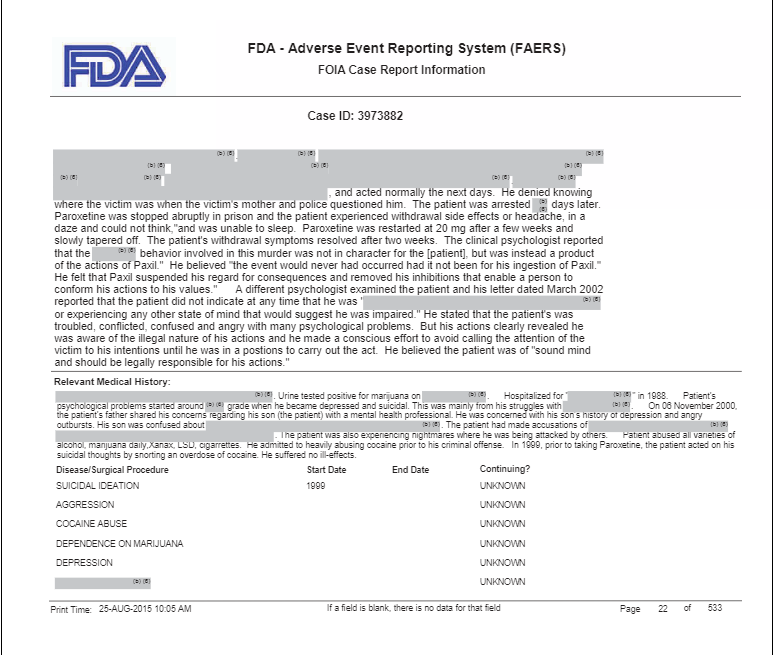
AERS Case Number 3973882

Homicide by a 16 year-old male. The patient was taking Paxil (unknown dosage) between February 2001 and July 2001.

You'll note in this case that the assessment goes to great lengths to suggest that there were other mitigating circumstances.


--

AERS Case Number 4078438

Homicide by a 15 year-old male. The patient was taking Paxil (unknown dosage) between April 2002 and an unspecified date.

What is remarkably interesting about this case is the comment that suggests the 15 year-old male patient may have carried out murder because, and I quote, "The patient's homicidal tendencies may have been influenced by a video game." - It has to be noted that this report, sent to the FDA by GlaxoSmithKline, was quoting a media article. 

One also has to look at the state of mind of this 15 year-old male prior to the homicide. He was sent to a detention centre where his Paxil was discontinued, he then attempted suicide on two separate occasions, he experienced mood swings, violent thoughts, visual and auditory hallucinations and exhibited self-harming behaviour. After stopping Paxil the patient then went on to commit a murder.

But it was probably due to being influenced by a video game, right?


--

AERS Case Number 4100301

Homicide by a 48 year-old female. The patient was taking Paxil (30mg) between April 2002 to 2002.

It appears this report was sent straight to Medwatch via one of the family members.


--


AERS Case Number 4114631

Homicide by a 34 year-old female. The patient was taking Paxil (unknown dose, unspecified dates)

What's striking in this case is that the person who committed murder was a nurse who provided home care. It appears as though she flipped one day and murdered one of her patients.


--

Finally, for now at least as there are literally many more reports (around 3,000 pages), I'll leave you with AERS Case Number 5890599. We know who this case refers to - the report is, as you will see, redacted in places. At the bottom of the report is a link to a heart-wrenching story written by the 'unidentified' person in the report.


AERS Case Number 5890599

Homicide by a 47 year-old male. The patient was taking Paxil (60mg per day)


--

Special thanks to Andrew Thibault for his wonderful research and for the database which is currently available on the Murder Meds website. Hat tip too to Doyle Mills for alerting me to the Murder Meds website.


Over the coming days I'll be posting the documents that the FDA have requested back from Andrew Thibauld - my message here is simple, share them once they are uploaded. Facebook them, Tweet them, let them go far and wide. The FDA want them back, make sure as many people see them before they are sent back.


Bob Fiddaman.


Please contact me if you would like a guest post considered for publication on my blog.