Zantac Lawsuit


Researching drug company and regulatory malfeasance for over 16 years
Humanist, humorist
Showing posts with label Lustral. Show all posts

Friday, July 28, 2017

Panorama: Prescription For Stigma?


By Bob Fiddaman & Kristina Gehrki

This week I watched BBC's eagerly anticipated Panorama documentary, "A Prescription For Murder?" I say 'eagerly anticipated' because on the day it was scheduled to air, organizations that routinely run from public dialogue were tweeting away in the wee morning hours. This includes the Royal College of Psychiatrists (RCP) and the Medicines Healthcare Products Regulatory Agency (MHRA). They took to Twitter long before viewers had an opportunity to view and judge Panorama's programme on its own merits.

MHRA, RCP and other so-called "mental health" organizations, claim the show stigmatized those who use antidepressants. RCP tweets included:
#BBCPanorama claims irresponsible and unfounded. Scaremongering title alone shows real stigma people taking #antidepressants face.
More #antidepressant prescriptions=more people getting help. Not more potential murderers. Don't stigmatize people needing help #BBCPanorama 
Professor Louis Appleby later chirped:
A media throwback: sensationalist, exploitative, not even new, with stigma & risk to patients collateral damage.http://www.bbc.co.uk/programmes/b08zjyp1 …
The MHRA's limp-wristed, London-based suits tweeted:
SSRIs have been used to effectively treat millions of people worldwide & like all medicines, the safety is continually monitored. (Notice that MHRA did not state "SSRI drugs do not cause an increase in suicide or homicide.")
I immediately tweeted back:
You forgot to add that your CEO is the former World Safety Officer for @GSK
Many other mental health charities and patients tweeted their disapproval. A majority of complainers seemed annoyed by the documentary's title. I pointed out the title had a question mark after it, ergo it was posing a question, not making a statement. But this obvious fact seemed to be lost on those who bombarded Panorama's Twitter page.

Out With the Old, In With the New

For decades, Big Pharma has made wildly inaccurate claims about everything from the chemical imbalance theory to the legitimacy of their own "science." Today the old chemical imbalance campaign seems to be replaced by the new stigma campaign. It is an emotional appeal to try and convince the public that people who speak on behalf of drug safety are shaming those who consume prescription drugs. The reality is that drug safety advocates only want consumers to know the real risks so they can make an informed personal choice.

Drug companies, regulators and "mental health" organizations aggressively brand drug safety advocates as "stigmatizers." They want the word "stigma" to carry similar emotionally-charged perceptions as the word "racism." This diversion is sickly twisted, but a clever communications tactic nonetheless.

The problem is stigma isn't relevant to drug safety discussions. As Thomas Insel, former director of the National Institutes of Mental Health (NIMH), discusses in the documentary "Letters from GenerationRX," stigma isn't even much of an issue in seeking mental health "treatment." Insel states "The fact is that actually more people are getting more treatment than ever before" and yet the suicide rate "has not come down." The reason, surmises Insel, is "We (the mental health profession) don't know enough."

To see Insel's interview and the tragic SSRI experiences of many families, "Letters from GenerationRX" is available here.

The stigma campaign is designed to create a false public rift to hinder open dialogue about medical freedom of choice and drug safety. Drug companies don't want people to recognize it is a fundamental human right to know the real risks vs. benefits of their product before consumption. Few consumers would consciously choose to forego this right and Pharma, the MHRA, and RCP know it.

Their propaganda is a recipe for disaster. To ignore serious side effects causes thousands of deaths. These organizations create an imaginary enemy and imaginary "war" of sorts. Pit two sides against each other and stir the pot. They then sit back, enjoy the heated conflict, and stealthily pad their pockets.

Brief Summary of "A Prescription For Murder?"

Panorama's hour-long documentary mainly focused on mass murderer James Holmes. It posed the question of whether the SSRI Holmes was prescribed before the Colorado shootings played a role in his actions. The drug Holmes was prescribed in increasing doses is called sertraline, better known by its brand names of Lustral and Zoloft. It is made and marketed by Pfizer Pharmaceuticals. As Pfizer's own scientist, Dr. Roger Lane, has confirmed, Zoloft and other SSRIs can cause akathisia. Lane describes akathisia as "subjective distress" and "unbearable discomfort." He states akathisia sufferers "can feel death is a welcome result" to end their symptoms. (Source) - The source is hosted on Woody Matters, a website created by the wife of Woody Witczak, Kim. Woody died a violent death after taking sertraline for a total of 5 weeks with the dosage being doubled shortly before his death.

Panorama's investigative reporter, Shelley Jofre, interviewed many sources to include Holmes' parents, the prosecuting attorney, and several healthcare professionals. The show also briefly featured two other tragedies, that of Shane Clancy, who experienced adverse drug reactions (ADRs) from citalopram (1)  The programme's aim, as I see it, was to explore whether the connection between SSRIs and violence is legitimate.

The documentary, which hasn't yet aired outside the UK, was a year in the making and appeared well-researched. I won't give away too much program info because many people outside the UK haven't yet seen it. Suffice it to say; it was riveting.

(Note: In 2002 Jofre aired "The Secrets of Seroxat." It focused mainly on SSRI withdrawal problems but also shared the tragedy of 60-year-old Don Schell. After taking just two Seroxat tablets he killed his wife, daughter, and infant granddaughter before killing himself. ) Jurors ruled in favor of the man’s relatives and also ruled that taking Seroxat was the proximate cause of all these deaths.

Real Data Linking SSRIs to Violence

The MHRA is, according to the programme, aware of at least 28 homicides associated with SSRIs. Further, 32 additional reports have been sent to them showing an association between homicidal thinking and the use of SSRIs (Fig 1).


Fig 1

Predictably, the MHRA has never followed up these reports as it is not in their financial interests to do so. Therefore, they can then continue to claim that, "although these drugs have been associated with homicide and homicidal acts, it doesn't mean that the drugs caused the acts." It's akin to an airline ignoring reports of loose rivets and refusing to conduct any investigations in response to the reports received. After the plane crashes and innocent people die, the airline officially declares "We can't be certain loose rivets caused the crash."

This week's Panorama documentary further confirmed for me that those who cavalierly promote and push these drugs at alarming rates, while loudly crying "stigma," are actually trying to stigmatize those who have been harmed by the real effects of these drugs. Further, they don't value all human lives equally: those who suffer fatal side effects seem inconsequential.

A publicly-funded PR campaign doesn't exist for those who have suffered and/or died from these drugs. We don't have well-oiled PR machines to spin false data nor journalists ready to write misleading stories in the mainstream press. We don't take drug money in exchange for dishonest research. When we speak truth to medical power, it is we who are negatively labeled by an uncaring profession and corrupt regulators who have personally profited from drug industry ties.

But there is one thing we do have--something priceless that no marketing budget can buy: our honest and real lived experiences. If you're still uncertain about the adverse drug reactions Zoloft and other SSRIs cause, read the diary entries of a barely nineteen-year old girl who unwittingly documented her adverse drug reactions and psychiatric abuse. Natalie Gehrki, barely 5 feet tall and 110 pounds, was prescribed Zoloft in increasing doses. Her final dose was prescribed over the phone without ever being seen by her doctor. The doctor did not inform Natalie's mom that an increase had been directed and since Natalie already had the Zoloft prescription in hand, she simply took the maximum dose as her trusted doctor instructed.

Like Holmes' doctor, Natalie's doctor failed to recognize signs of SSRI-induced akathisia, and she increased the offending drug (Zoloft). Holmes was prescribed 150 milligrams of Zoloft at the time of his psychotic murders spree; Natalie was prescribed 200 milligrams and violence ensued a few days after consumption. Blood tests later showed Natalie was not an efficient metabolizer of SSRI drugs. Oh, well; perhaps the FDA might look into metabolization issues one day so other children might live?

"Netherworld," Natalie's story produced by Miller, is available for free here.

Further SSRI/Homicide related cases

Investigative reporter, Andrew Thibault, has uncovered much more through a series of Freedom of Information requests from the Food and Drug Administration (FDA). Many of the documents were heavily redacted, but all have one thing in common: All patients carried out an act of homicide whilst under the influence of a SSRI. The documents have been made public, and I wrote a series of blog posts about this back in 2016.

Seroxat/Paxil (paroxetine) - GlaxoSmithKline
Cipramil/Celexa (citalopram) &  Lexapro/Cipralex (escitalopram) - Lundbeck/Forest
Prozac (fluoxetine) - Lilly
Lustral/Zoloft (sertraline) - Pfizer

To view A Prescription For Murder, go to the BBC IPlayer here. (UK ONLY)

Shout out to Katinka Blackford Newman, author of The Pill That Steals Lives, who was the development researcher for this programme.

Bob Fiddaman & Kristina Gehrki


1. When Leonie and Tony Met Lundbeck (citalopram manufacturers)


Thursday, May 19, 2016

The Homicide Files: Zoloft


The is the sixth in the Homicide Files series (previous 5 are at the foot of this post)

Today I focus on Zoloft (sertraline), an antidepressant of the selective serotonin reuptake inhibitor family.

Zoloft is manufactured and marketed by Pfizer and is the subject of many lawsuits in the United States, alleging, amongst other things, that Zoloft is ineffective (doesn't work), that it causes birth defects and that it causes violence and suicide.  It is known as Lustral in the UK.

The first file today is 99 pages in length and concerns a 27 year-old male. I'm not going to publish all the 99 pages, if you want to view the whole document then you can do so here.


AERS Case Number 4073159

27 year-old male, prescribed 100mg Zoloft per day between 1996-1998. Patient, according to the first page of the document, murdered an acquaintance of his. Moreover, the report says, "Either chronic use or sudden involuntary withdrawal caused a major psychotic event where "patient" murdered an acquaintance of his.


--

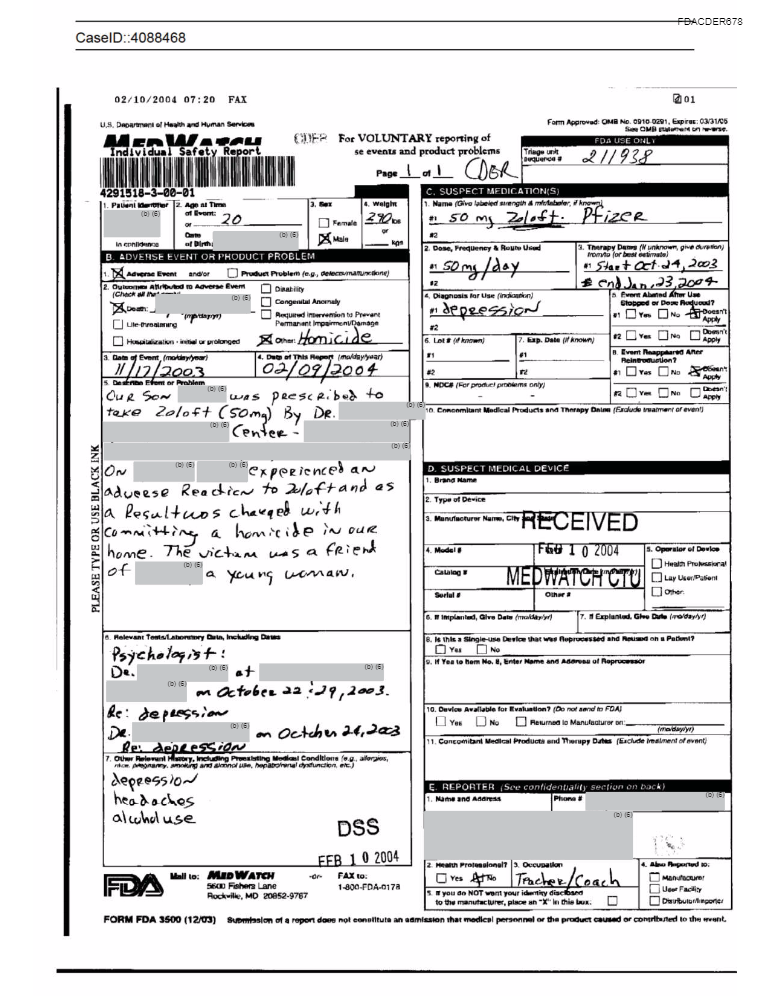
AERS Case Number 4088468

20 year-old male prescribed 50mg of Zoloft per day between Oct 24, 2003 - January 23, 2004.

The report was sent to Medwatch by the parents of the 20 year-old who state that their son experienced an adverse reaction to Zoloft and killed a "friend of a young woman" in their home.


--


AERS Case Number 5838493

19 year-old male. Prescribed Zoloft between 2003-2004. The report was sent in by a psychologist who said, "The patient started taking Zoloft (50mg) for one week then 25mg daily for two weeks." The psychologist also states, "On day 13 of his Zoloft therapy he decided it was not working and stopped taking in for 3 days, then he restarted Zoloft at 25mg daily."

Days later he killed someone.

His parents said, he committed the murder because of persistent severe agitation and aggression from Zoloft.


--

AERS Case Number 6100809

Homicide by a 32 year-old female who was taking Zoloft (dosage unknown) because she was having 'mental problems' for 3 to 4 months.


--

AERS Case Number 5837912

37 year-old female. Prescribed 200mg of Zoloft per day. She killed her son then attempted to kill her daughter. You'll note in this document how the reporter makes claims that the female patient may have been taking another prescription drug at the time of the murder. This, according to the document, was never proven. 


--

AERS Case Number 5668352

70 year old male. Was taking Zoloft (date unknown)  - He killed his wife and them himself. The report was sent in by one of the children. It states, "He did not have a history of depression... we all knew it was the drug when this happened"


--


So, six more cases of prescripticide. Feel free to read the links below to cases of other antidepressant medication.


Bob Fiddaman.


Previously in the Homicide Files series.


**Prescripticide is defined as a death that is caused by an adverse reaction to a prescription drug.


Tuesday, April 17, 2012

SSRI Completed Suicides


There's been much talk lately as to whether or not there is evidence that SSRi's can actually cause a patient to take their own life. For me, at least, the answer to the question is a no-brainer.

RxISK now has a searchable database where one can research just how many suicides are associated with prescription medication. The information was gathered from the FDA.

Citalopram [Cipramil, Celexa]
1,161 completed suicides.
447 suicide attempts
423 suicidal ideation [thoughts about suicide]

Escitalopram [Lexapro, Cipralex]

841 completed suicides.
472 suicide attempts
623 suicidal ideation

Fluoxetine [Prozac]

919 completed suicides.
457 suicide attempts
540 suicidal ideation

Paroxetine [Paxil, Seroxat, Aropax]

2,273 completed suicides.
1,886 suicide attempts
3,643 suicidal ideation

Sertraline [Zoloft, Lustral]

776 completed suicides.
585 suicide attempts
816 suicidal ideation

Venlafaxine [Effexor] *SNRi

1,117 completed suicides.
797 suicide attempts
1,233 suicidal ideation


The field of psychiatry and medicine regulators, including the FDA, will tell you that the benefits of taking SSRi-type medication outweighs the risks, some psychiatrists actually still deny there are suicidal risks associated with antidepressants. The 'risks' aren't just suicide, suicidal thoughts or attempts. There's a whole host of risks...but they all are apparently outweighed by the benefits.

What exactly are the benefits and how can anything that carries a risk of death be deemed 'beneficial'?

The above figures are just those that have been reported, many go unreported because loved ones left behind don't make the connection partly because the key opinion leaders in the field of psychiatry claim there is no link to antidepressant use and suicide.

Key opinion leaders are just that. They lead the field with their opinions and many doctor's look to their published papers as a useful resource tool before prescribing these drugs.

Reading the statistics above one would feel that it's hard evidence and that it should serve as a stark warning to prescribers. One would think...


RxISK can be found HERE


Thursday, October 20, 2011

SSRi Use For PMS - Is It Right?


When faced with a patient who is suffering from Premenstrual syndrome [PMS] what is a doctor supposed to do? Evidence suggests that SSRi use benefits those who suffer with PMS but there are also those who have tried this therapy who have claimed that the medication has actually made them worse.

It's a given that SSRi use can bring on agitation when first starting and stopping abruptly, in some cases it can bring on feelings of suicide and also homicidal thoughts have been reported.

PMS is a subject that I, as a man, should steer clear of. What could I possibly know about PMS and how it should be treated? I pretty much know the time of the month when the need to walk on eggshells is approaching...or at least I did when I was married.

I could write a post making light of PMS, that would be wrong but most that know me personally would know that there was no malice

A week or so ago, a reader of my blog was sitting in the waiting room at her doctor's practice. To pass the time she started flicking through the array of magazines strewn around the waiting room. One such magazine was called "Healthy Magazine". The article that caught her attention was written by a doctor [male] and was about treating Premenstrual syndrome, also known as Premenstrual tension [PMT]. She was actually visiting her doctor because she was struggling to taper off Seroxat, in fact she had been struggling for over two years and was finally down to 1.5mg, a tapering process that had caused her feelings of suicide, anxiety, head zaps, profuse sweating, vivid nightmares, weight gain, plus a whole host of other adverse events.

The article, entitled, "Your PMS Action Plan", offered advice, much of which was about tweaking your lifestyle etc.

In finishing his article, Dr Nick Panay suggested that if the 'tweaking' wasn't helping then talking to your doctor may help. He went on to suggest that your GP may recommend an SSRi if it was the emotional aspects of the PMS that you were struggling with. The article made no mention of the dangers of this group of drugs, no mention of suicidal thoughts, no mention of withdrawal problems and no mention of the teratogenic effects that they cause. This bothered me, so I wrote to the editor of the magazine:

I have been sent a segment of your magazine 'Healthy'' that a reader of my blog, Seroxat Sufferers, sent me.

The article in question, "Your PMS Action Plan", offers advice, it appears, from Mr Nick Panay. [Jpeg attached]

I'd like, if I may, to draw your attention to the heading "When to seek help".

The advice about SSRi's is unbalanced and inaccurate.

Mr Panay claims that SSRi's increase levels of serotonin, suggesting that levels may be too low.

This has never been proven, it is just a theory and one that may be misleading to your readers. I'd be grateful if this section could be edited or an announcement in your next edition of 'Healthy' be made to correct this misleading statement by Mr Panay.

I am intrigued to learn what studies Mr Panay refers to in his column when he writes: "...research has shown that taking them for two weeks at the end of your cycle is as effective as using them continuously - without the risk of becoming hooked."

Two queries about the above statement by Mr Panay:

i; Could Mr Panay provide me with the research he refers to?

and

ii; Does Dr Panay claim that one can become 'hooked' on SSRi medication?

Dr Panay offers no warning about taking SSRi medication during pregnancy, in particular during first trimester where studies have shown that [in the instance of Seroxat] increases the chance of the fetus developing serious heart defects. I refer you to the recent trial of Kilker Vs GlaxoSmithKline, where GlaxoSmithKline's Seroxat was deemed responsible for the causation of Lyam Kilker being born with serious heart defects. GlaxoSmithKline have quietly settled, out of court, a further 800 cases regarding Seroxat's teratogenic properties.

A video deposition of how they [GlaxoSmithKline] knew years ago about this problem, but failed to act, can be seen here - http://fiddaman.blogspot.com/2011/09/exclusive-jane-nieman-video-testimony.html

I'd be grateful if you could pass my concerns on to Mr Panay and ask him to answer me directly as I intend to write an article about his column.

Yours sincerely

Bob Fiddaman.

I was grateful to Dr Panay for answering my query personally, many column writers or TV doctors tend to ignore opposition.

Dr Panay wrote via his editor:


Could you please forward the RCOG evidence based guidelines to the gentleman. These were developed by a group of experts including myself and ratified by the RCOG.

With regards to his numbered queries

1) If he looks at refs 13 and 14 these are two of the studies (there are others) which show that luteal phase treatment with SSRIs is as effective as continuous usage.

2) I would never personally use the term "hooked" - but, it is well recognised some women do experience withdrawal symptoms when discontinuing SSRIs abruptly - the point is that SSRIs should be withdrawn gradually to avoid these side effects.

Other points of accuracy

1) I do not suggest that there is a serotonin deficiency - the hypothesis is that women with severe PMS (possibly genetically predisposed) can respond adversely to the physiological fall in serotonin levels in the days leading up to menstruation (as estrogen levels fall)

2) As far as early pregnancy is concerned, it is a case of weighing up pros and cons, risks v benefits. Specifically, do the benefits of continuing SSRIs into early pregnancy outweigh the risks in that individual. By the way, we do prescribe Seroxat in our PMS patients.

I hope this addresses all his concerns - I am sure that he is aware of how underestimated the problem of PMS/PMDD is and would support an evidence based approach to managing this difficult problem so I thank him for his concern and critique.

The *RCOG evidence that Dr Panay sent me was attached and is available for perusal here.

It is quite clear that the evidence supplied does suggest that SSRi use for PMS is effective, quite whether we should believe this evidence is another matter. We have seen, in the past, how, for instance, GlaxoSmithKline showed how 'safe and effective' Seroxat was in children and adolescents - we now know that the study was not only deeply flawed, it was also ghostwritten. I'm not suggesting for one minute that the RCOG evidence is flawed or indeed ghostwritten but I reserve judgement as I have spoken with many women who have experienced severe withdrawal problems on the medication recommended by Dr Paney. That's me addressing the balance issue, the risk v benefits if you will. One such friend who, upon hearing about Dr Panay's advice, told me, "Talk about throwing gas on a fire!"

I disagree that medication such as Seroxat can be started then abruptly stopped [RCOG evidence - luteal phase treatment with SSRIs is as effective as continuous usage]

I also disagree with Dr Panay and his stance on the usage of the word 'hooked' - if people experience withdrawal symptoms then do we suggest that the drug is not addictive?

The article will be read by many, men, women and possibly teenage girls as they sit and wait for their names to be called out for their appointment with their GP's. My only hope is that they don't take what is written at face value, that they do their research on SSRi type medication and that they are each able to make an informed choice on all the evidence which should include anecdotal evidence of the many women who have experienced the horrific side effects that these drugs cause.

One of they key words in Dr Panay's response to me sticks out like a sore thumb. "Hypothesis"


Be it depression, shyness or indeed PMS  - The treatment of SSRi use and the diagnoses of the illness it is prescribed to treat is based purely on hypothesis. That is the risk when taking these drugs, you are taking something based on guess work and also based on clinical trials from pharmaceutical companies who have been less than forthright with trial results in the past. All I ask for is informed consent, by that I mean list every single side effect these drugs cause and not just the minor ones such as dizziness, sickness and diarrhea. Don't ever feel you may put people off receiving the medication that may or may not help them by hiding the more severe side effects. Patients have a right to know what they are putting into their bodies, be that in the form of a patient information leaflet or a column written by a doctor in a health magazine.

Would I recommend an SSRi for PMS?

No, I wouldn't.

Could I offer an alternative?

No, I couldn't.

Herein lies the problem. A problem that the pharmaceutical industry have the monopoly on.

To be honest I wouldn't give my worst enemy Seroxat, I've experienced the harm it can cause. If it can turn normal healthy people into killers then one can only imagine what it could do to a woman suffering from PMS. If drugs like Prozac and Cipramil can induce suicide and homicidal thoughts then the last thing I would recommend to somebody suffering severe tension would be drugs of this ilk.

I'd like to thank Dr Panay for his response. I don't agree with his stance and I cannot offer an alternative... that doesn't mean that I am wrong now, does it?

If you have been treated with SSRi medication for PMS and you have found the treatment to be efficacious or indeed the opposite, then please feel free to drop me a line with your story.


*Royal College of Obstetricians and Gynaecologists.


Fid

ORDER THE PAPERBACK 'THE EVIDENCE, HOWEVER, IS CLEAR...THE SEROXAT SCANDAL' By Bob Fiddaman US and CANADA HERE
OR UK FROM CHIPMUNKA PUBLISHING

AUSTRALIAN ORDERS HERE


Wednesday, September 07, 2011

Anxiety UK Charity - Astroturfing?

Anxiety UK - Astroturfing?


An astute Seroxat Sufferers regular, Ruth, emailed me earlier with a charity she had stumbled across whilst researching. That charity is Anxiety UK.

Anxiety UK's 'About Us' page proclaims that it is a national registered charity formed 40 years ago by a sufferer of agoraphobia for those affected by anxiety disorders. It continues with:

Today we are still a user-led organisation, run by sufferers and ex-sufferers of anxiety disorders, supported by a high-profile medical advisory panel.
 All fine and dandy then. I have much respect for patient support groups...but a high-profile medical advisory panel?


The panel, which consists of medical advisers and patrons, throws up some names with interesting backgrounds in the field of psychiatry.

Top of the list is Professor David Clark. The Anxiety UK page describes him as thus:

Born in Darlington, England. He studied Experimental Psychology at Oxford University. His clinical training was at the Institute of Psychiatry, Kings College, London in Clinical Psychology. He was a lecturer in Clinical Psychology and Professor in Psychiatry research fellow at Oxford University.

A quick Google search shows that Clark is a firm believer in Cognitive therapy versus the use of medication. His co-authored paper, 'Cognitive Therapy Versus Fluoxetine in Generalized Social Phobia: A Randomized Placebo-Controlled Trial.' [1] found that Cognitive therapy is more effective than fluoxetine in people with generalised social phobia.

A decent approach but it leaves me somewhat baffled why Professor David Clark sits on a panel of a charity that directs readers of its website to Pfizer and Lundbeck?

"Generalised Anxiety Disorder" [GAD], writes Anxiety UK, "can be defined as a disorder in which the sufferer feels in a constant state of high anxiety and is often known as ‘chronic worrying’ or a ‘free floating’ anxiety condition."


Anxiety UK's GAD information page goes one step further, it would appear that they are cutting out the middle man [Doctor] as they offer you a self-assessment on their page.

If you can answer YES to most of the questions it is likely that you are affected by GAD.
During the past 6 months:- 

Do you feel that you have been nervous/on edge most days over the past 6 months?
Did you have problems falling asleep
Did you feel tension in your muscles because of feeling on edge?
Did you frequently feel tense and irritable? 

Anxiety UK strongly advises that people seek further information and guidance from their GP who will be able to make a formal diagnosis.

I cannot imagine for one minute that your average doctor would recommend Cognitive Therapy to any patient who had answered 'Yes' to most of the above questions. A prescription would more than likely be written for a medication that apparently can help with this 'disorder'.

The conveyor belt 


Fear not, even if you, like me, feel that medication can cause more harm than good, Anxiety UK are on hand to offer you more information. They do this by stating:


Want to know more?


The Anxiety UK site has information on a range of resources to provide more detailed information and help.

And that help directs you into the bowels of the pharmaceutical industry, whose main objective is to sell you drugs.

Here's a snapshot of Anxiety UK's GAD page:


Whilst I applaud the efforts of Professor David Clark to show that Cognitive Therapy works better than Prozac, I'm left scratching my head why he would wish to remain on a panel of a charity that directs its members to two pharmaceutical companies who manufacture drugs that, miraculously, can cure the very same symptom [GAD] that you have self-assessed yourself with.


Anxiety UK's medical advisers and patrons include:

Professor Cary Cooper CBE - Who is the author of over 100 books on occupational stress, stress medicine and industrial and organizational psychology.

Professor Robert Edelmann - Whose main research interests relate to chronic blushing.

Dr David Baldwin - Whose research interests include the clinical psychopharmacology of anxiety and depressive disorders and the prevention of suicidal behaviour.

I find myself wondering why Baldwin would be part of such a charity that directs members to Pfizer and Lundbeck, both have drugs known to cause suicide.

Pfizer's Sertraline, whose brand names are Zoloft and Lustral, has been reported to cause severe withdrawal problems, suicide and, some quarters now believe, birth defects.

Lundbeck's citalopram and escitalopram, whose brand names include Cipramil, Celexa, Lexapro and Cipralex, have all been associated with suicide, homicide, withdrawal problems and many believe, birth defects. More on Lunbeck and citalopram HERE.

Do you, like me, find it odd that a charity, with esteemed professionals as its medical advisers, would endorse the above pharmaceutical companies, or at least direct it's members to gain more information from these pharmaceutical companies?

With this in mind I contacted Anxiety UK early this morning with the following:


Dear Anxiety UK,


I am the author of the paperback, The evidence, however, is clear...the Seroxat scandal and also the blog, Seroxat Sufferers Stand Up And Be Counted.


An astute reader of mine recently alerted me to your page where I learned that you are directing readers/members to two pharmaceutical companies, namely Pfizer and Lundbeck, for 'recommended reading'


Question:


Why are you directing readers/members to two pharmaceutical companies whose antidepressant drugs are the subject of withdrawal problems, suicide ideation and birth defects?

By 5pm UK time, Anxiety UK had not responded.


Footnote:

In 2006 Pfizer announced that the European Commission has approved Lyrica [pregabalin] for the treatment of generalized anxiety disorder [GAD] in adults.

In early 2010 Pfizer announced that the Food and Drug Administration [FDA] issued a Complete Response letter regarding the company's New Drug Application [NDA] for Lyrica [pregabalin] capsules CV as a monotherapy treatment for generalized anxiety disorder [GAD]. The FDA determined that the data contained in the NDA were insufficient to support approval.

The registrant of Anxiety UK is listed as The National Phobic Society. Their website, aptly entitled, "No More Panic" also offers help of the medication kind.

So, are Anxiety UK an astroturfing group? If not, why are they directing its readership to two pharmaceutical companies, with a history of manufacturing drugs known to cause suicide?

It's medical advisers may wish to reconsider their position on Anxiety UK's panel, I know I would.


[1] Cognitive therapy is more effective than fluoxetine in people with generalised social phobia


Fid 


ORDER THE PAPERBACK 'THE EVIDENCE, HOWEVER, IS CLEAR...THE SEROXAT SCANDAL' By Bob Fiddaman US and CANADA HERE OR UK FROM CHIPMUNKA PUBLISHING 


AUSTRALIAN ORDERS HERE


Thursday, July 28, 2011

Psychiatric Drugs - Even Psychiatry Isn't Sure.


A recent article on the CNN Health web page asked the question, Is it OK to be on antidepressants for years?

The answer, given by a psychiatrist, should embarrass those that manufacture these drugs, it should embarrass those that regulate these drugs. It should embarrass those that continue to prescribe these drugs.

Dr. Charles Raison, an associate professor of psychiatry and behavioral sciences at Emory University, and an expert in the mind-body connection for health.


Ten years ago my answer to this question would have been, "Certainly not."

A year ago my answer would have been, "Almost certainly not."

Now, unfortunately, the most honest answer I can give you is, "I'm not sure."

Coming from a guy who has treated thousands of people over the years with antidepressants, I have to admit that my uncertainty both shocks and distresses me.

I should probably get over my sense of shock. One of the glories of science is that it keeps moving forward, and as it does so, it usually sweeps old certainties into the dustbin.

Psychiatry's commitment to the unqualified goodness of antidepressants is one of those old certainties. That I'm distressed is understandable.

Dr Raison's full response HERE

If you put all the pieces of the jigsaw together, the picture becomes so much clearer folks.

Now watch the video:


Fid


ORDER THE PAPERBACK
'THE EVIDENCE, HOWEVER, IS CLEAR...THE SEROXAT SCANDAL' By Bob Fiddaman
US & CANADA HERE OR UK FROM CHIPMUNKA PUBLISHING

AUSTRALIAN ORDERS HERE 


Sunday, June 12, 2011

Researchers Seek Prolonged Antidepressant Withdrawal Cases


An Italian researcher is collecting case reports of prolonged antidepressant withdrawal syndrome for important research papers now in progress. Something that should have been done by the pharmaceutical companies and medicine regulators years ago!

Please send your case report immediately -- instructions and an e-mail address are given below. Reports may be in English, French, Spanish, or Italian.

The research effort is led by Dr. Carlotta Belaise, a colleague of Dr. Giovanni A. Fava and frequent co-author with him of scientific papers challenging the long-term use of antidepressants.

Dr. Belaise is a research fellow in the Affective Disorders Program of the department of psychology at the University of Bologna in Italy. Her research team is collecting data on antidepressant withdrawal syndrome, "which we strongly believe is a very important, common and delicate clinical problem."

"A couple of manuscripts on this important issue are in progress."

Please send your case report immediately in this format:

Your pseudonym (to use if your report is published)
The date of this report
Your current age
Gender (if female, menopausal?)
Psychiatric drug history
When and how did you taper off each medication?
Your symptoms in the earlier phase of withdrawal
Your current symptoms
Which symptoms have gotten better? Which have gotten worse? What treatments have been helpful?
Is there anything else you would like to say about withdrawal and withdrawal syndrome?


Your identity will remain confidential. Researchers may contact you through your e-mail address for clarification, if necessary, and possibly for longitudinal follow-up periodically to track your recovery. Your e-mail address will not be used for any other purpose.

Send your e-mail HERE

HAT-TIP: SURVIVING ANTIDEPRESSANTS FORUM

Fid

Read the new book, The Evidence, However, Is Clear...The Seroxat Scandal

US/CANADA COPIES HERE 
UK/IRELAND FROM CHIPMUNKA PUBLISHING 

Please contact me if you would like a guest post considered for publication on my blog.