Zantac Lawsuit


Researching drug company and regulatory malfeasance for over 16 years
Humanist, humorist
Showing posts with label SSRI. Show all posts

Monday, July 17, 2017

MHRA: No Deaths in Pediatric Trials, But What About Adults?


Back in June I wrote to the MHRA regarding a Freedom of Information request I had submitted to them (originally in May 2017)

My request stemmed from evidence submitted during the Dolin Vs GSK trial where it was learned that 22 consumers of Paxil (Seroxat) died, 20 of whom died by suicide, 80% of whom were over the age of 30 - All subjects were taking Paxil at the time of their suicide.

My question, or rather a number of questions, I put to the MHRA was an effort to seek more information regarding other drugs in the SSRI class that were used on both pediatrics and those over the age of 24.

As many of you know, the MHRA wrote me and suggested that such a search performed by them would exceed £600 and take them longer than 24 hours to complete. I wrote back to them the following...

I received your claim that releasing the information requested would be too costly for your office. Given that human lives are at stake (a value far greater than your work hours), I request the following:
1) Please estimate the amount of money you require in exchange for obtaining this information.
2) Please separately estimate the number of hours of work you might have to complete to "research" and answer each of my Freedom of Information questions.
I will set the wheels in motion for public crowd-funding so the answers to these questions can be in the public domain. The same public that have a right to fully informed consent can then decide whether or not they think antidepressants are safe and effective based on the information you seem reluctant to release.
I look forward to working with the public to raise your requested funds.

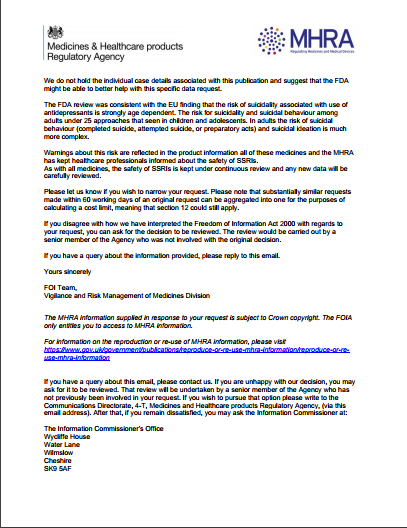
It would appear that the MHRA are now suggesting that my request isn't actually about money. Their response to me does, however, answer a number of questions regarding pediatric trials and SSRIs. They have now told me no person under the age of 24 has ever died in any of the SSRI clinical trials, except for trials involving Lundbeck's two SSRI's, citalopran and escitalopram. The MHRA claim they don't have that information.

So, what about the adult trials?

We know through litigation that GSK's Paxil clinical trials showed 22 people died, 20 of which were death by suicide. But what about the other clinical trials for other SSRIs?

This seems to be an question that the MHRA are, for whatever reason, failing to answer.

With this in mind, and also the time it will take the MHRA to 'research' this information I have, once again, responded to their latest reply to me.

First, here's their latest...


My latest response is short.

Dear MHRA,

I wish to narrow my request.

To save you time (and money)

Here is my first.


How many deaths occurred in the persons aged 24 or over in clinical trials for Prozac. How many were by suicide and how many of those patients were taking Prozac at the time of their death?


--

It seems an arse about face way to request all the information on all the SSRI clinical trials in adults but if they wish for me to send them one request at a time, which it appears they do, then I shall comply so we can eventually get to the bottom of this question and, at the same time, maybe save some lives.

I will, of course, update this blog when the MHRA respond, which, judging by previous correspondence with them, will take approximately one month.

Bob Fiddaman


Tuesday, November 01, 2016

SSRI Tips and Tricks on Withdrawal


One thing you won't see on SSRI patient information leaflets is how to combat the withdrawal effects. There are literally dozens and dozens of Facebook groups offering support to those struggling the debilitating withdrawal effects of SSRIs such as Prozac, Paxil, Zoloft etc. These groups are patients who have either gone through or are going through SSRI withdrawal - they shouldn't be dismissed, in fact, they are far better than what health care professionals have to offer.

The drug companies or medicine regulators won't help, to do so would be an admittance that SSRIs can, for many, cause serious problems when withdrawing and if they admit there's a problem then this will be a sign that they have licensed a drug, or drugs, to the public that can make matters worse rather than rectify or subdue the problem they were originally prescribed for.

When one takes a look at the patient information leaflet one sees the phrase that the benefits of taking an antidepressant outweigh the risks - the risks being thoughts of self-harm, suicide and akathisia, which, in essence, is a pre-cursor to completion of suicide.

Health committees spring up every now and again, their sole purpose, it appears, is to recognise there is a problem withdrawing from SSRIs and, well, and nothing. They offer no advice, they don't tell us why - they merely give you hope by stopping the carousel, asking you for your story then, putting you back on the carousel, ergo leaving you to deal with your problems by yourself - they will of course throw out the one line that covers their arse, "Talk to your doctor."

Most people that have wrote me over the years have told me that their doctors either up their dose when they experience withdrawal or change/substitute one SSRI for another - these patients then leave armed with a prescription and a ticket to ride the carousel.

For years the line 'Talk to your doctor' has been used as a tool by the pharmaceutical industry. To promote the use of SSRIs adverts have appeared on TV, in magazines, by proxy on radio shows where the host has been paid vast amounts of money to persuade listeners to use a certain brand of drug. When the problem of withdrawal kicks in, pharmaceutical companies and medicine regulators continue to use the 'Talk to you doctor' line, knowing that any prescribing doctor does not have a clue how to help people suffering severe withdrawal - Okay, there are some who know how to help, eg; Healy et al, but these are few and far between - perfect for the industry and regulators because it means they continue passing the buck, at the same time avoiding potential lawsuits for defective products.

Speaking of lawsuits, in 2002 GlaxoSmithKline settled with over 3,000 plaintiffs who had claimed that Paxil caused serious withdrawal problems of many kinds, resulting in patients unable to stop taking the drug. The settlement (with each plaintiff) saw them sign a confidentiality agreement whereby they could not discuss the award (monetary) they received from Glaxo. Here's how it works...

Any lawsuit claiming severe withdrawal effects from an SSRI will be denied and defended in a number of stages.

A - We warned them (the patient) already.

B - It was the condition whereby the patient declined into a spiral of decline, ergo this caused depression and the patient suffered anxiety as a result of his underlying illness and coming off the drug that was treating his underlying illness.. (In other words it wasn't a withdrawal effect, it was agitation caused by him stopping the drug.  We utterly refute this claim as our drug has benefited millions of people world wide...yadda yadda.

Prosecution team will point out that even by the drug company's own admission their drug can induce severe withdrawal effects and this is where the pharmaceutical company will argue point C.

C - Yes your honour, but we don't believe that to be the case in this particular litigation, we believe it to be the underlying illness that caused what plaintiff deems as 'withdrawal effects'.

When they feel the case slipping out of their hands they offer a settlement, one which they don't have to admit any wrong-doing.

It's a game and pharmaceutical companies play it to their advantage.


Brain zaps

One problem that exists with SSRI withdrawal is the "brain zaps" - if you've never experienced these you are one of the lucky ones - the only way to combat these (to make them go away) is to stop withdrawing and start taking your medication again at the prescribed dose (back on the carousel you go)

Looking through the Facebook support groups it seems the brain zaps is one of the more common side effects - it's played down by pharmaceutical companies and regulators.

In laypersons terms, or to use an analogy, brain zaps is basically your brain trying to deal with something it has become accustomed to over the months, years you having been taking the drug - it's no different to any other reduction you may encounter apart from the fact it gives you this feeling like your brain is being poked by a cattle prod, resulting in your whole body jerking, twitching. Turning your head too quick gives the effect of dizziness - this 'dizziness' is, once again, played down by the pharmaceutical industry and regulators. When reading the patient information leaflet you will see 'dizziness' as a common side effect - it looks harmless - hey, what's a bit of dizziness? For some the dizziness is best described as feeling like a cartoon character, you know they type, the kind of characters whose eyes are able to be pulled out before being let go and retracting at high speed back into their sockets.

More often than not withdrawal will cause this problem. You may turn your head and feel that your eyes do not follow your turn, they are left temporarily stationary in their original position. Once your head is turned it will take them a split second longer to follow the movement of your head - this will cause you the 'dizziness' referred to in the patient information leaflets - this is what taking, or withdrawing from an SSRI, can be like for a lot of people. The vast majority of which find it difficult to describe this 'dizziness' to their doctors.

The brain zaps  (your brain wanting it's normal daily fix) is your brain reminding you to feed it. For months or years you have been feeding it a regular dose - so, if you lived on three potatoes, chicken and vegetables for a year, and that meal satisfied you, gave you a sense of being full upon eating it, it then stands to reason if someone came along and removed a piece of chicken or potato, you'd be pretty pissed off - your meal wouldn't satisfy you anymore  - you'd be left unfulfilled and you'd probably reach for a snack to fill the gap that the missing potato or chicken piece had left. Same goes for when you are tapering from an SSRI - Your brain has become used to it's regular meal of potatoes, chicken and vegetables.

Now, imagine if just one pea was taken from your daily meal, it wouldn't be so bad, and you probably wouldn't even notice it, right? This is how you have to taper. Personally, I came down by just half a milligram per week. Some weeks, when I wasn't ready to drop another half, I didn't. My body, my rules.


The God Factor

Throw a stethoscope around a neck, give that stethoscope-wearing person a title, such as 'Dr', and you have before you a person that can fix any ailment you may have. These people have been through years of training, they are clever, so much more intelligent than you and I, right?

Wrong.

They have been trained to basically spot symptoms then use a medicine to treat that symptom - that is all - they don't have a magic wand, they do not have healing hands - they are not your modern day Jesus Christ nor indeed should they be treated as such. They are just normal people who chose a career path because they felt the need to want to help people - it's admirable that any human would want to care for another human - Sadly, the pharmaceutical industry is a machine that is constantly striving to see a niche in the market - to take control of that niche they first need to target the agents who sell their wares - namely; your prescribing physician. They, through various methods, convince the young Dr going through med school that they are the good guys, that depression is a disease that can be stabilized and controlled. Somewhere along the line financial and marital problems have become a disease as have fears that have been with us since the year dot. Shyness, being anxious because you have to give a speech are just two examples - both treatable with an array of meds, or so we are told.

If you've read this far down then you are probably here because of the title of this post, "SSRI Tips and Tricks on Withdrawal."

It's important to know why you are here and reading all of the above will, hopefully, give you the reason. You are not crazy, you are not in the minority, you are not abnormal - the drug you were prescribed was licensed by a regulator based upon the benefits you may receive from it. To date, the British drug regulator, cannot list one single benefit for any of the SSRIs on the market. They claim that these invisible benefits outweigh the highly visible risks - You've been duped ladies and gentlemen, just like your prescribing physician. (Source - Correspondence between myself and the MHRA)

So, the zaps - horrible aren't they? Kind of make you curl up into the fetal position because that's the only way you can cope, right?

There is a way that may or may not help you. It's free, it doesn't involve putting anything into your body apart from tap water (or bottled water if you prefer) - in fact, water is used a lot in these series of tips.

You won't see these on the patient information leaflet because, well, because the whole idea of selling sickness is to not warn you about the severe side effects you may experience.

1. If you decide to taper do so in the winter months and not the summer months. I can't quite put my finger on why you should choose the colder months but I know, through my own tapering experience of Paxil withdrawal, that it seemed to be worse when it was warmer outside.

2. Never try to quit by going cold turkey. Don't attempt to taper by missing doses every other day. Don't attempt to taper by halving your pill, although for some (Cymbalta for example) there is no liquid formulation, which brings me on to tip number three.

3. Taper using the liquid formulation (if you can) - Don't ask your Dr for the liquid, tell him/her - Dr's are there to help you and, at the end of the day it is you that is suffering the withdrawal, it is your brain crying out for its extra potato each time you skip or halve a dose. Tell your Dr you want to be prescribed the liquid - Do not ask.

4. Go at your own pace when withdrawing, this is not a sprint, it's a marathon and may take many months or even years to get completely off the drug. Again, many Dr's will dispute this, if they do then give them the middle finger - remember, this is your plate you are eating from and not theirs.

5. The dreaded brain zaps - Okay, this is my own personal tip, it helped me somewhat.

Run a bath full of cold water. Find a suitably sized bath towel and soak the towel in the water. Wring the towel and wrap it around your head in the style of a turban. Keep repeating this process once the towel starts to dry or if the zaps appear again.

6. Run cold water over your wrists (the part where you feel your pulse)

7. Go for walks (again the winter months is probably best) - Don't overdress - wear loose clothing - this may be difficult as you have probably gained a lot of weight during your time on your SSRI. Walk and push yourself - don't just walk around the block, find a park, tell yourself you are going to lap the park just by walking - treat the cold weather as your friend. Treat the walk as a way of helping you and not as a chore - at the same time weight will fall off you - let the daily walk be your addiction.

8. Drink lots of water, up to 8 pints a day - yes, it seems a ridiculous amount but you are basically helping flush out the culprit causing you the problem - If you can't manage 8 pints then just drink as much as you can - in any event, water is good for you.

None of the above will cost you a single penny - give it a try and write to me in a few months time to let me know if you feel you are on the road to recovery after using these tips.

In the meantime, good luck - you will get there - maybe once you do, you can advocate and help others stuck in this rut of SSRI withdrawal, particularly children.


Bob Fiddaman
Former Paxil addict.


Wednesday, March 16, 2016

Letters from Generation Rx - A Review


**Update April 7
The movie is now available to watch - see trailer at the foot of this review.

I was fortunate enough to be sent an advanced copy of Kevin P. Miller's groundbreaking new movie, Letters from Generation Rx, earlier this week. I pretty much knew that it would sadden me. I pretty much knew that it would, at the same time, make me angry. I wasn't wrong.


Award Winning Film-Maker, Kevin P. Miller


Kevin P. Miller has created something quite beautiful with his latest offering, beautiful yet tragic.

From the opening reel we are shown a woman driving her car with her children in the back passenger seats - the scenery is stunning, the whole cinematic event being a reconstruction, one in which the stunning scenery pales into insignificance when we realise that this is no opening scene about the beautiful countryside or, indeed, about a mother taking her children out for a ride to educate them about their surroundings.

From here we are taken on a journey, the driver, Kevin P. Miller, is an award-winning film-maker and he takes us carefully through a minefield of information and disinformation courtesy of global medicine regulators and pharmaceutical companies. The narration is provided throughout by Oscar winner Tilda Swinton. We, through Miller's careful navigation, are driven through the stench of the lies and deceit, along the way we meet the victims of those lies and deceit. We stop, look and listen to their stories, all sounding familiar, all with one common denominator. Selective Serotonin Reuptake Inhibitors (SSRIs)

I've met a good number of the victims in this movie, I wish I hadn't. Our paths crossed because they had lost someone loved to SSRI induced suicide. I have spoken with many more of the subjects featured in Miller's two hour long documentary - hearing their stories again doesn't make it any easier for me to hold back the tears, the anger.

This is a movie that those of us who choose not to read about children, teens and adults killing themselves will, no doubt, turn a blind eye to. "I know it goes on but it's too upsetting to read", are just some of the comments I have heard about the articles that I write. Sorry folks but that just isn't good enough.

Every one of us has a duty to protect the most vulnerable, just ask the parents, partners, featured in Letters from Generation Rx why they advocate for better regulations of prescription medications. Everyone of them have, since the death of their loved ones, made remarkable strides in creating an awareness about the dangers of drugs such as Zoloft, Paxil, Prozac, Lexapro, to name but a few.

Letters from Generation Rx shows us the human side of devastation, it also shows us the inhumane side of the pharmaceutical industry and global medicine regulators. It's jaw-dropping when we are shown by Miller how many of the regulators have vested interests at heart opposed to what they were put into place for - protecting public health.

The relationship between global medicine regulators and the pharmaceutical industry is incestuous and one that is based purely on profit margins.

Miller's movie will have you reaching for the pause button so you can compose yourself after each story is driven home, it did me anyhow.

I doubt if the findings in Letters from Generation Rx will bother the likes of pharmaceutical CEO's or any of the limp-wristed medicine regulatory authorities around the world. They have become too corrupt, too greedy - their hearts have been blackened as they all sit in their ivory towers counting the dollars whilst dismissing the death and destruction that paved way for those dollars.

The movie is harrowing, to say the least. One story is bad enough to endure but to assemble a bunch of stories and to craft them into a two-hour documentary is something that Kevin P. Miller should be applauded for.

To add further incestuous ties to pharma and the medicine regulators the movie shows how Health Canada saw fit to go after one of the victims featured... all because he came up with a healthy nutritional supplementation program after his wife died and two of his ten children later struggled to cope with the loss of their mother. TrueHope, became the target of Health Canada who tried to stop them selling and distributing EMPowerplus to the thousands of participants in the Truehope program in Canada. You'll have to watch the movie to find out the outcome.

Kevin P. Miller has, through his craftsmanship, created something that we should all be queuing to buy and then, once we've all watched and condensed it, we should all be busting a gut to make sure that we don't take this pharmafia abuse lying down anymore.

Letters from Generation Rx is essential viewing and is set for general release in the coming weeks.

Here's a teaser...


Bob Fiddaman.


Official Website for Letters from Generation Rx (Currently being updated)

Letters from Generation Rx Official Facebook Page

Recent Interview with Kevin P. Miller


Wednesday, April 22, 2015

Psychiatry Taking the Biscuit


I've been itching to blog about this since I first read it earlier today. I thought I'd dip it in some warm tea first, digest it, then indulge myself. Hey, if the pro-antidepressant brigade can take the biscuit then why can't I?

The article, penned by Daily Mail Health correspondent, Jenny Hope, tries to offer balance in as much as we see one psychiatrist, Dr. David Healy, make claims that depression is not caused by low serotonin levels and most drugs used to treat it are based on a myth, while other psychiatrists, quoted in the article, um, basically agree with him yet make outlandish statements regarding the efficacy of antidepressants.

You confused? I certainly was after reading it.

In fact the professionals offered a chance to rebut Dr. Healy's claims, namely Professor Sir Simon Weasly, President of the Royal College of Psychiatrists, and Professor David Taylor, Director of Pharmacy and Pathology and Head of Pharmaceutical Sciences Clinical Academic Group, King’s Health Partners, South London and Maudsley NHS Foundation Trust, actually make the article more entertaining with their blinkered views without actually offering any scientific evidence. NHS Choices and Dr Paul Keedwell, Consultant Psychiatrist and Specialist in Mood Disorder, also add input.

So, here's the crux of the article. Healy has claimed that the belief that the most popular antidepressant drugs raise serotonin levels in the brain is nothing more than a myth, adding, that they took off because of the idea that SSRIs restored serotonin levels to normal, ‘a notion that later transmuted into the idea that they remedied a chemical imbalance’.

So, all pretty standard stuff and nothing that we (who move in these circles) haven't heard before.

Here's where it gets interesting.

Weasly: "Antidepressants are helpful in depression, together with psychological treatments, is established. How they do this is not."

So, he is saying that, yes, antidepressants work but he, or anyone else for that matter, don't know why or how.

Weasly continues with, "Most researchers have long since moved on from the old serotonin model."

Great stuff Mr. Weasly but it would have been nice if this statement was followed up with an explanation as to what the current model is...if indeed there is one?

Next we have a spokesperson for NHS Choices chip in. They claim, "It would be too simplistic to say that depression and related mental health conditions are caused by low serotonin levels, but a rise in serotonin levels can improve symptoms."

So, NHS Choices are agreeing with Healy then?

I'm not so sure. Here's what they say about bipolar disorder, "Bipolar disorder is widely believed to be the result of chemical imbalances in the brain. The chemicals responsible for controlling the brain's functions are called neurotransmitters and include noradrenaline, serotonin and dopamine. If there is an imbalance in the levels of one or more neurotransmitters, a person may develop some symptoms of bipolar disorder."

Here's what they say about trichotillomania (hair pulling)

"As trichotillomania involves compulsive behaviour, some experts think it's closely related to obsessive compulsive disorder (OCD). OCD tends to run in families. It's thought to be caused by both biological and environmental factors, which may lead to a chemical imbalance in the brain. Neurotransmitters are chemicals that send messages from your brain to your nervous system. If something goes wrong with the way neurotransmitters work, it can cause problems, such as compulsive and repetitive behaviours."

Just two examples, both of which are not backed up with any scientific evidence whatsoever. In fact the evidence they run with is the classic line, "...is widely believed to be the result of..."

So, NHS Choices are, it seems, basing their evidence on some sort of faith? Exactly who are those believers and when and where did this belief originate from?

Healy offers the answer, and I concur. "...the misconception that low levels of serotonin were responsible for depression had become established fact." He suggested that the success of so-called SSRI drugs – which include Prozac and Seroxat – was based on the ‘marketing of a myth’.

Next, and somewhat absurdly, we see  David Taylor, Director of Pharmacy and Pathology and Head of Pharmaceutical Sciences Clinical Academic Group, King’s Health Partners, South London and Maudsley NHS Foundation Trust, offer his opinion. (Because that's all it is)

"Professor Healy makes a forceful but poorly supported argument against something which doesn't and has never really existed: the idea that SSRIs ‘correct’ an ‘imbalance’ of serotonin in the brain."

What?

So, let me get this straight. For years psychiatrists have been telling patients, adults, children and children's parents, that their depression is caused by a chemical imbalance yet Taylor claims that they haven't?

**Insert canned laughter here**

It's one thing to spin a lie but another to claim that the lie never existed. In any event, who made David Taylor the spokesperson for the whole of the psychiatry profession?

Like Weasly, Taylor follows up his statement with, "Researchers and psychiatrists alike know that SSRIs are effective in a number of disorders but no one is sure exactly how they work."

Guinea pig trials anyone?

If you don't know how a drug works then you won't know if that drug is causing an adverse event or not, right? You can, and more often than not you do, blame it on the condition, which, according to Weasly and Taylor, has nothing to do with a chemical imbalance.

Honestly, it would be easier to do the Rubik's cube behind my back then make heads or tails out of what Weasly and Taylor are saying here.

Finally, we have a sinister warning from Dr Paul Keedwell, Consultant Psychiatrist and Specialist in Mood Disorder.

"In the real world of the clinic, SSRIs are undeniably effective in treating individuals with major depression.

"They have become the first line treatment of choice because they have fewer troublesome side-effects than their predecessors, and are safer in overdose.

"David Healy has previously claimed that SSRIs cause dependence or provoke suicide. In so doing he has risked deterring individuals with severe depression from getting the help they need and this latest article just adds to this problem.

"The risk of suicide from untreated depression is much greater than the risk of treating it with antidepressants, and yes, this includes SSRIs."

So, in essence, Weasly, Taylor and Keedwell, don't know what causes depression but they know it isn't a chemical imbalance. They are all for prescribing SSRi's because, well, because they apparently have fewer side effects than the older types of antidepressants and are safer in overdose (apparently).

Yet neither Weasly, Taylor or, indeed, Keedwell know how SSRi's work. So, ladies and gentlemen, boys and girls, they are suggesting that you and I take a drug that will alter the thoughts in your brain - they can't tell you how or why these drugs do it though.

Keedwell further criticises Healy for speaking out, claiming that Healy is deterring individuals with severe depression from getting the help they need.

Naughty Irishman - Last time I looked, he wasn't outside any pharmacy pointing a gun at people who were walking out with their pills to alter the chemical imbalance that they haven't got. Remember, we have to believe that the diagnosis of their 'illness' is based on a faith... it is widely believed, but we don't know by whom.

It's all about informed consent and, judging by the reaction of Messrs. Weasly, Taylor and Keedwell, it would seem that the only information they want you to believe is the information that they give you, which basically amounts to having no scientific evidence to back up their claims.

Doncha just love the wonderful world of psychiatry.


Bob Fiddaman.


Friday, November 08, 2013

Email to CEO of the MHRA, Ian Hudson


I've just flicked the following email to the new MHRA Chief, Ian Hudson.

Any reply will also be made public.


Dear Mr Hudson,

As I understand you are now Chief Executive of the MHRA. I'd congratulate you but we both know that I'd be lying with those congratulations given your past links to GlaxoSmithKline and Seroxat.

That aside, I have to remain professional.

My question to you is one of great concern and one that I shall be making public on my blog http://fiddaman.blogspot.com

Are you, or do the MHRA plan to reevaluate the current recommendations that pediatrics should not be prescribed SSRi's?

I ask as it has come to light that MHRA consultant, Stephen J W Evans, has recently co-authored a study where he and the other authors call for a re-evaluation of the current prescription of SSRIs in young people - Back story here.

This email, along with your answer, if you are brave enough to answer that is, will be published on my blog.

Best wishes

Bob Fiddaman.


Wednesday, October 23, 2013

School Shootings and Other Bizarre Incidents


Bob Fiddaman


Tuesday, June 25, 2013

Pharmaceutical Intensive Care

SSRi use during pregnancy


What is Intensive Care?

Intensive care units (ICU), also called critical care or intensive therapy departments, are sections within a hospital that look after patients whose conditions are life-threatening and need constant, close monitoring and support from equipment and medication to keep normal body functions going. [1]

The British flagship programme Panorama is stirring the pot again, this time, it seems, it's siding with those who warn against the use of SSRi type medications in pregnant mothers.

Good for them.

I've highlighted SSRi birth defects on this blog many times, particularly paroxetine birth defects. It now seems a given that paroxetine, commonly known as Seroxat in the UK, Paxil in the states and Aropax in the Southern Hemisphere, can cause birth defects. But what about the other group of SSRis?


We, as consumers, constantly hear that the jury is out on their safety during pregancy and that doctors have to weigh up the risk/benefit ratio before prescribing.

This is classic pharmaceutical deflection and, dare I say it, medicine regulator deflection too.

Who is ultimately responsible here, the pharmaceutical company that make the product that can harm unborn children, the limp-wristed regulators who are supposed to regulate the drugs consumers take or the doctors who prescribe the drugs?

Personally, I believe it's the manufacturer who should be held accountable, there are many who take a different viewpoint, all valid views I might add.

Let's say you have fallen pregnant and you are feeling down. You go to your doctor and he, after apparently weighing up the risk/benefit offers you an antidepressant from the SSRi family. He tells you that untreated depression may harm your child and using an SSRi will therefore work to protect the child.

It's ridiculous when you think about that kind of statement. Its a statement that ignores the fact that 'depression' (sadness arising from negative life events or circumstances) can be treated by addressing the social factors causing it rather than by prescribing drugs that cause birth defects.

Let's say our subject is depressed because her employers have told her that there are going to be job cuts. She, like most, would worry. Because she is pregnant she'd probably worry more. How can I now afford to look after my child?

Pharmaceutical companies, regulators and doctors will have you believe that our subject is passing on her concerns to her unborn child. It's the selling point and one that is cruel and heartless. I don't think there is any doubt that having a mother who is scared, stressed, sad etc has a negative impact on a baby but surely that suggests doctors should be providing support to remove or cope with the stressors not prescribing drugs that they do not deny carry a risk. There are no risks associated with joining a new mothers coffee group, getting budget advice, seeking the support of friends, family or social service organisations and if the root causes of the distress are dealt with, huge benefits for both mother and baby. This approach surely has a better risk/benefit profile than prescribing antidepressants but of course doesn't come with the rewards to doctors from big pharma that prescribing does. Nor is it able to be provided in a 15 minute appointment which maximises profit for the doctor's business.

BBC Panorama spoke to eight mothers whose babies came into this world with serious heart defects. All eight mothers were taking SSRi medication during the course of their pregnancy. We are expected to believe that this is just a coincidence.

Babies are born with defects all the time and this really has nothing to do with what the mothers ingest... unless of course the mothers have been smoking, drinking alcohol or taking illegal substances during their term.

Yup, blame everything but the drug that is prescribed widely, right?

So, let's assume that our subject weighs up the risk/benefits herself and decides that taking an SSRi would increase the risk to her unborn child. But our subject is a smoker and want to quit... she has tried many times but just can't kick the habit.

Her doctor, once again, has a drug that can help her. Once again he has to weigh up the risk against the benefits. Chantix [also known as Champix] can, according to its manufacturer Pfizer, help anyone quit smoking. Zyban [also known as Wellbutrin] can, according to its manufacturers, GlaxoSmithKline, also help you quit smoking.

Your unborn child is, women are told, more at risk if you continue to smoke. This maybe true but both Chantix and Zyban, the latter being an antidepressant rebadged by GlaxoSmithKline, can also cause serious abnormalities in babies.

So, where do the regulators come in?

The UK medicines regulator, the MHRA, made recommendations back in early 2000 that SSRis should not be prescribed to children or teenagers. They did this because they had reviewed the evidence and found that there was no benefit in this population taking SSRis. In fact the evidence showed that there was an increased risk of suicidal thinking while this age group was taking an SSRi.

Now, I'm not suggesting that unborn children can have suicidal thoughts but if a drug can induce such chemical changes in the living then are we expected to believe that it will make no alterations to a child growing inside its mother?

The MHRA can and will tell us that they have played their part. They have issued the warnings to the prescribing physicians.

Analogy

"Hey kids, don't touch that fence, it has electricity running through it", the man on top of the grassy bank tells the children.

"Don't believe you", Simon tells the man.

Simon touches the fence. Many volts of electricity are passed through his body. Simon dies as a result of his injuries.

8 days later...

"Hey kids, don't touch that fence, it has electricity running through it", the same man on top of the grassy bank tells the children.

"Don't believe you", Julie tells the man.

Julie touches the fence. Many volts of electricity are passed through her body. Julie dies as a result of her injuries.

The man stands from his sitting position. He's satisfied and has no conscience, he did, after all, warn of the dangers.

Would a humanistic more active approach to protecting the lives of these children have been called for here?

Should the man have raised alarm, been more vocal, called the relevant authorities or maybe erected warning signs in clear bold text, "THIS FENCE IS ELECTRIC". Might warning parents that the fence was dangerous and urging them to monitor their children closely when in proximity to it have been warranted?

The man had been sitting on the grassy bank for many months. In total he had witnessed 5 children touch the fence. Only two of those 5 had died as a result of their injuries. The other three suffered burns but lived as a result.

Because of this the man decided that more people who touched the fence survived than those who died and the fence was therefore not a risk to children.

Bizarre way of thinking, right?

But this is the exact logic that regulators are using when it comes to mothers taking antidepressants during pregnancy. Moreover, they are passing the buck and allowing doctors to make the call.

Let's just take a look at a recent birth defect trial in the United States. The decision of which found GlaxoSmithKline guilty.

When the verdict was announced I contacted the MHRA and asked if they were going to change the labelling on Seroxat now that evidence had emerged that it was a clear teratogen [2]. They told me they were not. I wrote a whole chapter about this in my book where I produce the email correspondence between myself and MHRA CEO, Kent Woods [3]

Here's an extract from court documents [Kilker Vs GlaxoSmithKline]

September 15, 2009
13 Courtroom 253, City Hall
Philadelphia, Pennsylvania

Sean Tracey of the Tracey Law Firm [Attorney for Kilker]
Glaxo were represented, as usual, by King & Spalding


MR. TRACEY: May it please the Court, good morning.
JURORS: Good morning.
MR. TRACEY: I am going to reintroduce myself. My name is Sean Tracey. I represent Michelle David and Lyam Kilker. Before I begin, I want to reintroduce to you Jamie Sheller here, and there are a couple young lawyers up front here. Scott Love and Adam Peavy you are going to see wandering around and probably hearing from during this trial. Who you haven't met are my clients. This is Michelle David. Michelle, will you stand up. This is Michelle David. Over here with Michelle's mother is Lyam Kilker. Lyam is here with his grandmother. Lyam is going to stay a few minutes, then I think his grandmother is going to take him out of the courtroom.

Next we see Tracey explain to the jury the injuries caused to Lyam Kilker.

MR. TRACEY: This is the time for me to talk to you about what I believe the facts are going to be, what I think the evidence that comes in during this trial is going to be through the witness stand starting this afternoon, and through the documents that I have obtained as a result of this lawsuit. And so I want to start that by, this is the name of the case, as you have heard, Kilker versus GlaxoSmithKline. And Lyam Kilker, this is going to be undisputed, Lyam Kilker was born October 24, 2005. And shortly after he was born, Michelle found out he had been born with a series of congenital heart defects. During the time Michelle was pregnant, before she was pregnant, she was taking Paxil. She was on Paxil for her first trimester. Now, Lyam, after he was born, was at the hospital and he was diagnosed and his heart defects, there really are three. One is called the ventricular septal defect. One is called an atrial septal defect. Those are holes on the inside of the heart in the walls that separate the four chambers of the heart. The other heart defect he had is something called an interrupted aortic arch. The aorta, where it is supposed to curve, doesn't fully develop. And so what he has is three different, distinct heart defects, each of them related to the failure of his heart to fully develop.

Tracey then goes on to explain to the jurors about the FDA pregnancy categories.

MR. TRACEY: The first one is pregnancy Category A. Are there adequate and well-controlled studies? Are there human studies that demonstrate there is no risk to the fetus? If it is Category A, you can take this drug with impunity and you don't have to worry about children, you don't have to worry about if she gets pregnant. You will learn during this trial that, I think, over 50 percent of pregnancies in the United States are unplanned. Women aren't planning on getting pregnant. That's why these categories can be so important. You don't just consider these categories when you have a woman who is planning a pregnancy. It is any woman of childbearing years who may become pregnant. The evidence in this case is going to be that GlaxoSmithKline knew that over 50 percent of the women in the United States became pregnant without trying to, they were unplanned pregnancies. They knew this back in the 1990s. So Category A, no problems.
Category B, we have done animal studies, doesn't look like there is any problems. Animal studies have failed to demonstrate a risk to the fetus, but we don't have any human studies.
Category C is, we have done animal studies, we have done animal studies, and the animal studies have shown an adverse effect on the fetus, but we don't have any human studies at all.
Category D is, there is positive evidence, there is positive evidence of human fetal risk based on a number of different things, either adverse reaction data from investigations they do or adverse marketing data from women and doctors reporting problems with the drug or from studies. And in that case in a Category D drug you do not prescribe that drug to women of childbearing age with one exception. If the doctor decides that the benefit to the patient is worth the risk to the fetus, then the drug can be prescribed. Doctor Healy, who is a psychiatrist and neuropyschopharmacologist who is going to testify this afternoon, will explain that there may be times when the disease is so serious that it may be worth the risk to the doctor and the patient if there is a life-threatening illness. If somebody is capable of harming themselves or others, they may make the decision to prescribe the drug if, there is no alternatives.
Category X is, we don't care what the benefits are. You do not give this drug to a woman unless she has a pregnancy test that shows she is not pregnant.

Tracey adds:

MR. TRACEY: In 2004 when Michelle David was prescribed this drug, it was a pregnancy Category C, and GlaxoSmithKline says their animal studies have revealed no evidence of teratogenic effects.
Tracey then explains to the jury the process of human development.

MR. TRACEY: In human development when women get pregnant, what you are going to learn and understand is that the most vulnerable time to the human fetus is from weeks 3 to weeks. That is when the fetus is dividing and growing and is the most susceptible to something called a teratogen to a drug that can cause a birth defect. During weeks 3 through 8 the body is rapidly, rapidly expanding, rapidly developing. Cells are being signalled to go to where they are supposed to go. The heart is developing by week 8. By week 8 the heart, from a cellular perspective, is almost completely developed, and there is nothing you can do after that to prevent the heart, to prevent a heart defect if it has already occurred. The importance of this is that when women don't know or aren't planning on becoming pregnant, many times, most of the time, by the time the woman finds out she is pregnant, the damage has been done. This is when in this time frame, weeks 3 to 8, almost every congenital abnormality -- that is a fancy word for a birth defect -- almost every congenital abnormality happens during this time frame.
Tracey goes on to explain to the jury what a teratogen is. In a nutshell, a teratogen is any agent or factor that induces or increases the incidence of abnormal prenatal development.

Enter Dr Sloot

MR. TRACEY:  So during the course of this trial you will hear about teratogens and teratogenicity and you will find out about whether Paxil is a teratogen. And one of the ways you are going to learn about this is through a study, an animal study, an animal study done by a doctor named Sloot. Doctor Sloot is a European doctor who works for another pharmaceutical company called Shearing Plough. Shearing Plough is a pretty big company. You may have heard of it. In May of this year, 2009, a study was published by Doctor Sloot. The study said this. What Doctor Sloot did is, he took Paxil and all the other reuptake inhibitors and he exposed rat fetuses to these 12 different drugs, including Paxil. And what Shearing Plough was trying to figure out, what they were trying to do was figure out whether one of the drugs that they were going to put on the market to compete with GSK's drug was capable of causing birth defects. And so they took the drug they were going to take to market, and before they took it to market, they did this test. And they compared it to all the other SSRIs. Because, as you will learn, GSK never did this test. What Doctor Sloot discovered in May of this year is that out of all the teratogen --out of all the SSRIs, the 12, only one was a clear teratogen, Paxil. He discovered that Paxil in May of this year was actually more powerful a teratogen than cocaine. It would be safer, according to Doctor Sloot's study, to take cocaine than it would be to take Paxil while you were pregnant.

The Evidence

MR. TRACEY: I told you earlier that the way you learn about this case is through evidence, through witnesses that take the stand, through documents. And you are going to see documents in this case that have never seen the light of day before. You will see internal GlaxoSmithKline documents that the FDA hasn't seen, that the United States Congress hasn't seen, and that no jury has ever laid their eyes on before. For the first time in this trial you will see these documents. They have been under seal for over three years. And that's the way, one of the ways, you are going to learn about what GSK knew and when they knew it.

Tracey then explains to the jury how Glaxo had purchased the compound [paroxetine] from a Danish company called Ferrosan. He continues...


MR. TRACEY: Ferrosan had done the preliminary animal studies to look at teratogenicity. And they were done, I believe, in 1979 and 1980. And one of the studies was called Study 295. This is a study where they give Paxil, paroxetine, to pregnant female rats. And what the evidence showed in Study 295 is that the rats that got no Paxil, 88 percent of them were alive or 12 percent were dead by the fourth day after they were born. The ones that were given 5 milligrams of Paxil, 65 percent were dead by day 4. The ones that were dosed with 15 milligrams of Paxil, 92 percent were dead by day 4. And in the ones that were given 50 milligrams of Paxil, 100 percent were dead by the fourth day after they were born.

Ferrosan's Dr Baldwin

MR. TRACEY: At the time a doctor by the name of Baldwin, who works for them, Doctor Baldwin looked at the studies. He looked at Study 295, another study called 296, another study called 297. And 12 years before they started selling this drug to women in the world, Doctor Baldwin had some comments about these studies. What he told them internally -- this is a document that nobody has ever seen before. What he told them internally was: There remains the possibility this compound could be teratogenic at higher dose levels. As he saw, as you just did, that the more Paxil you got, the more rats died. And these were not heavy doses of Paxil. What he was concerned about was whether or not Ferrosan or anybody else was going to conduct or intended to conduct peri and postnatal studies to answer the question to why the rats died. He wanted to know that. In 1980 he sent a memo to the powers-to-be at Beecham. He said this needs to be done. The rats died. He talked about embryolethality. That means the fetuses die.


FDA Revolving Door

MR. TRACEY: Because I saw the animal studies that you just saw and the evidence that you will see about the animal studies and the rat pups dying, and I wondered how they could market the drug and say in the beginning that there were no problems with the drug. What I found out is that the FDA investigator that signed off and said you can sell your drug to the public is a guy named Gary Evanuic (sp.?). And Gary Evanuic, who signed off on Paxil being a Category B drug, now works for GSK. He works for GSK in the very department that sells Paxil.

Japan

MR. TRACEY: And as we are rocking along, in 1994 we are selling in the United States, we are selling in Europe. Business is brisk. Business is going well. And they want to move into other countries. They want to sell their drug in other countries. And they have a company called SmithKline or Smith Beecham Japan. It is one of their companies that is in Japan that sells their drug, one of their 70, I think, companies. And the Japanese, they suspected, were not going to accept their dead rat pup studies because they suspected the Japanese, because of the historical things that have gone on in Japan with birth defects related to Hiroshima, Nagasaki, and another environmental disaster there called Minamata, the Japanese had a heightened sense of concern. GSK believed that's what would be going on. And so GSK began discussions internally. Internally among themselves they said: What are we going to do, what are we going to do if Japan makes us do the studies to find out why the rat pups died? What are we going to do? Because what the documents, the internal documents that the FDA has never seen, that nobody else has ever seen, is, their conclusions were, if the Japanese make us do the studies to prove why the rat pups died, we might lose the United States market. So GSK was looking at science and research, not from the aspect of whether or not their drug was going to induce birth defects in children, but the evidence will be their only concern was commercial. Their only concern was whether they would lose the American market. The quote from them is: GSK concludes this is the study, the type of study we wish to avoid. We simply don't want to know the answer to these questions. They say: If the Japanese do request a study, if they do it, there is a potential problem, they may insist on us doing a study to their preferred design. And so what they did in March of 1994, they got a woman or man, I'm not sure which, I haven't been able to find out, named Gwyn Morgan. They got Gwyn Morgan involved. They put Gwyn Morgan in charge of reviewing the study designs that they would give to the Japanese. And Gwyn Morgan was to ensure for the company that any potential negative outcome from the studies is minimized. They designed the study to fail. They wanted the study to fail.

GSK Sales Reps

MR. TRACEY: GlaxoSmithKline has 110,000 employees. I think 40,000 of them are salespeople. What these people do, you will learn, is, they go to doctors' offices. And they take literature and they take cookies and they take lunch and they take pens and they take samples of Paxil. And they tell the doctors why they should prescribe their drug. These are bright, sophisticated, educated salespeople. They are the backbone of this company. And what they were telling doctors in the mid-1990s is that no drug is safer than ours for pregnant women.

Japan Revisited

MR. TRACEY: So we are rocking along. Remember that Japanese study I told you about, Doctor Patrick Wier? Well, they designed a study -- they avoided the studies they wanted to avoid and they designed a study that they thought would satisfy the Japanese, and they were right. But even in the study that was designed to fail, something cropped up, something that was potentially a problem for them. In this study done by GSK, which, quite frankly, by the way, was not a study designed to find out why the rat pups died, it was not a study designed to find out the answer to the questions Doctor Baldwin had in 1980, but some of rat pups did die, and they autopsied one of the rats. And in one of the rats they autopsied, they found that the rat that was found dead had edema, swelling around the heart, and it had a ventricular septal defect. The very same defect Lyam Kilker has. The very same defect that they had started receiving reports of in 1997. But they blew this off. They minimized it. In their conclusions they didn't even mention it. It is buried in the back of the study in an appendix.

Cannot Stop Taking Paxil

MR. TRACEY: Now, this case is primarily, primarily, about birth defects, primarily about what happened to Lyam Kilker and whether they knew about what would happen to him. But in the course of selling Paxil for the past 15 years other issues have come up. One of them is this. In the mid-1990s some studies came out, some literature came out, showing that Paxil had a significant problem with withdrawal. What that means is this. They were finding that women that took the drug and then want to the stop couldn't get off of it. So they would get sick. They would try to stop and they would get sick. And so they would be forced to keep taking the drug so they wouldn't be sick.

Glaxo Burying Data

MR. TRACEY: In the mid-1990s there had been some studies done, not by GSK but by others, and talking about withdrawal. This, you are going to learn from the evidence, caused them some concern. They were concerned about losing their market, losing their market to Prozac. And what they decided to do was, do their own study. And one of the documents you are going to see is this document, a document from a woman named Bonnie Rossello. Bonnie Rossello is the vice-president of GSK's marketing, Paxil marketing. And what Bonnie said in 1997 was: In response to this, let's do our own studies. Then we will own the data. If the results come back negative, we can bury it all. We can bury the evidence that our drug is a problem. In 1997 that's what she said.


The full opening statement can be downloaded HERE

After hearing evidence from both sides Jurors deliberated about seven hours over two days before finding Glaxo failed to properly warn doctors and pregnant users of Paxil's risk. The panel awarded $2.5 million in compensatory damages to the family of Lyam Kilker.

With the latest news coming from BBC's Panorama about other SSRi's causing birth defects it pays to do your homework on these types of drugs before taking them. The pharmaceutical companies won't be clear and concise about the risks because it would only serve to harm their profits. The regulators won't be clear and concise because they refuse to see the link, even when sent evidence from the above trial. Doctors will continue to prescribe because they have been told that untreated depression can harm the unborn - I have yet to see any clear evidence on this that has not been funded the the pharmaceutical industry.

Forget the doctor weighing up the risk/benefit - Weigh up the odds yourself. Don't be fooled by the stethoscope and BNF in your doctor's office. Look for the product placements, note pads, coffee cups, calanders - I'll guarantee they have the name of a drug on them. That's called good pharmaceutical repping.

Panorama will no doubt be accused of scaremongering. To me, at least, the biggest scaremongers are those that tow the line that untreated depression in pregnant mothers can harm the foetus and then prescribe an SSRi.

Whilst there may be evidence that depressed mothers should treat there depression there is no evidence that SSRi treatment can help protect the baby.

If you stop and think about clinical trials for SSRis it leaves you with a burning question.

Clinical trials for SSRis all have a protocol to follow. All stipulate that there can be no subjects allowed onto the clinical trials that are pregnant.

Women, when faced with the decision of taking antidepressants, should remember this. They should also ask their prescribing physician to provide them with evidence that SSRi treatment can prevent their foetus from developing depression.

There is no evidence. If evidence were needed pharmaceutical companies who carry out trials would include pregnant women in these very same trials. They don't because there is a risk.

SSRi birth defects include, but are not limited to:

Abdominal Birth Defects / Omphalocele
Anal atresia (complete or partial closure of the anus)
Autism Spectrum Disorders
Cardiac (heart) defects
Cleft lip and cleft palate
Clubfoot (one or both feet turn downward and inward)
Craniosynostosis (skull defect)
Limb Defects
Neural-tube defects (brain and spinal cord, spina bifida)
PPHN (Persistent Pulmonary Hypertension of the Newborn)

Even if you have taken antidepressants during pregnancy and your child is born defect-free you still have many hurdles to jump.

Breast feeding an infant whilst taking an SSRi carries risks too. Mothers could unknowingly be feeding the very same drug to their infants that the regulators have warned against giving to children and teenagers.

I've yet to see any Sir David Attenborough documentary that has showed me an animal eating toxic plants before allowing her young to suckle.

And we, as humans, claim to have the highest intelligence.


The Panorama story can be found HERE.

The following video contains images that some viewers may find disturbing.


Bob Fiddaman


[1] The Intensive Care Society
[2] "Teratotogen" - Medical Dictionary
[3] The Evidence, However, is Clear - The Seroxat Scandal

Monday, May 06, 2013

Sara Carlin - 6 Years On

18 year old Sara Carlin


Today [May 6] marks the 6 year anniversary of the death of Oakville teen, Sara Carlin.

Sara tragically took her life back in 2007 and her much publicized 2010 inquest saw her parents, Neil and Rhonda, face teams of lawyers representing doctors and GlaxoSmithKline.

Sara had, around a year or so prior to her death, been prescribed Glaxo's Paxil [paroxetine], a drug that is infamous for inducing suicide, particularly in children and adolescents.

Sara was just 18.

The inquest, that I labelled the Glaxo & Friends Vs The Carlin Family, rolled out apparent SSRi experts who made various claims that 'suicide is much more strongly related to cases of untreated depression' and in any event Paxil induced suicide is more common when first starting the drug.


Oh really?

Sara had missed her dose for three to four days leading up to her suicide. This was disregarded by the experts because "the information provided did not suggest that Ms Carlin suffered from the usual triad of symptoms seen with withdrawal" - Oh really?

Completed suicide is a symptom of withdrawal. There is no greater suffering than death Mr Expert Man!

Anyway, Sara's story went global and many, myself included, believe that her suicide was brought on by Paxil. Yes there were other factors, all of which were used by lawyers representing both Glaxo and doctors during the inquest. I've mentioned before how Glaxo like to blame everything but their product, Sara's inquest is a classic example of this.

We see this played out all the time in coroners courts. I don't envy anyone who has to sit through so called experts blaming the victim but softening the blow with terminology such as 'troubled youngster' or 'mentally ill'.

Coroners courts put the victim on trial and offer opportunity for people that didn't even know the victim to say how bad they was, be it through drinking, illegal drug-taking or being an uppity teen. We've seen victims of suicide bad mouthed before and after Sara's inquest, Toran Henry and Shane Clancy are two that spring to mind.

A whole heap of recommendations were made at the end of Sara's inquest. I have wrote about the word 'recommendation' before. It means nothing.

None of the recommendations made back in 2010 have been implemented.

Today my thoughts are with Neil and Rhonda


Here's a video I did for Sara back in 2010, a video that has been viewed over 13,000 times.

Nessun dorma Sara


Related Sara Carlin articles

Sara Carlin Inquest – Latest

Sara Carlin Inquest – Failure of Oakville Medical Profession

Sara Carlin – ‘Death by Paxil’ Inquest – The ‘Expert’

Sara Carlin Inquest – Coroner’s Witness In U-Turn… And That Man Shaffer!

Coroner’s Inquest – Glaxo & Friends Vs The Carlin Family

Sara Carlin Inquest – Local MP Slams GlaxoSmithKline

SARA CARLIN INQUEST - What The Jury Should Know

Sara Carlin Inquest - "Paxil likely played important role in teen's suicide"

Sara Carlin Inquest - The Eli Lilly 'Links' & Today's Recommendations.

**Exclusive - Sara Carlin Inquest: The Bias Of Coroner's Counsel, Michael Blain & Coroner, Bert Lauwers?

The Inquest of Sara Carlin and the Moderation of Yahoo Groups


Bob Fiddaman


JOIN THE FIDDAMAN BLOG ON FACEBOOK


Thursday, May 02, 2013

Patient Information or Litigation Disclaimer?


I was browsing through some SSRi patient information leaflets [PILs] earlier and have come to the conclusion that the manufacturers warnings about this, that and the other are merely coded messages to the consumer.

Years ago, when SSRi's first hit the market, there were few warnings of side-effects. Sure, back then we had dizziness, nausea, sweating etc but that's standard for most, if not all, prescription medicines.

Today, after US litigation, patient reporting and, it has to be said, internet activism, the PILs take on a completely different look. They [the manufacturer] are telling us we can't sue because we were told.

It's almost as if pharmaceutical compliance departments had a eureka moment and turned really bad news into something that could be productive in the future. "Hey if we stick broad but vague warning labels on our drugs then we cover ourselves from future litigation... quick, get the number for that medical ghostwriting team we used back in 1998"

Let's take a look at Seroxat for example. [NHS Information]


Motion to dismiss

1. Some people who take Seroxat may find that it intensifies depression and suicidal feelings in the early stages of treatment. 
Very vague statement but one that would certainly be used by GlaxoSmithKline attorneys if they were ever faced with a lawsuit. "There is no case for your client as my client clearly stated in the patient information leaflet that Seroxat wasn't for everyone."

2. "If you are taking Seroxat, or you care for someone who is taking Seroxat, you need to look out for changes in behaviour that could be linked to self-harm or suicide.
"If you notice any of these changes or are worried about how Seroxat is affecting you or someone you care for, you should contact your prescriber, a mental health professional or NHS Direct as soon as possible."

Again, Glaxo attorneys could have a field day, "Your honour, we have reason to believe that the deceased did not contact their prescriber, yet my client clearly stated in the patient information leaflet for them to do so if they were feeling suicidal, therefore we argue that there is no merit in this case" 


 3. Seroxat is not suitable for everyone and some people should never use it.

"Your honour, if the deceased had killed themselves by touching an electrical fence despite there being a warning not to do so would my learned friends still be representing him in court?" 


4. Over time it is possible that Seroxat can become unsuitable for some people, or they may become unsuitable for it. If at any time it appears that Seroxat has become unsuitable, it is important that the prescriber is contacted immediately.

"Your honour, the plaintiff may have become, over time, unsuitable for our client's product, he may also have had an adverse reaction to my client's product. At no time, leading up to his attempted suicide, did he contact his prescriber despite the fact that my client had advised this in the patient information leaflet."


5. You should only take this medicine during pregnancy if your doctor thinks that you need it
"Your honour, whilst my client has every sympathy for the birth defects the child in this case was born with, it was not my client's fault. My client never prescribed Seroxat to this young mother, it was her doctor."

6. If you take this medicine during the late stages of pregnancy your baby may have some problems after birth

"Your honour, how many warnings did this mother need, was she illiterate, could she not read? My client refutes any responsibly with regard to the plaintiff's son being born with septal heart defects. In fact, my client believes that it should be the plaintiff who should be facing prosecution for acting irresponsibly."

 7. This medicine may decrease fertility in men.

"Your honour, he was warned."


8. Before you have your baby you should discuss breast-feeding with your doctor or midwife. They will help you decide what is best for you and your baby based on the benefits and risks associated with this medicine. You should only breast-feed your baby while taking this medicine on the advice of your doctor or midwife.

"Your honour, my client blames the plaintiff and both the doctor and midwife, they should have read the patient information leaflet."


Judge's summation - Sadly, it is with great regret that I am granting GlaxoSmithKline motion to dismiss on the grounds that they covered all bases for any future litigation by applying warnings to their patient information leaflet. I am, however, recommending that in future Glaxo elaborate on the warnings. My recommendations are underlined:


1. Some people, particularly those who are poor metabolizers, who take Seroxat may find that it intensifies depression and suicidal feelings in the early stages of treatment. GlaxoSmithKline nor your prescriber cannot tell you if you are a poor metabolizer so, in essence, by administering Seroxat you are playing solo Russian roulette.

2. If you are taking Seroxat, or you care for someone who is taking Seroxat, you need to look out for changes in behaviour that could be linked to self-harm or suicide. Changes such as an increase in depression, anxiety, an inability to sit still, a lack of empathy toward others, excruciating electric-like zaps in your head, horrific nightmares where the subject matter is death, homicide, suicide. Outbursts of anger, for no apparent reason, aimed at those you love. If you notice any of these changes or are worried about how Seroxat is affecting you or someone you care for, you should contact your prescriber, a mental health professional or NHS Direct as soon as possible. NHS Direct et al should then telephone a 24 hour hotline, manned by an independent body who have no financial ties to GlaxoSmithKline, and request a safe withdrawal protocol. The patient should be hospitalized, at GlaxoSmithKline's expense, and monitored at regular intervals. Any item of clothing that could be used as an instrument for suicide must also be removed. GlaxoSmithKline's CEO, Sir Andrew Witty, should be contacted, no matter what time of day or night it is. Sir Witty may then realise that bad things didn't just happen to patients under JP Garnier's watch, they are still happening and are not part of "an era". Sir Witty can sit with the patient while he/she experiences thoughts of self-harm and/or suicide. Because of the logistics and vast number of people who suffer these kind of adverse reactions to Seroxat it is recommended that Sir Witty handpicks a team of GlaxoSmithKline executives to be on emergency call to tend to the needs of Seroxat induced suicide victims.


3. Seroxat is not suitable for everyone and some people should never use it. Some people cannot excrete Seroxat from their system quicker than others. This means that they build up toxic levels of the drug, in fact these people are overdosing on Seroxat without actually knowing it. This simple fact should be made crystal clear in future patient information leaflets. Sir Witty and his handpicked team of executives should disseminate this information to the public by word of mouth. Alternatively  a full page advertisement can be used in popular mainstream newspapers to warn this vulnerable patient population. "Toxic levels of Seroxat may lead to self harm and suicidal thoughts" should also be added to the patient information leaflet.


4. Over time it is possible that Seroxat can become unsuitable for some people, particularly those who are poor metabolizers, or they may become unsuitable for it, particularly those who are poor metabolizers, If at any time it appears that Seroxat has become unsuitable, it is important that the prescriber is contacted immediately. The Prescriber should then contact GlaxoSmithKline to file an adverse reaction report. In turn GlaxoSmithKline should investigate the adverse reaction and report back to the prescriber with a causality assessment. This will then help the prescriber decide, in future consultations with patients, if Seroxat is the drug for them.

5. You should only take this medicine during pregnancy if your doctor thinks that you need it - This whole sentence needs drastic change. A doctor does not have access to the rat pup studies that GlaxoSmithKline has and kept from the public. Expectant mothers should be made aware of the Sloot study whereby Seroxat and other SSRi's were exposed to rat fetuses. Out of all the SSRi's used in this study only one came out as a clear teratogen - Seroxat. Another example of a teratogen, in case consumers are not aware of the word, is the anti-nausea and sedative drug, Thalidomide.

6. If you take this medicine during the late stages of pregnancy your baby may have some problems after birth. The sort of 'problems' are:


Persistent Pulmonary Hypertension of the Newborn (PPHN) – 6 times increased risk
Anencephaly (fatal neural tube defect) – 2.5 times increased risk
Clubfoot – 5 times increased risk
Craniosynostosis (craniofacial defect) – 2.5 times increased risk
Omphalocele (abdominal wall defect) – nearly tripled risk
Gastroschisis (abdominal wall defect) – 30 percent increased risk
Pulmonary Atresia – 3 times increased risk
Spina Bifida – 60 percent increased risk
Diaphragmatic Hernia – 80 percent increased risk
Anal and Esophagal Atresia – 30 percent increased risk
Heart Defects – nearly doubled risk
Septal Defects, including Atrial and Ventricular (also known as “hole in the heart” defects)
Hypoplastic Left/Right Heart Syndromes
Malformed or blocked heart valves that will not close
Transposition of the Great Arteries
Tetralogy of Fallot
Mitral Valve
Heart murmur

Like packets of cigarettes I make the recommendation that GlaxoSmithKline add a photograph to the packaging of Seroxat. An example is below.


Spina Bifida – 60 percent increased risk when taking Seroxat [1]


7. This medicine may decrease fertility in men. Given recommendation 6 this may not be such a bad thing, particularly if the female partner is also digesting Seroxat. Sir Witty and his team of handpicked executives may wish to visit any male patient who has decreased fertility as a result of taking Seroxat and, if requested, help to fill out some adoption forms for the wannabe father. GlaxoSmithKline shall foot the bill for the whole adoption procedure, including lawyers fees and expenses for the child up to the age of 19.

8. Before you have your baby you should discuss breast-feeding with your doctor or midwife as Seroxat can find a way into your baby when he/she breast feeds. This can cause serious implications for the newborn child and may result in Seroxat overdose, addiction, agitation and in some instances death. They will help you decide what is best for you and your baby based on the benefits and risks associated with this medicine. They will also offer you the court transcripts from the Kilker Vs GlaxoSmithKline birth defect trial where GlaxoSmithKline were found guilty for manufacturing a drug [Seroxat] that caused Lyam Kilker to be born with heart defects. This will  help expectant mothers to make a fully informed decision and may deter them from breast feeding given that Seroxat can harm a baby whilst it is still in the womb so chances are the baby can be harmed if ingesting breast milk that is still in the mother's system. You should only breast-feed your baby while taking this medicine on the advice of your doctor or midwife and with the knowledge that your doctor or midwife actually know what they are talking about.


I make these recommendations with the knowledge that healthcare professionals and GlaxoSmithKline have the right to ignore them as do global medicine regulators and coroners. In fact, the word 'recommendation' means nothing. It just makes people like me seem as if I really care when in actual fact I'm just recommending what I think should be done but I know that the likelihood of any recommendations made simply means that nothing has to be adhered to. I'm a Judge and I have to be seen to be doing something. I use war as an example. World leaders got together to fight the might of Hitler. At some point it was only recommended that they intervene. They didn't have to but because they did they stopped Hitler, some would suggest that those recommendations to intervene should have been carried out earlier, maybe more lives would have been saved. Thing is, those recommendations were listened to, they were put into place and we are a better world for it.

I would urge for GlaxoSmithKline's CEO and handpicked executives to search their consciences but past litigation [in the US] has shown that these individuals blame everyone and everything but their product.

I would like to recommend that Seroxat is removed from the shelves but know I would face tough opposition from those who have been duped into believing that the benefits of this particular antidepressant outweigh the risks. The risks, all of them, should be printed out in clear laypersons terms, again, I can only recommend this. I do know that, after reviewing all the court documents in cases such as Seroxat induced suicide, Seroxat birth defects, Seroxat withdrawal/addiction, that I will never allow any family member of mine to take this drug. That's my privilege as I am a Judge.

Glaxo's motion to dismiss - Granted.

Rt Hon Judge I.M Pointless


**Footnote**

Later that year the Rt Hon Judge I.M Pointless granted the same motions to Eli Lilly, Wyeth, Pfizer, Forest Labs, Lundbeck and other SSRi manufacturers, including those manufacturers that make generic versions of SSRi medication. 

He also made similar recommendations.


[1] Birth Defects Cased By Seroxat [Birth Defect Resource]


Bob Fiddaman


JOIN THE FIDDAMAN BLOG ON FACEBOOK


Tuesday, February 19, 2013

Psychiatric Medication In Children - Why?

Which is the safest, which has proven to be more effective?


I'm often asked if I am opposed to children and adolescents being prescribed psychiatric medication for depression, ADHD and all other reasons they are prescribed them.

Simple answer is yes.

Clinical trials will show us that these medications have no proven efficacy in children yet many psychiatrists, doctors and even parents dismiss the science. There are many reasons for this.


As parents we don't like to admit that we are a failure, it's much more easier to accept that our children are unruly because they have something wrong with them, a brain malfunction, a chemical imbalance. We are told by healthcare professionals that many of the prescription medications available for children are safe and effective, we are told that the adult medications [SSRi's] are effective in children too. The warnings, in other words, mean nothing. Any suicide link is only small and those that did go on to complete suicide whilst on these drugs were probably deeply troubled and no drug could have saved them.

What if we lived in a world where children could be children. What if we treated their low moods or hyperactivity with something interesting, something they would enjoy?

More often than not supporters of psychiatric medications will tell us that "the Zoloft helped Billy" or "the Prozac has been great for Annie" - Many children who were prescribed these drugs years ago are still on them today, so they must be good, right?

Well, if you or I had a headache we may take an aspirin or paracetamol. The headache will clear so we stop the medication. Patients who visit their healthcare professionals because they are depressed or have circumstances that they cannot deal with are prescribed something more powerful than an aspirin or paracetamol. Once their "depression" fades they, unlike the headache patients, will continue to take the medication. They are told that they must take it or the depression may return or the behavioural problems may return or get worse than they was originally.

So, what's the alternatives?

I'm about to start a series of posts regarding psychiatric medication alternatives. No post will lay claim, like pharmaceutical propaganda, that these alternatives will work, one thing, however, is each of them that I feature carry no risk of side effects, that means no withdrawal, no skin rashes, no suicidal thinking, no self harming and no completed suicides. None of these alternatives come in a bottle or blister pack.

Coming soon: - Psychiatric Medication or Play Therapy?

Believe it or not, 93 play therapy outcome studies supported the efficacy of this intervention with children suffering from various emotional and behavioral difficulties. So why isn't this first line treatment for our children?

More soon...

Fid


JOIN THE FIDDAMAN BLOG ON FACEBOOK


Please contact me if you would like a guest post considered for publication on my blog.