Zantac Lawsuit


Researching drug company and regulatory malfeasance for over 16 years
Humanist, humorist
Showing posts with label Clinical Trials. Show all posts

Tuesday, November 30, 2021

High-Profile Medical Experts or the Facebook and Media Clan?


If high-profile medical experts with international reputations in early drug-side-effect detection and risk mitigation, pharmacovigilance, and patient-centered care had something to say about the vaccine clinical trials, would you be interested or would you much prefer to visit Facebook's COVID-19 Information Centre for vaccine resources? (Fig 1)

Fig 1

If this question would have been posed before the outbreak of COVID_19, most would have answered with, "It's a no-brainer." Today, however, sees a different position. Facebook's flagging of posts seems to convince many of those already jabbed that nobody but their fact-checkers could possibly be right. This is dangerous and no matter how much you try to convince the double-jabbed that there is something not quite right with what we are all being told, the wind grows stronger and blows the piss back in your face (pissin' in the wind)

I'm certain once this blog post is finished and shared on Facebook the standard (Fig 1) will accompany it within seconds. So, how to we tap in to those who take the Facebook flags as Gospel? Personally, I think many are way too far down the government and drug company driven hyperbole. It would take a severe adverse reaction or even death to a loved one to alter their opinion.

The following information is taken from the RxISK website, RxISK is owned and operated by Data Based Medicine Americas Ltd. (DBM), based in Toronto, Canada.

It is run by a group of high-profile medical experts with international reputations in early drug-side-effect detection and risk mitigation, pharmacovigilance, and patient-centered care.

The exact same group of people that the majority of the double-jabbed are choosing not to listen to, opting instead to believe and follow the 'science' of Facebook's COVID_19 Information Centre for vaccine information.

I've yet to see Facebook's flags take it's 'clickers' to any information regarding the vaccine clinical trials, moreover, how trials are run (historically)

The latest from the RxISK team, 'There was a Young Woman who Swallowed a Lie', is educational for those who don't move in the same circles as I. It can either be ignored or can be used to educate - out of the two, I prefer education over ignorance, we all should.

Sure, it rehashes what the double/triple/quadruple vaccinated seem to dismiss on a whim but it drives home the seriousness of what we see unfolding in the world today, it shows how easy it is to hoodwink an apathetic public, despite evidence there is something drastically wrong with the narrative, of which the majority seem to have gobbled up from apparent government "scientists", mainstream media outlets and social media platforms whose spokespersons seem to be the red-sofa types, you know, the Piers Morgan's, Jeremy Vine's and Dr Hilary Jones' of this world.

Morning and daytime TV has a targeted audience. With COVID-19 impacting routines and consumers spending more time at home, daytime television viewing has increased significantly. What better way to spread a message, eh? It doesn't have to be the truth.

The aforementioned will, just like the double/triple/quadruple vaccinated, refuse to even read  'There was a Young Woman who Swallowed a Lie', It goes against everything they believe in and have told their viewers - to do a U-turn at this stage would mean they'd lose face, something that Messrs Morgan, Vine, and Jones rarely do.

The high-profile medical experts on the RxISK website write:

"Governments are considering mandating, or already have mandated an unproven technology, against a background of vaccine approval and pharmacovigilance processes that leave a lot to be desired even in the case of proven technologies.

"The techniques used to evaluate these novel agents are not new but have been corrupted and no longer meet the norms of science."

If, by some strange twist of fate, a double/triple/quadruple vaccinated person is reading this blog post, it's at this point a switch is flicked in their heads and they choose to not read on, this is pretty much how Fig 1 works.

However, I'll persist.

The patient-centered care team at RxISK continue with:

"Icon is the CRO that co-ordinated the trial of a vaccine that is sometimes now called Comirnaty, and more generally called Pfizer. Icon subcontracted to other companies, at some point engaging Platinum Research Ltd, which includes Ventavia, the CRO with concerning trial practices that was the subject of Paul Thacker’s Nov 2 BMJ paper. Icon boast that the main trial was conducted with unprecedented speed and pitch for further business based on this.

"Icon staff wrote the papers reporting the results of these trials submitted with BioNTech as the sponsor. Of the 29 listed ‘authors’ on the main trial, there are 3 Americans, 4 who run for profit clinical trial centres overseas, and 19 company people of whom 17 are linked to Pfizer and 2 to BioNTech. There are few clinicians on these papers, and likely none have met any of the trial subjects, particularly those who have been harmed."

If this has not whet your appetite to read on then the lengthy post may not be your thing. However, you'll be missing out on something that can educate you, your children and your children's children.

The post from RxISK is split into many parts, I highly recommend reading it, if not all at once, then bookmark it and read it at your own leisure (maybe in-between listening to Dr Hilary Jones harp on about the importance of getting vaccines and booster 1,2,3,4 etc.

Learn about:

 - Mandating Unproven Technologies

- Vaccine Efficacy

- Randomized Controlled Trials and Real-World Evidence

- Vaccine Safety 

- Pharmacovigilance

- Mandates

- Choking on the Lie 

- Why Young Women?

Remember, and keep repeating to yourself, RxISK is run by a group of high-profile medical experts with international reputations in early drug-side-effect detection and risk mitigation, pharmacovigilance, and patient-centered care.

Bob Fiddaman


Monday, February 18, 2019

Q&A with Carmine Pariante


Carmine Pariante FRCPsych is a professor of biological psychiatry at the Institute of Psychiatry at King's College, London, and consultant perinatal psychiatrist at the South London and Maudsley NHS Trust. He received his PhD from the University of London and his MD from Gemelli University, Rome (Source Wikipedia)

Toward the end of last year, I became increasingly concerned about the behaviour of some of the psychiatrists on Twitter, many of whom were (and still are) belittling patients harmed by brain pellets.

I was hoping to discuss this in person with Carmine Pariante but due to logistics and time restraints, this never happened. Instead, we both agreed on a Q&A.

Sadly, for me at least, communication between us (via email) came to an abrupt end.

My reasons for ceasing communication can be seen in the thread of emails below. I will leave it to readers of this blog to decide whether or not I made the correct decision in ending the conversation.

Carmine wanted the last word but because he opened the questioning and was given ample opportunity to express himself, I have denied this request. I did inform him, however, that he can leave a comment on here if he wishes or publish this Q&A with his additional comment on his own website.

As a side note, when I eventually retire from this often dark and depressing arena, I hope some of the newer advocates, of which there are plenty, take up the issue of clinical trial data that is withheld and ghostwritten literature. It's the single most important issue regarding brain pellets, any other debate is irrelevant until this issue has been tackled and resolved. We need to speak about this because it has been sidestepped for far too long.

Bob Fiddaman

--

Q&A with Carmine Pariante

** Some grammatical errors have been rectified

Pariante
All medications have profound side effects: antibiotics, painkillers, or drugs for cardiovascular disorders. People suffer severe and life-threatening, unpredictable adverse effects taking many common medications. Do you think that antidepressants are simply like any other drugs: helpful and safe for a lot of people; ineffective, unsafe and intolerable in an important minority of patients; and tragically able to cause severe, unpredictable, life-threatening adverse effects in a small minority of patients? If not, how are they different from other medications?

Fiddaman
First off, I'm happy you raised this issue as it seems to be the defence of many psychiatrists when the efficacy and dangerous issues of antidepressants are raised.

Yes, all medicines carry risks of adverse events but, in the main, those other medicines target specific areas or diseases. I wouldn't really class suicidality as an "adverse event", to do so plays it down and it becomes lumped together with headaches, nausea, dizziness etc, as do the issues of withdrawal, birth defects, sexual dysfunction.

Antidepressants can induce suicidal thinking and, in some cases, completion of suicide, I hope we can agree on that?

To take a gun and pull a trigger, to tie a noose and wrap it around your neck, to take a knife and stab yourself through the heart, to jump from a bridge to your death, all carry horrifying images but this is the stark reality of it for some people. These should never be classed merely as 'adverse events' - these are people, both young and old, who, because of antidepressants, killed themselves because of an inner restlessness (akathisia) caused by these drugs. Nobody in authority, except for a small handful, seems to want to address this issue, opting instead to deflect by wishing to talk about the adverse events of 'other drugs.' I have never seen any discussion by yourself or RCP that tackles this issue. It's almost as if its a taboo subject for you or something you, and your peers, are ignorant of?

Do I think antidepressants are safe and effective for a lot of people and not safe for a minority? - No. I think both prescriber and patient believe they are safe and effective when in actual fact this may just be the placebo effect at work. If, as you suggest, they do help people then I'd like to know how? Aspirin, for example, helps by targeting the pain and swelling - What do antidepressants target, why do people seem to do well on them (group A) when others don't (Group B)? What is it that group A has that group B doesn't? Also, one should not use the term 'safe and effective' when one knows that they cannot clearly state this because of the suicide link. Isn't it more important to say, these drugs could induce suicide but are safe and effective for others? What's more important to you given that you, or anyone else for that matter, have never seen the raw data that drug companies seem reluctant to release?

I think depression is over-diagnosed and, as a result, antidepressants are over-prescribed. If you see today's figures as a modern-day clinical trial then the results will, of course, favour their safety and efficacy - the more taking them actually masks the problems people face whilst on them, be it suicidal thoughts or withdrawal problems. If, for example, two in ten people suffer at the hands of antidepressants then prescribing more would eventually bring this figure down. In any event, the apparent safety and efficacy of these group of drugs are based on 8 to 12-week clinical trials. In the real world, people are taking them for much longer. In the real world, people aren't 'severely' depressed, as they are in clinical trials, they may just be going through a bad stage of their life because they may need help due to circumstances in their environment. A pill cannot magically pay bills, fix broken marriages, or help a child pass exams but, for some prescribers, this seems to be the reason why they prescribe them.

I feel the question you asked here is irrelevant when the focus should not be 'other meds cause problems' - the focus should be, 'we acknowledge that these drugs can make people self-harm, have suicidal thoughts or, at worst, kill themselves and/or others.' This is what needs to be addressed, along with a whole other multitude of dangerous adverse events associated with these drugs. Talking about it and referencing 'other drugs have adverse events' is shying away and playing down the risks.

If an airline company had a fleet of ten 737's and one of those planes was unsafe to fly in, I doubt very much if the airline CEO would say 'one of our planes, we don't know which one, is unsafe to fly in but the other 9 are safe'.

In the case of antidepressants, prescribers are, in essence, playing Russian Roulette when they prescribe them. It's an unfair advantage prescribers have as they never take turns in pulling the trigger.

Pariante
I should probably start by stating one thing on which I am sure you and I both agree. I am, like you (and many others) very concerned that antidepressants (especially the selective serotonin reuptake inhibitors) may have more frequent negative effects than originally thought, in terms of reactions to both taking the antidepressants and to stopping them. The reasons behind this slow building of awareness within the medical and psychiatry communities are multiple.

Certainly, there has been a lack of transparency on such data from clinical trials conducted by pharmaceutical companies in the 90’s and early 2000’s , before current guideline and practice changed.

But there is also an objective difficulty, at times, to distinguish between these described negative effects of antidepressants (for example, the increased anxiety, physical agitation and suicidal ideation, which has been typically described in young patients) and the increased anxiety, physical agitation and suicidal ideation that are common symptoms during a depressive illness.

Withdrawal symptoms at the time of stopping these drugs (especially if stopped abruptly) have been well described and are recognizable, but distinguishing symptoms that develop weeks or months after stopping antidepressants from the relapse of the depressive illness  (which, in most patients, has a continuous, peak-and-trough natural course), is very difficult.

Of course, we do need to develop better clinical and research understanding of these negative effects.

There is one thing on which we obviously disagree: you believe that antidepressants are not helpful at all, to any patients, and thus, for you, any negative effect is an unjustified burden. I do not agree with you on this.

Most of the medical and psychiatric communities, and hundreds of studies conducted so far, clearly show that antidepressants do work in improving the core symptoms of depression – especially, the pervasive sadness and lack of hope and motivation that so many patients describe as unbearable, in their account of this serious condition.

We shall not forget that most people who commit suicide suffer from depression and that antidepressants, when you study a large population of patients taking antidepressants, do reduce suicides rates in adults and older people (although in young people, as I have said before, it might be different).

You say that antidepressants do not work, that they have only a “placebo effect” and thus that they are like “dummy” pills. But this is simply not correct: hundreds of studies have been conducted comparing antidepressants to a placebo (“dummy pills”), showing that antidepressants are better than placebo in improving the aforementioned core symptoms of depression – the pervasive sadness and lack of hope and motivation.

Moreover, there have been many studies who have examined other drugs that affect the brain (for example, opioids and benzodiazepines), which in theory should have a very strong placebo effect, yet they lack this specific antidepressant effect of improving the pervasive sadness and lack of hope and motivation.

Of course, you are right that antidepressants are not safe and effective for everybody, for 100% of patients who take them. In fact, only 50% of patients respond very well to an antidepressant, and probably only around 75% are somehow helped. And yes, some people suffer from severe negative effects, sometimes life-threatening.

I accept that it is possible that some patients might have died as a consequence of taking antidepressants, and my heart goes to them and to their families. But these, as tragic and sad as they are, are very rare events.

Many more patients do not die, do not take their own life, because they are on antidepressants.  Not only the scientific and clinical studies demonstrate this, but also the testimony of many such patients who have gone public with their positive, life-saving experience with antidepressants.

In response to one of your comments, I would like to stress that this is the same exact situation that afflicts all branches of medicine. People suffer from negative effects of medications, or even die, because they take drugs for pain, hypertension, infection, cardiac problems: all drugs have the potential to induce negative (and sometimes life-threatening) effects. Your example of the airline company applies to all of medicine.

Yet we take medications because we know that in general, we are more likely to benefit than to suffer from them; that many more people benefit from them than suffer from their negative consequences.

It is the same for antidepressants – although I acknowledge that, if you think that there is no benefit from taking antidepressants, you may only see the burden. But clinical and research evidence (and patients’ accounts) tell us that these drugs do help patients.

Of course, you are right that there is a risk that antidepressants may be prescribed too much, to people who do not need them – and, for these people, the negative effects would outweigh the benefits.

However, all the clinical guidelines are strongly preventing this from happening. Clinicians and psychiatrists are reminded over and over again that antidepressants should only be prescribed to people with ‘clinically-significant depression’, and not to people with a ‘bad stage in their life’, to use your words.

‘Clinically-significant depression’ means being so sad and hopeless and tired that we cannot go to work, or socialize with friends, for weeks and months; that our work and family life suffer; that we feel that life is no longer worth living; that we think about taking our own life, or that we plan to do so. These are the people that should be prescribed antidepressants.

Yes, more antidepressants are prescribed today than 10 years ago, but this may also mean that more people are seeking help because the stigma against depression has reduced. It does not need to be a bad thing if these drugs are taken only by the people who really need them.

Where do we go from here?

Personally, I am grateful to the ‘harmed’ patients community who, through social media and advocacy, has raised awareness of the fact that antidepressants may have more serious negative effects than we originally thought.

The question now is: how do we help these patients, and help the patients who may be suffering from such negative effects in the future, while also at the same time protecting the patients who are benefiting from taking antidepressants, and will continue to do so in the future?

How do we bring my community and your community together, since we both want the same things: help people who suffer from depression?

Fiddaman
You and I will have to agree to disagree on the points you raise, Carmine, otherwise, we will get bogged down in missing the glaringly obvious. Before I answer your question, regarding the prescribing community and the prescribed harm community moving forward, I'd like for you to answer the following...

Do you think withholding clinical trial data is appropriate?

Do you think ghostwriting is acceptable?

Pariante
**Note**
Carmine added a personal note to this email suggesting that I was being discourteous. I have not added the personal note but it can be provided should the need arise


Let me first clarify that I can only express an opinion as a scientist. I have never been involved in conducting or participating to, a commercial clinical trial, or a trial for regulatory purposes, nor I have ever worked work for a regulatory agency; so I am not familiar in details with the process required by the FDA or equivalent regulatory bodies.

Having said that, as a scientist, let me say again that I believe that, in general, it is not appropriate to withhold any type of clinical data, and, in fact, any type of data.

As I have mentioned before, pre-registration of clinical trials and of analyses has changed the culture both for scientists and for pharmaceutical companies. Analyses of both efficacy (whether a drug work or not) and safety (what are the side effects)  should now be routinely pre-registered as part of the process, and the data presented when the study has been completed.

Again, as I have said before, for releasing individual-patients data there are additional issues such as confidentiality of patients, but there are procedures in place to do this, when ethically possible, and there are different types of processes based on whether the data are released to a public database or to an independent group of scientists for re-analyses.

I repeat again that clinical trial data – and in fact, any data – should never be withdrawn just because the researchers do not like the results!

Regarding ghostwriting, again as a scientist, to me being an author of a scientific paper requires full knowledge of the data. For a clinical trial, these include efficacy, safety, and other clinical, biological or psychological measures that are relevant to the paper.  In addition to the knowledge of the data, an author would need to be fully aware of the analyses and their implications. If you define as ‘ghostwriting’ the practice of appearing as an author on a scientific paper without such full knowledge, then let me say again that I am always against it.

Fiddaman
Having re-read your note to me, I'm surprised at your hurt tone. I and lots of others have been damaged by treatment. This is not something to handle lightly by saying something along the lines of, "Now, don't be angry." I am angry with the system. I'm also now concerned. I had no idea whether you do clinical research or not. The issue is your practice as a clinician and that of your colleagues. I fail to see how any of you can safely treat me or those I love if you have no access to the data and if the entire literature on meds is ghostwritten.

The extreme example of this at present is the ever-increasing use of antidepressants for teens where up to 100,000 children are on them. Yet there is not one positive trial of these drugs for children who are depressed, not one. Even the Prozac trials, that got Prozac licensed, are negative. Ditto for the paroxetine trials for children when the FDA issued an approvable letter for it.

Some doctors won't be too concerned by the sufferings of their patients (out of sight, out of mind). But even for you, the worry must be that patients in general, or the managements who employ doctors, are eventually going to wonder if you're worth having. Unless someone like you gets to grips with these issues, which you're better placed to do than I, you are at risk if/when things go horribly wrong. If there is no place in the system for recognising that treatment can kill or maim, you, the prescriber, are likely to end up in the firing line. Despite what you may think about my stance on antidepressants, I don't want this to happen to you or your colleagues.

How can any prescriber at the moment relay informed consent to any of their patients? From my point of view, I'd love some sense that you were bothered by this issue, Carmine, because then I'd think we might make some progress.

As I stated, I'm surprised at your hurt tone. Yet I do find it refreshing to see a doctor who feels and shares emotion. I say this given that many doctors cannot recognize, or refuse to acknowledge, the "hurt" they cause others when blindly prescribing. Blind prescribing is common given that doctors give people antidepressants without knowing the risks because doctors, yourself included, haven't seen the data.

Pariante
Why do you say I am not bothered by the data not being available - I keep saying that I am! I am also saying that the situation is improving with new rules and regulation

I have not said “don’t be angry” at the situation or the system - I said don’t be angry at me, Carmine, who is talking to you

Doctors in all specialities prescribe based on guideline; guidelines are written based on independent review of the evidence by experts, and the evidence includes safety and efficacy data. It is simply not true that all the l literature on meds is ghostwritten - and in any case, I condemn ghostwriting and I am confident that data transparency is much more advanced now.

So I am really not sure I understand where you and I disagree.

Fiddaman
This is a very important subject we are talking about please try and stop taking things personally. I am just asking questions that I feel many may like to see your answers.

Close to all the literature on on-patent drugs is ghostwritten. Nice Guidelines, where they refer to drugs, are based on ghostwritten literature and they have no access to the data. Being independent is meaningless if the conclusions are predetermined by the ghostwriting.

Where is the evidence to show anything is better?

Pariante
I disagree that the situation is, today, as grim as you depict it, although I agree that this has been an important problem in the past.

First of all, all the drugs that you and the community of harmed patients are concerned about (such as SSRIs) have been off patent for many years, often decades. The data have been released in the last few years and in fact, this is the reason why we do know so much more now about their adverse effects, as the many scientific papers on antidepressant-induced suicidal ideation or severe withdrawal symptoms testify.

Second, for the (very few) newer drugs still on patent or in development, there are clear rules and regulations for all trials to be registered before the results are known, and for all data (efficacy, safety, factors influencing response) to be published when the study has been completed.

Ghostwriting is unequivocally criticized or banned, and rightly so, by scientific journals and medical organisations.

The NICE or other experts panels have access to published scientific data which today is presented with excellent ethical and professional standard – because of the new rules and regulations, and also because of a change in culture about data transparency across scientists, pharmaceutical companies and regulatory bodies.

Has this been a problem in past? Yes, of course. But I think that the present is better and the future will be even better.

Fiddaman
You casually claim, “the present is better and the future will be even better.” yet provide no evidence to support your claim. You don't know whether the drugs you prescribe are safe because you've never seen the clinical trial data. NICE doesn't know either as they have never seen the drug company data. It is deeply disturbing that none of these facts appears to bother you and fellow prescribers.

Patient safety cannot be a chief concern and the Hippocratic Oath cannot be honoured when ghostwriting and cherry-picked data is an accepted, routine practice. Despite your claims, things have actually gotten worse, not better. Consider:

The recent approval of esketamine, a new mind-altering drug marketed to treat depression, is based on some of the shoddiest trials ever conducted.
Current antidepressant trials in children are now being conducted in Colombia, the Russian Federation, Ukraine, American foster homes and correctional facilities (Lundbeck's vortioxetine trials). Everyone knows the reasons why and none are for the benefit of product consumers.

You should be more concerned about the data you don't see, rather than what you do see. I asked a critical question about clinical trial data and ghostwriting because this is the foundation upon which fraudulent and harmful psychiatric prescribing is built. Whether it be delusion or deceit, most psychiatrists cannot or will not acknowledge that they are unsure about drug safety. To do so would expose psychiatry's cracked foundation and bring the walls tumbling down.

I have been a drug safety advocate for more than a decade. My readers are intelligent and I respect their time. Your limp-wristed response is offensive. I must conclude that continuing our Q&A is unfortunately of little or no benefit to readers.

Thank you for your time. I will post our brief Q&A on my blog as previously promised. You are free to do the same.


--

Monday, October 22, 2018

GSK Study 356 - The Truth is Out - 25 years Too Late!


Regular readers of the Fiddaman blog may have been keeping a close eye on an old study from the early 90's (08 Apr 1993 – 25 Oct 1994) that I've recently found via GSK's clinical trial registry website.

The study, known as GSK Study 356, reported 7 suicide attempts (2 of which were completed suicides). However, these attempts at suicide are not mentioned within the documents GSK has made public. Moreover, the actual number of suicide attempts in Study 356 was 9. (2 of which were completed suicides)

How do we know this?

Documents obtained from the Australian drug regulator, the TGA, show us this but strangely do not tell us in which group the attempts at suicide occurred...until now.

For those who are unfamiliar with the study, it was, to my knowledge, an attempt at finding which of the two antidepressants, namely Prozac and Paxil, were better at treating major depression. The study was sponsored by GSK.

After posting two blogs on the subject, GSK Study ID - 29060/356 - The Missing Suicide Attempts and No Action to be Taken Against GSK for Hiding Suicide Data, the TGA have written to me in efforts to clarify what was revealed by me last month.

However, rather than trying to add clarity to my previous two blogs, the TGA has opened a pretty big can of worms.

In asking them why GSK failed to report the missing suicide attempts they told me the following. It makes for very interesting reading.

Good Afternoon Mr Fiddaman

I have followed up your enquiry about the presentation of information about the Clinical Trial - GSK Study ID - 29060/356 on the GSK study website.

The nine events you have referred to were discussed with investigators at a meeting on November 26th 1993, whilst the study was still ongoing and blind.  Seven of those same events were also included in the Dear Investigator Letter which went out to investigators in August 1993. Of the nine events that were discussed with the investigators five events were subsequently coded to the WHO preferred term of drug abuse, through the methodology applied at that time. On the trial summary these are presented as cases of “Drug Abuse (Overdose)”. There were two of these recorded for paroxetine (patients 139 and 147) and three of them recorded for fluoxetine (patients 18, 76 and 144) 

The remaining four cases were coded to the WHO preferred term of “Suicide Attempt”. On the trial summary two of these events are listed as “Suicides” (in the fatal SAE section) with one for paroxetine (patient 92) and one for fluoxetine (patient 122). The two other cases are presented as “Suicide attempt”, both for fluoxetine (patients 87 and 142).

The information as presented in the clinical trial summary accords with the safety information as provided in the full study report.

I trust that the information provided is of assistance.

Regards

Bernadette Barton 
Assistant Director
Adverse Event and Medicine Defect
Pharmacovigilance and Special Access Branch

Therapeutic Goods Administration
Department of Health
PO Box 100
Woden ACT 2606 Australia

--

So, there you have it, folks. The missing suicide attempts were coded as "drug abuse." They did this, according to the TGA, because this was the preferred term, at the time, used by the World Health Organisation (WHO)

So, breaking down the 9 who attempted suicide we have 6 from the Prozac group and 3 from the Paxil group. (1 patient from each of the groups completed suicide)

It's a head-scratcher for me - why would WHO use such a system?

The medical definition of "suicide attempt" and "drug abuse" differ somewhat.

Suicide Attempt
A non-fatal, self-directed, potentially injurious behavior with an intent to die as a result of the behavior; might not result in injury

Prescription Drug Abuse
Taking medication in a manner or dose other than prescribed

This begs the question: How many other GSK sponsored studies buried suicide attempts in the drug abuse category?

Study 356 was carried out in the early 90's. By the late 90's there was growing concerns regarding Prozac, the concerns surrounding Paxil came later.

Here's a Guardian article from 1999. I'll just post the sub-heading and the link:

It was too good to be true. Prozac, the wonderdrug hailed as the answer to the war against depression and taken by some 37 million people worldwide, is not as harmless as we've been led to believe. Disturbing evidence has now emerged, showing that, after the initial relief and euphoria of the first dose, Prozac can push some patients into so agitated a state of mind that they are a danger not only to themselves, but to others, too. (Full Article)

One has to remember here that Study 356 was sponsored by GSK, the manufacturers of Paxil who, at the time, wanted Paxil to be the blockbuster drug that Prozac already was.

Would doctors have prescribed Prozac knowing that there was a high ratio of suicides in a clinical trial - personally, I think they would have. The marketing for these two drugs was heavy and included incentives for doctors to prescribe them. Eli Lilly reps dining and dashing', whilst GSK reps would persuade doctors at strip bars, amongst other places.

Now we know. It's taken the best part of 12 months to get to the bottom of this study, a study that is almost 25 years old!, and I couldn't have done it without the help of Kathy, who is the moderator of the Facebook page,  Australian Antidepressants Class Action & Awareness and an administrator for the Australians For Safe Medicines Facebook page.

Special thanks to the TGA too. They seem a little bit more transparent than their counterparts, the FDA and MHRA.

The British, American, and, indeed, Australian media are disinterested.

Bob Fiddaman


Sunday, September 16, 2018

No Action to be Taken Against GSK for Hiding Suicide Data


Earlier this month I posted previously unseen documents that clearly showed how GlaxoSmithKline (GSK) hid 9 suicide attempts from the results of a 1993 clinical trial posted on their website. See - GSK Study ID - 29060/356 - The Missing Suicide Attempts

The documents were sent to me by 'Kathy', who is the moderator of the Facebook page,  Australian Antidepressants Class Action & Awareness and an administrator for the Australians For Safe Medicines Facebook page.

After publishing my findings, Kathy wrote to the Therapeutic Goods Administration (TGA) and asked if they would be taking action against GSK for failing to report the 9 suicide attempts in the Aropax clinical trials, known as GSK Study #356.

The TGA's response is staggering, to say the least.

Dear Kathy

Thank you for emailing the Therapeutic Goods Administration (TGA). I acknowledge your concerns about the GSK clinical trial (A double-blind, multicentre study to compare paroxetine and fluoxetine in the treatment of patients with major depressive disorder with regard to antidepressant efficacy, effects on associated anxiety and tolerability) that was conducted in 1993-1994.  However, the TGA is unable to comment about the clinical trial as it was completed twenty four years ago.

As has been explained to you previously, the TGA’s safety monitoring is based on rigorous pre-market assessment and then the post-market signal investigation area of the TGA monitors the safety of medicines, to contribute to a better understanding of their possible adverse effects when they are used outside the controlled conditions of clinical trials.

Thank you for your interest in medicine safety.

Regards

Bernadette Barton
Assistant Director
Adverse Event and Medicine Defect
Pharmacovigilance and Special Access Branch

--

On the 'About TGA' section of their website, they state: "TGA's approach to therapeutic product vigilance is to continually monitor and evaluate the safety and efficacy (performance) profile of therapeutic products and to manage any risks associated with individual products.

Just to be clear, the results of GSK Study #356 failed to mention 9 suicide attempts, moreover, they failed to say which group these 9 suicide attempts pertained to. Study #356 had two active drugs, namely paroxetine and fluoxetine, both of which are selective serotonin reuptake inhibitors (SSRIs). There was no placebo group in the study.

As a regulator who claims to "manage any risks associated with individual products" I am utterly gobsmacked by their response above.

Surely a regulator should be asking GSK why they failed to include these 9 suicide attempts. Surely they should be telling GSK to publish the correct statistics and not a watered down version of what actually occurred during the study.

In essence, the TGA is saying, we don't care if the public doesn't know how many suicide attempts occurred in either the paroxetine or fluoxetine group. We don't care that GSK failed to report that the percentage of suicide attempts was a staggering 11.11%. We don't wish to manage these risks, even though we claim on our website that we do. We don't care the public isn't armed with this information when visiting their doctor or psychiatrist. We don't think 9 suicide attempts in a clinical trial is important.

I find the last line of the email kind of ironic: "Thank you for your interest in medicine safety."

Are they taking the piss?

Bob Fiddaman


Tuesday, September 04, 2018

GSK Study ID - 29060/356 - The Missing Suicide Attempts


Fluoxetine - AKA Prozac
Paroxetine - AKA Aropax, Seroxat, Paxil

Study ID - 29060/356
A double-blind, multicentre study to compare paroxetine and fluoxetine in the treatment of patients with major depressive disorder with regard to antidepressant efficacy, effects on associated anxiety and tolerability.


Snapshot was taken 3rd September 2018

Study ID - 29060/356/_1
Extension phase for a double-blind, multicentre study to compare paroxetine and fluoxetine in the treatment of patients with major depressive disorder with regard to antidepressant efficacy, effects on associated anxiety and tolerability.

Both studies appear on the GSK Study Register website, the second study is a continuation (extension) of the first.

As you can see, both studies were double-blind, which means neither the patient or investigator knew what drug they were taking/prescribing. After the trials have been completed, GSK can break the code and find out on which drug the adverse events occurred. In this case, one suicide in the paroxetine group and one in the fluoxetine group; no suicide attempts in the paroxetine group, and; two in the fluoxetine group, one of which was a completed suicide. In both groups, there was one suicide each, both were women.

According to recently obtained documents from the Therapeutic Goods Administration (TGA), the #356 trial reported 7 suicide attempts* (2 of which were completed suicides). However, there is no mention of the 5 attempted suicides on the GSK Study Register website, at least not for paroxetine. They do, however, cite two suicide attempts for patients taking fluoxetine during the trial, one of which was a completed suicide.

*Further, more documents show that there were in fact 9 suicide attempts in Study #356, however, there is no mention of this on the GSK Study Register website.

Masking the suicide attempts
GSK report that there were 6 subjects with non-fatal serious adverse events (SAEs) in the paroxetine group and 10 in the fluoxetine group. A total of five (2 paroxetine, 3 fluoxetine) are in the Drug Abuse (Overdose) category.

Drug overdoses
Could these be deemed as attempted suicides or were the overdoses unintentional? If, indeed, they were attempts at ending one's own life, then why is it not reported as such? Well, according to recently obtained documents, no suicide attempts were made by overdose.

Therapeutic Goods Administration (TGA)
Who are the TGA?

The TGA  is Australia's regulatory authority for therapeutic goods. They carry out a range of assessment and monitoring activities to ensure therapeutic goods available in Australia are of an acceptable standard. They are the American equivalent of the FDA and British equivalent of the MHRA.

The Previously Unseen Documents for Study ID - 29060/356
These were obtained under the Freedom of Information Act and forwarded to me by 'Kathy' who runs the Australian Antidepressants Class Action & Awareness Facebook page. Kathy copied me in on a lot of the correspondence between herself and the TGA. The process of obtaining the following documents took a considerable amount of time; I'd estimate the best part of a year. Kathy's tenacity and doggedness paid off.

After initially requesting payment for the documents, the TGA apparently had a change of heart and released many documents pertaining to Study #356, most of which make for very interesting reading. Before I publish them, it's important you understand the reasons why there are many redactions (black-outs) in the documents. According to the Australian Freedom of Information Act 1982, there are a number of exemptions where certain information may be redacted. They include: protecting patient privacy; irrelevant material; documents disclosing trade secrets or commercially valuable information and; documents subject to legal professional privilege.

Human Research Ethics Committees (Australia)
It may be unethical for a researcher to continue a trial if:

(a) there are or have been substantial deviations from the trial
protocol;
(b) side effects of unexpected type, severity, or frequency are
encountered

National Statement on Ethical Conduct in Research Involving Humans

You'll hear more about the Human Research Ethics Committees (HREC) in the documents below.

First off, the two suicides...

32-year-old female 
Causality: "Possible"
Outcome: Death, maybe drug


46-year-old female
Causality: "Possible"
Outcome: Death, maybe drug


Attempted Suicides

According to the study posted on the GSK website, there were only two suicide attempts, both of which occurred in the fluoxetine group. One of these was fatal. However, the documents obtained from the TGA say something quite different. There is a contradiction as to exactly how many suicides attempts occurred. Firstly, according to a Paroxetine Clinical Study Meeting, Dr Sykes claimed there were 9 reported suicide attempts, two of which were completed suicides.

The study meeting, according to the document, was held on Friday the 26th of November, 1993


However, 4 months prior to Dr Sykes' claims, GSK, then SmithKline Beecham, sent a letter to all investigators involved in the trial. They stated, "...we have now received reports of 7 suicide attempts (including two deaths) for the 356 study comparing paroxetine to fluoxetine."

The letter, below, goes on to state how confident they are that, "the number of suicide attempts in this study is within that expected as a consequence of the depressive illness per se."

In other words, it wasn't the drug, it was the illness.


In between these two letters, we have a document from a Professor (dated September 1993). The letter was sent to the Research Ethics Committee.

GSK had made contact and told him about the suicides and suicide attempts. Here it gets interesting because it gives us the number of those enrolled (63). The Professor states, "...there have been seven suicide attempts including two deaths in the first 63 patients included in this Australian multicentre study." (11.11%)

The letter,, signed off by an Associate Professor at the School of Psychiatry, goes on to say how he had researched data and had found no evidence that either paroxetine or fluoxetine increase suicide rate or ideation in depressed patients. Remember, this was 1993 - no lawsuits had yet revealed the extent of those who had died or attempted suicide on paroxetine, or indeed Prozac.


In November 1993, the Research Ethics Committee ceased enrollments for the study because of the "reported cases of suicidal gestures'.  A review of the attempted suicides was needed before #356 could proceed.


#356 was halted and, it seems, an independent review of the study took place one year later. The independent review clarifies that there were actually nine suicide attempts, two of which were successful. In all, according to the review, there were 100 patients enrolled. The review, however, found no reason why the study shouldn't continue. (Attempted suicides = 9%)

Of the 91 patients who did not attempt suicide, the review states, "26 either withdrew or were withdrawn prematurely from the trial."  No reason is given for this.

According to the review, no suicide attempts were made by means of a drug overdose.

Here is the 25-page Independent Report.

Comment

Where are these missing suicide attempts? Why are they not reported on the GSK Study Register website?

There were 7 suicide attempts when 63 patients were enrolled (11.11%) . Surely this figure should have raised a red flag?

There were 9 suicide attempts when 100 patients were enrolled (9%) . Even this figure is astronomically high.

Investigators and review panels didn't really have much to go on back in 1993/94, apart from, of course, GSK's own information and published literature that was mainly ghostwritten by PR companies hired by GSK.

From the early onset of this study, GSK made it abundantly clear to investigators (prescribers) that there was no supporting evidence that suggested paroxetine could induce suicidal ideation. The study was double-blind so the patients and investigators didn't know what drug was being used.

Today, on the GSK Study Register website we see that since the study completion, GSK broke the code (so they could see what patient took what drug). They admit to having one suicide in the paroxetine group and one in the fluoxetine group. What they don't do, and they've had 25 years to rectify, is show us what drug caused the suicide attempts. According to the findings, we see no attempts in the paroxetine group and 2 (one completion) in the fluoxetine group. This would suggest that they also broke the code for the suicide attempts but only showed 2 (both in the fluoxetine group) when the documents obtained from the TGA show that there were 7 attempts when 63 patients were enrolled and 9 attempts when the enrollment reached 100.

The 356 Study that sits on the GSK website today doesn't really raise any red flags in its current format. With documents I've published today should we have a need to be concerned?

It is unknown in what group the non-fatal suicide attempts occurred. For all we know they could have all occurred in the fluoxetine group. I'm unsure why GSK have omitted such important data but I can speculate.

It leaves me wondering that if such a trial was carried out today, would the review board still claim there is no link between either paroxetine or fluoxetine and suicidal ideation?

Since the year of this #356 study (1993) GSK has paid $390 million for suicides or attempted suicides said to be linked to paroxetine. This has included an average of $300,000 to resolve 300 attempted suicide cases and an average of $2 million for 150 suicide cases. (Source)

The most recent paroxetine suicide case involves former corporate lawyer Stewart Dolin, whose life ended when he jumped in front of a Chicago Transit Authority train on July 15, 2010, while taking a generic version of Paxil. On April 20, 2017, an Illinois federal jury found GSK liable for Stewart Dolin’s death and ordered the pharmaceutical company to pay $3 million to Wendy Dolin. However, on August 22, 2018, the Seventh Circuit Court of Appeals overturned the verdict claiming, "GSK had presented sufficient evidence time and again through the proceedings – before, during and after trial – to demonstrate it had no control of the drug labeling at the center of the case. Therefore, they said, the lawsuit should have been dismissed." Further, they added, "Court judges erred when they allowed to go to trial a lawsuit brought by Stewart Dolin's widow (Wendy Dolin)"

By 2000, Eli Lilly had reportedly paid more than $50 million to settle more than 30 Prozac (fluoxetine) lawsuits related to murders or suicides. There were also undisclosed settlements. While Prozac suicide lawsuits spiked in the 1990s, Lilly faced less litigation after the drug lost patent in 2001 and generics flooded the market. An FDA-required black box warning for suicide ended all “failure to warn” lawsuits. (Source)


Bob Fiddaman

Special thanks to 'Kathy' of the Australian Antidepressants Class Action & Awareness Facebook Group

Kathy is also an administrator for the Australians For Safe Medicines Facebook page.

She is now in the process of requesting suicide information from Venlafaxine trials in Australia.


Monday, July 17, 2017

MHRA: No Deaths in Pediatric Trials, But What About Adults?


Back in June I wrote to the MHRA regarding a Freedom of Information request I had submitted to them (originally in May 2017)

My request stemmed from evidence submitted during the Dolin Vs GSK trial where it was learned that 22 consumers of Paxil (Seroxat) died, 20 of whom died by suicide, 80% of whom were over the age of 30 - All subjects were taking Paxil at the time of their suicide.

My question, or rather a number of questions, I put to the MHRA was an effort to seek more information regarding other drugs in the SSRI class that were used on both pediatrics and those over the age of 24.

As many of you know, the MHRA wrote me and suggested that such a search performed by them would exceed £600 and take them longer than 24 hours to complete. I wrote back to them the following...

I received your claim that releasing the information requested would be too costly for your office. Given that human lives are at stake (a value far greater than your work hours), I request the following:
1) Please estimate the amount of money you require in exchange for obtaining this information.
2) Please separately estimate the number of hours of work you might have to complete to "research" and answer each of my Freedom of Information questions.
I will set the wheels in motion for public crowd-funding so the answers to these questions can be in the public domain. The same public that have a right to fully informed consent can then decide whether or not they think antidepressants are safe and effective based on the information you seem reluctant to release.
I look forward to working with the public to raise your requested funds.

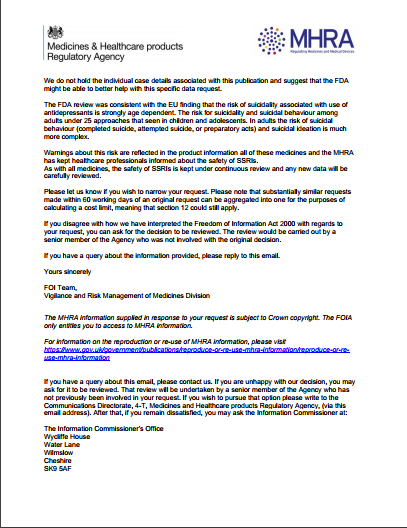
It would appear that the MHRA are now suggesting that my request isn't actually about money. Their response to me does, however, answer a number of questions regarding pediatric trials and SSRIs. They have now told me no person under the age of 24 has ever died in any of the SSRI clinical trials, except for trials involving Lundbeck's two SSRI's, citalopran and escitalopram. The MHRA claim they don't have that information.

So, what about the adult trials?

We know through litigation that GSK's Paxil clinical trials showed 22 people died, 20 of which were death by suicide. But what about the other clinical trials for other SSRIs?

This seems to be an question that the MHRA are, for whatever reason, failing to answer.

With this in mind, and also the time it will take the MHRA to 'research' this information I have, once again, responded to their latest reply to me.

First, here's their latest...


My latest response is short.

Dear MHRA,

I wish to narrow my request.

To save you time (and money)

Here is my first.


How many deaths occurred in the persons aged 24 or over in clinical trials for Prozac. How many were by suicide and how many of those patients were taking Prozac at the time of their death?


--

It seems an arse about face way to request all the information on all the SSRI clinical trials in adults but if they wish for me to send them one request at a time, which it appears they do, then I shall comply so we can eventually get to the bottom of this question and, at the same time, maybe save some lives.

I will, of course, update this blog when the MHRA respond, which, judging by previous correspondence with them, will take approximately one month.

Bob Fiddaman


Friday, May 05, 2017

SSRI Deaths in Clinical Trials


Following on from MHRA Yell "Barracuda!", I have sent the following request (under the terms of the Freedom of Information Act) to the MHRA.

I can't see any reason why they can't answer, given they already confirmed to me, in writing, about the 22 deaths that occurred in Paxil clinical trials.

1. How many deaths occurred in the pediatric trials for Paxil/Seroxat. How many were by suicide and how many of those patients were taking Paxil/Seroxat at the time of their death?

2. How many deaths occurred in the pediatric trials for Prozac. How many were by suicide and how many of those patients were taking Prozac at the time of their death?

3. How many deaths occurred in the persons aged 24 or over in clinical trials for Prozac. How many were by suicide and how many of those patients were taking Prozac at the time of their death?

4. How many deaths occurred in the pediatric trials for Celexa/citalopram. How many were by suicide and how many of those patients were taking Celexa/citalopram at the time of their death?

5.  How many deaths occurred in the persons aged 24 or over in clinical trials for Celexa/citalopram. How many were by suicide and how many of those patients were taking Celexa/citalopram at the time of their death?

6. How many deaths occurred in the pediatric trials for Lexapro/escitalopram. How many were by suicide and how many of those patients were taking Lexapro/escitalopram at the time of their death?

7. How many deaths occurred in the persons aged 24 or over in clinical trials for Lexapro/escitalopram. How many were by suicide and how many of those patients were taking Lexapro/escitalopram at the time of their death?

8. How many deaths occurred in the pediatric trials for Zoloft/Sertraline. How many were by suicide and how many of those patients were taking Zoloft/Sertraline at the time of their death?

9. How many deaths occurred in the persons aged 24 or over in clinical trials for Zoloft/Sertraline. How many were by suicide and how many of those patients were taking Zoloft/Sertraline at the time of their death?

Bob Fiddaman


Tuesday, May 02, 2017

MHRA Yell "Barracuda!"


I think I am familiar with the fact that you are going to ignore this particular problem until it swims up and bites you on the ass!Matt Hooper - Jaws


The above photo and caption are from the movie Jaws. Power and money-hungry Mayor Larry Vaughn, played by Murray Hamilton, refuses to acknowledge that the residents of Amity are at risk of a shark attack. If Vaughn doesn't close the beaches, the shark could harm and kill citizens. Matt Hooper, played by Richard Dreyfuss, is an oceanographer with a special interest in the study of sharks. He uses his knowledge to try and convince Vaughn to protect the town, but Vaughn ignores him. Given the popularity of Jaws (it won an Oscar), I assume we all know the outcome of Vaughn's callous ignorance, right?

I'm not Matt Hooper, but lately, I feel like him. For years I've been at loggerheads with the MHRA as I seek answers to improve public health. Today's blog spotlights my latest correspondence to/from the MHRA about the increased risk of adult suicide posed by Paxil.

The MHRA and FDA know SSRIs are not recommended for consumers under the age of 24 because these products increase the suicide risk. In the US there is a black box warning, and in Europe, the patient information leaflet highlights this increased risk of suicide for any consumers under age 24. It is actually printed in bold face font. (See Doublespeak)

What we don't know is how and why regulatory authorities chose to highlight the product's dangers in consumers under 24 and not communicate the increased suicide risk for consumers over 24.

Let's look at the facts regarding Paxil clinical trials. (Paxil is known as Seroxat in Europe.)

In GSK's Paxil pediatric trials, which included more than 1,000 patients treated with Paxil, there were zero completed suicides. We know this because GSK's vice president for regulatory affairs, Dr. David Wheadon, admitted this in a written statement. What we don't know is how many of the children who were given Paxil developed suicidal thoughts and actions. MHRA and the FDA apparently feel this information is not important for the public's viewing.

In GSK's Paxil adult trials, we know 22 deaths occurred, 80% of which were people over age 30. (See here.) What we now know, thanks to the evidence made public in the Dolin vs. GSK trial, 42 people taking Paxil developed suicidal thoughts and actions.(See here)

So, to sum up: No deaths occurred in Paxil pediatric trials, and 22 deaths occurred in Paxil adult trials. Twenty of these deaths were completed suicides, and 80% of these were people over age 30.

Surely, the MHRA never had this information?

Wrong.

Here's a series of emails between myself and the MHRA. Spelling and grammatical errors from the MHRA are as received.


From: Bob Fiddaman
Sent: 31 March 2017 14:54
To: Pharmacovigilanceservice
Subject: Re: Drug labeling

On the current Seroxat Patient Information leaflet (Revised 11/01/2017) it states, under the subheading "Thoughts of suicide and worsening of your depression or anxiety disorder"...

If you are depressed and/or have anxiety disorders you can sometimes have thoughts of harming or killing yourself. These may be increased when first starting antidepressants, since these medicines all take time to work, usually about two weeks but sometimes longer.

You may be more likely to think like this:

· If you have previously had thoughts about killing or
harming yourself.
· If you are a young adult. Information from clinical
trials has shown an increased risk of suicidal
behaviour in adults aged less than 25 years with
psychiatric conditions who were treated with an
antidepressant.

Q: Could you please explain why "young adult" is in boldface type font and who made the decision to include "young adult" in a boldface type font?

--

From: Pharmacovigilanceservice
To: Bob Fiddaman
Sent: Wednesday, April 5, 2017 10:44 AM
Subject: RE: Drug labeling

Dear Mr Fiddaman

The SPC for Seroxat includes the following:

A meta‑analysis of placebo‑controlled clinical trials of antidepressant drugs in adult patients with psychiatric disorders showed an increased risk of suicidal behaviour with antidepressants compared to placebo in patients less than 25 years old (see also section 5.1).

As the above suggests that this particular age group are most at risk, the MAH will have suggested the emboldening of the text within the PIL. There are fors and againsts the use of emboldening, but in this particular case it has been considered appropriate.

Kind regards,

Chris Penny 
Pharmacovigilance Service Team Manager

--

From: Bob Fiddaman
Sent: 16 April 2017 15:52
To: Pharmacovigilanceservice
Subject: Re: Drug labeling

Chris,

Just so you know.

Plaintiff’s Exhibit 347: Each picture depicts a real person who completed suicide while taking Paxil in a GSK-clinical trial. The red “Vs” mean their specific suicides were violent in nature. There were multiple suicides using firearms, including a murder suicide by one patient. There were also two deaths from people jumping in front of trains.

When it comes to suicide attempts, GSK did not keep track of all the attempted suicides in their clinical trials because, according to their company witness, it would be too burdensome.

My question.

The MHRA knew about these adult completed suicides, correct?


Attachment added to email
--

From: Pharmacovigilanceservice
To: Bob Fiddaman
Sent: Wednesday, April 19, 2017 12:03 PM
Subject: RE: Drug labeling

Dear Mr Fiddaman

I can confirm that the MHRA is notified of all serious adverse events, as laid out in the Pharmacovigilance Clinical Trial legislation.

Kind regards,

Chris Penny 
Pharmacovigilance Service Team Manager

--

From: Bob Fiddaman
Sent: 19 April 2017 17:08
To: Pharmacovigilanceservice
Subject: Re: Drug labeling

Dear Chris,

For clarification. Were the MHRA notified of the 22 deaths that occurred in paroxetine (Seroxat) clinical trials carried out by GSK (SmithKline Beecham) and that 16 of those deaths (80%) were attributed to adults over the age of 30?

--

From: Clinical Trial Helpline
To: Bob Fiddaman
Cc: Pharmacovigilanceservice
Sent: Friday, April 21, 2017 5:19 AM
Subject: RE: Drug labeling

Dear Mr Fiddaman,

As stated in the previous email from Chris Penny the MHRA is informed of serious adverse reactions occurring in clinical trials in compliance with current legislation.


The deaths that you are referring to took place between approximately 1983 and 2003. This data would have been submitted to European Competent Authorities and the suicidality risk of paroxetine was formally addressed at a European level in 2003/2004. Class labelling for a risk of suicide and related thoughts and behaviours was adopted for all the SSRIs based on data reviewed in 2004.


Best wishes,

Rosalind
Clinical Trials Unit
MHRA

--

From: Bob Fiddaman
Sent: 21 April 2017 16:29
To: Clinical Trial Helpline
Cc: Pharmacovigilanceservice
Subject: Re: Drug labeling

Thanks Rosalind.

One final question.

The MHRA have no plans to update the Seroxat label regarding Seroxat-induced suicide in adults over the age of 24, correct?

--

From: Clinical Trial Helpline
To: Bob Fiddaman
Cc: Pharmacovigilanceservice
Sent: Tuesday, April 25, 2017 2:05 PM
Subject: RE: Drug labeling


Dear Mr Fiddaman,

As stated before, class labelling for a risk of suicide and related thoughts and behaviours was adopted for all the Selective Serotonine Reuptake inhibitors (SSRIs) based on data reviewed in 2004. Paroxetine is an SSRI. Suicidal ideation and behaviour is already addressed in the Paroxetine Summary of Product Characteristic (SmPC).


Best wishes,

Rosalind
Clinical Trials Unit
MHRA

--

So, there you have it, folks. The MHRA decided to highlight the increased risk of suicide among consumers under age 24, and they decided not to highlight the increased risk of suicide among consumers over 24.

Why didn't the MHRA feel the need to highlight the 22 adult deaths that occurred in the Paxil trials? It appears the MHRA believes Paxil isn't safe for children, but is safe for adults?

Why, in 2017, is the MHRA still not updating the Paxil warning label for adults?

Why do the MHRA continue to highlight the risk of patients under the age of 24?

I think I know why. GSK already knew that their ideal target market for Paxil was not going to be children. GSK is not allowed to promote Paxil to children (but they still did and were fined for their criminal behavior.)

But GSK was not about to lose Paxil profits when it came to capturing the adult market. MHRA helped them out by emphasizing in the patient information leaflet that the risk is only for consumers under 24. By intentionally printing these specific words, "young adults," in bold face type, MHRA is essentially telling older consumers: "Pay no attention to this increased suicide warning if you are over 24. This product poses no increased risk of death."

Obviously, MHRA should warn older adults by highlighting the 22 deaths and including older adults in the warning. Perhaps MHRA's CEO, Ian Hudson, doesn't want to do this because, whilst under oath in 2000, he stated he had seen no evidence to suggest that Paxil "caused any person, worldwide, to commit an act of homicide or suicide."

I'll leave the final words to Ian Hudson, um, Mayor Vaughn who, despite knowing about the risks created by keeping the Amity beaches open, had this to say...

"You yell barracuda, everybody says, "Huh? What?" You yell shark, we've got a panic on our hands on the Fourth of July."


Bob Fiddaman

Related

Former Glaxo Safety Officer Becomes Head of MHRA

EXCLUSIVE: Dr Ian Hudson: In Defence of the Suicide Pill (Full Video Deposition)

Paxil Suicide - The Way GSK Hid the Link

Dolin Vs GSK - 8.9 Suicide Increase For Adult Paxil Users


Tuesday, April 25, 2017

Explosive News!


I am going to take a rest for a week or so from blogging.

That's not the exposive news folks.

My next post will show correspondence between myself and the MHRA and will show confirmation that they knew about the 22 deaths that occured in Paxil clinical trials, 20 of which were suicides, 80% of which were carried out by patients over the age of 30. 100% of whom were taking Paxil (Seroxat).

In the meantime, all of this needs to sink in.


Plaintiff's Exhibit 347 - Dolin Vs GlaxoSmithKline


Bob Fiddaman.


Monday, August 31, 2015

MHRA: Double Standards


I first became aware of the British drug regulator, the MHRA, adding a copyright notice to Freedom of Information request responses some time ago.

They first did this to me in 2007. I had sent them a series of questions regarding the suicide link in GlaxoSmithKline's antidepressant Seroxat (known as Paxil in the US)

The copyright notice reads...

The information supplied in response to your request is the copyright of MHRA and/or a third party or parties, and has been supplied for your personal use only. You may not sell, resell or otherwise use any information provided without prior agreement from the copyright holder. 

I, as you would expect, took umbrage to this and let my feelings known via this blog (here)

Again, this time in 2014, the MHRA, once again saw fit to include a copyright notice to another response to a Freedom of Information request I had sent them. This was in response to an FOI request I had sent them regarding SSRi adverse reactions of aggression including harmful behavior to others (including injury) Back story here.

Earlier this week I was contacted by Cheryl Buchanan who has, in the past, wrote a guest post for this blog. (here) Cheryl had requested an answer from the MHRA (under the terms of the FOIA) regarding SSRi use in pregnancy. It's important to note that Cheryl has been at loggerheads with the MHRA and citalopram manufacturers, Lundbeck, for some considerable time now.

The MHRA sent Cheryl a response and included a copyright notice. Cheryl wrote back the following to them.

Dear MHRA,
Thank you for responding to my request, I have some further questions which I will sent to you shortly but at the moment I am perplexed as to why you have put a copyright on the response you sent me?  I feel it is within pubic interest to have the data within the response available to anyone who would like to see it. Is every paragraph copyrighted or am I allowed to share any of the information which relates to myself and my own report?

The response from the MHRA was...

Copyright information is included in responses from the agency where data is presented to the requestor. Data given in these types responses has the potential to be taken out of context, and the agency would wish anyone who has requested information from us to include the context when sharing information.
The agency is happy for you to share information released under the Freedom Of Information Act, indeed from the agencies perspective the response is already deemed as being “in the public domain”. The copyright notice is included as the information should be able to be traced back to the MHRA as the source, and as mentioned previously, the context can be included.


So now I'm confused?

You see, when a pharmaceutical company apply for a licence for one of their drugs they are supposed to submit supporting evidence. They do this by cherry-picking the best results from clinical trials. The poor results (ie; those showing that efficacy has not been proven) are never sent to the MHRA.

Here's my take on the MHRA copyright notice.

Would it be fair to say that when pharmaceutical companies submit clinical trial results to the MHRA in support of drug licensing that they include the failed clinical trials...so the actual benefit of a drug isn't "taken out of context"?

Just a thought.

What's good for the goose is good for the gander, right?


Bob Fiddaman.


Please contact me if you would like a guest post considered for publication on my blog.