Zantac Lawsuit


Researching drug company and regulatory malfeasance for over 16 years
Humanist, humorist
Showing posts with label China. Show all posts

Saturday, January 06, 2018

GSK Call In the Fireman


I've recently finished reading, for the second time, John Grisham's excellent, 'The King of Torts', a novel that highlights underhand tactics used by the pharmaceutical industry. 

In 'Torts' we are introduced to a character who goes by many names. To keep this simple I'll just be referring to him as 'Max Pace.' Pace is hired by pharmaceutical companies to douse the flames when it arises that a drug that has been on the market has serious and life-threatening side effects. The information is purposely leaked by the pharmaceutical companies via Max Pace whose job it is to target prosecuting attorneys in the hopes of a quick and cheap settlement. Pace describes himself as a fireman, someone whose job it is to 'put out the fire.'

The character reminded me a great deal of Peter Humphrey, the outsider who was brought in by GSK China to douse the flames of a whistleblower who, at the time, was threatening to spill the beans on GSK China's illegal activities which included, but weren't limited to:


  • Bribing Mark Reily, GSK's head of China Operations, in the form of 'sexual relations' in return for maximizing business for China Comfort Travel (“CCT”). - CCT was an important part of the GSK bribery and promotion scheme because it facilitated a money laundering operation in connection with the bribing of hospitals and doctors who prescribe GSK drugs to patients. 
  • Funneling 3 billion yuan (US$482 million) through this network to recipients. Receipts were forged for purchases and transactions that never took place, including fake conferences.
  • Bribing doctors and other medical staff were to sell GSK products, the cost of those bribes was added to the price of the products that consumers paid for.

Enter the fray Peter Humphrey and his wife Yu Yingzeng who were hired by GSK China to investigate a whistleblower whom they believed was behind a series of emails sent to the company big-wigs, including the then CEO of GSK UK, Andrew Witty. Humphrey and Yu operated ChinaWhys, an International Business Risk Advisory Firm.

Humphrey and Yu were told by GSK China that they believed Vivian Shi, then the company’s government relations head in China, was the whistleblower but they needed proof. The allegations made by the anonymous whistleblower did not concern them.

In a nutshell, it was the job of Humphrey and Yu to create a report on Shi to frame her as a vindictive former employee.

The Sex Tape

Whilst in talks with GSK China, Humphrey, and his wife learned of a sex tape that the anonymous whistleblower had sent in via an email attachment. The sex tape showed Mark Reily and an unnamed woman and was sent to GSK executives along with the corruption allegations. A further 23 emails were sent to Chinese governmental entities throughout China.

GSK told Humphrey and his wife that the allegations had previously been investigated and were false.

According to a court document, during an April 15, 2013, meeting, Humphrey asked GSK officials for copies of the anonymous whistleblower allegations, but GSK refused to provide them. Instead, the document claims, GSK officials stressed that GSK had improved its compliance mechanisms following earlier corruption and other illegal activities that led a DOJ settlement in 2012 ($3 Billion to resolve fraud allegations and failure to report safety data)

The court document. PETER HUMPHREY; YU YINGZENG; CHINAWHYS COMPANY LTD Vs GLAXOSMITHKLINE PLC; GLAXOSMITHKLINE LLC, was filed in United States Court of Appeals for the Third Circuit on 1st January 2018.

More on this 'appeal' later.

In essence, GSK was playing down the allegations, even though they knew them to be true, and using Humphrey and Yu into advancing GSK’s efforts to conceal its bribery activities.

The court document, which I have a copy of, also states:
On June 26, 2013, a GSK employee finally sent two of the whistleblower emails to Humphrey while he was in the United States.
Over the next two days, police raided multiple GSK China offices. Following those raids, GSK senior legal counsel Jennifer Huang asked ChinaWhys to investigate the Public Security Bureau (PSB) and to “prepare an Organic analysis ASAP on the Chinese political regime, particularly on Chinese Communist Party Regime, PSB, and state council with official’s name identified.” 
Humphrey and Huang had a phone call that same day, while Humphrey and Yu were in the United States. Huang said she wanted to investigate the PSB “to find out who’s who in the investigation.” At that point, Humphrey became concerned that GSK was seeking now to obstruct the investigation by Chinese authorities and replied that he could not do anything that could be deemed as violating state secrets and thus could only use public information for his research.
On July 1, while Humphrey and Yu were still in the United States, GSK China’s head of business development, Leslie Chang, asked Humphrey to investigate various government organs. Humphrey refused. Then, after returning to China, Humphrey met again with Mark Reilly (the head of GSK China) in a hotel room as Reilly was preparing to flee the country. At that time, Humphrey advised Reilly that ChinaWhys could no longer provide service to GSK. 
On July 10, 2013, ChinaWhys was raided by the police who told Humphrey, “This was ordered from above. This is related to GSK.”

Around the same time, four senior GSK China executives were also arrested.  In response to those arrests, GSK’s global CEO, Sir Andrew Witty, claimed that GSK’s head office in London lacked knowledge of the whistleblower’s allegations and “had no sense of this issue.” This, according to the court document, was untrue.

Humphrey and Yu were arrested for illegally buying and selling private information and detained for almost a year before their trial. During this year of detention and whilst awaiting trial, GSK stated that its China business “hired ChinaWhys in April 2013 to conduct an investigation following a serious breach of privacy and security” (the Reilly sex tape) but that ChinaWhys was “not hired to investigate the substance of the allegations of misconduct made by the whistleblower.” This, according to the 2018 court document, was a misleading statement by GSK and prolonged Humphrey and Yu’s incarceration because British diplomats attempting to intervene on Humphrey and Yu’s behalf did not have accurate information about what had led to their arrest.

One British official involved in those efforts to intervene on behalf of Yu and Humphrey claimed,“GSK were really cagey. They just kept saying it was routine work and kept the information deliberately vague. When we went to the Chinese we were arguing with one hand tied behind our backs.”

On September 19, 2014,  GSK PLC issued a Statement of Apology to the People of China in which it announced that “GSK China Investment Co. Ltd (GSKCI) has been identified according to Chinese law to have offered money or property to non-government personnel in order to obtain improper commercial gains, and has been found guilty of bribing non-government personnel.” GSK was fined $492 million for its bribery activities in China in the biggest such penalty ever imposed by a Chinese
court. The then GSK CEO, Andrew Witty, stated that “Reaching a conclusion in the investigation of our Chinese business is important, but this has been a deeply disappointing matter for GSK.” In addition, Mark Reilly, the head of GSK China, was convicted for his part in the bribery scheme. He was sentenced to three years prison with a four-year reprieve and ordered deported, meaning he will never serve his sentence.

Humphrey and Yu. however, were treated less favorably. In August 2013 they were both convicted and imprisoned in China under harsh conditions for almost two years in squalid conditions and crowded jail cells. They were both denied urgent medical attention and were separated from each other  Humphrey developed prostate cancer, for which he did not receive proper treatment and as a result, the cancer became life-threatening.

In June 2015, the couple was released from prison.

Humphrey watched the TV coverage of the GSK trial from his Shanghai prison cell. He was shocked by the contrast between his punishment and theirs.

"Suspended jail sentences for three or four of the main culprits when I and my wife had been sentenced to years in prison," he says, adding, "Someone asked me recently why someone like Mark Reilly (GSK China's boss) could be set free and we were in jail. I think it's very simple, we don't have half a billion dollars. That story was about money from the beginning. Money got them into trouble and money got him out."

In November 2016, Humphrey and his wife filed suit against GSK where they sort to seek damages from GSK relating to the loss of their business (ChinaWhys), compensation for the emotional and physical harm and damage to their reputation.

Almost one year later, U.S. District Judge Nitza Quinones Alejandro, threw out the case claiming that a U.S. Supreme Court ruling barred lawsuits filed under the federal Racketeer Influenced and Corrupt Organizations Act (RICO) over injuries that occur entirely outside the United States such as this one involving incidents in China.

“For this reason", he said, "Plaintiffs lack standing to assert civil RICO claims, and these claims are dismissed."

Undeterred, Humphrey and Yu have now appealed this decision, hence the Jan 1, 2018, filing. They are requesting that the United States Court of Appeals reverses the order of the District Court dismissing the Complaint for failure to plead a “domestic injury”.

I covered the Chinagate scandal in great depth when news broke back in 2013. A chronological list of the blogs can be seen below. To date, it's some of the most rewarding research and reporting I've ever done on this old blog of mine.

Remarkably, GSK re-hired the services of Vivian Shi, whom they thought was the whistleblower. Reily, according to MalayMail Online, became part of GSK's senior executive team in London


Bob Fiddaman

BACK STORIES:

Glaxo - The Sex Tape Scandal

GSK's Mark Reilly Accused of Running a "massive bribery network"

I'm Just a Blogger - Here's GSK Served on Prawn Crackers

GSK Hiked Product Prices to Fund Bribery Scam

GSK's Sales Reps Want Their Money Back

GSK's Private Investigator [The Video]

Peter Humphrey's 2012 Presentation - Pharma Bribery

GSK's Chinese Whispers and David Cameron

“GSK were really cagey", Claims Whitehall Official.

Glaxo Hire Ropes & Gray to Delve Into its Chinese Operations.

GSK CHINA - Bribery was Rife 13 Years Ago

Witty Plays Down China Scandal

Witty Witty Bang Wang. The Glaxo Gangbang...Allegedly

Book Your Holidays With GSK Travel

Andrew Witty... I know narrrrrrrrthing


GSK's Sales Reps Want Their Money Back

Glaxo - The Sex Tape Scandal

GSK's Private Investigator [The Video]

Peter Humphrey's 2012 Presentation - Pharma Bribery

GSK's Chinese Whispers and David Cameron

"GSK were really cagey", Claims Whitehall Official

Glaxo Hire Ropes & Gray to Delve Into its Chinese Operations

GSK CHINA - Bribery was Rife 13 Years Ago

GSK's Hired Detectives - Day One, As It Happened

So, What Do You Think, Mr Harvey Humphrey?

GSK Plead Guilty For Being "Very Decent"

Glaxo's PI Released From Prison

The Penny Drops for GSK's Private Investigator

GSK's Mark Reilly and the Word, 'Opaque'

Glaxo and Former Whistleblower Suspect Reunite

GSK China Bought Patient’s Silence for $9,000

Lawsuit Alleges GSK's Witty Lied to the Media - Part I

ChinaWhys Vs GSK - The Claims - Part 2

More Woes for GSK as Peter Humphrey Files Suit


Monday, March 27, 2017

More Woes for GSK as Peter Humphrey Files Suit


GlaxoSmithKline are rarely out of the news. Regular readers will know that I'm covering the wrongful death lawsuit in Chicago, Dolin Vs GSK. Now, it appears the whole squalid 'Chinagate' scandal has, once again, reared its ugly head as Peter Humphrey, who was incarcerated in a Chinese prison, along with his wife, has filed suit against GSK claiming federal racketeering and conspiracy claims under RICO, as well as state law claims for fraud, intentional infliction of emotional distress, negligent infliction of emotional distress, and civil conspiracy.

Glaxo wouldn't be Glaxo if they admitted to any wrong-doing so, in spectacular fashion, they are disputing the complaint, citing that Humphrey should go back to China to arbitrate these claims.

The suit, filed in the United States District Court of Pennsylvania, argues that the case does not have to be filed in China because...

 - Defendants are part of the GSK Group, which holds itself out as an integrated “global healthcare company.” 

 - Directors of GlaxoSmithKline plc manage the risks of the Group at a group level, rather than at an individual business unit level.

 - GSK’s General Counsel, Dan Troy is based in the United States.

GSK’s General Counsel, Dan Troy, is based in the United States and manages the companies 400 lawyers based in Pennsylvania, New Jersey, North Carolina, Belgium and the UK. As discussed further below, Troy “played an active role” in forming GSK’s response to the whistleblower’s revelations of corruption in China.

For those who don't know, Troy is the former Chief Counsel for the FDA. During his time at the FDA he ordered that all decisions to take action against false prescription advertising go through his office -- after which the enforcement actions mysteriously dropped by two-thirds. He also got to work revising the agency's regulations to allow drugmakers to promote drugs for uses not yet supported by clinical research.

Quite a revolving door and Troy is a subject I will be covering soon on this blog.

Meantime, Humphrey's lawsuit intends to highlight, once again, how GSK attempted to bribe doctors around the world by various means in order to increase the sale of their drugs. This, despite  settling a multi-billion dollar settlement agreement with the Department of Justice (DOJ) in 2012.

GSK’s China-based bribery and illegal promotional activities extended to at least June 2013.

More coming soon.

Bob Fiddaman.

More on Peter Humphrey and the Chinagate scandal here.


Sunday, November 20, 2016

ChinaWhys Vs GSK - The Claims - Part 2


Following on from the first parter, Lawsuit Alleges GSK's Witty Lied to the Media - Part I, today sees part 2 (The claims of ChinaWhys against GSK) - Part 3 (Coming later this week) will focus on the incarceration of Peter Humphrey and his wife, Yu Yinzeng and also the rehiring of accused whistleblower, Vivian Shi)

Here is what Peter Humphrey and his wife, Yu Yinzeng, of ChinaWhys, are alleging...


 - Between 2010-2013 GSK spent nearly $225 million on planning and travel services. Approx 44% of the sampled invoices were inflated and approximately 12% were for events that did not occur.

 - GSK set up a special "crisis management" team in order to bribe Chinese regulators with money and gifts. A GSK executive attempted to bribe a Chinese investigator with an IPad and a lavish dinner. All bribes were approved by the head of Chinese operations, Mark Reilly.

 - GSK planned to suppress evidence of its illegal bribery activities.

 - As far back as 2008, GSK China deliberately falsified its books and records in order to conceal its illegal practices in China. These included, bribery and promotion of drugs for purposes that have not been approved by the Chinese authorities.

 - GSK paid a patient RMB 50,000, who nearly died after being given Lamictal off-label. Despite having knowledge of Lamictal causing near death in this patient, GSK still told its reps to promote the use of Lamictal for off-label purposes.

 - GSK targeted 'persuasive doctors' in attempts to influence purchasing decisions at their hospitals. GSK are to said to have forged a connection with these doctors by taking them to expensive lunches and dinners and also giving them gifts and cash.

 - GSK paid between 500 and 1,000 doctors to go on an all-expenses paid holiday to locations such as Brazil, India, Israel, Greece, Japan and Hungary. GSK covered all costs, including cash to cover meals and sight-seeing excursions. These were disguised by GSK as "Conference trips."

 - Head of Chinese operations, Mark Reilly, received a bribe in the form of 'sexual relations' in return for passing business on to China Comfort Travel, a travel agency who organised 'conference sevices' for GSK.

 - GSK paid doctors based on their prescription numbers.

 - GSK's senior legal counsel, Jennifer Huang, asked private investigator, Peter Humphrey, to investigate the Public Security Bureau and to prepare an analysis of the Chinese political regime. Huang told Humphrey that she wanted to find out who's who regarding the team who were investigating GSK.

 - Humphrey became concerned that GSK were trying to obstruct the investigation and declined to investigate state secrets.

 - Humphrey was also asked, by GSK, to look into the Ministry of Public Security, the Economic Crimes Investigation Department regarding the relationship between them and  the Public Security Bureau. Humphrey, once again, declined.

 - Head of Chinese operations, Mark Reilly, told Humphrey that the alleged whistleblower, Vivian Shi was "coming after him." (Humphrey).  Reilly then fled China the following day.

 - GSK China told its employees to "destroy all non-compliant promotional materials and gifts." They also implemented a new email system and deleted emails that were more than a year old. They claimed this was to "reduce unnecessarily legal costs."

--

Bob Fiddaman.

Back Stories from the Fiddaman Blog

Glaxo - The Sex Tape Scandal

GSK's Mark Reilly Accused of Running a "massive bribery network"

I'm Just a Blogger - Here's GSK Served on Prawn Crackers

GSK Hiked Product Prices to Fund Bribery Scam

GSK's Sales Reps Want Their Money Back

GSK's Private Investigator [The Video]

Peter Humphrey's 2012 Presentation - Pharma Bribery

GSK's Chinese Whispers and David Cameron

“GSK were really cagey", Claims Whitehall Official.

Glaxo Hire Ropes & Gray to Delve Into its Chinese Operations.

GSK CHINA - Bribery was Rife 13 Years Ago

Witty Plays Down China Scandal

Witty Witty Bang Wang. The Glaxo Gangbang...Allegedly

Book Your Holidays With GSK Travel

Andrew Witty... I know narrrrrrrrthing

The Penny Drops for GSK's Private Investigator.

GSK China Bought Patient’s Silence for $9,000

Lawsuit Alleges GSK's Witty Lied to the Media - Part I

Thursday, November 17, 2016

Lawsuit Alleges GSK's Witty Lied to the Media - Part I


Lawsuit Alleges GSK's Witty Lied to the Media - Part I  
~ Bob Fiddaman


A 42 page complaint was filed on November 15, 2016, by Peter Humphrey and his wife, Yu Yingzeng, in relation to GSK's nefarious activities in China which saw the pair incarcerated for around 2 years in Chinese slum-like conditions prison cells.

The complaint delves deep into the whole sordid affair and alleges bribery on a huge scale, more importantly, the complaint alleges that GSK hired the services of Humphrey and Yu in efforts to smokescreen the corruption in China, corruption, according to the complaint, that they had known about for many years. Furthermore, the 42 page document alleges that GSK's CEO, Andrew Witty, lied to the media when he was asked about the corruption in China.

Humphrey and Yingzeng were the founders of ChinaWhys, a professional-services consultancy that specializes in discreet risk mitigation solutions, consulting and investigation services to corporate clients in matters of high sensitivity across Greater China and the Asia Pacific.

On April 15, 2013, Humphrey met with GSK's Head of Chinese operations, Mark Reilly, April Zhao, GSK China legal counsel and Brian Cahill, also GSK legal counsel. It was at this meeting that Humphrey was told that GSK had been sent a series of emails from a whistleblower alleging widespread corruption - GSK told Humphrey that they believed they knew who the whistleblower was.

Vivian Shi had previously worked for GSK as a government affairs director, GSK had terminated her services with them in December 2012. According to the complaint GSK claimed that Shi had orchestrated a "smear campaign" against GSK involving a total of 23 emails that had been sent to Chinese officials throughout the country, a letter had also been sent to GSK's 'top management' alleging widespread corruption in GSK's pharmaceutical and vaccine business that had been approved by GSK China's senior management.

These were allegations brought to Humphreys attention just months after GSK had been fined a record breaking $3 billion by the Department of Justice in America - the fine was handed down after a guilty plea by GSK who, after the settlement, entered into a five-year Corporate Integrity Agreement with the Office of Inspector General of the Department of Health and Human Services. The agreement requires enhanced accountability, increased transparency and wide- ranging monitoring activities conducted by both internal and independent external reviewers.

One month after meeting with GSK officials Humphrey was told that GSK's global CEO, Andrew Witty, had been made aware that GSK had been using a travel agent to channel kickback to customers and doctors throughout China. Days after Witty had been made aware, the whistleblower also sent a video to him and other senior management that showed GSK China's Mark Reilly engaged in sexual activity - Reilly later claimed that the woman in the video was his "regular girlfriend".

GSK officials told Humphrey that they had launched their own internal inquiry regarding the whistleblower allegation and that they were false. They told Humphrey, "There is nothing there". This, according to the complaint, was a lie.

Humphrey and his wife offered to investigate the whistleblower allegations but GSK declined the offer, opting instead for Humphrey to investigate Vivian Shi, the woman they believed was the whistleblower.

Two months after Humphrey and Yu started their background search of Vivian Shi, GSK received another letter from the whistleblower alleging that GSK China continues to engage in systematic bribery of doctors, this email focused on GSK China's botox business whereby the whistleblower claimed that...

GSK had a 'pay to prescribe' scheme that funneled money through a central source at Beijing Medical College whereby 'lecture fee payments' were made to doctors who could "...incentivize and reward doctors for prescribing Botox."

At no point did GSK show either Humphrey or Yu this letter.


On June 12, 2013, the Wall Street Journal (WSJ) ran an article highlighting GSK China's massive bribery network. In July of that year 4 senior GSK China executives were arrested and, according to Humphrey's filed complaint, GSK CEO, Andrew Witty told the worlds media that "...it appears that certain senior executives in the Chinese business have acted outside of our processes and our controls to both defraud the company and Chinese healthcare system." Witty also claimed that GSK's Head office in London lacked knowledge of the whistleblower allegations and "had no sense of this issue."

According to the complaint, this made no sense as since the previous month GSK did, indeed, "have a sense" of the issue since it announced its 4 month internal investigation into allegations of bribery and corruption in China and found "No evidence of corruption or bribery."

The complaint states...

Witty argued, nonsensically, that the previous whistleblower allegations were "quite different" from the more recent charges, saying, "they are two completely different sets of issues, we fully investigated the first and, of course, this has now surfaced in the last couple of weeks."
This was a lie, since "what surfaced" in the PSB investigation and raids of GSK offices in July was precisely the illegal activity that the whistleblower had documented and threatened to reveal in January.

The complaint was filed in The United States District Court for the Eastern District of Pennsylvania.

Humphrey and Yu are represented by Boies, Schiller & Flexner LLP


**Coming in Part 2**
 - A full and comprehensive list of the allegations made by Peter Humphrey and Yu.
 - GSK ask Humphrey to 'overtly' obstruct the Chinese government investigation.
 - Evidence, including emails, to be destroyed as not to implicate any wrong-doing by the company.


Bob Fiddaman


Back stories.

Glaxo - The Sex Tape Scandal

GSK's Mark Reilly Accused of Running a "massive bribery network"

I'm Just a Blogger - Here's GSK Served on Prawn Crackers

GSK Hiked Product Prices to Fund Bribery Scam

GSK's Sales Reps Want Their Money Back

GSK's Private Investigator [The Video]

Peter Humphrey's 2012 Presentation - Pharma Bribery

GSK's Chinese Whispers and David Cameron

“GSK were really cagey", Claims Whitehall Official.

Glaxo Hire Ropes & Gray to Delve Into its Chinese Operations.

GSK CHINA - Bribery was Rife 13 Years Ago

Witty Plays Down China Scandal

Witty Witty Bang Wang. The Glaxo Gangbang...Allegedly

Book Your Holidays With GSK Travel

Andrew Witty... I know narrrrrrrrthing

The Penny Drops for GSK's Private Investigator.

GSK China Bought Patient’s Silence for $9,000


Wednesday, November 09, 2016

GSK China Bought Patient’s Silence for $9,000


A truly fascinating read regarding the corruption in China, all committed by the hand of British based pharmaceutical giant, GlaxoSmithKline.

The New York Times (NYT) recently ran a superb article regarding GSK's nefarious activities in China, activities that saw them plead guilty, a result of which saw them being handed down a $500 million dollar fine.

The article by David Barboza, although brilliant, is tantalizing, in as much that The Times claims to have in its possession emails and documents, none of which they have provided, at least in their entirety.

The China scandal is a story of greed, corruption, cover-ups, bribery and pay-offs, all combined with a sex scandal video and a company burying it's head in the sand over its China practices - preferring instead to go after the person who blew the whistle on the whole sordid affair.

It's a subject I covered many times on this blog (Links at the foot of this post) and one that seems to be rehashed with additions on a regular basis.

The Times article throws out some very interesting facts about the case that were previously kept under wraps - one such fact being that they (The Times) have evidence that "Glaxo “almost killed one patient by illegally marketing its drug Lamictal,” said the email, which was obtained by The Times. “GSK China bought the patient’s silence for $9,000.”"

Glaxo buying a patient's silence? Surely not?

There was me thinking they only did that in litigation, Paxil withdrawal (Over 3,000 patients 'paid off') - Paxil Birth defects (Over 800 patients 'paid off')

So, who was the patient in receipt of Glaxo's $9,000, moreover, what did this patient have that GSK didn't want others to see?

According to the NYT...

The email was one of nearly two dozen that the whistle-blower sent over the course of 17 months to Chinese regulators, Glaxo executives and the company’s auditor, PricewaterhouseCoopers.

In 2012 Glaxo plead guilty to a whole host of violations throughout America, the guilty plea resulted in a record breaking fine of $3 billion. At the time, Glaxo Chief, Andrew Witty, pledged, “We’re determined this is never going to happen again.”

Witty, who had been made aware of the unfolding stench in China shortly after the 2012 guilty plea in the US, is stepping down from his CEO position in April next year - It's quite a legacy he has left behind, one which he took over from former Chief, JP Garnier who, in essence, oversaw the corruption in America and left Witty to suck up the fallout.

What an abhorrent company this is. Corruption, bribery (of officials and patients) and the manufacturer of prescription meds that have either killed people or disfigured them in such a way that they need to continue having surgery for the rest of their lives. Let's not forget those that have suffered as a result of becoming addicted to GSK's medications either.

The Times article also digs deeper into the involvement of Mark Reilly, who, at the time, was Head of GSK's China operations. They claim...

An email alleged that Mr. Reilly, a British national who had helped manage the company’s China operation for four years, was complicit in a bribery scheme tied to a travel agency called China Comfort Travel, or C.C.T. According to the email, Glaxo funneled money through the travel agency to pay off doctors. The travel agency also supplied Mr. Reilly with women, as a way to secure that business.

“In order to acquire more business, C.C.T. bribed Mark Reilly, the general manager of GSK (China) with sex,” the email said. “Mark Reilly accepted this bribery and made C.C.T. get the maximized benefits in return.”

That's some perk to have!  China Comfort Travel bring a whole new meaning to the word 'comfort'.

Any jobs going whereby the employer offers a bonus of playing hide the salami?

I'm sure red-blooded males would have been first in-line for such a job working for a company complicit in fraudulent activities. Sadly, for those red-blooded males at least, Reilly was offered (and took) the perk - I wonder if he claimed for the 15 minutes of overtime too? (Assuming that Reilly could last that long in the sack)

When faced with over 17 months of emails from the whistleblower Glaxo decided to seek help, they did so by hiring a private investigator, Peter Humphrey and his wife, Yu Yingzeng.

Humphrey did some digging and, at the time, provided information to Glaxo that pointed to the possible whistleblower. Vivian Shi, was a 47-year-old executive handling government affairs in Glaxo’s Shanghai office, I say former because she was previously fired by GSK for their belief (Before Humphrey was hired) that she was behind the whistleblowing allegations. The 'official' line of her dismissal was that she had been falsifying travel expenses.

Humphrey, it appears, was merely suggesting that Shi may have been involved - he, at no time, ever provided GSK with any evidence that their former executive was the one who was whistleblowing. Shi, who remember had already left GSK, denied any part in the whole Chinagate scandal.

During his investigations Humphrey obtained information that was deemed to be by false means according to Chinese officials. Both he and his wife were later arrested, charged then sent to prison. Meantime, Reilly, who was the mastermind of the whole scam, was sent back home to the UK - No jail time. It's unknown what Reilly is doing today, presumably he doesn't work for GSK in any capacity, although I wouldn't put it past them to re-hire him, just as they did with Vivian Shi, the very person they had fired because they thought she was the one blowing the whistle on its Chinese operations.

Remarkably, GSK re-hired Shi last year, although it is unclear in what capacity. (See Glaxo and Former Whistleblower Suspect Reunite)

GSK must be a truly great company to work for, not only do they offer, by proxy, free blowjobs to heads of operations but they re-hire you after previously sacking you for, ahem, "falsifying travel expenses."

The Times article is a must read and once again highlights how GSK prefer to target people who bring the company's misdemeanors to their attention rather than target the person carrying out the misdemeanors.

GSK Corporate motto claims, "We are dedicated to improving the quality of human life by enabling people to do more, feel better, live longer." - I just never knew this included blowjobs via complicit bribery deals - the re-hiring after breaking rules - and buying patients silence.

Nice job (blow) Glaxo!

Bob Fiddaman

Back Stories

Glaxo - The Sex Tape Scandal

GSK's Mark Reilly Accused of Running a "massive bribery network"

I'm Just a Blogger - Here's GSK Served on Prawn Crackers

GSK Hiked Product Prices to Fund Bribery Scam

GSK's Sales Reps Want Their Money Back

GSK's Private Investigator [The Video]

Peter Humphrey's 2012 Presentation - Pharma Bribery

GSK's Chinese Whispers and David Cameron

“GSK were really cagey", Claims Whitehall Official.

Glaxo Hire Ropes & Gray to Delve Into its Chinese Operations.

GSK CHINA - Bribery was Rife 13 Years Ago

Witty Plays Down China Scandal

Witty Witty Bang Wang. The Glaxo Gangbang...Allegedly

Book Your Holidays With GSK Travel

Andrew Witty... I know narrrrrrrrthing

The Penny Drops for GSK's Private Investigator.


Thursday, January 21, 2016

Two Former Glaxo Scientists Charged With Trying to Steal Data


It never rains but it pours for poor old Andrew Witty. Last week it was learned that he had been implicated for ignoring the claims of an employee that dishonest study data was used to promote the effectiveness of a smoking-cessation product, NiQuitin. And now the company that he is CEO of are (yet again) in the news.

It appears that the dust hasn't yet settled in China and two former scientists at a GlaxoSmithKline research facility in Pennsylvania have been indicted for allegedly scheming to steal data on an in-development cancer drug from the research facility and sell them in China.

Yu Xue and Lucy Xi were scientists working at GSK's research facility in Upper Merion, Pennsylvania and had allegedly engaged in a scheme to steal GSK research data, procedures and manufacturing processes for biopharmaceutical products.

Xue, it is alleged, emailed confidential information from her GSK email account to her personal email account so she could then forward it to Li and Mei, two of three others named in the complaint, with whom she, in 2012, founded Chinese companies Renopharma Inc., Nanjing Renopharma Ltd. and Shainghai Renopharma Ltd.

Although this doesn't show GSK in a bad light it does beg the question about the security at GSK.

The indictment charges all five people with conspiring to fraudulently obtain property from GlaxoSmithKline, theft and wire fraud, according to Business Insider.

It's a pity we don't get Glaxo employees trying to steal GSK's procedures for researching, developing and manufacturing other products, Paxil and Wellbutrin for example. Or maybe more of their reps coming forward and blowing the whistle on the illegal promotion of these two particular antidepressants.

So, already in 2016 we have two news stories featuring British pharmaceutical giant, Glaxo. One showing that dishonest study data was used to promote the effectiveness of NiQuitin, the other for showing how two of their own employees breached security and tried to pass off trade secrets.

Ah well, they're getting better - at least no kids have died as a result of their latest shenanigans.

Bob Fiddaman.


Tuesday, November 10, 2015

Pfizer: The Scooby Gang Are On The Case.


If you still believe that pharmaceutical companies have opened their doors and are being transparent then look no further than a recent report from the lawyer-based website, Law360.

Your illusions delusions will be shattered.

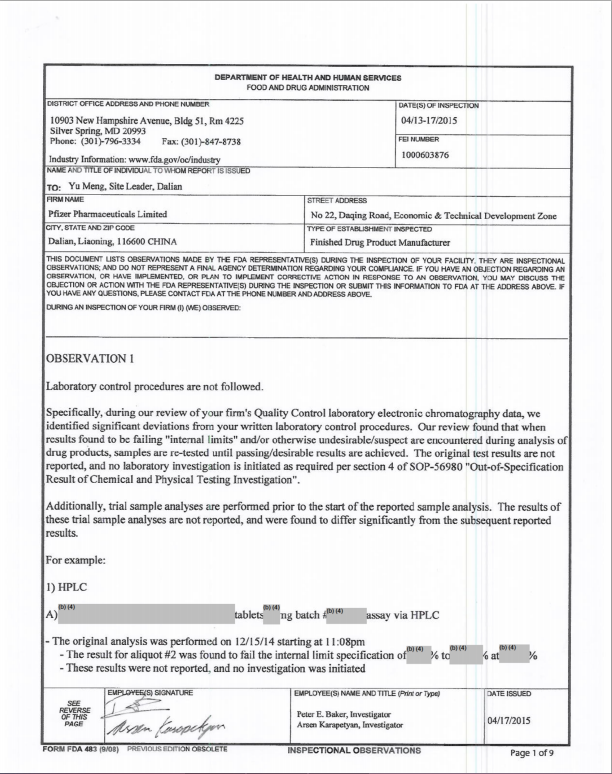
Law360 are reporting on a recent investigation into Pfizer by the U.S. Food and Drug Administration (FDA)

Let me tell you folks, it's straight from the production team of Hanna Barbera. It's definitely a case for Scooby-Doo, Fred "Freddie" Jones, Daphne Blake, Velma Dinkley and Norville "Shaggy" Rogers.

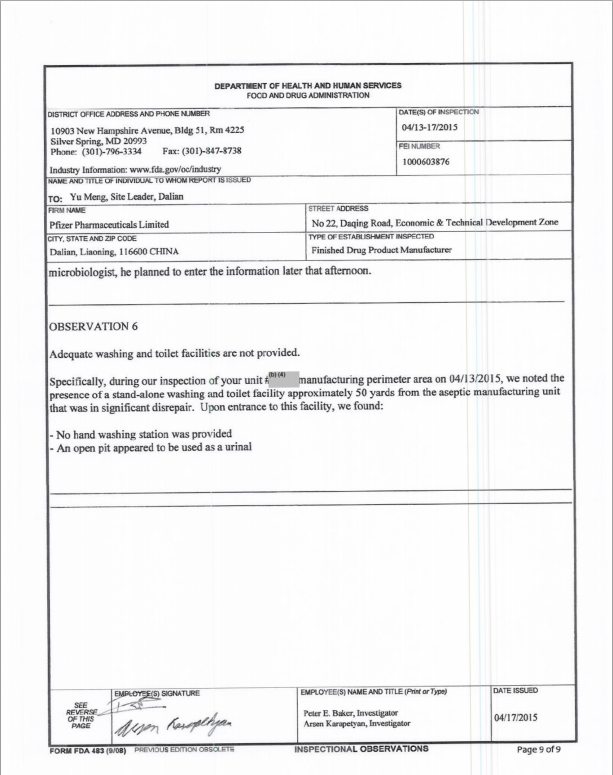
It appears the FDA are being given the runaround by Pfizer officials who, it seems, are covering up manufacturing lapses at one of their sites in China.


According to the FDA, when Pfizer encountered "undesirable/suspect" test results, it simply performed new tests until satisfactory results were achieved.
"The original test results are not reported, and no laboratory investigation is initiated," the FDA wrote.
Agency officials also recounted fishy circumstances surrounding the availability of records. According to the report, investigators at one point noticed an 8-inch stack of documents in a room, then returned 10 minutes later to find that the stack had disappeared. When the investigators requested that the records be returned, only one-third of the papers were brought back, and the rest were later discovered stashed in a wooden crate in a construction area, the report said.
Subsequent analysis of those records revealed that Pfizer's internal documents contained conflicting data as well as references to possible use of expired ingredients, the 483 added.
Further, Pfizer's quality control unit lacked suitable oversight of records, and employees on occasion failed to document certain activities in a timely manner, according to the 483.

Never has the term "LOL" been more appropriate.

An 8-inch stack of documents that miraculously disappears into thin air, only to return somewhere else on the Chinese site... with two thirds of the stack missing! The likes of Dynamo, David Copperfield, Penn & Teller and even Paul Daniels must be quaking in their magical boots.

Scooby Dooby Doo, Where are you?
We've got some work to do now.

Scooby Dooby Doo, Where are you?
We need some help from you now.


Pfizer have responded in typical fashion...

"Materials and that drugs produced at the site met every national and international testing specification."

Thanks for clearing that up folks.


In other news, I recently bid on eBay for the complete series of Scooby Doo. I came so close to winning, but was outbid at the last second! I would have got away with it too, if it weren't for those meddling bids!

:-)

The FDA's 9-page warning letter to Pfizer below.


PS - I'd still do Daphne.


Bob Fiddaman.


Wednesday, October 28, 2015

Andrew Witty: The Art of Deflection.


Sir Witty should have been a politician. Very adept at answering a question...with a question.

Here's a recent interview with Evan Davis, Presenter, Newsnight, BBC

Skip to 29.40. Transcript for this section is below video.


Transcript. 29.40

Evan Davis
I'm going to open it to the floor in a second, because we do want to leave half the session for the audience to ask questions. I'll just finish with kind of a general reflection, because it is interesting, and it's nice when you talk about the drugs and what they cure, what the treatments are. Don't you find it very interesting that the pharmaceutical industry has a bad reputation? We read about the China corruption, we read about profits, we read about profiteering. It is an industry that saves lives, no one can dispute that. It's an industry that produces pills that are completely transforming for people's welfare. Yet, it's actually not a terribly popular industry. I just wonder if you can explain that paradox. Is it that you've done bad things and that's been recognized, or is there somehow something the public don't understand about the industry that makes them feel negative about it? Or am I wrong in thinking there's a slight [indiscernible] around it?

Andrew Witty
No, clearly – first of all, I think we are, slightly alongside any big industry, or any big institution, there is a bit of that. We are big companies, we're global. Again, like any big organization, you're vulnerable to your weakest link in the organization. So if something goes wrong, particularly in today's social media world – I often think about what it must have been like to run a global company in the 1970s, where you had to wait for the ship to arrive to find out what happened on the other side of the world. Today, the Wall Street Journal calls you before you've even heard about something inside your own company. So I do think there is a certain phenomena where – and you see that across many, you look at it in politics, you look at it in newspapers. The hacking stories, all things like that. So I think it's a bit of that. I do think – let's be honest, nobody wakes up in the morning hoping that they're going to need a drug from GSK. You don't wake up in the morning thinking, actually, if it's a really good day, I might be diagnosed to be ill and I might need a drug. So we're not aspirational in that sense. So you start by saying, actually, I've got some bad news, because I've been told I'm not very well. They then said: we might have some good news, because there's something we can help you with. Then in some countries, I have to pay for it. Or in Britain, you might go to the doctor and they say: actually, I'd like to give you this, but NICE have said I can't. So then there's a whole series of reasonably negative concepts around pricing. So there's a bit of that. Then you've got – actually, we do occasionally make mistakes. Things go wrong. We have inevitably – of course, we go through all the processes with the regulators to get a drug to be as safe and effective as it can possibly be. But the reality is, every time a human takes a drug, it's like a clinical trial. You don't really know what's going to happen. Everybody can react a different way. So on the one hand, what is the story of the drug industry? The story of the drug industry is wonder drugs. On the other hand, it's danger drugs. Those are the two extremes that we have. It's kind of unavoidable.

Evan Davis
But you're saying there are bad apples, and it goes wrong. Is that right, or is it – for example, in the China case. Was it that there was a bad apple and it went wrong, or was it that that was normal behaviour in certain markets, and it just got called out in that particular case?

Andrew Witty
For obvious reasons, I'm not going to get into all the details of that.

Evan Davis
Was that behaviour actually something, or was it just a slight extension of behaviour that is normal?

Andrew Witty
I think the bigger question is, where do you want to go forward?

Evan Davis
No, but just answer that one.

Andrew Witty
There's no doubt, if you ask the more general question – so there have been concerns over the years of, is the drug industry transparent enough? What's the relationship of the drug industry with doctors? All of those are kind of concerns – let's call them concerns or reasons for anxiety, whatever they are. Sometimes they've spiked up into real issues. What we've really tried to do, and we're beginning to see some other companies, I think, following a similar direction, is we've said: you know what? We get that. We get that transparency is a cause of concern. People are worried that something is being hidden. We didn't think there was but people – perception is everything, right? So what did we do? We came out and said: we will publish every single bit of clinical data we have in the company. We are the only company to do that at this point. Every single thing. If a researcher wants to know exactly what the data was on patient number – all anonymized, but on Patient 1002, in Clinical Trial 87, from 2002, we will give them that information. All the way through, we'll do that. We've said we will stop all payments to physicians to speak on behalf of the company. It's a perfectly legal practice, everything the company has done – but we stopped it all.

Evan Davis
But this is a recognition – there is a lot you've done to present these things differently. But it is a recognition that it was pretty dysfunctional before, isn't it? Because publishing data, to me, honestly, doesn't seem like a great achievement. It just seems to me that that's what you should be doing with data. Not bribing doctors seems like a thing you would do.

Andrew Witty
I wouldn't say it's bribing doctors – it's perfectly legal to pay. If you went to a physician and said, would you expect to be paid for speaking on behalf of somebody, they will probably say yes. Actually, in most countries in the world, it's perfectly legal. However, there are risks it can be abused. People can make mistakes. And there are risks that there is a misperception. Just to your point on publication, do you think academics are mandated to publish their data? Do you think universities publish all their failed studies? They don't, but we do.


One box of chocolates for the first person to tell me how many times Witty deflects the questions put to him.

**Footnote

GSK were forced to be transparent, they didn't just decide one day that they were going to be the first pharmaceutical company to "open it's doors" (Halfway)

This from the Department of Justice/GSK agreement

"Among other things, the CIA also requires GSK to implement and maintain transparency in its research practices and publication policies and to follow specified policies in its contracts with various health care payors."

Also...

"Moving forward, GSK will be subject to stringent requirements under its corporate integrity agreement with HHS-OIG; this agreement is designed to increase accountability and transparency and prevent future fraud and abuse."


I think the bigger question is why did Witty fail to mention that his company were forced to be more transparent.

I'll leave the last words to Witty...

"It's a perfectly legal practice, everything the company has done..."


Bob Fiddaman.

Original video here.


Tuesday, August 04, 2015

Glaxo and Former Whistleblower Suspect Reunite


Straight out of a Mills & Boon romance novel comes news that Vivian Shi and GlaxoSmithKline have joined forces again.

The whole Chinagate scandal is one that keeps resurfacing.

For those who haven't been following, I'll try and break it down with bullet points.


  • GSK executives were sent a series of emails that alleged that bribery was rife amongst their operations in China and the main man behind the bribery network was GSK's Mark Reilly.
  • GSK then hired the services of ChinaWhys, a company run by Peter Humphrey and his wife.
  • Humphrey targeted Vivian Shi, GSK's former head of government affairs. 
  • According to Jim Edwards over at Business Insider, "Inside GSK, management suspected that Vivian Shi, the company's head of government affairs, sent the emails. There was no evidence, but GSK investigated her travel expenses and eventually she left the company sometime after October 2012 along with her boss, John Lepore, who joined media group Reed Elsevier as head global government affairs.
  • Vivian Shi had, some years previously, been fired. GSK said it was on the grounds of alleged irregularities in travel expenses.
  • Investigating partners Peter Humphrey and his wife, Yu Yingzeng, were  released from a Chinese prison early last month after each serving close to two years, a sentence that was based on charges of "illegally obtaining private information."
  • Mark Reilly, who originally told Humphrey that the whistleblower allegations were false, later went on to plead guilty. He was given a suspended prison sentence and deported.
  • Glaxo were fined £300 million and issued a public apology for their corrupt behaviour.

Now, it appears, Glaxo and Shi have kissed and made up. Reuters are reporting that Glaxo have rehired Shi, although it is unclear in what capacity they have rehired her for.

This is almost as bizarre as Bobby Ewing and the famous shower scene.

More news coming if and when updated.


Bob Fiddaman.


Sunday, July 12, 2015

GSK's Mark Reilly and the Word, 'Opaque'


I'm somewhat confused.

I had to check out the word 'transparency' and then seek the opposite of that word.

Opaquenot able to be seen through; not transparent.

Okay, so now I understand.

So, would it be safe to suggest that Mark Reilly, the former boss of GlaxoSmithKline in China, was being Opaque when he first met and spoke with the private investigator he hired to look into whistleblower allegations?

Here's where the confusion, for me at least, comes back again.

An article appeared today in The Sunday Times. It's a fascinating read and digs a little deeper into the whole GSK Chinagate scandal. (It's subscription only but can be read courtesy of The Truthman blog - here)

See if you, like me, are confused.

GSK’s troubles began in the autumn of 2012 when a whistleblower contacted the Chinese pharmaceutical regulators alleging massive bribery and corruption by the company’s sales force in China. 
Mark Reilly, GSK’s country manager for China, hired Humphrey to investigate the source of the complaints, telling him the allegations were “false and defamatory”.

Now, lets take a look at The Guardian's coverage of the trial of Mark Reilly.

The British former boss of GlaxoSmithKline in China will be deported back to the UK after pleading guilty to bribery-related charges and being handed a three-year suspended prison sentence.

You can understand my confusion here, right?

Would it be false or defamatory to call Mark Reilly a liar?


Just asking.


Bob Fiddaman.


Related - The Penny Drops for GSK's Private Investigator.


Please contact me if you would like a guest post considered for publication on my blog.