It's anticipated that the book should be on sale by the start of April.
Here's the cover.
ORDER THE PAPERBACK
'THE EVIDENCE, HOWEVER, IS CLEAR...THE SEROXAT SCANDAL' By Bob Fiddaman
SIGNED COPIES HERE OR UNSIGNED FROM CHIPMUNKA PUBLISHING
"It's not about what they tell you, it's about what they don't."
~ Bob Fiddaman, Author, Blogger, Researcher, Recipient of two Human Rights awards
Researching drug company and regulatory malfeasance for over 16 years
Humanist, humorist
Showing posts with label bobfiddaman. Show all posts
Tuesday, March 08, 2011
Thursday, March 03, 2011
Teacher sacked for making a stance against the drugging of children
There comes a time in life when you have to stand up for what you believe in.
Tarah Ausburn has stood up. She has been counted.
She may be opinionated but by God, she has my total respect.
Tarah was fired from her job at Imagine Prep High School because she took a stance with regard to the way drugs are handed out to children like candy. Tarah decided to make her voice heard via a bumber sticker on her car which read, "Have you drugged your kid today?"
Woman deserves an award if you ask me.
More at CCHR
Want to show your support for Tarah? Sign the online petition. Time for YOU to stand up and be counted.
Some browsers may not be picking up the petition widget I added to this post. Fear not...here's a direct link to the petition. - SIGN
Fid
ORDER THE PAPERBACK
'THE EVIDENCE, HOWEVER, IS CLEAR...THE SEROXAT SCANDAL' By Bob Fiddaman
SIGNED COPIES HERE OR UNSIGNED FROM CHIPMUNKA PUBLISHING
GSK Boss - Pay Slashed
| Current GSK Chief Exec Andrew Witty. Image: thelancetstudent.com |
GSK's Chief Executive, Andrew Witty, has had his annual salary cut due to plunging sales of the controversial diabetes pill Avandia, writes Reuters.
Witty took over the sinking ship a couple of years ago from French multi-millionaire and Monty Burns look-a-like, Jean-Pierre Garnier.
| Former GSK Exec JP Garnier Image: bbc.co.uk |
Witty's annual salary dropped £714,000 in 2010.
Reuters writes:
"The shortfall followed plunging sales of controversial diabetes pill Avandia, which was withdrawn from the market in Europe last autumn and severely restricted in the United States after being linked to increased heart risk.
"Witty received an unchanged base salary of 1 million pounds in 2010 but had his bonus reduced by 41 percent to 1.177 million from 2 million in 2009, GSK said in its annual report on Wednesday."
Any spare change, guv?
It amazes me that a Chief Executive in charge of a company, be it Witty or his predecessor Garnier, still walk the streets. Glaxo's lists of misdemeanors seem never ending. Paxil [UK name Seroxat] being top of their shit list...ahem, I mean hit list.
So, when exactly did the rot set in at GlaxoSmithKline?
Come take a journey with me...in video.
Hat-Tip - Pharmagossip
Fid
ORDER THE PAPERBACK
'THE EVIDENCE, HOWEVER, IS CLEAR...THE SEROXAT SCANDAL' By Bob Fiddaman
SIGNED COPIES HERE OR UNSIGNED FROM CHIPMUNKA PUBLISHING
Monday, February 07, 2011
Step up to the plate - Dr. Alex Yellowlees
I was utterly flabbergasted this morning when I learned that yet another "media doctor" was handing out stone-age advice regarding the safety and efficacy of antidepressants.
In an article by Julie Anne-Barnes that appeared in the Scottish Daily Mail, she quotes a certain Dr. Alex Yellowlees, who apparently 'specialises in the treatment of depression'
She writes:
Yellowlees, according to his online biography, is much sought after by the media for comment on a wide range of psychological issues. His online biography also claims that he is a specialist in eating disorders and is a Medical Director of the Priory Hospital situated in Glasgow, Scotland.
Newspaper articles can often misquote and/or quotes can be taken out of context. If Yellowlees can show me where there is evidence that SSRi's are "so low on side effects" and that is the reason they are "popular".
The MHRA Yellow Card reporting system would suggest that Yellowlees has either been misquoted or he just doesn't know what he is talking about. Search the MHRA Print Outs for adverse reactions to SSRi's.
Early last year I wrote about another "media doctor", Dr Hilary Jones. Jones often gives advice on GMTV, a programme watched by many millions. Jones also gives advice online.
Here's an email he received and his subsequent 'advice'
Should I stop my antidepressants?
Q: After losing my job last year I was diagnosed with mild depression and prescribed Seroxat. I've been on the tablets for a few months and feel much better now. Is it OK to just stop taking them? Jemma, 29
"Stop taking a tablet every third day for a fortnight, then every other day for a fortnight. Then you should be ready to stop altogether."
Bad advice Dr Jones.
Bad advice Dr Yellowlees.
Here's the article where Yellowlees is quoted:
Special thanks to Annie Bevan for sending the scanned article to me.
ORDER THE PAPERBACK
'THE EVIDENCE, HOWEVER, IS CLEAR...THE SEROXAT SCANDAL' By Bob Fiddaman
SIGNED COPIES HERE OR UNSIGNED FROM CHIPMUNKA PUBLISHING
In an article by Julie Anne-Barnes that appeared in the Scottish Daily Mail, she quotes a certain Dr. Alex Yellowlees, who apparently 'specialises in the treatment of depression'
She writes:
"Consultant psychiatrist Dr Alex Yellowlees, who specialises in the treatment of depression, said that the number of prerscriptions for antidepressants had increased rapidly because of their effectiveness.
"He said: 'They work for quite a range of conditions, whether it is anxiety or depression, and there is good therapeutic evidence that they work.'
"'The fact they can deal with a number of issues and are so low on side effects means they are going to be popular.They are clinically effective.'
Yellowlees, according to his online biography, is much sought after by the media for comment on a wide range of psychological issues. His online biography also claims that he is a specialist in eating disorders and is a Medical Director of the Priory Hospital situated in Glasgow, Scotland.
Newspaper articles can often misquote and/or quotes can be taken out of context. If Yellowlees can show me where there is evidence that SSRi's are "so low on side effects" and that is the reason they are "popular".
The MHRA Yellow Card reporting system would suggest that Yellowlees has either been misquoted or he just doesn't know what he is talking about. Search the MHRA Print Outs for adverse reactions to SSRi's.
Early last year I wrote about another "media doctor", Dr Hilary Jones. Jones often gives advice on GMTV, a programme watched by many millions. Jones also gives advice online.
Here's an email he received and his subsequent 'advice'
Should I stop my antidepressants?
Q: After losing my job last year I was diagnosed with mild depression and prescribed Seroxat. I've been on the tablets for a few months and feel much better now. Is it OK to just stop taking them? Jemma, 29
A: The symptoms of depression vary but can include feeling exhausted, tearful, guilty, worthless, and being unable to sleep or eat. When you lost your job you probably experienced some of these symptoms.
It's great that you feel better now, but do you know what has brought about this change? Hopefully you have overcome the problems you suffered when you lost your job, but the Seroxat you've been taking will have boosted the serotonin levels in your brain, making you feel happier.
Your body is used to the effects of the pills, so if you stop taking them suddenly you can experience side effects such as disturbed sleep and flu-like symptoms. Talk to your GP - he may suggest you wean yourself off the pills gradually. Stop taking a tablet every third day for a fortnight, then every other day for a fortnight. Then you should be ready to stop altogether. If the depression returns, go back to your GP for guidance.
"Stop taking a tablet every third day for a fortnight, then every other day for a fortnight. Then you should be ready to stop altogether."
Bad advice Dr Jones.
Bad advice Dr Yellowlees.
Here's the article where Yellowlees is quoted:
Special thanks to Annie Bevan for sending the scanned article to me.
ORDER THE PAPERBACK
'THE EVIDENCE, HOWEVER, IS CLEAR...THE SEROXAT SCANDAL' By Bob Fiddaman
SIGNED COPIES HERE OR UNSIGNED FROM CHIPMUNKA PUBLISHING
PAXIL/SEROXAT ADDICTION
Video for the MHRA and EMEA...Oh, Glaxo's lawyers too!
ORDER THE PAPERBACK
'THE EVIDENCE, HOWEVER, IS CLEAR...THE SEROXAT SCANDAL' By Bob Fiddaman
SIGNED COPIES HERE OR UNSIGNED FROM CHIPMUNKA PUBLISHING
Thursday, February 03, 2011
Seroxat book almost here
Well, it's been long enough coming but it looks as though my book will be available in print very shortly.
For the past 4 months or so I've been painstakingly working with my editor, Kathy Sharrad. We have chopped and changed and even stripped the original PDF file that has been available for download for the past year or so.
A foreword has been written for me, you will have to wait and see who it is that has wrote it.
I'd like to thank all of those who helped make this happen, all those who blog on a regular basis, all those that keep coming back to read my work, all those that have offered their support since the creation of this blog 5 years ago.
The encouragement offered when I wanted to throw the towel in on the whole project will never be forgotten.
I'm very proud of the book. I hope you all find it informative and I hope it gives a wake up call to those who think everything is peachy with the way SSRi's are regulated here in the UK, in particular, Seroxat.
From next week I will be taking a short break. I'll tell you all why upon my return.
Exciting times ahead it would appear.
Chapters for the book, The evidence, however, is clear...the Seroxat scandal, of which there are 21, are as follows:
Chapter 1: Highway to hell
Chapter 2: Cold turkey
Chapter 3: A chemical imbalance: the serotonin myth
Chapter 4: Meet with me Mr Woods, part I
Chapter 5: The Yellow Card Scheme
Chapter 6: GlaxoSmithKline
Chapter 7: When the rot set in at GlaxoSmithKline
Chapter 8: Remove your video ... or else!
Chapter 9: Sara and Sharise
Chapter 10: Meet with me Mr Woods, part II
Chapter 11: The meeting and the influence of blogs
Chapter 12: It’s one big game
Chapter 13: Rob Robinson
Chapter 14: Brand name confusion
Chapter 15: The kids are alright
Chapter 16: You scratch our backs and ... we won’t scratch yours!
Chapter 17: GlaxoSmithKline Guilty
Chapter 18: Is Seroxat a teratogen? Goodbye MHRA
Chapter 19: Show me the way to Puerto Rico: the Glaxo whistleblower
Chapter 20: Field of dreams: the SSRI scandal
Chapter 21: Only in America
Be back in a couple of weeks folks.
Thanks again for your continued support.
Fid
UPDATED:
ORDER THE PAPERBACK
'THE EVIDENCE, HOWEVER, IS CLEAR...THE SEROXAT SCANDAL' By Bob Fiddaman
SIGNED COPIES HERE OR UNSIGNED FROM CHIPMUNKA PUBLISHING
Wednesday, February 02, 2011
Glaxo Pandemic Vaccine Under Scrutiny
| Image: .sleep-aid-tips.com |
It appears The World Health Organisation [WHO] are reviewing the GlaxoSmithKline pandemic vaccine over ties to narcolepsy. Narcolepsy is a sleep disorder that causes excessive sleepiness and frequent daytime sleep attacks.
WHO were alerted to a recent study ,"Increased risk of narcolepsy observed among children and adolescents vaccinated with Pandemrix", whereby the authors found that:
Among those 4-19 years of age who received Glaxo's Pandemrix vaccine had a manifold increased risk of falling ill with narcolepsy during the 8 months following vaccination in comparison to those unvaccinated in the same age group. Based on the evaluation done so far, the National Narcolepsy Task Force finds it probable that Pandemrix®-vaccination contributed to the observed increase in incidence of narcolepsy among those 4 -19 years of age.
The study, conducted in parts of Scandanavia, found that 60 children and adolescents aged 4-19 years fell ill with narcolepsy. The figures were based on data from hospitals and primary care, and the review of individual patient records by a panel of neurologists and sleep researchers. Of those fallen ill, 52 (almost 90 percent) had received Glaxo's Pandemrix vaccine.
The report concludes:
By January 24, 2011, 56 notifications of narcolepsy in association with Pandemrix vaccination have been received by the National Vaccine Adverse Events Register maintained at the National Institute of Health and Welfare in Finland. Of these, 54 cases belonged to the age group of 4–19 years. Among most of the notified cases, the onset of symptoms of narcolepsy had started approximately two months following Pandemrix vaccination.
Not to worry though. The pharma industry can control your narcolepsy with medication such as Selective serotonin reuptake inhibitors [SSRIs]
...and so the cycle continues...
HAT-TIP - PHARMALOT
Fid
ORDER THE PAPERBACK
'THE EVIDENCE, HOWEVER, IS CLEAR...THE SEROXAT SCANDAL' By Bob Fiddaman
SIGNED COPIES HERE OR UNSIGNED FROM CHIPMUNKA PUBLISHING
Tuesday, February 01, 2011
EMEA ADVERSE DRUG REACTIONS SSRI's
Back in October 2010 I made a request under the freedom of information to the European Medicines Agency [EMEA]. My request was partly met by the EMEA but, as ever with these regulatory bodies, lacked transparency.
Yesterday they came through with that request.
I basically wanted a breakdown of adverse reactions caused by each of the SSRi class of drugs.
Instead, the EMEA collated all the adverse reactions stating:
"According to 'Eudravigilance Access Policy for Medicines for Human Use', no medicinal product name can be disclosed can be disclosed upon request..."
A search, they told me, was conducted in Eudravigilance, based on the following criteria:
** Active substance - zimeldine 1; fluoxetine 2; citalopram 3; paroxetine 4; sertraline 5; alaproclate 6; fluvoxamine 7; etoperidone 8; escitalopram 9.
In other words:
1. Zimelidine [Brand names, Normud, Zelmid] has been banned worldwide due to serious, sometimes fatal, cases of central and/or peripheral neuropathy known as Guillain-Barré syndrome and due to a peculiar hypersensitivity reaction involving many organs including skin exanthema, flu-like symptoms, arthralgias, and sometimes eosinophilia. Additionally, zimelidine was charged to cause an increase in suicidal ideation and/or attempts among depressive patients.
2. Fluoxetine [Brand name Prozac, was introduced shortly after zimelidine was removed from the shelves]
3. Citalopram [Brand names Celexa, Cipramil] In the United States, citalopram, like other antidepressants, carries a black box warning stating that it may increase suicidal thinking and behavior in those under age 24. It is still prescribed to minors.
4. Paroxetine [Brand names Aropax, Paxil, Seroxat) - The most controversial of all SSRi's, classed as a teratogen in the United States but not in the UK
5. Sertraline [Brand names Zoloft, Lustral] In 1999, Zoloft came under great public scrutiny after it was discovered that Eric Harris, one of the two shooters involved in the Columbine High School massacre, had been taking the drug before taking Luvox. Many immediately pointed fingers at zoloft and fluvoxamine.
6. Alaproclate (GEA-654) is a psychoactive drug and research chemical derived from zimelidine (Normud, Zelmid) that was being developed as an antidepressant by the Swedish pharmaceutical company Astra AB (now AstraZeneca) in the 1970s. It acts as a selective serotonin reuptake inhibitor (SSRI), and along with zimelidine and indalpine, was one of the first of its kind. Development was discontinued due to the observation of liver complications in rodent studies.
7. Fluvoxamine [brand name Luvox] At the end of 1995, more than 10 million patients worldwide had been treated with fluvoxamine.
8. Etoperidone [Discontinued]
9. Escitalopram [Brand names Lexapro, Cipralex, Seroplex, Lexamil, Lexam] According to The New York Times, aggressive pharmaceutical marketing of escitalopram by Forest Laboratories has been controversial: the generic alternatives to the drug are cheaper, but a substantial number of doctors continue to prescribe the more expensive proprietary drug. The United States Senate Special Committee on Aging has released portions of the "Lexapro Fiscal 2004 Marketing Plan" which gives some of the details of the plans to promote use of the drug by doctors.
The EMEA sent me a 57 page list of adverse reactions to the above drugs. Reactions which include; Blood and lymphatic system disorders, Cardiac disorders, Congenital, familial and genetic disorders, Ear and labyrinth disorders, Endocrine disorders, Eye disorders, Gastrointestinal disorders, General disorders and administration site conditions, Hepatobiliary disorders, Immune system disorders, Infections and infestations, Injury, poisoning and procedural complications, Metabolism and nutrition disorders, Musculoskeletal and connective tissue disorders, Neoplasms benign, malignant and unspecified (incl cysts and polyps), Nervous system disorders, Pregnancy, puerperium and perinatal conditions, Psychiatric disorders, Renal and urinary disorders, Reproductive system and breast disorders, Respiratory, thoracic and mediastinal disorders, Skin and subcutaneous tissue disorders, and Vascular disorders.
The 57 page list of adverse drug reactions can be passed on to those of you wishing to view it.
It's further evidence that the regulators are monitoring reactions...but doing very little about the drugs that cause them.
Fid
ORDER THE PAPERBACK
'THE EVIDENCE, HOWEVER, IS CLEAR...THE SEROXAT SCANDAL' By Bob Fiddaman
SIGNED COPIES HERE OR UNSIGNED FROM CHIPMUNKA PUBLISHING
Monday, January 31, 2011
GSK settles Avandia heart attack case before trial
| Image: avandialawyercenter.com |
Burford case settled on eve of jury trial in Philadelphia
GSK, who have always robustly defended their diabetes drug Avandia, settled a U.S. federal court case alleging its diabetes drug led to the death of a man from a heart attack.
Burford, who died in 2006, was the first to go to trial and could have resulted in a large award against GlaxoSmithKline. Alas, the unknown settlement [with gagging orders] suited both parties.
The settlement also means that Glaxo have quietly settled two other Avandia cases brought in Philadelphia by two plaintiff attorneys, Joseph Zonies and Thomas Cartmell.
In the UK, cases like this go before a judge, no jury is in attendance.
The current UK Seroxat litigation, of which I am a claimant, will be the subject of future posts on this blog. I've remained quiet due to legal reasons but will be going public with revelations shortly. Both ITV and BBC have already approached me.
Watch this space.
Fid
ORDER THE PAPERBACK
'THE EVIDENCE, HOWEVER, IS CLEAR...THE SEROXAT SCANDAL' By Bob Fiddaman
SIGNED COPIES HERE OR UNSIGNED FROM CHIPMUNKA PUBLISHING
Wednesday, January 26, 2011
HERE WE GO AGAIN - Viibryd, the new SSRi
| Image: Business Wire |
Just when you thought it was safe to go back to your doctor and not be presented with a new option of antidepressant medication.
On Monday 24 January, it was announced that the the U.S. Food and Drug Administration [FDA] had approved vilazodone HCl tablets, to be marketed under the brand name Viibryd, for the treatment of adults with major depressive disorder.
According to a press release, Viibryd is a new molecular entity and the first and only selective serotonin reuptake inhibitor and 5HT.
Stephen M. Stahl, M.D., Ph.D., Professor of Psychiatry, University of California, San Diego, promotes the use of Viibry with the following:
"When treating MDD, our goal is to offer treatment options that meet the individual needs of each patient..." "Viibryd is an important new treatment option with proven efficacy and a demonstrated safety profile."
Wow a psychiatrist promoting a pill, whatever next?
Clinical Data, which owns worldwide rights to vilazodone from Germany’s Merck KGaA, will offer the drug as a new option for treating patients with major depressive disorder.
They confirmed the safety and effectiveness of vilazodone in two eight-week clinical trials. The drug not only acts as a selective serotonin reuptake inhibitor, not unlike the antidepressant paroxetine [Seroxat/Paxil], but it also is supposed to impact the so-called 5HT1A receptor, a target for the anti-anxiety pill buspirone. Though the combination makes the drug unique, the company says the mechanism of the drug isn’t fully understood. [1]
I just love the last line, "...the company says the mechanism of the drug isn’t fully understood."
No shit Sherlock!
Can we, as consumers, accept that the two eight-week clinical trials were carried out with no manipulation of data? Are we expected to offer ourselves up as guinea pigs when the manufacturer is unsure how the drug works? Surely, if they are unsure how it works, they will be unsure how to treat any adverse reactions that will more than likely arise out of patients taking it?
Here's an idea. It's free advice to doctors.
When a patient comes in feeling depressed, don't reach for the prescription pad because you only have a 5 minute slot with your patient. Tell them to exercise, it's proven to be more effective than the apparent minimal benefits drugs such as Seroxat can offer.
I suspect Clinical Data would have already briefed their reps regarding the promotion of this rebadged brain zapping drug - just like Glaxo did with their little cash cow.
It amazes me how a medicine regulator can grant licence to a drug that can increase suicidal thoughts in those taking it. I suspect the warnings will be minimal, "dizziness, nausea, diarrhea."
No doubt the patient information leaflet will be laden with the phrase "Talk to your doctor if you suffer this or that"
Pharma market it.
Regulators approve it.
Doctors prescribe it.
Patients endure it.
Great. I sincerely hope coroner's keep their eyes on Viibryd.
Rant over.
[1] Clinical Data Stock Surging on FDA Approval of Anti-Depression Drug
Fid
ORDER THE PAPERBACK
'THE EVIDENCE, HOWEVER, IS CLEAR...THE SEROXAT SCANDAL' By Bob Fiddaman
SIGNED COPIES HERE OR UNSIGNED FROM CHIPMUNKA PUBLISHING
Monday, January 24, 2011
Terence Young MP - "...regulators still aren't issuing proper safety warnings."
Terence Young, an Ontario MP whose daughter's death was blamed on a now-discontinued prescription drug, Prepulsid, is spreading the word with regard to calling for an independent drug safety agency.
I believe that Terence Young is right, I also believe that both the UK and US need a new independent drug safety agency.
The following video was taken from CTV News and shows Terence explain why an independent agency is needed. He told the morning show:
"Nothing significant has changed since Vanessa died. There are dangerous drugs on the market right now, because regulators still aren't issuing proper safety warnings," Young said.
"Twenty-two prescription drugs that Health Canada and the pharmaceutical industry told us were safe to our families have been taken off the market since 1997 for injuring and killing patients."
Add to that the fact that Health Canada, like it's British and American counterparts, are funded by the pharmaceutical industry and you can see why there is a need for change.
Terence Young also gave evidence last year at the inquest of Sara Carlin, an 18 year old teenager who tragically took her life whilst on Paxil [Seroxat in UK]. The jury at that inquest called for an independent health regulator to be set-up.
With so much opposition to Health Canada, it's hard to see why they still "regulate" prescription medication. But with a regulatory body financed by the pharmaceutical industry, it will be extremely difficult to knock them from the perch they have been sitting on for so many years.
Terence is also the author of "Death By Prescription", a harrowing account of the untimely death of his daughter, Vanessa.
I read the book some time ago, the opening chapter had me in floods of tears.
Here's the video from CTV
**Apologies for the poor synch quality.
Fid
ORDER THE PAPERBACK
'THE EVIDENCE, HOWEVER, IS CLEAR...THE SEROXAT SCANDAL' By Bob Fiddaman
SIGNED COPIES HERE OR UNSIGNED FROM CHIPMUNKA PUBLISHING
FACEBOOK: STOP THE LIES ABOUT SEROXAT/PAXIL AND OTHER SSRIs
399 Members and growing.
One subscriber has been removed for having ties to GlaxoSmithKline and their lawyers.
Please join and invite those on your Facebook friend list to join.
**Note
You will need a Facebook account to join.
Fid
ORDER THE PAPERBACK
'THE EVIDENCE, HOWEVER, IS CLEAR...THE SEROXAT SCANDAL' By Bob Fiddaman
SIGNED COPIES HERE OR UNSIGNED FROM CHIPMUNKA PUBLISHING
Sunday, January 23, 2011
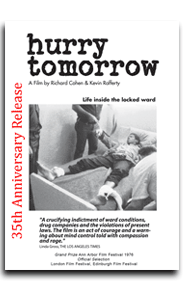
Hurry Tomorrow - A film by Richard Cohen and Kevin Rafferty
This documentary gives a rare look at the pill-pushing that goes on in mental institutions.
For six weeks in 1974, an independent film crew was granted full access to a locked psychiatric ward in Los Angeles, where they recorded brutal scenes of dehumanizing treatment and forced drugging.
Video - Psychiatric treatment filmed in a locked psychiatric ward at Metropolitan State Hospital. Jack gets the staff to let his wife leave. He is then coerced into getting an injection. Scene from Hurry Tomorrow.
More details and videos HERE
Fid
ORDER THE PAPERBACK
'THE EVIDENCE, HOWEVER, IS CLEAR...THE SEROXAT SCANDAL' By Bob Fiddaman
SIGNED COPIES HERE OR UNSIGNED FROM CHIPMUNKA PUBLISHING
Saturday, January 22, 2011
Fish, Chips...and Prozac!
| Image: thecartoonpictures.com |
Alarm bells are ringing in Montreal, Canada it seems.
St. Lawrence River fish have been found to be loaded with Prozac and other antidepressant drugs.
One would think that anglers with nothing better to do had been experimenting using Prozac as bait to satisfy their need to hook their catch [pun intended]
Maybe pharmaceutical companies are carrying out a huge benefit/risk assessment on the little fishies in St Lawrence river, that would be absurd, right?
The Montreal Gazette writes:
Researchers at the Université de Montréal and Environment Canada have discovered large quantities of antidepressants in the liver, muscle and brain tissues of brook trout exposed to three months of various levels of treated effluent from Montreal's sewage treatment plant.
According to the peer-reviewed study, published this week in the journal Chemosphere, most of the drug was found in liver tissue. Slightly less was found in the brain. The least amount was found in muscle, which is the filet eaten by humans.
One can only begin to imagine how Percy the perch or Carol the carp are coping now that their waters have been invaded by levels of serotonin. And what of the pregnant fishies, maybe an increase in defective births is on the cards?
The problem stems from people flushing unwanted meds down the toilet, more worryingly it also stems from residue in human faeces as most sewage treatment plants are not equipped to deal with pharmaceutical products.
The research team found eight kinds of anti-depressants in the fish. The highest concentrations came from Prozac.
If you are a keen angler, maybe the time is right to cast your line into the St Lawrence river. Prozac and other SSRi's are inhibitors and the fish may find themselves taking risks. Who knows, there may be a suicidal hotspot beneath the water, a place where fish with suicidal ideation commit suicide by jumping out of the water...or maybe find discarded fishing line to strangulate themselves.
Beware of the Prozac induced pike, the Seroxat induced salmon or the eel doped up on Effexor.
This is one tapering program I'd just love to see in action!
Full story HERE
Hat-Tip - CCHR
Fid
ORDER THE PAPERBACK
'THE EVIDENCE, HOWEVER, IS CLEAR...THE SEROXAT SCANDAL' By Bob Fiddaman
SIGNED COPIES HERE OR UNSIGNED FROM CHIPMUNKA PUBLISHING
Friday, January 21, 2011
Seroxat Sufferers Goes over the Quarter of a Million Mark.
I must be doing something right.
Thanks to those who keep coming back.
Gracias.
Quick update on the book: The editing is complete, just waiting on a prominent figure to finish writing the foreword for me.
Fid
ORDER THE PAPERBACK
'THE EVIDENCE, HOWEVER, IS CLEAR...THE SEROXAT SCANDAL' By Bob Fiddaman
SIGNED COPIES HERE OR UNSIGNED FROM CHIPMUNKA PUBLISHING
Thursday, January 20, 2011
Seroxat Toilet Paper?
| Image: beforeyoutakethatpill.com |
Calls for the infamous 'Seroxat in adolescents' published papers to be withdrawn is gathering momentum.
Jon Jureidini and Leemon McHenry are calling for the controversial 2001 paper in the Journal of the American Academy of Child and Adolescent Psychiatry (JAACAP) that concluded that Seroxat was “generally well tolerated and effective” for treatment of major depression in adolescents.
The paper misled healthcare professionals that read it as it showed impressive results treating adolescents with Seroxat.
Many lawsuits in the US have showed that the paper was way off skew with its claims. In items of disclosure presented in US courts documents show that company employees and public relations advisers also saw the trial data as having failed to prove that the drug worked in adolescents.
They all kept quiet.
Worryingly, JAACAP’s editors maintain there are no grounds for its withdrawal.
Jureidini and McHenry believe that journal editors are too reluctant to retract papers when the extent of this influence is revealed. Editors are “jeopardising their scientific standing and moral responsibility to prescribers and patients,” by failing to retract, they argue.
Study 329, a study of 275 adolescents, was one of three clinical trials conducted by SmithKline Beecham (as GSK was then known) in the 1990's. Results showed that Seroxat was no more effective than the placebo.
Bad news for Glaxo but great news for their spin team who turned the findings full circle to show that Seroxat was indeed effective in the treatment of adolescent depression.
It was a this point that SmithKline Beecham hired the services of Scientific Therapeutics Information, a medical communications company, of which Sally Laden was an employee. It was Laden who drew up the first 'spinning' draft.
Laden's manuscript was then sent to the Journal of the American Medical Association, which rejected it after peer reviewers highlighted problems.
The paper was rewritten and sent back to the JAACAP. Despite showing that the results did not “clearly demonstrate efficacy for paroxetine”, the JAACAP published it.
The paper is synonymous with ghostwriting. Martin Keller and some of the other 22 listed authors had previously worked for GSK or had received funding from them, but this was not declared. Sally Laden was listed as providing “editorial assistance.”
Both Jon Jureidini and Leemon McHenry called for the article’s retraction in December 2009, accusing GSK of intending to deceive by concealing negative data.
GSK, in typical fashion, denied this and threw out the tried and tested safety net line, “GSK remains firm in the belief that we acted properly and responsibly in the conduct of our clinical trials programme, documentation and submission of results from studies of paroxetine to regulators, and in communicating important safety information.”
Despite overwhelming evidence that shows the published paper to be false and misleading, editors at the JAACAP refuse to retract it.
Question is...why?
More on the study at the excellent Healthy Skepticism website
SOURCE - Neuroskeptic Blog
Fid
ORDER THE PAPERBACK
'THE EVIDENCE, HOWEVER, IS CLEAR...THE SEROXAT SCANDAL' By Bob Fiddaman
SIGNED COPIES HERE OR UNSIGNED FROM CHIPMUNKA PUBLISHING
Wednesday, January 19, 2011
Health Canada's Revolving Door
You thought the FDA's ties to the industry were bad, or even the MHRA's 'jobs for the ex-pharma boys was repulsive. Think on!
Health Canada's revolving door for past employees of the pharmaceutical industry is, alarmingly, spinning out of control. Each rotation of the door at Health Canada sees the industry monopolise pretty much everything in Canada.
Arthur Schafer writes the following in a column for the Ottawa Citizen:
"The people who run Health Canada certainly know how to get the job done. First, you announce a series of "stakeholder" consultations on drug regulation. You call the process Health Canada Technical Consultations on Regulatory Modernization. The innocuous title - Who could be against modernization? - sounds as if it's little more than standard issue bureaucratic rigmarole. Ordinary folks are more likely to reach for toothpicks with which to prop open their sagging eyelids than to feel a sense of alarm. The pharmaceutical industry, however, knows exactly what's going on and it's always quick off the mark when the stakes are high.
"The participants' list for this governmental exercise in "public consultation" makes it obvious, but only to insiders, that the fix is in. Here is Health Canada's recipe: one-third of participants should be drawn directly from the drug industry; one-third should be health professionals funded by the drug industry; and one-third should be drawn from patient and disease groups, also funded by industry."
Welcome to yet another medicines regulator run by the pharmaceutical industry, where drugs will be granted a licence with the click of ones fingers, where adverse drug reactions, reported by the public, will be, in the main, ignored or played down. Where the buck will be passed from within the departments of Health Canada, in the meantime more patients struggle with the drugs prescribed to them by Canadian doctors.
Earlier this year saw recommendations made at the Sara Carlin inquest, one of the main recommendations was a call for an independent drugs regulator. Even the five person jury could see the total bias that exists with this particular bunch of limp-wristed yes men.
The pharmaceutical industry are having their cake and eating it, it's a two finger salute to the Canadian public, the two fingers dripping in Maple syrup with a crystal clear message to Canadian citizens. "It's no use complaining, we have the monopoly here. You will take the drugs we once manufactured, the drugs we now monitor."
The whole regulatory system is the proverbial 'jobs for the boys'. Goliath meets Goliath and keeps the public in check.
The pharmaceutical industry is holding the balls of Canadians, it's gently squeezing them. Complain and the squeeze becomes a firm grip.
If ever there was proof that the industry regulates its own drugs then the current revolving door at Health Canada is evidence of that.
Further reading HERE
Fid
ORDER THE PAPERBACK
'THE EVIDENCE, HOWEVER, IS CLEAR...THE SEROXAT SCANDAL' By Bob Fiddaman
SIGNED COPIES HERE OR UNSIGNED FROM CHIPMUNKA PUBLISHING
Tuesday, January 18, 2011
Herbal Remedies - Are the MHRA Protecting their paymasters?
| Image: thejabberwock.org |
The herbal remedy business is booming it seems. More and more people have become disenchanted with the likes of the pharmaceutical industry whom seem to be in and out of court rooms making settlements to patients who have been harmed by their wares. The public, I feel, have also lost faith in the people that regulate the pharmaceutical wares, namely the Medicines Healthcare and products Regulatory Agency [MHRA]
The herbal remedy business is a huge threat to the likes of GSK, Pfizer and the other various pharmaceutical companies. For one, the side effects of herbal remedies are rare in comparison to prescription medication and the feedback of remedies highlights that we don't really need to take pharmaceutical products when more natural substances are readily available... at least they was until the EU stuck their oar in.
The BBC are reporting that hundreds of traditional and imported remedies on the shelves of health food shops and herbalists are set to be banned under new licensing rules.
Bizarrely, the EU is claiming that it is aiming to protect users from any damaging side-effects that can arise from taking unsuitable medicines.
Never one to miss a back-slapping opportunity, the MHRA, also seem to be backing this directive.
Richard Woodfield, of the MHRA:
"What regulation does is to ensure products meet assured standards. Although the standards are challenging, they are achievable and manageable," he said.
"We already have 24 different companies regulating under the scheme and they are certainly not all large companies."
Put a sock in it Rich, you cannot even regulate prescription drugs properly...or you are powerless to regulate, it's one of the two.
Be interesting to find out if the likes of Horny Goat Weed has actually made consumers suicidal or if the company that makes it have ever manipulated data or made out of court settlements to the tune of billions of pounds.
The MHRA really have their finger on the pulse, huh?
I'm sure the families of those who have lost children to SSRi medication will be delighted that the MHRA are working hand in hand to ban herbal remedies.
I'd like to congratulate the MHRA on adhering to their promise of safeguarding human health from herbal remedy products. It's glaringly obvious these are nasty "medicinal products" that can cause the consumer severe withdrawal effects, suicidal ideation, homicidal thoughts and heart defects in new born babies.
Yeh, the MHRA have their finger on the pulse alright!
**Footnote
The MHRA are fully funded by the pharmaceutical industry. Their Chairman, Alasdair Breckenridge is a former employee of GlaxoSmithKline [then SmithKline Beecham] as is their Head of Licensing, Ian Hudson [Former World Safety Officer at SKB]
This shit just writes itself.
Fid
ORDER THE PAPERBACK
'THE EVIDENCE, HOWEVER, IS CLEAR...THE SEROXAT SCANDAL' By Bob Fiddaman
SIGNED COPIES HERE OR UNSIGNED FROM CHIPMUNKA PUBLISHING
Glaxo - Devoid of ethics?
Fellow campaigner, The Truthman, asks the question, 'Are GSK devoid of ethics', on his blog, GSK, License To [K]ill
The Truthman is referring to an article from Meanie Newman, taken from The Bureau of Investigative Journalism. She writes:
GlaxoSmithKline has unveiled a record-breaking £2.2bn charge to cover litigation costs that will wipe out its fourth quarter profits.
Thanks to The Truthman for giving us this update.
Take a good look at the Truthman's blogroll [right hand side of blog], it features many fascinating articles relating to GlaxoSmithKline.
Fid
ORDER THE PAPERBACK
'THE EVIDENCE, HOWEVER, IS CLEAR...THE SEROXAT SCANDAL' By Bob Fiddaman
SIGNED COPIES HERE OR UNSIGNED FROM CHIPMUNKA PUBLISHING
Friday, January 14, 2011
Former Glaxo Exec Joins Agilent Technologies
| Image: nihrecord.od.nih.gov |
Former chairman of research and development and board member of GlaxoSmithKline, Tachi Yamada, is joining the corporate board of Agilent Technologies, a California maker of scientific instruments.
In a statement, Agilent President and CEO Bill Sullivan said of Yamada’s appointment “his extensive pharmaceutical industry knowledge coupled with his medical background gives him a unique insight into a number of issues facing Agilent that will serve us well as we continue to grow our life sciences business.”
About a year ago Yamada was pressured by the Senate Finance Committee over a report on GSK’s diabetes drug Avandia and its risks for heart problems. In essence, Yamada was accused of bullying Dr. John Buse, whom had identified what he thought were potential signs of dangerous side effects to Glaxo's diabetes drug, Avandia
This isn't the only controversy that follows Yamada.
Dr. Yamada was one of the top GSK executives deposed in the Donald Schell Paxil homicide/suicide case. (trial exhibits, more depositions and trial transcripts) Here's what Yamada had to say (about drug warning labels) when questioned under oath by Houston attorney Andy Vickery:
Dr. Yamada: ....We also have the pressure to understand that our drugs aren't safe and that every drug — although every drug — every drug has potential complications but the benefits outweigh the risks.
Andy Vickery: And in that context, what is the importance of proper labeling as a means to accommodate these two competing interests? We need to get this drug out there on the one hand to people but the drug might hurt some people. Can that be ameliorated in some degree by proper labeling?
Dr. Yamada: That is the hope. That is the hope. It's not — It's not always been borne out, and so the FDA is rethinking about what they want to do, how they actually control the physician. I mean one of the problems is that — Maybe I'm saying too much here, Chuck. (Note: "Chuck" is GSK's counsel.)
Andy Vickery: I can't ask you what he said yesterday, but I bet one of them was just answer his questions. But I appreciate your helpfulness.
Dr. Yamada: It's like a pack of cigarettes. You see on there Surgeon General's warning.
Andy Vickery: Right.
Dr. Yamada: Nobody pays any attention to it.
Andy Vickery: Right.
And another excerpt from the Yamada deposition:
Andy Vickery: Dr. Yamada, as a physician, clinician, academician who not only practiced medicine but taught other doctors how to practice medicine for many years, would you agree that as a general proposition that if language appears in the warnings section in boldface that it is more likely that doctors will take heed of that information than if it's put back in the postmarketing surveillance section and it's not in boldface?
Dr. Yamada: Well, my experience would be that doctors just don't look at the label, period. Now, it could be because I was in an academic institution and that's what we did. Maybe we felt that we were more up-to-date and therefore we didn't need no label. I don't know, but my experience is that most physicians don't look at the label very carefully. And I'm not certain — I personally am not certain whether it would make a difference whether something was in a black box or in a warning section or in a precaution section, and if you would ask 20 young physicians, I'm not sure they could tell you the difference between those three.
Andy Vickery: Do you know that in the information disseminating process one of the truly important ways that your company communicates both the indications and the side effects of your medications to doctors is through the — I forget what title we were using about the detail men, as I call them, the people that call on doctors?
Dr. Yamada: Yes.
Andy Vickery: That's a very important conduit for information; isn't it?
Dr. Yamada: I believe it is, yes.
Andy Vickery: And do you know that your people are trained, your salespeople that call on doctors are trained to emphasize and reemphasize information that is in the warning section of the labels to doctors for the very reasons that you talk about?
Dr. Yamada: I believe so, but I don't know for a fact.
Andy Vickery: Okay, sir. How are you doing comfort wise?
Dr. Yamada: I'm fine. I'm fine.
Andy Vickery: Any time you want to take a break.
Yamada never explained why, in January of 2001, he testified under oath that a GlaxoSmithKline decision to put proper warning labels on one of its drugs (Paxil) is "never a business decision" when a confidential 1997 GlaxoSmithKline document (exposed via "discovery" by Paxil withdrawal plaintiffs' attorneys) reads:
Discontinuation: why this is an issue '97 Seroxat/Paxil sales to end Sept. already exceed $1 BILLION
Beneath this statement is an image of a big black money bag with a giant white dollar sign embedded in its centre.
Great to see those responsible for the continued dissemination of bad drugs rewarded with high paying executive positions, huh!
Fid
ORDER THE PAPERBACK
'THE EVIDENCE, HOWEVER, IS CLEAR...THE SEROXAT SCANDAL' By Bob Fiddaman
SIGNED COPIES HERE OR UNSIGNED FROM CHIPMUNKA PUBLISHING

Subscribe to:
Posts (Atom)
Please contact me if you would like a guest post considered for publication on my blog.