Zantac Lawsuit


Researching drug company and regulatory malfeasance for over 16 years
Humanist, humorist
Showing posts with label Cymbalta. Show all posts

Monday, May 16, 2016

The Homicide Files: Cymbalta


Following on from my previous two posts (Paxil Homicide & Celexa & Lexapro Homicide) I now turn my attention to Cymbalta (Duloxetine)

Cymbalta is a serotonin-norepinephrine reuptake inhibitor and is notoriously difficult to withdraw from due to it being a capsule filled with tiny beads.

These series of posts are a result of a recent Freedom of Information request made by Andrew Thibault to the American drug regulator, the FDA. Information sent to Thibault is now publicly available ~ I've been sifting through some of the documents.


AERS Case Number 6060757

Homicide by female (age 26) The patient was taking Cymbalta (60mg per day) beginning sometime in 2005. She shot and killed her husband. (Click on images to enlarge)


--

AERS Case Number 6273800

Homicide by male (age 84) The patient was taking Cymbalta (40mg per day) between May 2005 - March 2007.

The report shows us that his prescribing physician does not attribute that Cymbalta may have played a part in this homicide. One has to question if this statement was based on scientific fact or just, as I suspect, an assumption. The 84 year-old shot his wife then himself.


--


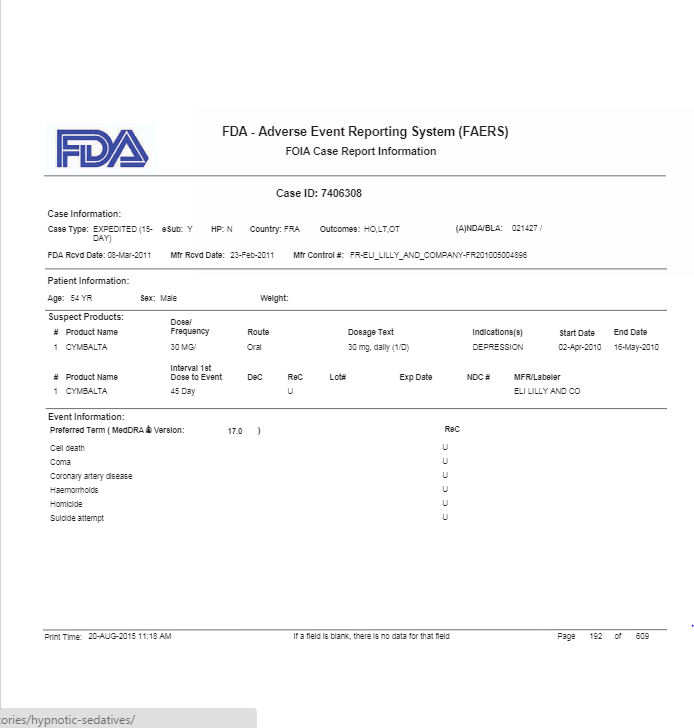
AERS Case Number 7406308

Homicide by male (age 55) The patient was taking Cymbalta (30mg per day) between April 2,  2010 - May 16,  2010.

Patient shot his wife dead then tried to kill himself. His family members reported that there were no domestic or family conflicts and that nobody could explain what happened.


--

AERS Case Number 7730741


Homicide by male (age 15) The patient was taking Cymbalta (30mg per day) for just 13 days before carrying out homicide.

The key points to this murder have been redacted by the FDA in efforts not to identify the 15 year-old male. It does say, however that he shot and killed more than one person.

It was also reported that over the 13 day period when he was taking Cymbalta he suffered hypomania, including agitation, psychic activation (whatever that is?), periods of euphoria and akathesia (feeling of  inner restlessness)


--

AERS Case Number 7762506

Homicide by male (age 42) The patient was taking Cymbalta (unknown dose) he was also being treated with Prozac. Ironically both medications are made by the same company, Eli Lilly.

The report shows how Prozac made him a "happy manic" while Cymbalta would make him "depressed"

The patient killed a person or persons. Some time after this event his wife gave birth but the child died some days after being born. Makes you wonder his his wife was also taking psychiatric medication and if her child died as a result of her taking medication. In essence, this could be a double homicide both caused by medication, prescripticide*, if you will.


--

AERS Case Number 5924658

Homicide by female (age 62) The patient was taking Cymbalta (unknown dose) between an unspecified time.

The 62 year-old female had no history of suicidal thoughts.

This report is interesting in as much that the FDA have redacted the actual time where she is reported to have experience suicidal thoughts. Why have they done this? 

She shot her husband in the arm and he bled to death. Eli Lilly, who filed the report to the FDA have added that "It was unclear if this was accidental or not"- Hmm.


Bob Fiddaman.


*Prescripticide ~  is defined as a death that is caused by an adverse reaction to a prescription drug.

Previously in this Homicide series...


Database available on Murder Meds.


Tuesday, August 11, 2015

Lilly's Cymbalta Expert


Late last week a jury ruled that Eli Lilly and Co. isn’t liable for withdrawal symptoms including brain zaps experienced by a woman, Claudia Herrera, after she quit the antidepressant Cymbalta.

The crux of the argument, it seems, was that Lilly faced claims of not disclosing, on the warning label for Cymbalta, that 44% of users, in its own studies, suffered discontinuation side effects. Instead, plaintiff lawyers argued, Cymbalta’s label initially disclosed that 2% or more experienced certain side effects.

Lilly's legal team hit back suggesting that  the 44% figure wasn’t relevant to prescribers because, in the same studies, 22% of subjects discontinuing a placebo also reported side effects. The label discloses the Cymbalta withdrawal side effects that occurred significantly more frequently than those of people who took a sugar pill.

Obviously, both sides would need more evidence to provide to a jury. Lilly's expert. it appears, may have tipped the balance.

Douglas Jacobs, a psychiatrist, told jurors there’s no evidence in the medical literature of withdrawal symptoms lasting for months. Herrera’s symptoms might have been a manifestation of her underlying depression and anxiety disorders,

It's classic pharma defence, blame the "illness" and not the drug. So exactly who is Lilly's expert, Douglas Jacobs? Well, he and Eli Lilly go way back.

In 1991, Jacobs' brainchild, "National Depression Screening Day" was launched throughout America/ Two years later, in 1993, it was learned that "National Depression Screening Day" were funded by a number of organisations. The year 1993 saw them receive around $300,000 to $400,000." About half of that came from Eli Lilly Co (1)

Human rights organisation, the CCHR, wrote extensively about Jacobs ties with Lilly here. The article, entitled, "SIGNS OF SUICIDE – A MENTAL HEALTH QUIZ THAT FAILS", highlights how The Signs of Suicide® Prevention Program was produced and sold to schools by a non-profit organization called Screening for Mental Health. (SMH)

Founder and Director of SMH was... you've guessed it, Dr. Douglas Jacobs.

Here he is (below) receiving a cheque on behalf of SMH. The cheque of $500,000 was presented to Jacobs by Bob Pitsal of... you've guessed it, Eli Lilly.


In fact, from 1996 to 2008, Eli Lilly handed over a staggering  $3,920,425.00 to SMH. (2)

Further reading about Lilly's connections with National Depression Screening Day can be found here.


More recently, Jacobs has been in the news for controversial statements made in regard to Daniel Marsh.

Marsh was just 15 when he broke into the home of an elderly couple and brutally stabbed them to death.

Three years previously Daniel Marsh, who at that time was just 12, was honored by a local American Red Cross chapter for saving his father’s life when the elder Marsh suffered a heart attack behind the wheel of the family’s car.

So, what could change a seemingly thoughtful caring 12 year-old into a sadistic killer just three years later?

On day 7 of the trial of Daniel Marsh it emerged that he was on a number of psychiatric medications. This, from Charmayne Schmitz (3)

Wellbutrin was added to Daniel’s existing medications with the first visit to Dr. He on January 30, 2013, and was started at 50 mg. On the second visit, February 12, 2013, it was increased to 100 mg. This was after Daniel’s mother told the doctor that Daniel was attending school daily, eating properly and had no problems with the additional medication. It was noted in the file that the medication may be increased later to 150 mg. On February 27, the mother called and asked that the medication be increased to 150 mg.
Daniel was seen by Dr. He again on March 14, 2013. Daniel’s mood and anxiety were noted as improved, but he was still depressed, and somehow anxious about his friends. As on the initial visit, he answered, “No,” to Dr. He’s questions about having homicidal/suicidal feelings or tendencies. The doctor’s summary was that he “tolerates” the medication.
On April 16, 2013, the next office visit, Daniel appeared more depressed and anxious. Daniel told the doctor that he had become angry and kicked the family dog. His mother said he had stopped taking the Seroquel that had been prescribed since December of 2012 because he didn’t like how it made him feel. It was noted that he was in the severe clinical range. The Zoloft, also being prescribed since December, was increased to 150 mg at that time.
By telephone on May 1, 2013, Daniel’s mother reported that Daniel was in crisis. He refused to restart the Seroquel and she requested different medications to calm him down. Abilify was prescribed. Lab tests were ordered because Dr. He wanted to know what triggered the crisis. The tests came back positive for marijuana.
The next office visit was on May 30. Daniel showed signs of severe depression, anxiety, muscle tension and anger. The Wellbutrin was increased to 300 mg. Daniel had been recently suspended for bringing a pocket knife to school. Daniel’s mother reported that he would only take the Abilify as needed, when he had extreme anxiety, not as prescribed on a daily basis. This was the last time Dr. He saw Daniel.

Jacobs, who was an expert for the prosecution in the Marsh trial,  was adamant that drugs and doctors could not be blamed for Daniel’s violent acts, in fact Jacobs, who was paid $15,000 to review the medical records of Daniel Marsh and testify about his findings, was later cross-examined by Deputy Public Defender Ron Johnson.

Once again, Charmayne Schmitz covered the story (4)

Dr. Jacobs was disciplined once for failure to diagnose in a suicide case. He charged half his fee despite the discipline. Johnson read the finding: “Dr. Jacob’s opinion was naïve and not with common sense,” from the State Board of Maryland. Dr. Jacobs claimed that he never read their finding.
Johnson then raised the issue that Dr. Jacobs was paid by a drug company, Roche, about $30,000 to $40,000 in 1998. He also testified at a Congressional Hearing in 2000 for Roche, about a relationship between the drug Accutane and suicidal tendencies. Afterwards, the FDA issued a black box warning for Accutane. Dr. Jacobs also worked on two other cases of wrongful death for Roche.
Eli Lilly and Company was one of the contributors to his non-profit. Lilly makes Prozac. Up to 200,000 people were screened by the program. 60% of those would have possibly seen a physician, so Lilly stood to gain 120,000 patients.
Zoloft is not approved for pediatric patients, except for OCD (obsessive-compulsive disorder). This is stated in the black box warning. Jacobs said in clinical trials children have a high placebo response. So, there is no stated evidence that Zoloft works for pediatric patients. When questioned, Jacobs said the clinical experience has shown it to be beneficial.
Dr. Jacobs said there isn’t a lower dosage of Wellbutrin for a 15-year-old. It would be the same as for an adult.
Johnson raised the issue of the medical guide again. It mentions anger, violence and aggression. The doctor treating Daniel “made a clinical judgment.” Daniel was asked about these symptoms and said he had none. Daniel did tell the therapist, but he wasn’t explicit.
Trials of drugs are usually 16 weeks. There are no trials for combinations of drugs. The only evidence is from case reports. The case reports are not evidence of causation unless the FDA gets a large number of them. The doctor then dismissed a case study mentioned by Johnson from a medical journal, stating that “young kids have violent thoughts” on Prozac. The doctor said there weren’t a lot of them reported.


Daniel Marsh was sentenced to 52 years to life.


Hardly surprising then that months later Jacobs is once again in court giving evidence regarding another antidepressant, this time Eli Lilly's Cymbalta, where he told the jury that "there is no evidence of withdrawal symptoms lasting for months." Adding that, "Herrera’s symptoms might have been a manifestation of her underlying depression and anxiety disorders."

It leaves me wondering if the Jury in the Cymbalta lawsuit were made aware of Lilly's expert witness.

Google "eli lilly douglas jacobs" and see what it throws up.

A similar case to that of Herrera's is set for trial in California later today.


Bob Fiddaman.


(1) 1,300 Sites Nationwide To Test For Depression - October 05, 1993
(2) Signs of Suicide – A Mental Health Quiz That Fails - Citizens Commission on Human Rights
(3) Testimony by Marsh Psychiatrist – Part Two - Charmayne Schmitz 
(4) Harvard Psychiatrist Puts Blame on Patient and Family - Charmayne Schmitz 


Monday, August 03, 2015

C-Day for Eli Lilly


I do love it when pharmaceutical companies enter into trials (litigation) in the small hope that they can persuade judges to toss cases on points of law.

Litigation fascinates me and it's something that has been very much part of my reading materiel over the past few years or so. I should have studied law, I guess it's never too late - sadly I have the memory of a sieve and don't think I could soak and retain any information given to me... and then sit a bar exam. So, it's just a hobby of mine to read through court transcripts and depositions.

There are many stages of litigation before it actually gets into court. In the main, both sides try and strike a deal that will suit both parties, those making the claim and those defending the claim. Pharmaceutical attorneys are in the business of saving their clients money so they will do pretty much everything in their power to make it difficult for plaintiffs. America is different to the UK in the respect that Pharmaceutical companies, when facing group actions (class-action lawsuits) try to consolidate them all so they are heard in a specific state, a state that may have a different set of rules (laws) than any other state, a state that normally gives them a better chance of success (due to favourable laws)

Pharmaceutical attorneys also apply for "Summary Judgement". In a nutshell this means that they apply to a judge and ask him to strike the cases against them because, "they will argue that no factual issues remain to be tried and therefore a cause of action or all causes of action in a complaint can be decided upon certain facts without trial."


One recent motion for "Summary Judgement" came in the cases Herrera v. Eli Lilly and Company (case no. 2:13-cv-2702-SVW-MAN) and Hexum v. Eli Lilly and Company (case no. 2:13-cv-2701-SVW-MAN)

Eli Lilly and Company are defending cases brought against them regarding their antidepressant, Cymbalta. The crux of the claim is that Lilly failed to adequately warn the plaintiffs and their physicians of Cymbalta’s true withdrawal risks. Lilly filed a motion for "Summary Judgement" and the judge (Judge Stephen V. Wilson, U.S. District Court for the Central District of California, Los Angeles) denied them this motion. Now, Lilly go to trial to face the allegations and, more than likely, they will use points of law throughout the trial, or rather they will exhaust every single avenue to try and get the cases dismissed. If this doesn't show the average person how guilty they are then I don't know what will.

The beauty of this trial is that Lilly are up against a formidable team in Baum, Hedlund, Aristei & Goldman. The Los Angeles based law firm have quite a history when going up against pharmaceutical companies. They, along with three other law firms are representing over 2,000 plaintiffs who allege they have suffered injury, and in some cases, death, due to symptoms suffered while attempting to discontinue Cymbalta.

Cymbalta has been prescribed widely and there have been many reports of severe withdrawal reactions to it. Lilly, just like other antidepressant manufacturers, chose to either ignore these reports or, as the case may be, play down the reactions, ie; blame the illness rather than the product. It's a classic stance of the pharmaceutical industry and, it has to be said, a classic stance of those who regulate prescription medications (FDA). You can judge for yourselves if you think it's difficult to taper from Cymbalta, here.

These cases are ones that I shall be keeping tabs on. The first starts Tuesday Aug. 4 in Los Angeles.

Oh to be living in California right now. I'd pretty much drop everything to be present at trial, I'd pretty much like to see Baum, Hedlund, Aristei & Goldman in action and Lilly attorneys too.

I like a flutter now and again - I'm betting that Lilly will, at some point during these series of group actions, cave in and settle. First though, they must try to find legal loopholes to avoid paying out millions of dollars, those dollars being the profit they have made on Cymbalta. Profit that came about due to their failure to warn against the horrific withdrawal reactions many have had to endure.

Let's get these items of disclosure out into the public domain, let's see how Lilly played down the risk.

Yup, I do love it when Pharmaceutical companies refuse to offer settlement. It makes blogging such a pleasure and enlightens and educates me.

Sad, I know but, hey-ho, some folks like to knit, some like to go to the gym.

I like to read and disseminate information regarding the dangers of these drugs and the way that pharmaceutical companies, such as Lilly, hold back information from the public purely to keep their pockets bulging and to keep their shareholders happy.

More coming soon.


Bob Fiddaman.


Thursday, May 07, 2015

Cymbalta - Australian Doctor's Warned


A subscription only based website aimed at Australian healthcare professionals is reporting that doctors in Australia are being urged to prescribe Eli Lilly's antidepressant Cymbalta (duloxetine) with caution after a 35-year-old Victorian truck driver died of serotonin syndrome from a dose increase.

Nicholas Moorby died in April 2013, four months after his GP increased his Cymbalta dose from the recommended maximum daily dose of 120mg (three 60 mg capsules) to 240mg/4 capsules per day.

According to the Australian Doctor website, "friends of Mr Moorby noticed he was "agitated", "really out of it", "blabbering" and "making no sense" in the days leading up to his death."

Moorby's GP, who increased the dose, admitted that he had made an "error of judgement" and did not face any criminal charges over the death.

This from the Australian Doctor:

His GP was told by Mr Moorby that his psychiatrist recommended the dose increase due to his severe depression. The unnamed GP told the told the Coroners Court of Victoria last month,“Unfortunately, a lot of the specialists nowadays do not write scripts, they would tell the patient, go and see your GP and get the GP to write them. There are many cases where specialists prescribe big doses of anti-depressive so while I go to one or two tablets it’s not unusual for specialists to go to four, so I did not question him on that,” 

Moorby had amphetamine, methamphetamine, duloxetine, oxycodone, promethazine and alcohol in his system when he died. However, Forensic pathologist, Dr Heinrich Bouwer, told the court that an adverse drug reaction to excessive duloxetine could occur with or without the interaction of amphetamines.

The Australian medicines regulator, The Therapeutic Goods Administration, recorded 21 cases of serotonin syndrome due to duloxetine in their Dec 2013 report.

For those that don't know, serotonin syndrome, also known as serotonin toxicity, is a  life threatening drug reaction that causes the body to have too much serotonin. This leads to excessive stimulation of the central nervous system and peripheral serotonin receptors.

When you take poor metabolizers into account and you see what the friends of Nicholas Moorby said... he was "agitated", "really out of it", "blabbering" and "making no sense"  - there really is a strong argument that these drugs can induce suicide and homicidal acts. Alas, the pharmaceutical companies and the blinkered views of psychiatrists often blame the "underlying illness" for the cause of suicide and/or homicide.

In the United States Eli Lilly and Company are facing a number of lawsuits regarding Cymbalta.

Over 20 lawsuits have been filed in federal courts across the US which sees claims that Lilly deliberately omitted information about the true risk of withdrawal in the product label and in marketing materials.

More information about those lawsuits can be found on the Baum, Hedlund, Aristei & Goldman, P.C here.


Bob Fiddaman.


Saturday, September 13, 2014

Cymbalta Beads


I was reading through the comments section of an online Cymbalta withdrawal support group yesterday.

'Cymbalta Hurts Worse' is a Facebook support group where readers offer advice in getting off Cymbalta. Reading through brought back so many memories of my time on Seroxat [known as Paxil in the US]

Cymbalta, marketed and manufactured by Lilly, is the subject of a lawsuit in the US. Plaintiffs in the suit have claimed that Lilly deliberately omitted information about the true risk of withdrawal in the product label and in marketing materials, they also claim that Lilly manipulated medical literature and exaggerated the benefits of Cymbalta.

Meantime, the multi-billion dollar pharmaceutical company offer no help whatsover to those addicted to their product.

Here's some of the comments...

POSTER 1: Day one of lowering my dosage...scared for the days to follow but I refuse not to come off of this! I can do it!!!
POSTER 2:  Are you two using the bead method?
POSTER 1: No my doctors takin it slow but I'm doing it with the help of this homeopathic remedy soooo we will see I feel okay today...just scary cause I'm a student and work so I don't want my grades to be affected if I'm feeling the withdraw 
POSTER 2: Good luck to you. If it proves to be too much, consider the bead method. It's the safest way to wean off.
POSTER 1: I tried to come off a few years ago with only one drop down then compeltely off and it was the worst idea of my life!!! Got so sick 
POSTER 3: Bead method taking out a few beads or 1 bead at a time is the only way I know that minimizes dreadful withdrawal effects. Please keep us posted and best wishes.
POSTER 4: I'm on day of 5 of removing a couple of beads per dose as I take one at night and one in the morning, I never thought I could do this but I can and I will. You will be fine as long as you listen to your body and take it slowly, good luck! 

So, what exactly is the "bead method"?

Altostrata, who runs the hugely successful Surviving Antidepressants forum, explains...

Cymbalta comes in 20 mg, 30 mg, and 60 mg capsules. 
Cymbalta is tricky to taper. It does not come in liquid form and cannot be compounded into a liquid. To protect the drug, each bead inside the gelatin capsule has an enteric coating to protect the drug from stomach acid, which would destroy the drug. (It is absorbed further down in the digestive tract.) The pellets cannot be dissolved in any liquid without destroying the active ingredient.
You cannot crush the pellets or dissolve them in a solution -- the drug would never get into your system, it would be destroyed in your stomach and you would have immediate cold-turkey withdrawal.
The number of beads in each Cymbalta capsule will vary within a given dosage and across dosages. The capsules are filled by weight. Count your beads carefully. Put unused beads into a clean, dry, capped prescription bottle marked with the dosage of the original capsule and expiration date. You might want to use them later. Do not mix beads from capsules of different dosages, such as 30mg and 60mg.

Patients trying to stop taking Cymbalta are in a tough spot. No help from the manufacturer Lilly, no help from medicine regulators such as the FDA and MHRA, no help from their prescribing physicians

Lilly, the FDA and MHRA are fully aware of the problems patients are facing but do nothing.

So, it's down to support groups such as 'Cymbalta Hurts Worse' and 'Surviving Antidepressants', there are many more too.

R. Brent Wisner, of Baum, Hedlund, Aristei & Goldman, P.C, who are representing plaintiffs had this to say...

“We believe that Lilly’s warning that Cymbalta withdrawal occurs at a rate greater than or equal to 1% is deceptive.  It is just a sleight of hand.  One of Lilly’s own studies shows that over 50% of patients experience withdrawal when they stop Cymbalta.  1% is not 50%, not even close.  A drug label is not the place to play games with words.  It is a place to honestly inform doctors and patients about the benefits and risks of medicines so they can make informed choices.  Our clients feel strongly that they were betrayed by Lilly and we will do all we can to ensure their voices are heard by the courts.” 

The removing of beads to help in tapering from a prescription drug is a patient idea, it's an idea that was forced upon them because the likes of Lilly, the FDA and MHRA have just sat back thumb twiddling and buck passing. Meantime, patients are left to their own devices to try and taper from a prescription drug that they took on faith to help with a diagnosis that has no science behind it at all.

I feel for anyone starting on a tapering process of any antidepressant, particularly those types that have no liquid formulation to help patients withdraw slowly.

Here's the irony.

The definition of the word 'PATIENT' is split into two categories here.

NOUN: A person receiving or registered to receive medical treatment.

ADJECTIVE: Done in a careful way over a long period of time without hurrying.

Perhaps drug-makers and their agents (drug regulators) could define which one is applicable to consumers trying to withdraw from antidepressants.

If you, or someone you know, has suffered the horrific side effects of Cymbalta then you may be eligible to file a personal injury lawsuit. You can contact an attorney at Baum Hedlund here.

Bob Fiddaman.


Friday, August 15, 2014

Eli Lilly to Face Cymbalta Lawsuits


Cymbalta US Lawsuits


Eli Lilly and Company are facing a number of lawsuits regarding their antidepressant Cymbalta [Duloxetine]

Consumers of the drug, which is also used to treat various pain disorders, are claiming that Eli Lilly misled them about the withdrawal side effects of Cymbalta, side effects which include, but are not limited to electric-shock like sensations in their body and brain (also known as “brain zaps”), dizziness, nausea, vomiting, vertigo, excessive sweating, insomnia, nightmares, and diarrhea.

Over 20 lawsuits have been filed in federal courts across the US which sees claims that Lilly deliberately omitted information about the true risk of withdrawal in the product label and in marketing materials.

According to the LA law firm Baum Hedlund, the label wrongly claims that Cymbalta only has a 1% withdrawal risk, when in actual fact Cymbalta studies show a much higher risk rate - between 44% to 50% withdrawal risk!

Plaintiffs also claim that Lilly manipulated medical literature and exaggerated the benefits of Cymbalta.

Plaintiffs are being represented by by Baum, Hedlund, Aristei & Goldman, P.C., along with Keller Rohrback L.L.P. and Pogust, Braslow & Millrood.

“We believe that Lilly’s warning that Cymbalta withdrawal occurs at a rate greater than or equal to 1% is deceptive.  It is just a sleight of hand.  One of Lilly’s own studies shows that over 50% of patients experience withdrawal when they stop Cymbalta.  1% is not 50%, not even close.  A drug label is not the place to play games with words.  It is a place to honestly inform doctors and patients about the benefits and risks of medicines so they can make informed choices.  Our clients feel strongly that they were betrayed by Lilly and we will do all we can to ensure their voices are heard by the courts.” - R. Brent Wisner, Baum, Hedlund, Aristei & Goldman, P.C

Struggling to come off a psychiatric drug is a scary experience, it can lead to akathisia, which is a known precursor to suicidal thoughts and acts.

The electric-like zaps are something I personally endured when coming off Seroxat [known as Paxil in the US] - basically, it feels like your head is being zapped with a cattle prod, it's your brain's way of saying 'FEED ME'... it's the reduction of the drug compound that causes this effect, something that Glaxo and, in this case Eli Lilly, kept from the consumer.


The full press release can be read here.

If you, or someone you know, has suffered the horrific side effects of Cymbalta then you may be eligible to file a personal injury lawsuit. You can contact an attorney at Baum Hedlund here.

Baum Hedlund has litigated over 4,500 antidepressant personal injury and wrongful death cases against pharmaceutical companies.


Bob Fiddaman


Wednesday, March 16, 2011

ANTIDEPRESSANT SUICIDE VIDEO

SSRISTORIES.COM has a collection of 4,400+ news stories with the full media article available, mainly criminal in nature, that have appeared in the media (newspapers, TV, scientific journals) or that were part of FDA testimony in either 1991, 2004 or 2006, in which antidepressants are mentioned.

SSRi Stories is a great resource, here's just a small number of SSRi related suicides I have highlighted in this video.

http://ssristories.com/


ORDER THE PAPERBACK
'THE EVIDENCE, HOWEVER, IS CLEAR...THE SEROXAT SCANDAL' By Bob Fiddaman
SIGNED COPIES HERE OR UNSIGNED FROM CHIPMUNKA PUBLISHING

Please contact me if you would like a guest post considered for publication on my blog.