First off, I'm not a mathematician. Maths, or if you're American, math, is another language to me, in fact, for me at least, it would be easier to learn Chinese than it would to grasp maths. I was the kid at the back of the classroom who still counted on his fingers underneath the table, out of view of those who were better at numbers than I.
I was going through some of the archives and recent media articles regarding the original 329 study.
There were 275 subjects in the 8 week trial, 12 of whom had suicidal thoughts (in the paroxetine arm)
12 suicidal thoughts out of 275 subjects = 4.363636363636364%
Okay, out of the 275 subjects, 90 were on paroxetine. The table below is based on efficacy results for 90 patients. The actual figure of adverse events was based on 93 patients but I'm keeping the figure at 90 for ease.
12 suicidal thoughts out of 90 subjects = 133.33333333333334 (Roughly 13%)
Given there were approximately 2 millions prescriptions for paroxetine written for adolescents one year after the study was published in the JAACAP this means, if I have my maths correct, that...
133.33333333333334 of two million = 266,666
In 2003, GSK's then Head of Psychiatry, Alastair Benbow (pictured above) went on national television and claimed that, "less than a small class size would have these suicidal thoughts." (video below - 1 minute 21 seconds, Alastair Benbow
Benbow's 'small class size' is a classroom, therefore, that can fit 266,666. pupils. What school did Benbow attend?
Okay, so two million prescriptions does not necessarily mean two million adolescents. The two million prescriptions may have been repeat prescriptions to individuals. So, lets say the number of individuals written a prescription is between 200,000 and 2,000,000
Whatever way you slice it, Alastair Benbow must have gone to an awfully big school!
To put this into some sort of perspective, America de Cali, a Columbian football team, play their homes games at the Pascual Guerrero stadium which holds some 33,000 spectators. So, if 250,000 individuals were given prescriptions for paroxetine one year after the JAACAP review by Keller et al had been published, Benbow's small classroom would have looked something like this...
If 500,000 individuals were handed out prescriptions for paroxetine then Benbow's small sized classroom would have resembled this (Kingdome, Seattle - now demolished)
Okay, let's give Benbow the benefit of the doubt here and say that just 175,000 individuals took paroxetine one year after the JAACAP review.
That would give us (excuse the Devil numbers) a class size of 16,666 pupils.
In other words, Benbow's small sized class could be compared to the Nilson Nelson Gymnasium in Brazil (pic below)
Furthermore, and once again cutting Benbow some slack, let's say just 87,500 took paroxetine one year after the JAACAP review - that would still give us a pretty large classroom, - 8,333 pupils.
An averaged sized class (not small sized class) in the US was between 19 and 26 pupils in 2011/12. (Source)
Remember, Benbow claimed that, "less than a small class size would have these suicidal thoughts."
What exactly is less than small? English language and usage may be worth looking at to understand what Benbow was actually saying. (Smaller vs. less vs. lesser) Maybe it was yet more coding from GSK (see http://study329.org/) for explanation of "emotional lability"
Maybe Benbow was talking about the 12 patients who had suicidal thoughts that the restoration team found... or maybe he was talking about the 6 that Keller et al found?**
Either way, it was an extremely poor choice of words to use. Perhaps Benbow should have used the same criteria I've used here, although going on national television and saying something like, "We believe that between 8,000 and 266,000 would have had these suicidal thoughts one year after our study was reviewed and published" , wouldn't really have gone down too well with GSK executives, or, indeed, their shareholders.
Truth is over two million prescriptions were written for children/adolescents one year after the Keller study was published. It is unknown how many children/adolescents were individually prescribed paroxetine, it's believed to be, as I mentioned, between 200,000 and 2,000,000. Even if the figures are less we still see a potential for thousands of adolescents and children that may have been at risk of suicidal thinking. One also has to take into account that these figures are based on US prescriptions only. Add to it prescriptions written for adolescents and children in other countries and we have stadiums bursting at the rafters!
Maybe a more striking headline regarding the recent restoration study findings should have been 'Between 8,000 and a quarter of a million kids put at risk one year after flawed paroxetine data published.'
The interview with Benbow (below) is from 2003, some two years after the Keller paper was published.
As I said, at the top of this post, I'm not a mathematician so I may be totally wrong with these figures. When Benbow said , "less than a small class size would have these suicidal thoughts", I took it as maybe 10, or 20 at the most. Truth of the matter is, in an 8 week clinical trial 12 patients, who were taking paroxetine, suffered suicidal thinking - that figure may be higher because none of the 90 (93) patients given paroxetine in the 8 week trial were followed up, in other words, more may have had suicidal thinking after the 8 week period. The patients who dropped out before or at the 8 week point weren’t properly followed up – who knows what the story was behind the patients reported as just being ‘lost to follow up’ or ‘consent withdrawn’ for example.
Some patients did go on to take part in a 6 month continuation phase and these were followed up at various points, but this data has never been published.
If any statistician stumbles on this post of mine they may be able to clear things up for me?
**Keller et al only classed 5 of 6 as serious adverse events (suicidal ideation/gestures)
It's been almost two days now since the publication of the damning 329 restoration study in the British Medical Journal (BMJ) and, as I suspected, no apology has been forthcoming from either GlaxoSmithKline, any other the original study 329 authors or the The Journal of the American Academy of Child & Adolescent Psychiatry's (JAACAP)
What we have seen, however, is a couple of quotes from spokespersons. GSK's Bernadette Murdoch and lead author of the original 329 study, Martin Keller - they make interesting reading, even though they are small musings.
First off, Bernadette Murdoch, Communications Director for GlaxoSmithKline Australasia.
On responding to the restoration study, Murdoch told ABC Australia, "We did provide an unprecedented level of data to the research team. In relation to the findings from the team's analysis, they do appear to be in line with the longstanding view that these medicines, anti-depressants like paroxetine, are not suitable for children. This is widely known and clear warnings have been placed on the product label for more than a decade."
Before offering you her small quote on the original study, let's just try and analyse her above quote. I'm no psychologist, these are just my thoughts.
"We did provide an unprecedented level of data to the research team."
This is true. In fact GSK provided over 77,000 pages of raw data to the restoration team. What Murdoch failed to mention was GSK made it difficult for the team, so difficult in fact that the restoration authors called this process of research the "periscope."
This from the authors...
"This restoring invisible and abandoned trials (RIAT) exercise proved to be extremely demanding of resources. We have logged over 250,000 words of email correspondence among the team over two years. The single screen remote desktop interface (that we called the “periscope”) proved to be an enormous challenge. The efficacy analysis required that multiple spreadsheet tables were open simultaneously, with much copying, pasting, and cross checking, and the space was highly restrictive. Gaining access to the case report forms required extensive correspondence with GSK. Although GSK ultimately provided case report forms, they were even harder to manage, given that we could see only one page at a time. It required about a thousand hours to examine only a third of the case report forms. Being unable to print them was a considerable handicap."
"In relation to the findings from the team's analysis, they do appear to be in line with the longstanding view that these medicines, anti-depressants like paroxetine, are not suitable for children."
Deflection, deflection, deflection. Here Murdoch, probably guided by GSK's attorneys, tries to let the reader know that all antidepressants, not just Paxil, are not suitable for children. She is telling us something that we already know yet, at the same time, letting the reader know that GSK are a good company and would not ever allow drugs that are not meant for children onto the market. GSK did not voluntarily offer this information, they were forced to do so after regulators found that they were lying in their original 329 study.
"This is widely known and clear warnings have been placed on the product label for more than a decade."
Again, this appears as if Murdoch is trying to undermine the restoration study, it's almost like "Oh hum, tell us something we don't know." She wants the public to know that, for almost a decade, her company have been warning the public about the dangers of paroxetine in children and adolescents. This, however, does not detract from the fact that her company tried to gain a licence for paroxetine use in children and adolescents even though they knew that..
A: It didn't work;
B: It was dangerous.
Speaking about the original 329 study (the fraudulent one) Murdoch offered this...
"These studies were conducted in the '90s, many years ago when computer systems were very different. A lot of the notes were handwritten. It's important to remember that when a medicine is approved for use, it's not just the pharmaceutical company that makes that decision. There are lots of checks and balances in between, so a regulator uses all of the data that's available on a medicine before recommending it for use for a patient,"
In essence, it appears, that Murdoch is saying, "It's not just our fault". It's almost like an admittance of guilt. We were less than fruitful with the truth but it was the job of the regulators to try and catch us out, they didn't, so they must also take the blame. In using the line, "These studies were conducted in the '90s, many years ago when computer systems were very different. A lot of the notes were handwritten," it appears Murdoch is blaming technology - ie; the RIAT team had better technology than what we did so they found stuff that we didn't...because our computers back then were not as sophisticated as what they are today.
It's interesting to note that no apology was offered by Murdoch. It's basically a rebuttal and a deflection on a calamitous scale.
Original Study 329 Lead Author Martin Keller.
This guy is priceless.
Keller, pictured above, is quoted in The Journal of Higher Education,the No. 1 source of news, information, and jobs for college and university faculty members and administrators.
Here's what he had to say...
"The 2001 results faithfully represented the best effort of the authors at the time, and that any misrepresentation of his article to help sell Paxil was the responsibility of Glaxo. Nothing was ever pinned on any of us," despite various trials and investigations, and when I say that, I’m not telling you we’re like the great escape artists, that we’re Houdinis and we did something wrong and we got away with the crime of the century. Don’t you think if there was really something wrong, some university or agency or something would have pinned something on us?"
So, it appears that Keller here is speaking on behalf of all of the original 329 authors (22 in all)
Interestingly, he lays the blame at the feet of GlaxoSmithKline, the same company who have, according to court documents, paid Keller on a number of occasions, although he denies that he, or any of the other 21 authors were paid to put their name to the 2001 JAACAP article. Keller, according to investigative journalist, Alison Bass, has in fact "received $500,000 annually from pharmaceutical companies that manufacture the antidepressant drugs that he lauded in a series of medical research reports." ~ Boston Globe 10/04/99
It's a bizarre stance and one of complete denial. "...any misrepresentation of his article to help sell Paxil was the responsibility of Glaxo."
Key word here is 'responsibility' and Keller, it appears, seems to be shirking his. The responsibility was on Keller and his team to make sure that they read the raw data, or, at the very least, asked for the raw data.
It's a merry-go-round of buck passing akin to kids being asked, who spilled the milk?
Keller goes further, in a two page letter sent to Retraction Watch, a group of individuals that strive for celerity as much as accuracy. The letter is signed by Keller and 8 of the original article authors.
David Healy, who was one of the co-authors of the restoration study has responded to Keller here.
The letter, missing the signature of, amongst others, Karen Wagner, is regarding the science behind the two studies. I'll leave that to the experts. What I do find interesting is the claim by Keller et al that the article wasn't ghostwritten. It's just one paragraph but uses an interesting choice of words...
“Restoring Study 329” asserts that this paper was ghostwritten, citing an early publication by one of the coauthors of that article. There was absolutely nothing about the process involved in the drafting, revision, or completion of our paper that constitutes “ghostwriting”. This study was initiated by academic investigators, undertaken as an academic / industry partnership, and the resulting report was authored mainly by the academic investigators with industry collaboration. "
Not ghostwritten?
**Insert laughter here**
Here's Keller's letter to Sally K. Laden, the ghostwriter who worked for STI, the PR firm Glaxo hired to write the findings on their study.
"Dear Sally, you did a superb job with this.... enclosed are some rather minor changes from me, Neal and Mike."
I'm quite surprised Keller has opened up a discussion regarding the new restoration study. He's been quiet for many years regarding payments that have been made to him and his former University, Brown, in Rhode Island. By opening discussion about the new study leaves him open to questions about money he was paid but never declared, something he has remained tight-lipped about since news broke of his faux pas.
Furthermore, is Martin Keller really qualified to spot suicidal beahviour in adolescents/children, indeed, does Keller actually know the difference between males and females, come to think of it, do GlaxoSmithKline?
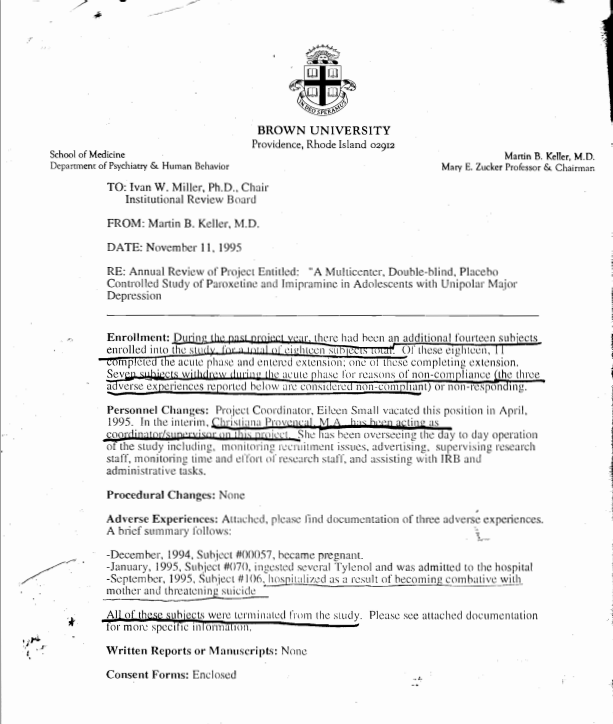
A memo from Keller to the IRBs at Brown and two of its affiliated hospitals, Butler and Bradley. In January 30, 1995, Keller reports (fig 1) that a teenage girl, patient #70 in study 329, ingested 82 Tylenol pills on January 19 and was hospitalized at St. Ann's Hospital. She was discontinued from the study at the end of January and coded as noncompliant according to another memo (fig 2) from Keller to Brown's IRB. Yet according to the GlaxoSmithKline's final report, (fig 3) patient #70 in the same study was a 12-year-old boy enrolled in the trial on February, 22, 1995 and withdrawn on March 24 after suffering from chest pains. This patient had been randomized to the imipramine arm of study 329.
fig 1
fig 2
fig 3
Quite remarkable. Paxil, it seems, can now give you chameleon qualities!
To date, neither GlaxoSmithKline or any of the 22 authors of the original study, or indeed, Sally K. Laden, have apologized.
It's been a long time coming, 14 years give or take.
Today sees the publication of a damning reanalysis of GlaxoSmithKline's infamous Study 329, a study, or a review of which, that was first published in the Journal of the American Academy of Child and Adolescent Psychiatry (JAACAP) in 2001.
BACKGROUND
The study made claims that paroxetine (Paxil, Seroxat, Aropax) was a safe and effective medication for treating major depression in adolescents and has, for the past 14 years, been widely cited in the medical literature, providing physicians with assurances about the usefulness, and safety, of paroxetine in this patient population.
Despite many calls for its retraction it remains unretracted and still provides false and misleading information to physicians and, in many cases, parents, who read it.
Let's take a look at the findings of the original study...
"Paroxetine is generally well tolerated and effective for major depression in adolescents."
Initially, the study looked plausible, after all, it had the backing of high ranking child psychiatrists who had, so we were led to believe, trawled through the data and supported the claim that paroxetine was safe and effective for children and adolescents.**
The new groundbreaking study published today shows how the claims and subsequent support of the claims were misleading and, in actual fact, false.
The reanalysis, Restoring Study 329: efficacy and harms of paroxetine and imipramine in treatment of major depression in adolescence - Joanna Le Noury (Lead author), John M Nardo, David Healy, Jon Jureidini, Melissa Raven, Catalin Tufanaru, Elia Abi-Jaoude, concludes that...
"Neither paroxetine nor high dose imipramine showed efficacy for major depression in adolescents, and there was an increase in harms with both drugs."
More on this new study and commentary from me, further down this post of mine.
With an initial study that made claims of safety and efficacy doctors and patients were led to believe that there would be no problems ingesting paroxetine and that it would make a lot of troubled children and teenagers well. Behind the scenes the pediatric Paxil machine was turning its wheels. GlaxoSmithKline, the company that sponsored the original study and manufactured the pill, had learned, some three years previous to the original publication, that the study did not show efficacy in this patient population but they had spent a lot of time and money trying to gain a licence in children and unfavourable results would mean losing out to a lucrative market. Internal company memos, sent to senior management set the stall. It showed how they, with silence and denial could convince doctors and journals to play along with the claim that Paxil was safe and effective.
One has to ask why they would do this. One can only arrive at the answer that Glaxo did it for the profit, nothing more, nothing less. In fact, it's a good question to ask Glaxo officials - Why did they claim a study drug was safe and effective when they knew that it wasn't?
How do we know this?
Well, a company email surfaced via litigation in the US. It was dated Oct 14, 1998 and told senior management that...
“As you will know, the results of the studies were disappointing in that we did not reach statistical significance on the primary end points and thus the data do not support a label claim for the treatment of Adolescent Depression.”
“This ‘cutting edge,’ landmark study is the first to compare efficacy of an SSRI and a TCA with placebo in the treatment of major depression in adolescents. Paxil demonstrates REMARKABLE Efficacy and Safety in the treatment of adolescent depression.”
Well, it has to do with not being fruitful with the truth. The study results were sent to a PR firm who, after reading through them came to the conclusion that paroxetine was indeed safe and effective. Here's the rub though, Glaxo only provided the PR firm with a summary of the study, roughly 200 pages. The actual study results (raw data) was over 77,000 pages long. Neither the PR firm or the authors who added their names to the study actually saw the raw data, more importantly, nae bizarrely, neither the PR firm or the original study authors asked to see the raw data. One has to ask why?
Glaxo didn't want the negative results leaking out to doctors, the public or their sales staff so they, once again internally, sent out the following to senior management..
“TARGET To effectively manage the dissemination of these data in order to minimize any potential negative commercial impact…. It would be commercially unacceptable to include a statement that efficacy had not been demonstrated, as this would undermine the profile of paroxetine.”
It worked as, one year after the JAACAP article went public, some two million American children and adolescents were prescribed Paxil. That figure is America only - add to it the number of children and adolescents elsewhere in the world that have been prescribed it and you will see why this was a lucrative market for GlaxoSmithKline.
RESTORING STUDY 329
In as much as proving that the original 329 study was deeply flawed and misleading, the restoration (reanalysis) shows severe problems with the way studies are accepted by medical journals and also highlights how study authors merely put their names to ghostwritten reviews, in this case Glaxo hired a PR firm (1 & 2) to draft the misleading evidence that Paroxetine was generally well tolerated and effective for major depression in adolescents, despite evidence to the contrary, evidence that, allegedly, the PR firm did not see.
The "authors" of the original review, unlike the authors of 'Restoring Study 329' didn't actually get to see the raw data and signed off the review (passed it off as their own clinical findings) - it's akin to structural engineer inspectors taking it as gospel that a building is safe because the builders told them so.
Restoring Study 329 also showed significant increases in the paroxetine and imipramine arms, including serious, severe, and suicide related adverse events, all of which became apparent when the data were made available for reanalysis.
One has to ask some serious questions here about the original 329 authors, all of whom have, over the past 14 years, refused to retract their names from the study.
In an accompanying feature in the British Medical Journal (BMJ) Peter Doshi associate editor, The BMJ, writes...
"The first draft of the manuscript ultimately published in the Journal of the American Academy of Child and Adolescent Psychiatry (JAACAP) was not written by any of the 22 named authors but by an outside medical writer hired by GSK. And the paper’s lead author, Brown University’s chief of psychiatry, Martin Keller, had been the focus of a front page investigation in the Boston Globe in 1999 that documented his under-reporting of financial ties to drug companies.
"But for those who have been calling for a retraction of the Keller paper for many years, the system has failed. None of the paper’s 22 mostly academic university authors, nor the journal’s editors, nor the academic and professional institutions they belong to, have intervened to correct the record. The paper remains without so much as an erratum, and none of its authors, many of whom are educators and prominent members of their respective professional societies, have been disciplined."
Doshi also picks up on Karen Wagner who was one of the original 329 study authors. He writes...
Karen Wagner, is a coauthor of the JAACAP paper. Wagner, a psychiatrist at the University of Texas, is also named eight times in the 2011 US Department of Justice complaint against GSK. According to the complaint, Wagner promoted paroxetine at a 1999 GSK sales force event. A GSK newsletter cited in the complaint quotes Wagner as telling the sales force that major depression was “a lethal disorder and it requires treatment.” Based on the results of Study 329, which were at the time still unpublished, “Dr Wagner said: ‘We can say that paroxetine has both efficacy and safety data for treating depression in adolescents.’”
At a telephone press conference (BMJ kindly invited me to participate) on Monday (14th Sept) Doshi spoke about the two studies. "What we have here is one paper published in 2001 saying that paroxetine is safe and effective and a new analysis that says that the drug is unsafe and ineffective, different conclusions and I think the RIAT authors have it right." (RIAT is the name given to the restoration authors - restoring invisible and abandoned trials)
On answering if criminal charges may be brought against any of those connected with the original study, Fiona Godlee, editor in chief of the BMJ, said, "I think there are movements, and this debate is ongoing, about the extent to which research and misconduct, which I think we can all agree, seems to have happened here and certainly many other instances could be the subject of criminal proceedings."
GlaxoSmithKline have had a copy of the RIAT findings since March. I asked one of the co-authors, David Healy, who was also part of the teleconference, if Glaxo had responded to it. He told me, "Not to us, that we're aware of."
RIAT author, Jon Jureidini, a child psychiatrist, also spoke of the study. "You will see from our paper that the harms associated with this drug in this trial were quite striking - twice the severe adverse events, four times the psychiatric events and high levels of suicide (events) and self harm, all of which were unclear in the previous publication." The high levels of suicide that Jureidini spoke of are shocking. There were 11 suicidal patients in the paroxetine group compared to just one in the placebo group.
In an accompanying video (link at foot of this post) Jureidini shows how the RIAT team found more adverse events than the FDA and how Martin Keller, the lead author in the original study, under reported events, even though they had been identified by GlaxoSmithKline.
Speaking of videos, in 2003, some five years after GSK sent internal emails to senior management stating efficacy had not been proven with paroxetine, Alistair Benbow, then GSK's Head of Psychiatry, was asked on national televison if he thought paroxetine could be safe in children. He answered, "Absolutely, it could be... the evidence, however, is clear, these medicines are not linked with suicide, these medicines are not linked with an increased rate of self-harm." 24 secs.
COMMENTARY
It's 'take a bow' time for the restoration study authors, Joanna Le Noury, John M Nardo, David Healy, Jon Jureidini, Melissa Raven, Catalin Tufanaru, and Elia Abi-Jaoude.
This is a significant piece of history and the British Medical Journal should be applauded too for finally showing some common sense and for not bowing down to pressure from British pharmaceutical giant, GlaxoSmithKline.
I don't expect for one minute that we will get any form of apology from either GlaxoSmithKline, the original study authors or, indeed, the Journal of the American Academy of Child and Adolescent Psychiatry. They have had nigh on 14 years to make retractions to the fraudulent study and they have each, individually declined. Today's publication of the reanalysis should, however, shake the boots of the authors. What they have done here is become part of Glaxo's murky history and hopefully every single one of the authors (22 in all) will, at some point in the future, come under scrutiny from law enforcers. Fraud is fraud, whatever way you slice it and each of the 22 have, knowingly or unknowingly, been part of that fraud, a fraud that put children and adolescents at risk, a fraud that has for 14 years been part of the reason why Paxil, this non-efficacious and unsafe antidepressant with side-effects such as suicidal thinking, has found its way into the mouths of children and adolescents.
For their part in this lack of care and duty to children they will have to face tough questions from family, friends and the media. Pleading ignorance just won't cut the mustard anymore.
The universities who have stood behind these authors also need to feel shame today, they have also been part of the reason why so many kids have been put at great risk and, arguably, many kids who have gone on to complete suicide induced by Paxil.
The original study, given the thumbs up by the original 329 review authors, was also taken as gospel by doctors who referred to it when checking to see if it was safe to prescribe kids Paxil off-label. Had Glaxo had been truthful then kids such as Sara Carlin, Sharise Gatchell and Adrian Keegan, to name but a few, would probably still be alive today. The same can be said for the authors, had they had asked to see the raw data then they would have drawn the same conclusion as the restoration authors, had they had called for the study to be retracted then kids who are now in the ground would, more than likely, be above the ground and enjoying their young lives. The JAACAP also needs to hold up its hand here as do the Universities who have, it appears, backed the authors associated with them.
There are different degrees of murder and manslaughter, someone, if not all, should be held accountable here. No better place to start than the current CEO of GlaxoSmithKline, Andrew Witty. Failing a murder or manslaughter charge then why not bring those responsible to trial under The Federal Child Abuse Prevention and Treatment Act, child neglect under this law states, "An act or failure to act which presents an imminent risk of serious harm.". I think the risks have been clearly proven, don't you? Am I wrong to suggest that those responsible should face criminal charges? Ironically, in England, the National Society for the Prevention of Cruelty to Children (NSPCC) use the tagline, "Every Childhood Is Worth Fighting For," yet I cannot find one single piece of legislation that protects children from unsafe prescription drugs, or those that market and promote these drugs. This needs to change!
GSK BOXING CLEVER
On April 26, 2013, RIAT team member, Jon Jureidini, sent Andrew Witty a letter calling for the retraction of the JAACAP 329 article (fig 1). In a cleverly drafted response (fig 2) from GSK's Head of Governance, John E. Kraus, GSK told Jureidini that they did not agree that the journal article was false and misleading, they added that the article, "accurately reflects the honestly held views of the clinical investigator authors." In essence, GSK are correct, and it is yet another example of GSK's spin.
What GSK are saying here is that the article (not the actual study) stands up to scrutiny. Of course it does! The JACCAP article was based on a summary of the actual study and the findings of the PR firm hired to write the findings of that summary. Remember, GSK omitted negative findings in the summary sent to the PR firm and ghostwriter, Sally K. Laden. (Letters obtained from http://study329.org/)
FIG 1
FIG 2
I really can't find words to describe GlaxoSmithKline's attitude. I am, for the first time since the conception of this blog, utterly dumbfounded by GlaxoSmithKline's 'shrug of the shoulders' and lack of respect for those harmed by their product approach. Glaxo will argue until they are blue in the face that it has never been proven that Sara Carlin, Sharise Gatchell, Adrian Keegan and many more killed themselves because of paroxetine induced suicide. They can say this with confidence because no subject in the original trial, as far as we know, went on to complete suicide. The truth of the matter is, since its launch, paroxetine has been implicated in many suicides. In Britain alone there have been 65 reported suicides associated with paroxetine, these are just reports sent in to the British drug regulator when family members or doctors suspect that paroxetine may have been attributed to the individual suicides. Many more are not sent in - and herein lies the problem of the original study. If a patient kills themselves whilst on paroxetine the treating physician may once again refer to the original 329 review, and what will they see?
"Paroxetine is generally well tolerated and effective for major depression in adolescents."
No mention of a suicide threat, so any of the subsequent articles about Paxil related suicides and black box warnings will be largely ignored because, at the end of the day, a doctor is going to believe the word of 22 academics rather than a tabloid newspaper or documentary.
The study published today highlights the suicide threats in the original study, the subjects who, remember were just children and adolescents, who felt suicidal whilst in the trial. Many more were self harming, a precursor to suicidal thinking - GlaxoSmithKline did not label these subjects as suicidal, instead they opted for the term "emotional lability." A code they used, one can only assume, to prevent questions being asked - to me, a layperson, the term "emotional labilty" just means the subject was unstable. In fact, the medical dictionary defines it as "a condition of excessive emotional reactions and frequent mood changes." Glaxo will, once again, argue that suicidal thinking could fall into this definition but to actually label an adverse reaction as a suicidal thought would have probably meant that the original study would not have been published and hailed as a landmark study in the treatment of depression in children and adolescents.
I guess the results of the restoration study will show the world just how abhorrent this British company are when it comes to the welfare of children and adolescents. It's not the intention of the study to show that, it's just my view. It will also show how the whole process of clinical trials are deeply flawed and one sided and how paying highly respected child psychiatrists to endorse a drug takes precedence over actually allowing those same highly respected child psychiatrists to see the actual raw data.
Two studies, two opposite outcomes...and a whole bunch of internal company memos that show how this one company knowingly managed the dissemination of the negative study results so perfectly, making a huge profit as a result and, at the same time, putting children and adolescents at risk.
Clinical trials should be about science and about rigorously checking raw data. Restoring 329 is, I believe, the very first study that has used these models.
I anticipate that Le Noury, Nardo, Healy, Jureidini, Raven, Tufanaru, Abi-Jaoude and the BMJ will now fall under the radar of GSK and the mud-slinging will begin. That's how Glaxo operate. They do it with reps who bring it to the attention of senior management that illegal activities are occurring within the company, they do it with expert witnesses who offer evidence against their products in court rooms, an example of this can be seen here, they do it with anyone who basically questions their ethics.
The RIAT team need to be applauded, it's not been easy to wade through 77,000 pages of raw data, a task made even harder by GlaxoSmithKline when the study authors learned that they could not simply save information off Glaxo's database, they had to painstakingly do it the old-fashioned way, by using a pen and paper.
Many others need to be applauded for their efforts over the years too. Leemon McHenry and Shelley Jofre spring to mind, as do investigative journalists Evelyn Pringle and Alison Bass. The LA based law firm, Baum Hedlund have also been instrumental in getting the information out as have the infinite amount of bloggers, not forgetting, of course, the Healthy Skepticism team and the Citizen's Commission on Human Rights.
It will be interesting to see, over the coming weeks and months if any of the original authors reject the findings of the restoration study - chances are they will, likelihood is that they won't be able to tell you why they reject these new findings. Science, particularly where raw data is used, cannot be argued.
For the record, the 22 authors of the original study are:
Martin B. Keller (lead author), Neal D. Ryan, Michael Strobber, Rachel G. Klein, Stan P. Kutcher, Boris Birmaher, Owen R. Hagino, Harold Koplewicz, Gabrielle A. Carlson, Gregory N. Clarke, Graham J. Emslie, David Feinberg, Barbara Geller, Vivek Kusumakar, George Papatheodorou, William H. Sack, Michael Sweeney, Karen Dineen Wagner, Elizabeth B. Weller, Nancy C. Winters, Rosemary Oakes, and James P. McCafferty.
As for GlaxoSmithKline, they will do everything to minimize the fallout of this study, after all they have shareholders whom they wish to continue buying their shares. If those same shareholders had any morals they would disassociate themselves with a company who knowingly put profit before the safety of children and adolescents - then again, money blinds people - the original 329 study is crystal clear evidence of that.
Make a habit of two things: to help; or at least to do no harm. - Hippocrates
Bob Fiddaman.
** I use the term 'children and adolescents' because, to me at least, there is no definitive cross-over when a child becomes an adolescent.
Related news: Glaxo go to trial in the UK within the next 12 months where they will defend allegations that Paxil (known as Seroxat in the UK) caused severe withdrawal issues and dependency in a number of people who were prescribed it.
Just three words that sum up BBC Journalist Shelley Jofre's 2006 interview with (the then) Editor in Chief of JAACAP, Mina Dulcan.
Jofre's style of interviewing is refreshing, she doesn't sugarcoat things and she is never afraid to ask the questions that would leave the likes of Michael Parkinson or Jonathon Ross cringing.
This 2006 interview, which has been released in transcript form via the 329 website, is quite remarkable and it highlights two things.
1. Jofre's ability to get under the skin of those in denial.
2. The level of denial of all those connected with the publication of the original 329 review.
Here's just one small extract - things were getting too heated for Dulcan, it seems...
Jofre: The results are pretty negative. That’s the point isn’t it and they weren’t really presented in an accurate way in your journal?
Dulcan: Well, I think there is always room for interpretation and it really feels to me as though this discussion has reached a point at which it is not going anywhere. You are really badgering me to try to get me to say something that you believe and really it is not consistent with the way a scientific journal operates.
Game, set and match to the ankle biter (me thinks)
It's no secret that British pharmaceutical giant, GlaxoSmithKline, have been involved in some rather unsavory shenanigans of late. Bribery and corruption seem to be two words that people associate with Glaxo, and rightly so. With an admittance of guilt and a record $3 billion fine in the US it came as no surprise that the cancer had spread across to China, where, once again, Glaxo agreed to plead guilty and pay out $489 million. They are currently under the investigation by the UK Serious Fraud Office for yet more allegations of bribery and corruption. They also go to trial in the UK within the next 12 months where they will defend allegations that Paxil (known as Seroxat in the UK) caused severe withdrawal issues and dependency in a number of people who were prescribed it.
The above cases already settled may be the cost of running a business and, after the dust settled, Glaxo (including their shareholders) shrugged their shoulders and put it all behind them.
Buried deep in the the record-breaking US settlement was the fact that Glaxo had made millions, if not billions, through the sale of Paxil. They illegally promoted its use in children and adolescents. Because this settlement centred around the illegal promotion of a number of Glaxo's products and also how they bribed doctors to prescribe more of their products, there really hasn't been much of a backlash from the public.
All that is about to change and it all centres around Glaxo putting profit ahead of the safety of children and adolescents. The spotlight will, once again, fall on Glaxo hiding important safety information from healthcare professionals and the public, safety information that put a vulnerable population at risk and, arguably, resulted in children and adolescents self-harming, suffering withdrawal and completing suicide.
The fact that Glaxo hid this information from all and sundry shouldn't really be the issue here. The general public need to look through that, after all, it's just part of running a business to hide negativity away from prying eyes.
What we, the public, should be outraged about is Glaxo execs, senior management and reps (to an extent) put children and adolescents at risk by keeping the truth from both them and their doctors.
Glaxo have, in essence, erected a fence around a playground. They have told the children that it's perfectly okay to touch the fence (even though the fence has electricity running through it)
Glaxo have also reassured the parents of these children in the playground.
In teenagers, Glaxo have offered news of a new rollercoaster, it's the best rollercoaster in the world and, more importantly, it is perfectly safe to ride (even though there is a number of cracks in the structure and missing wheels on the carts)
Those selling the tickets to ride the Glaxo rollercoaster are blissfully unaware because they have been informed by world renowned structural engineers that the rollercoaster is safe. Little do they know that these same structural engineers haven't even inspected the rollercoaster. Little do they know that Glaxo have merely told these engineers that their rollercoaster is safe and they should sign off the relevant paperwork that supports this claim.
The above comparisons relate to Glaxo's infamous 329 study that has, for many years, hid the facts of the electrical fence and the unsafe rollercoaster.
Here we have a company who have raked in billions of dollars on Paxil alone. Any harm that has come to children and adolescents has been met with denial from Glaxo. Indeed, adults climbing that same fence and riding that same rollercoaster are, apparently, not at risk either.
I digress.
This is not about adults, it's about children and teenagers. It's about a pharmaceutical company who, for whatever reason, decided one day to put them at risk by giving a drug the all clear when they knew that the drug could, potentially, end the lives of those children and teenagers.
To support the safety and efficacy of this drug, they hired world renowned pediatric psychiatrists, pretty much in the same way they hired those structural rollercoaster engineers) - with such an endorsement they knew (despite the risk to the kids) that they would make a huge profit.
Who thinks like that these days? A psychopath perhaps?
No doubt, when the reanalysis of Study 329 is published soon, Glaxo will cite that it was all part of an era and they aren't like that anymore. There will be no apology and, more importantly (for Glaxo) the electric fence and rollercoaster will remain in place, the fence still with electricity running through it, the rollercoaster still with cracks in its structure and carts missing wheels. Those that regulate the structural engineers of both the fence and rollercoaster will, as usual, do nothing.
That's some legacy for Glaxo, 329 authors (by proxy) and Medicine regulators.
The 329 website can be found here and will be updated once the reanalysis has been published in the British Medical Journal later this month.
Had an email off the BMJ earlier this morning in regard to the infamous Paxil 329 study.
It's not looking good for GlaxoSmithKline, who are currently under investigation from the UK Serious Fraud Office for various bribery and corruption allegations and who are also facing a lawsuit in the UK regarding Paxil's (also known as Seroxat) propensity to cause severe withdrawal issues and dependency.
Hi
We have an important paper publishing in The BMJ next week that might be of interest.
Briefly, it's the first reanalysis of data from a widely used antidepressant drug trial that comes to a different conclusion about the drug's efficacy and safety in adolescents.
Accompanying articles highlight industry malpractice, hidden data allowing manufacturers, academics and clinicians to overstate the benefits and underplay the harms of treatment, regulatory failure, and inaction by the academic journals and institutions.
Three of the authors are based at the University of Adelaide.
Dr Fiona Godlee, The BMJ Editor-in-Chief says this reanalysis "sets the record straight" and "shows that the public and clinicians do not have the unbiased information they need to make informed decisions."
And she calls for legislation to ensure that the results of all clinical trials are made fully available for legitimate independent third party scrutiny.
We are planning a telephone briefing with the authors and Dr Godlee at 15:00 hrs UK BST / 23:30 hrs ACST on Mon 14 September to talk through the findings and their implications ahead of publication.
BMJ.
More info on the reanalysis of 329 can be found here.
In 2014 it was announced that the Serious Fraud Office (SFO) were going to be investigating GlaxoSmithKline with regard to their nefarious activities that have recently come to light in countries such as China, UK, USA, Iraq, Poland, Bahrain, Jordan, Kuwait, Syria, Lebanon, Oman, Qatar and the United Arab Emirates.
As with all investigations we rarely get to see what is going on, that's why I found the following court document surprising, so surprising that I decided to invite long time friend and fellow blogger, the Truthman, on board to help me to some digging. Truthman's excellent exposé on GSK can be found on his blog, the aptly titled, "GSK, Licence To Kill."
The court document gives us three names, there may be more employees of GSK, past and present, that may have already been interviewed by the SFO or, as we suspect, many more who may be interviewed in the future.
The three GSK employees, two of them current and one a former employee, are, it appears, not cooperating with the SFO, each claiming that they have a right to be legally represented during those interviews.
According to court documents the three individuals were told by the investigating SFO that they could not have legal representation - the SFO later did a u-turn but told the three that they could not use the services of the same law firm representing GSK with respect to the investigation.
All three asked for a judicial review on the decision claiming that they had a right to use whoever they chose to represent them. The High Court, after reviewing the original decision, found that the grounds were unarguable.
The three employees.
Whilst it's important to note that the three individuals are not suspects into GSK's alleged bribery and corruption, it's interesting to see the positions they hold at GSK. It's also interesting that these individuals, if they have nothing to hide, would hold up the process of the SFO investigation on the basis that they wanted their legal representation to come from the same law firm, Arnold & Porter UK LLP. If, the 'GSK Three' wished to help the SFO then surely it wouldn't matter who they were represented by.
So, who are the three?
1. Jason Lord. (No photo available)
Research shows that Lord was, in 2006, GlaxoSmithKline (GSK) Security Adviser in the Corporate Security and Investigations Department.
In 2006, Lord attended and gave a presentation at the Jordan Intellectual Property Association (JIPA), a membership-based association that has organized several IP training events in Jordan. (Web Archive)
For those that don't know, Jordan is another country currently under investigation. The claims are that GSK staff in Jordan have bribed doctors. The allegations relating to Jordan and also Lebanon were first reported in the Wall Street Journal, which cited emails from a person who first contacted GSK in December. The paper said the emails allege that GSK sales representatives bribed doctors to prescribe drugs and vaccines by issuing free samples to doctors that they were allowed to sell on.
Not much else is known about Jason Lord.
2. Paul Reynolds.
Paul Reynolds, GlaxoSmithKline
According to his LinkedIn page, Reynolds currently holds the position of GSK Head of Respiratory Marketing, UK.
Between July 2010 – March 2012 Reynolds was GSK's Senior Marketing Director, Seretide (Europe, Asia Pacific, and Emerging Markets)
Seretide is a product manufactured and marketed by GlaxoSmithKline, it is used to treat Asthma.
In 2014, BBC Panorama aired 'Who's Paying Your Doctor?' where it was alleged that GSK paid doctors to promote GSK's asthma drug Seretide in Poland between 2010 and 2012.
Ironically, in 2012, Reynolds became Commercial Director, Retail for GlaxoSmithKline, a position which he held in Warsaw, Poland.
In 2011, Reynolds, wrote an article for the pmlive, a webiste about the pharmaceutical industry.
Some of his quotes, we feel, were misplaced. Maybe Reynolds was speaking from the heart when he said...
"Companies like GSK began taking action against the mistakes of the past many years ago. I feel that I operate in a company that works tirelessly to do the right thing, not just to work within the rules and to restore trust, but to act and operate transparently and ethically, because it is the right and the only thing that a business and an industry should do. Pushing at the boundaries against competitors or with customers, whether they are prescribers, payers or patients, is not good business. The industry was still learning to operate within a new space, having previously enjoyed much greater freedom. So, naturally the focus was on understanding how to operate within new rules, without contravening them.When I look back at this early part of my marketing career, I see the naivety of some of my actions and of those of people around me, as we tested how far we could go while staying within the remit of the Code. For me now, rules are to be bettered and not tested and this outlook is one I see as the norm today."
We find it interesting that Paul Reynolds mentions the 'pushing of the boundaries' early in his career. Was Reynolds suggesting the boundaries of what is ethical perhaps or what is legal? He also says that the industry previously enjoyed 'greater freedom', what exactly does he mean here? 'Greater freedom to do what? Considering this article was written in 2011 and GSK were yet to be fined for their $3 Billion US fraud felony in 2012, and their China bribe operation in 2014, perhaps Paul Reynolds was being a little premature in his assessment of GSK's ethical compliance system?
As we mentioned,Reynolds currently holds the position of GSK Head of Respiratory Marketing, UK. Seretide is the UK brand name for Advair, as it is known in the US.
GSK's Advair is used to prevent asthma attacks, and to treat chronic obstructive pulmonary disease [COPD] and the recent whistleblower suit, that GSK plead guilty to and paid a record $3 billion in fines, shows how they aggressively marketed it with promotional 'get togethers' as shown in the video excerpts [below]
3. Justin Mayger
Justin Mayger, GlaxoSmithKline
Mayger currently holds the position of Director, Compliance and Control Integration at GSK. He was first employed by GSK in 2005 where he took on the position of Senior Business Risk Consultant. Five years later saw Mayger take up the position of Director, Anti-Bribery and Corruption Prevention (ABAC) at GSK. (LinkedIn)
The role of the ABAC is to investigate allegations as soon as it becomes aware of them. Part of GSK's policy on bribery and corruption in the business reads...
GSK has zero tolerance towards bribery and corruption. GSK employees shall not make, offer to make, or authorise payment to a third party (e.g. sales agent, distributor or intermediary) with knowledge that all or part of the payment will be offered or given to any individual to secure an improper advantage, obtain or retain business.
All three will now be interviewed by the UK Serious Fraud Office. It's unknown why the SFO have picked these three individuals to help with their investigation.
The court document, THE QUEEN ON THE APPLICATION OF (1) JASON LORD (2)PAUL REYNOLDS (3) JUSTIN MAYGER Claimants v DIRECTOR OF THE SERIOUS FRAUD OFFICE, can be downloaded here.
Glaxo's current CEO, Andrew Witty, was the Vice President and General Manager of Marketing of Glaxo Wellcome Inc. [GlaxoWellcome and SmithKline Beecham merged in 2000 to become GlaxoSmithKline.] Some of his responsibilities included, strategy development, marketing execution and new product positioning. Witty and his team were awarded a Medical Marketing Association [MMA] award [Medical Marketer of the Year] in 1998. He also worked in the Company’s International New Products groups, both in the Respiratory and HIV/Infectious disease fields.
Two words - Marketing and Respiratory. Alarm bells anyone?
GSK's CEO, Andrew Witty, said in a statement about the record $3 billion payout that “Today brings to resolution difficult, long-standing matters for (Glaxo). Whilst these originate in a different era for the company, they cannot and will not be ignored. On behalf of (Glaxo), I want to express our regret and reiterate that we have learnt from the mistakes that were made,”
We think the SFO need to look further afield if they wish to get to the bottom of the whole Seretide promotional activities of GSK, if indeed that is their intention here.
Collectively, myself and co-writer, Truthman, strongly urge the SFO to interview Andrew Witty if they wish to know more about the respiratory drug promotion from GlaxoSmithKline. Let's face it, the guy must have a wealth of experience in all matters relating to the respiratory side of the business at the global pharmaceutical giant. Failing that, maybe the SFO should contact Peter Humphrey, he was hired by GSK China to investigate bribery claims, despite GSK denying that the claims were true - they later went on to plead guilty to the claims.
We would be extremely surprised if Andrew Witty ends up anywhere near a prosecution, given that lawyers representing GSK seem to be doing their very best to stall the investigation.
GSK have huge power and sway in the UK, they are a major cash cow, and one only has to look at the board to see that there are many Knights of the realm (Sir's) who make most of the executive decisions at GSK. In fact, GSK have so many Knights stewarding the company we could be forgiven if we mistook it as some kind of pseudo-Camelot, except these Knights certainly aren't as chivalrous.
Another Revolving Door
Trying to get a successful prosecution against GSK, or any individuals operating within GSK, may prove to be difficult given that Kathleen Harris, a former SFO lawyer, was recently hired as a partner at US-headquartered firm Arnold & Porter, the very same law firm who are defending Glaxo and who wished to represent the Glaxo three during their interviews. (Source) During her time at the SFO she supervised and provided strategic oversight to a number of high-level investigations and prosecutions. She also played a key role in developing seminal guidelines on critical issues, including plea negotiations, civil remedies, civil recovery and corporate prosecutions.
Upon leaving the SFO to join Arnold & Porter, Harris said, “Arnold & Porter has a prominent group of white collar defense lawyers with extensive criminal law experience on the prosecutorial side from the U.S. Justice Department and other regulatory agencies, as well as on the defense side. It’s great to be a part of this team.” (Source)
It wouldn't surprise us if the current SFO investigation comes down to some sort of plea negotiation between both parties. Both the Truthman and I hope we are wrong. History, however, may repeat itself as this is not the first time we have seen a revolving door between prosecution and defence where GSK have been involved in litigation or investigation. (see US Attorney General Eric Holder and the Revolving Door)
Contrast the SFO investigation with the MHRA's investigation into GSK and you will see such a huge difference. The SFO wish to seek the truth by actually investigating claims, where the MHRA carried out a near five-year investigation into GlaxoSmithKline, commencing in 2003 and ending in 2008, and, well, really didn't do much to find the whole truth.
GSK had failed to report in a timely manner adverse event data from clinical trials in children of its antidepressant, Seroxat (Paxil). (See Restoring Study 329) After nearly five long years the MHRA decided not to prosecute, not only that, it emerged that the MHRA did not even bother to interview any employees from GSK.
At the time, I, Bob Fiddaman, asked the MHRA, under the terms of the Freedom of Information Act, the following question...
“Why were MHRA enforcement investigators unable to question GSK staff?”
The MHRA replied...
Under UK criminal law suspects in criminal investigations can not be compelled to answer questions, they have a right to remain silent. Lengthy negotiations were conducted with solicitors acting for individual members of GSK staff and for GSK itself with a view to persuading them to attend interviews under caution. The conclusion of the correspondence was that all the potential interviewees indicated that they would not attend an interview under caution.
The individual suspects (as opposed to the corporate entity GSK) could have been arrested and required to attend an interview under caution. However they could still not be compelled to answer questions and, given that their solicitors had clearly indicated that they would not answer questions, the investigation team concluded that there was nothing to gain by carrying out arrests.
The near five-year investigation resulted in the MHRA sending GSK a "You've been naughty, but it's okay" type of letter, a letter that, the then current GSK CEO, JP Garnier, responded to by stating, that 'Glaxo had done nothing wrong.'
Talk about arrogance!
Maybe the MHRA should take a lesson from the Serious Fraud Office or, maybe the MHRA need to get better counsel?
Those in-the-know know why the MHRA did not prosecute GSK and it had nothing to do with their official explanation.
Let's hope that Messrs Lord, Reynolds and Mayger can provide the SFO with information they need to find the ringleader involved in the fraud and bribery, let's hope they (SFO) can show the British drug regulator how investigations should be carried out. Let's hope the SFO's investigation leads to criminal prosecutions and, hopefully, some custodial sentences.
With a former SFO employee now working for Arnold & Porter, our hopes may be dashed.
I hope I can make it across the border. I hope to see my friend and shake his hand. I hope the pacific is as blue as it has been in my dreams. I hope. - Red, Shawshank Redemption
The song, 'Local Boy in the Photograph', originated from a newspaper article about a boy from Flint in North Wales, who committed suicide by jumping in front of a train.
I like the Stereophonics.
The photograph above the lyrics was first aired publicly by David Healy. A quite brilliant insight into Study 329 was shared by Healy to an audience (Video below). The photograph, a simple cunning plan by GlaxoSmithKlime management to keep employees away from the truth, more importantly, to detract them from believing a series of Panorama programmes aired by the BBC, presented (and investigated) by pint-sized ankle-biter, Shelley Jofre.
I like David Healy.
I like Shelley Jofre.
I dislike GlaxoSmithKline.
Healy's presentation, The Famous Grouse review of the history of Study 329, is jaw-dropping. I normally skip presentations by Healy because I assume it's an old one, and I have seen all of his previous ones on YouTube. I think David Healy pretty much knows that he would be preaching to the choir if I attended his presentations.
The Famous Grouse review of the history of Study 329 is different in as much that Healy offers information almost as a teaser, that tease delivered with a glint in the eye, an all knowing eye that has, along with other astute academics, revisited Study 329 and have gained access to the raw data that was never seen by ghostwriter, Sally K. Laden and the Study 329 authors who were, and to an extent still are, the bees knees when it comes to matters of pediatric depression. All were paid handsomely by GSK to lend their names to the 329 review, each and everyone of them have been approached and asked to support a retraction of the review, all have declined.
I dislike the authors and ghostwriters of 329.
Healy's talk set my pulse racing, a maze of pharmaceutical and academical greed hiding suicidal behaviour in children and adolescents just so a drug (Paxil) could be aimed at children. There are many instigators behind this whole debacle - Alistair Benbow (the former GSK Head of Psychiatry who once tried to sue me) also makes it onto Healy's slideshow presentation - it leaves you in no doubt that Benbow erred when interviewed by BBC journalist Shelley Jofre - question is, was Benbow lying, as some would suggest, or was he fed the wrong information from the hierarchy at GSK? Did Benbow play the part of Pinocchio in front of millions of TV viewers or was he merely your average dummy, complete with fist up his backside, speaking on information given to him?
329 is a stain on GSK and, as Healy presents it, raised red flags for Shelley Jofre when she read it. Something didn't quite sit right with her and much of the plaudits should be sent in her direction because without Jofre's gut instinct we would all be sitting here today wondering why so many depressed kids were killing themselves. I truly believe Jofre's tenacity has kept that figure down.
And what of the boy in the photograph?
You may throw your coffee mug at your screen when learning through Healy's presentation how GSK used a photograph of a youngster to play down the risk of suicide in teenagers to their employees. The photograph, just one in a series of four, all appear in the presentation and it, to me at least, highlights the fact that Jofre got to them and she got to them big time.
The video lasts for about an hour. This, ladies and gentlemen is reality TV.