Zantac Lawsuit


Researching drug company and regulatory malfeasance for over 16 years
Humanist, humorist

Thursday, May 12, 2016

The Murderous Pills and The Keystone Cops (FDA)


A few days ago I read what was probably one of the most concise and factual articles about SSRI and other psychiatric medicine induced homicide.

The article, researched and written by Andrew Thibault, features a series of assessment reports obtained by Thibault from the FDA (The American drug regulator). It took him a while to secure these documents, all of which were requested under the Freedom of Information Act, many of which have large chunks of information missing.

In his article Thibault highlights just a small handful of the cases taken from the FDA Adverse Event Reporting System (FAERS). Thibault writes...

In October 2014, I submitted a Freedom of Information Act (FOIA) request to the FDA to obtain copies of the FAERS homicide reports. After ten months of “Foot Dragging and Alibis,” which is what Rep. Joe Barton (R-TX) once suggested the agency's acronym stood for, the FDA still had not produced a single report. Frustrated with the FDA's stonewalling, I filed a federal lawsuit in August 2015. Within three months of filing the FOIA lawsuit, the FDA coughed up over 3,000 pages of FAERS reports.

What follows are some examples of these reports that leave the reader in no mind that the FDA, along with the pharmaceutical companies are very aware of psychiatric medications being associated with homicidal acts.

It's a must read and kudos should be given to Thibault for his patience during the 10 month period where the FDA were unwilling to release the documents. At the end of his article Thibault tells of the FDA requesting some of the documents back from him. More on that in a future post.

Meantime, here's his work, 'The FDA Is Hiding Reports Linking Psych Drugs to Homicides.'

For now, I'm going to focus on some of those documents that relate to an association with homicide and Paxil (Seroxat) - You'll note that many of the reports sent in are assessed by the pharmaceutical company that manufacture the suspect drug, in this case, GlaxoSmithKline.

The files have been uploaded and a huge database now exists for doctors and patients alike to make up their own minds. I'd include the media but for whatever reason the majority of media outlets tend to shy away from reporting the truth about antidepressants.


AERS Case Number 3951806 (Click on the images to enlarge)


Homicide by a 47 year-old female. The patient was taking Paxil (30mg per day) between August 2001 and May 2002.


--


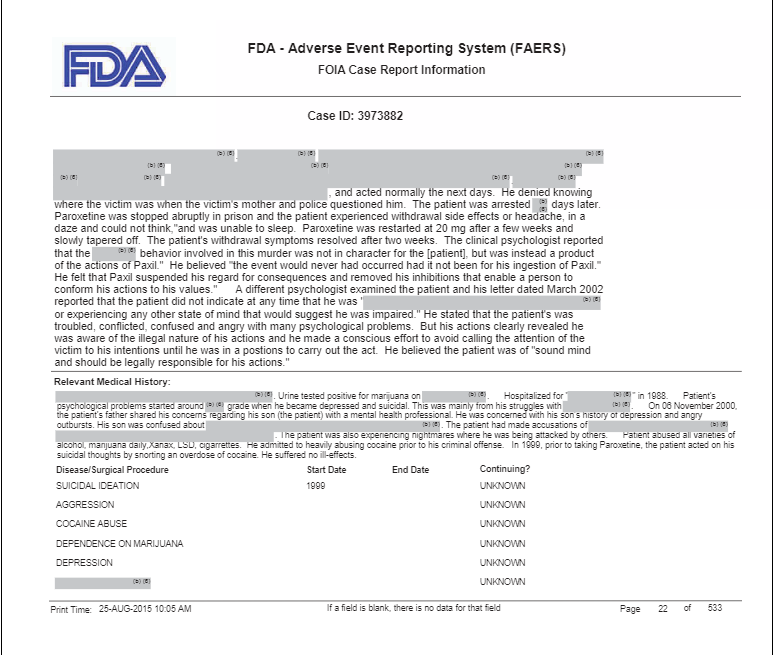
AERS Case Number 3973882

Homicide by a 16 year-old male. The patient was taking Paxil (unknown dosage) between February 2001 and July 2001.

You'll note in this case that the assessment goes to great lengths to suggest that there were other mitigating circumstances.


--

AERS Case Number 4078438

Homicide by a 15 year-old male. The patient was taking Paxil (unknown dosage) between April 2002 and an unspecified date.

What is remarkably interesting about this case is the comment that suggests the 15 year-old male patient may have carried out murder because, and I quote, "The patient's homicidal tendencies may have been influenced by a video game." - It has to be noted that this report, sent to the FDA by GlaxoSmithKline, was quoting a media article. 

One also has to look at the state of mind of this 15 year-old male prior to the homicide. He was sent to a detention centre where his Paxil was discontinued, he then attempted suicide on two separate occasions, he experienced mood swings, violent thoughts, visual and auditory hallucinations and exhibited self-harming behaviour. After stopping Paxil the patient then went on to commit a murder.

But it was probably due to being influenced by a video game, right?


--

AERS Case Number 4100301

Homicide by a 48 year-old female. The patient was taking Paxil (30mg) between April 2002 to 2002.

It appears this report was sent straight to Medwatch via one of the family members.


--


AERS Case Number 4114631

Homicide by a 34 year-old female. The patient was taking Paxil (unknown dose, unspecified dates)

What's striking in this case is that the person who committed murder was a nurse who provided home care. It appears as though she flipped one day and murdered one of her patients.


--

Finally, for now at least as there are literally many more reports (around 3,000 pages), I'll leave you with AERS Case Number 5890599. We know who this case refers to - the report is, as you will see, redacted in places. At the bottom of the report is a link to a heart-wrenching story written by the 'unidentified' person in the report.


AERS Case Number 5890599

Homicide by a 47 year-old male. The patient was taking Paxil (60mg per day)


--

Special thanks to Andrew Thibault for his wonderful research and for the database which is currently available on the Murder Meds website. Hat tip too to Doyle Mills for alerting me to the Murder Meds website.


Over the coming days I'll be posting the documents that the FDA have requested back from Andrew Thibauld - my message here is simple, share them once they are uploaded. Facebook them, Tweet them, let them go far and wide. The FDA want them back, make sure as many people see them before they are sent back.


Bob Fiddaman.


Monday, May 09, 2016

Court Documents Show Celexa in Bad Light for Kids


The above meme is applicable to doctors and patients alike. The 'open your mouth' line fits perfectly for both. Doctors should know all the facts before they recommend a treatment to a patient, a patient should know all the facts about the said treatment before they open their mouths to ingest it.

Which brings me nicely to a study recently published regarding a clinical trial involving a widely prescribed antidepressant. Citalopram, known better by its brand names of Celexa in the US and Cipramil in the UK.

Citalopram was tested in kids between 1999 and 2002 and was known as CIT-MD-18 pediatric depression trial. The results and subsequent publication of those results were, as we've come to expect, ghostwritten by PR company Weber Shandwick, more specifically it was ghostwritten by Natasha Mitchner at Weber Shandwick Communications, under instruction from Jeffrey Lawrence (Product Manager Forest Marketing)

For those who don't know, Forest Labs are the American pharmaceutical company that market Celexa. Forest Labs are a subsidiary of Forest Pharmaceuticals.

“A randomized, placebo-controlled trial of citalopram for the treatment of major depression in children and adolescents,” was published in the American Journal of Psychiatry in June 2004. However, its lead author wasn't neither Mitchner or Lawrence.

Some 10 years after publication a lawsuit against Forest was, in part, settled. The lawsuit, Celexa and Lexapro Marketing and Sales Practices Litigation, had during its intensive investigation, found the confidential documents relating to CIT-MD-18, 750 of which, have now been made public on the on the Drug Industry Document Archive (DIDA) website. In all, over 63,000 documents were handed over to plaintiff lawyers who were suing Forest Labs for the safety and efficacy of Celexa and Lexapro (US trade names for citalopram and escitalopram respectively) in marketing the drugs “off-label” for pediatric use.

The 750 public documents have been desconstructed by Jon N. Jureidini, Jay D. Amsterdam, and Leemon B. McHenry and the results are startling, to say the least.

"The citalopram CIT-MD-18 pediatric depression trial: Deconstruction of medical ghostwriting, data mischaracterisation and academic malfeasance" shows, amongst other things, that;

CIT-MD-18...


  • Contained efficacy and safety data inconsistent with the protocol criteria.
  • Procedural deviations went unreported.
  • Negative secondary outcomes were not reported.
  • Adverse events were misleadingly analysed.
  • Manuscript drafts were prepared by company employees and outside ghostwriters with academic researchers solicited as ‘authors’.
  • Authors failed to mention that the five citalopram-treated subjects discontinuing treatment did so due to one case of hypomania, two of agitation, and one of akathisia, none of these conditions were found in the placebo group.


The deconstruction of the 750 documents also showed the authors that protocol-specified outcome measures showed no statistically significant difference between citalopram and placebo. In other words, children taking citalopram found it as effective as taking a sugar-coated pill.

This is contrary to the 2004 study published in the American Journal of Psychiatry in June 2004 where it was stated that, "In this population of children and adolescents, treatment with citalopram reduced depressive symptoms to a significantly greater extent than placebo treatment and was well tolerated."


Fig 1


The 2004 study shows that its lead author was Karen Dineen Wagner (Fig 1) but as the deconstruction study shows Wagner merely added her name to the study (as lead author) that was penned by Natasha Mitchner at Weber Shandwick Communications.

Wagner is no stranger to controversy, she'd previously added her name to the Paxil 329 ghostwritten paper without actually looking at the raw data [which showed an increased rate of suicidal thoughts in kids taking Paxil]. It's also been learned through various litigation in the US that Wagner was paid to deliver lectures promoting the use of Paxil for depressed kids and teens to both GSK’s sales reps and doctors, this despite ever taking a look at the raw data of 329. Maybe she had faith in the ghostwriter of Paxil 329, Sally K. Laden, just as she did with the Celexa ghostwriter Natasha Mitchner ~ Who knows what makes Wagner tick?

In the complaint filed against Forest Labs it was alleged that the American pharmaceutical company arranged for Karen Wagner to give promotional presentations on the pediatric use of Celexa and to serve as the chair of a seven-city Continuing Medical Education ("CME") program on treating pediatric depression... even though the CIT-MD-18 trial was a failure.

So, to recap...
  • Forest conduct clinical trials then write up the results of that trial via a ghostwriter.
  • Once the study result are written, Forest hire well known pediatric psychiatrists to claim the the ghostwritten work is theirs.
  • Despite Celexa showing no efficacy over placebo, the study (now allegedly written by Karen D. Wagner) shows that it "reduced depressive symptoms to a significantly greater extent than placebo."
  • Forest Labs are denied a licence to sell Celexa for child depression but, none the less, send out reps to promote it's safety to prescribing physicians, who were often "dined and dashed" in efforts to get them to prescribe Celexa, the drug that was shown not to work in kids, to kids.

Oh, I forgot to mention, the kids targeted by Forest, Wagner et al were age 7 to 17.


Jon N. Jureidini, Jay D. Amsterdam, and Leemon B. McHenry conclude their findings with...

"It is important to make these articles transparent to correct the scientific record. It is furthermore imperative to inform the medical community of mischaracterized data that could lead to potential harm to children and adolescents who are vulnerable to the effects of medication on the growing brain and may increase suicidal thinking and behaviour."

I couldn't agree more.

Jureidini, Amsterdam, and McHenry ~ take a bow. I salute you all.


Drs. Amsterdam and Jureidini were engaged by Baum, Hedlund, Aristei & Goldman as experts in the Celexa and Lexapro Marketing and Sales Practices Litigation

Dr. McHenry was also engaged as a research consultant in the case. Dr. McHenry is a research consultant for Baum, Hedlund, Aristei & Goldman.


"The citalopram CIT-MD-18 pediatric depression trial: Deconstruction of medical ghostwriting, data mischaracterisation and academic malfeasance" appears in the International Journal of Risk & Safety in Medicine, vol. 28, no. 1, pp. 33-43, 2016


Fiddy Rant.

So, here we see yet another pharmaceutical company hiring the ghost writing services of a PR firm. Yet another pharmaceutical company who make claims that a drug is safe and effective when it isn't. Once again we see prominent psychiatrists adding their names to published papers when their input to these published papers is minimal to say the least. Furthermore, and yet again, we see a pharmaceutical company promote the use of a non-efficacious drug by wining and dining health care professionals.

Citalopram is from a group of medicines known as Selective Serotonin Reuptake Inhibitors (SSRIS). It has been well documented that Citalopram can induce thoughts of suicide and homicide in many numbers of people that take it. Why then, did Forest Labs spin the data on the CIT-MD-18 pediatric depression trial? Why did Karen Wagner et al claim to have written the study when court documents show that it was written by someone else?

Moreover, what is it with pharmaceutical companies and top paediatric psychiatrists and their apparent lack of care for the safety of 7-to 17 year-olds?

Criminal charges need to be brought against those who played a part in the manipulation of this study. That goes for the top executives at Forest Labs, the reps who promoted its use in kids and the top psychiatrists who put their names to support the data (without actually looking at the data). Charges too should be brought against any doctor who received a bribe from Forest Lab reps, be that a free dinner of tickets to the baseball game.

Off-label prescribing of antidepressants to kids is wrong. I know there are some that disagree with me but look at the facts now. Study 329 (Paxil didn't work in kids) - CIT-MD-18 (Celexa didn't work in kids) ~ So, why prescribe something that doesn't work? 

The side effects of Celexa are pretty horrific for adults let alone children ~ don't even get me started on they harm the can cause to fetuses!

The evidence in these two recent cases now show that neither Paxil or Celexa is beneficial to children yet in 2016 both drugs are still prescribed to children. The heavy illegal promotion undertaken by GlaxoSmithKline and Forest Labs reps still works to this day.

Shit doesn't just stink, it sticks.


Over to you, DOJ.


Bob Fiddaman.


Related


The jewel in the crown ~ Mikey Nardo


Thursday, April 28, 2016

Emily Patterson - The Homeless Activist


I don't like seeing people living on the street ~ usually it stems from heartache or, in many cases, addiction that has led to loss of jobs, relationship breakdowns etc.

I don't like seeing 'one of our own' on the streets, particularly when they fight for justice, not for themselves but for other people.

Let me introduce one such person to you all.

Emily Patterson is a 48 year-old American woman who, for a number of years, has targeted the nefarious practices of pharmaceutical giant, Johnson & Johnson. She does so because she, like many other activists, myself included, have witnessed, and continue to witness, an injustice.

Some years ago Emily was working on a project for her website, Sunflower Naturals. Emily had, through her own research, discovered that lots of products on the shelves of many stores contained known toxins. Her first article related to many of these known toxins and she was contacted by victims of other products and realized just how large the problem with unsafe healthcare products had become. After participating in numerous advocacy campaigns by non-profits for over 20 years to get known toxins out of consumer goods Emily decided to to use what she had learned.

Ergo, Johnson & Toxin was born, a website that highlights Johnson & Johnson's activity, much of which that goes unreported in the mainstream media.. Emily's mission, she told me is, "If we can achieve cleaning the corruption out of Johnson & Johnson, their products will be safe globally, and all other pharmaceutical companies will have to follow suit to remain competitive."

Sadly, for Emily, she is homeless, drifting from place to place, scrimping and saving just to line her stomach with sustenance provided by food stamps. She is currently living on a beach in Florida, a blanket and tarpaulin her only source of shelter. (Fig 1) - A description of events that led to Emily losing her home can be found here.


Fig 1


Tenacious as ever, Emily still continues to target Johnson & Johnson and today (28 April) she intends to gatecrash a J&J shareholder meeting. She writes...

Johnson & Johnson Annual Shareholder Meeting is on Thursday, April 28th, 2016 at 10 AM. I'm sure every single one of us is looking forward to this Bee Ess Fest, with our beloved criminal CEO and Chairman of the Board, Alex Gorsky. He brought us global lawsuits, I mean products like, Risperdal to put boobs on boys and suck Medicaid dry through fraud. Gorsky also brought us other wonderful lawsuits, I mean products, such as Transvaginal Mesh, which turns vaginas into cheesegraters - a real turn-on for Viagra addicts, eh? And let's not forget his awesome all-metal hip lawsuits, I mean products, making your insides rot from metalosis before you are even dead. excellent way to die, ya think?
I'm wondering if maybe, this year at the Johnson & Johnson Shareholder Meeting, well-respected (well, unless you hate bankers), global leaders in finance, healthcare and supposed support for human health (well, since it includes their own, eh?), gather to be bullshitted by professional bullshitters like Alex Gorsky and Domsadick Caruso, will consider asking some real questions. Here are a few for starters:
1. When will Johnson & Johnson be required to, or grow a conscience and willingly, remove all body powder intended for women and baby girls, containing talc, which obviously dramatically increases the risk of developing killer ovarian cancer, from the shelves of physical and virtual stores of the United States?
2. When will the United States Justice Department do as requested and conduct a thorough investigation into the histories of Johnson & Johnson CEO Alex Gorsky and Johnson & Johnson CFO Dominic Caruso?
3. How does Johnson & Johnson intend to repay institutional investors for lost revenue due to foreclosures, loan defaults, etc of injured/dead victims of known harmful Johnson & Johnson products.

Remember, Emily, unlike me, has never been harmed by a pharmaceutical product. She does this on behalf of the many thousands (possibly millions) that have. For that she has my utmost respect and to see her homeless is deeply saddening.

During her time advocating for the likes of you and I Emily has been contacted by Johnson & Johnson present and past employees who have had issues with certain managers. Her website is a valuable source of information and is viewed by many thousands each day.

Her mission, for the present time at least, is to target J&J shareholders. She told me...

"I realized a few years ago that shareholders don't necessarily know Johnson & Johnson products are not safe. The are told the lawsuits are frivolous and are truthfully, just more focused on numbers, not all the drama. Shareholders call victims a cost of doing business. In a way, I would agree with that, except the injuries are extreme and severe with known harmful products still on the market. I believe that shareholders will consider forcing change in the pharmaceutical industry when they realize that victims are piling up globally, and the victims are also their customers. As more bank customers become disabled and dead from known harmful Johnson & Johnson (and other pharmaceutical company) products, banks suffer the loss since disabled and dead people cannot pay mortgages, repay loans or repay credit. If I can get global investors like Vanguard to look at the *numbers*, how much money is going out the back door and not coming back in, we have a good chance of shareholders protecting their vested interest: the health and safety of their customers. They might even realize these are their products also, and decide it's in their personal best interest to ensure their own safety."

Emily has been homeless since June 17th 2011 after losing her Pennsylvania home. She has skills that would put most of us to shame, being a website developer and having worked, in the past, for Google and Yahoo.

Despite the unpleasantness of living each day hand-to-mouth Emily still remains upbeat. She told me, "All these skills and no one wants to hire me. Doing what I can until something breaks for me. I believe everything is preordained, things will change when they are supposed to."

I have to take my hat off to Ms Patterson. I salute her.

Her website, Johnson & Toxin, can be found here and you can follow her on Twitter here.

Please support her in any way you can. The world needs more people like Emily Patterson.


Bob Fiddaman.


Tuesday, April 19, 2016

Psychiatry Going All Monty Python!


It's been a strange week, for me at least. First, my beloved Aston Villa were relegated from the Premier League into the Championship ~ I was going to write my thoughts on it but so many have already done that, besides I've become disillusioned with modern day football over the years ~ inflated ego's kicking an inflated pig bladder over grass doesn't really appeal to me anymore. I'd rather watch a goldfish swimming around a fish bowl or, better still, use Canadian dwarfs as tenpins whilst bowling tennis balls down a shiny alley to knock them over. (that's a personal joke so, puhleeease, no hate-mail)

Next, I hear that Axl Rose has joined AC/DC and will take over vocal duties from Brian Johnson who is having problems with his hearing ~ I was going to offer my thoughts on this too, again, so many have already done that. Besides, despite being a fan since 1978 and seeing them perform live more times than I can remember, last year was my farewell to them. Wembley stadium was packed with fans, the majority of whom being there because it was "fashionable" to see AC/DC. I can't sit with those type of people anymore.

Then came along something that sent me into a state of apoplexy. It's the latest from the field of psychiatry that had me biting the leg of the chair in efforts to control my hysterical laughter, much to the bemusement of the old lady sitting next to me on the bus (I jest)

The headline comes from Medscape, an online magazine aimed at professionals in the field of medicine, it reads, "Undetected ADHD May Explain Poor SSRI Response in Depression."


Okay, okay, calm down folks. Sometimes headlines can be misleading. Let's just take a look at the article more closely.

The research cited in the article was  presented at the Anxiety and Depression Association of America (ADAA) Conference 2016. (Plenty of chair leg biters present) and was, according to Tia Sternat, Mood and Anxiety Disorders Program, University of Toronto, the result of "collected data from 123 referrals to a single tertiary-care mood and anxiety clinic. The mean age of patients was 39.8 years; ages ranged from 17 to 71 years. A total of 105 patients were included in the final analysis."

The  diagnosis was performed using the Mini International Neuropsychiatric Interview Plus 5.0.0.


So, no brain scans, blood samples, urine tests?

Just an "interview"

Class.


It gets better. Here's Tia Sternat again...

"...symptoms of ADHD morph as people age, and what happens is that they'll end up with treatment-resistant depression or anxiety," she said.


The article finishes with...

"Tia Sternat has disclosed no relevant financial relationships."

So, not the same Tia Sternat who was once employed by Janssen Inc and who is a business learning manager at Pfizer then?

Honestly, what a load of codswallop!

Here we have a situation where antidepressants are not working so, let's not blame the antidepressant, let's blame the patient, furthermore, let's tell the patient that the reason the medication doesn't seem to be working is because they have an underlying mental illness that cannot be seen on any modern day scan or through blood or urine samples...but they have it because the answers they gave in a questionnaire proves this.

Talking snakes, fig leaves and apples, anyone?

Now, the majority of my Facebook and Twitter friends won't even read this when I post the link, they may leave a comment on social media and, in general, it will be something along the lines of "Crazy" or "Madness", even "Stupid morons" may even make comment sections?

What we have here is an apparent medical 'profession'  (I invert the word with comma's because to be professional you really should be good at something) who have had to come up with a reason why prescriptions they dish out don't work. It's not the drug, it's the patient, let's find a way that we can convince fellow professionals that ADHD is laying dormant in this particular group of patients and then let's show our findings to all those gathered (fellow psychiatrists) at the Anxiety and Depression Association of America (ADAA) Conference 2016.

I'm wondering if the presentation was greeted with enthusiastic applause or if it was greeted by open-mouths and fellow 'professionals' staring into the abyss (Oops, first sign of ADHD folks)

It reminds me of the famous Monty Python parrot sketch. Customer buys parrot ~ takes parrot home ~ realises said parrot is dead ~ returns it to shop only to be told that it's not dead, it's sleeping. Not the purchase ~ it's the customer, which is, in essence, what we all are to the white-coated brigade.

Psychiatry really shoots itself in the foot with this kind of research, particularly when using pens and paper as a means to determine if someone has a disease in their brain. They may as well determine mental disorders by playing 'pick-up sticks with your butt cheeks.' One who picks the least sticks up has Bumpolar or Attention Buttcheek Disorder (ABCD)

What a clusterfuck!


Bob Fiddaman.


Monday, April 18, 2016

Q&A With Musician Kirk Brandon


Singer/songwriter and generally all-round thoroughly nice chap, Kirk Brandon, has kindly responded to a Q&A I sent him. Kirk is currently on tour around the UK with his band, Spear of Destiny, so a big thank you for taking time out and answering the questions I put to him.

Kirk's experience of Seroxat mirrors that of many others and it's unusual for someone in the music business who actually has the gumption to come out and speak about it all. Speaking out about any product manufactured by pharmaceutical companies brings threats of lawsuits, particularly when that person happens to be in the public eye. Kirk's attitude is, seemingly, a middle finger salute to the likes of GSK ~ Something that has to be applauded.

I, like Kirk, experienced horrific withdrawal at the hands of Seroxat ~ I decided to write a blog (and later a book). Kirk wrote a song about Seroxat (video at foot of his Q&A's) ~ it's a song that resonates and one can hear the passion through the lyrics and delivery.

Kirk and I met a few years ago. He was playing a gig in my hometown and we chewed the cud before he hit the stage ~ I'm sure we will meet again at some point in the near future, hopefully shoot some pool, have a few drinks and chew the cud some more. Who knows, maybe even set the seeds for some sort of awareness gig,? Sometimes an apathetic public need music in their lives to drive home the message. The music industry needs more lions with courage, it needs more Kirk Brandon's.

**Hands Holy lance to Mr. Brandon**

Here's the Q&A


Full name: Kirk Brandon
Age: 59
Location: Brighton/London


Q: Kirk, first off, thanks for taking time out for this Q&A with me. I know you're currently on tour with your band. Can you tell me about your projects of late, ie; Spear of Destiny, Theatre of Hate, your project with Sam Sansbury and also if you plan to record and tour with Dead Men Walking again?

A:  Currently on tour with Spear of Destiny. A band I have had since 1983.

Later this year, November I believe we are releasing a new album of Theatre of Hate music. This album has been over 9 years in the making. Theatre of Hate pre dates Spear by 2 years. We'll also play a handful of shows at its launch.

Apart from this, I have recently taken up a new endevour, a recording and tour of myself on acoustic guitar accompanied by cellist Sam Sansbury. The success of this has actually surprised us all. It has been a very new way of interpreting the music I have written. We will do some more live shows later in the year.

--

Q: Tell me about your experience with Seroxat (Paxil)

A:Seroxat came at my very lowest point in my life. I went to the Dr and asked to speak and talk things through with someone but instead he put me on Seroxat. I took it for 10 months until ultimately going 'cold turkey' from it as it is highly addictive.

After initially taking it, I quite quickly entered a hallucinogenic world. This was pretty scary a place to find yourself. I saw things that obviously were impossible and experienced thoughts and emotions I had never experienced before. At one point I felt I was possibly becoming insane. The things I felt and saw were things I had never before or since experienced. It was the drug without doubt.

On two occasions I contemplated suicide on a very serious level, but realised that I could not do this to my two year old daughter and mar her very young life.

Alongside these traumatic thoughts and feelings I was overwhelmed with feelings of rage. I contemplated murdering people and it's my belief that at the end, when I went through the truly harrowing experience of cold turkey, I was in fact a short time away from actually killing people.

--

Q: Your album, 'Dutch Masters The Story So Far - II', featured a track called 'Seroxat', the lyrics are very powerful. Can you tell me what prompted you to write this?

A: I wrote the song 'Seroxat' as way of telling people of the dangers of addiction to the drug and also as a message to GSK. I knew they would view the song as an irrelevance as they would me but, the public need as dire a warning as possible on the subject of Seroxat. People kill themselves on it and kill other people as well. Especially in America where guns are easily accessible.

--

Q: Do you know many people in the music business who are unaware of the side effects that drugs, such as Seroxat, can cause?

A. I do meet people, musicians who have have had their brains and lives altered by the drug Seroxat. Generally people tend to find out about it only after having taken it.

--

Q: This question is in two parts Kirk, would you ever consider doing a benefit gig for victims of Seroxat and other antidepressant-type drugs and do you think that by raising awareness through the medium of music is a way forward with regard to holding pharmaceutical companies accountable for unsafe and potentially dangerous drugs they manufacture?

A:  A concert for the dangers/awareness of Seroxat? Yes, absolutely.

The public need an awareness of the frightening consequences of taking this mind bending drug.
As for the pharmaceutical giant GSK, again yes. Their sinister policies/practises especially with this drug needs exposure.

--

Q: You have a pretty huge fan base, would you say that the majority of your fans know about your struggles with Seroxat?

A: I think they know I went through a very bad experience with the drug, yes. They know I have very strong feelings on the subject.

--

Q: Would you recommend writing a blog or public diary to people who had suffered severed antidepressant withdrawal events?

A:  Yes. It may help with life after Seroxat addiction and act as a warning to others that even at low points in their lives, to stay well away from this hallucinogenic terrifying drug.

--

Q: Do you have any more songs in the pipeline that have either Seroxat or GlaxoSmithKline as the subject matter?

A.  At the moment no.

--

Q: Have you ever considered writing a book about your time and subsequent struggle with Seroxat?

A. This part of my life is well documented in my memoires I am currently finishing up on.

--

Q: What do you say to people who believe that antidepressants are safe and effective?

A. If they are safe, explain the suicides and violence done whilst people have taken the drug. If a flag doesn't come then these people are blindly leading themselves into a hell world, easily accessible but ultimately extremely difficult to escape from.

--

Q: If you could ask GSK's Andrew Witty three questions what would they be?

A.  Would he give Seroxat to his own children? As his company once recommended to Dr's via their reps?

Does he believe drug induced suicide is viable as company policy?

What will he personally do for atonement for the deaths of people on his watch as steward of GSK?

--

Q: Do you think that Seroxat and other SSRis need to be banned or do you feel that they do benefit some people? 

A. Ban them immediately. Release all data from the companies into the public domain.

--

Q: What is your opinion with regard to the way prescription drugs are regulated in the UK, do you think the British drug regulator, the MHRA, are doing enough to protect patients from harmful drugs?

A. The MHRA are not fulfilling their purpose if no action is taken regarding Seroxat and GSK.
An investigation should be launched into all policy regarding GSK by them. An independent governmental one.

--

Q: Where do you see yourself in 10 years time?

A. I hope still alive.

--

Q: Finally Kirk, some personal questions...


1. What book are you currently reading?
The Greek Tragedies

2. What was the last CD you listened to (in full)?
'Blackhawk Down' from the film


3. What is the best movie you have seen this year?
Any good 'space film'.

4. What country would you most like to visit?
America again

5. If you had the choice of being either a defence or prosecution lawyer, which would you choose and why?
Prosecution.

Questions need answers. The public needs information. Accountability.


Kirk's website - kirkbrandon.com


Kirk Brandon - Seroxat


Bob Fiddaman.


Previous Q&A's

Q&A With Ablechild's Sheila Matthews-Gallo

Q&A With Leonie Fennell

Q&A With the "Truthman"

10 Years of Blogging - Q&A With Neil Carlin

Q&A With My Dad


Wednesday, April 13, 2016

Paxil Birth Defects: GSK Attorney Sinks to New Low


Todd Davis ~ remember the name. Davis is an attorney who has represented GlaxoSmithKline on numerous occasions. He is employed by King & Spalding.

On with the story...

Elisabeth Balzer took Paxil while pregnant. Her son, Braden, was born with tetralogy of fallot (a combination of four heart defects). A  cardiologist expert witness, Dr. Ra-id Abdulla, testified that a review of Braden Rader’s and his mother’s medical records showed that Braden’s heart defects was related to exposure to Paxil during his mother’s pregnancy. Abdulla also pointed out (under cross-examination) that the American Heart Association has already “assessed, documented, and judged” the existence of a causal link between Paxil and heart defects.

Braden has already been through two heart surgeries, one several months after his birth and the second just last year.

A few days later it was the turn of Braden's mother, Elisabeth, to take the stand. Elizabeth began speaking of her emotional response to Braden undergoing open-heart surgery as an infant. Immediately Glaxo's counsel objected, moreover, Todd Davis argued that Balzer did not have valid claims for any pain, suffering or emotional distress she may have had as a result of her son’s injury.

Using Mississippi state law, Davis said, “She didn’t know that the injury happened to Braden. It occurred during the first trimester. There’s no way she could have any physical impact from an injury that she didn’t know had occurred.”

Balzer’s lawyer, James Morris Jr, of Morris Law Firm, responded by saying,  “What could be more shocking or upsetting to a woman than to be advised that your baby has a birth defect? To talk about her as if she was a bystander is ridiculous. This child was inside her when the defect occurred. It was delivered, her own child, with the defect. I’m shocked that that type of argument would even be made. If the appellate courts and the Supreme Court want to go with Mr. Davis’s theory then I really regret where this country is headed.”

The outcome?

Judge Kenneth Powell, who was presiding over matters, sided with GSK's counsel. Powell said, "I will not permit the plaintiff to testify about physical injury or physical manifestations or anything that denotes pain and suffering” in front of the jury."

A week or so later Balzer had her case against GSK dismissed in yet, it has to be said, more bizarre circumstances/ reasons given by Judge Kenneth Powell. Judge Powell found that Dr. Robert Kiehn’s (Elizabeth's prescribing physician) testimony did not include an important detail: that he would have refrained from prescribing Paxil to the pregnant Mrs. Balzer had he been given more adequate warnings of the possible risks.

However, another of Balzer’s lawyers, Adam Peavy of Bailey Peavy Bailey Cowan Heckaman PLLC, disagreed, he said, “To suggest that the question was never asked is not accurate. It was asked multiple times about what he would’ve done with a different warning, or if he was warned about Paxil causing birth defects. Your honor excluded that evidence.”

So, to recap.

Elizabeth Balzer's prescribing physician was asked numerous times during deposition whether or not he would have prescribed Paxil to her had a warning of birth defects being caused by Paxil would have, at the time, been available to him.

Judge Powell excluded this part of the testimony.

Powell then rules in favour of GSK by claiming that there was no evidence to show that Balzer's treating physician would have prescribed her Paxil had he have known about the Paxil birth defect link ~ of course there wasn't any evidence, the Judge himself had, previously in the trial, excluded it from being heard!

Adam Peavy of Bailey Peavy Bailey Cowan Heckaman in Houston, who represented Rader, said he plans to appeal.

This isn't the first time Davis has made claims that people under deposition or on the stand couldn't have "possibly known." In 2007 Davis also tried to use the "Couldn't have known" argument, this time, however, he was protecting Sally K. Laden, a ghostwriter for GSK. Once again, the drug in question was Paxil. (Back story)

Hats off to Todd Davis of King & Spalding. He really earned his corn on this one ~ he used the Mississippi law to Glaxo's advantage.

Hats off too to whatever religious belief Davis follows. It must be wonderful to have a doctrine whereby mothers aren't permitted to show any form of emotion when discussing their child's birth defects. Who knows, maybe Davis is an atheist?

I take it that a Bible was sworn on at some point during these proceedings? I'd just like to know where in the Bible it states that "Thou shalt not show emotions if they are female."

Kudos too to Judge Kenneth Powell who should be awarded with the 'Short-Term Memory of the Year Award.'

Bob Fiddaman.


Sources:

Legal Reader

Law360

The Legal Inteligencer


Related

Ryan, Glaxo's Non-Viable Fetus - Part I

Ryan, Glaxo's Non-Viable Fetus - Part II - The Twists


Sunday, April 10, 2016

Q&A With My Dad


As part of the 10 year celebrations of this blog I've been asking people who have been part of my journey to take part in a Q&A session with me. My dad (above) has obviously been a part of that journey. Dad visits and stays with me once every three weeks (depending on if my grandchildren are staying) ~ he's become quite popular down my local, one customer, and friend, Linda, always gives him a kiss when she sees him, she even buys him boxes of ready-made porridge. Her boyfriend, Jordan, refers to my dad as "sir", such is the respect they hold for him.

Dad, sadly, lost my mom a few years back - obviously we were all devastated by her death, none more so than dad as he and mom were just one year shy of their 50th wedding anniversary.

Dad was born and raised in Birmingham during a period when times were hard, bread and dripping being part of the staple diet back then. He always tells me that he is proud of the work I do - for that I am eternally grateful.


Here's my dad.


Full name: Douglas Richard Fiddaman
Age: 83
Location: Alcester, Warwickshire


Q: Dad, has you way of thinking about pharmaceutical companies and their wares changed since I became an advocate/activist?


A:  As far as antidepressants go, yes. I never really understood exactly how many people were prescribed these types of drugs until you brought it to my attention.


--

Q: When you were young how was depression viewed?

A: You just got over it, you know, people would say, "You'll be alright" ~ and we did. We didn't have much back then, we made our own entertainment. Depression was pretty much kicked into the curb with an arm around the shoulder and words of encouragement. There was no medicine for it.
--

Q: Do you believe that people who are depressed have a disease of the brain?

A: I wouldn't have thought so, there's nothing to suggest that they do. There are varying degrees of depression but I don't believe it's a disease of the brain.
--


Q: When mom died you went through a period of mourning. Many people are given antidepressants when they are mourning ~ did you consider this option, if not, why?

A: No, mourning is a process that you just go through. It took a long time to get over your mom's death. I still get sad moments, I think about her every day, she's been gone 8 years now. It's inevitable that everyone will experience a state of mourning in their lives - you don't need antidepressants, you just need time.

--

Q: Have you, at any time in your life, been offered antidepressants by a healthcare professional?

A: No.

--

Q: What is your claim to fame?

A: I once met Ian Carmichael, the actor, John Slater, another actor, and Billie Holliday, the blues singer. I was a night porter working in a hotel (see pic below) and I was told to  take a drink up to her room. A man came to the door, she was in bed, she was the worse for wear - she looked up from her bed and acknowledged me. I didn't know who she was at the time.


--

Q: Who or what do you think is responsible when someone dies as an adverse reaction to a prescription drug?

A: If it's a prescription drug then the company that produce that drug should be called into question as should the healthcare professional who prescribed it.

--

Q: Difficult question, but what is your fondest memory of mom?

A: Your mom always had my interests at heart, always looked after me, we never argued about money. I knew 100% that I was loved by your mom, there are not many people who can say that. So, my fondest memory, I guess, would be that. I knew that she loved me 100% and I was very grateful for that.

--


Q: Finally Dad, some personal questions...

1. What book are you currently reading?

A: Webster's International Encyclopedia, specifically about the US states.

2. What was the last CD you listened to (in full)?

A: A compilation of Irish artists - Noreen Bawn being my favourite song.

3. What is the best movie you have seen this year?

A: Wild with Reese Witherspoon

4. What country would you most like to visit?

A: Germany because that's where the Fiddaman name comes from.

5. Do you believe in life after death?

A: I am open-minded, I don't believe that there is but I would never say for sure that I am right.


Bob Fiddaman.

Previous Q&A's

Q&A With Ablechild's Sheila Matthews-Gallo

Q&A With Leonie Fennell

Q&A With the "Truthman"

10 Years of Blogging - Q&A With Neil Carlin

Wednesday, April 06, 2016

10 Years of Blogging - Q&A With Neil Carlin


Today marks the 10th anniversary of this blog. What started as a gripe against the British drug regulator (MHRA) has led me on a journey, one that I could never have dreamed of.

In 2010, four years into blogging I was at a bit of a stalemate, I was finding it increasingly frustrating trying to get the answers from both GlaxoSmithKline and the MHRA as to why I suffered at the hands of Seroxat. Neither of them, to this day, have ever been able to answer me.

Then it happened. The start, or rather the change in direction of this blog of mine.

I stumbled on a post from Canada. A young woman, known as Sara Carlin, had hit the news ~ her parents were seeking an inquest into her death, a suicide in 2007 - May 6 to be precise.

The date is significant as I will mention later.

I reached out to her father, Neil, and we were soon communicating. Sara, his daughter had been prescribed the very same drug that I was asking questions about ~ Seroxat (known as Paxil in Canada)

In 2006, a year or so prior to her death, Sara had been to see her doctor (Dr Stanton) who had diagnosed her with panic disorder and depression. This, he claims, was based on a 30-minute visit to his medical office. Sara, he claimed, had told him that she was having trouble sleeping, that she was having lots of nightmares, that she had no energy and was feeling very negative and depressed.

Sara was prescribed Paxil. She, at the time, was just 17 years-old.

Sara's parents, Neil and Rhonda, were not told.

The possible increased risk of suicide with Paxil usage was not mentioned by Dr Stanton either.

What happened over the course of a year or so is well documented on this blog (just type Sara Carlin in the search box at the top left of this blog)

Neil and I became quite close during Sara's inquest, an inquest that, I believe, was incredibly biased into protecting GlaxoSmithKline and its antidepressant. Remarkably, the press just couldn't see the protective cloak thrown around Paxil during Sara's inquest, this despite the coroners lawyer, Michael Blain, going in front of TV camera's on day one of Sara's inquest and announcing that the court "don't think that the medication played a role in Sara Carlin's death" (Video) ~ This before her inquest actually started!

Furthermore, at the end of her inquest the jury was told that they could not name or blame any party in this inquest, including the three doctors from Oakville, Ontario Canada and the drug company GlaxoSmithKline.

Despite these restraints the 5 person jury returned with a list of 16 recommendations, including...


  • An arm's-length body independent from Health Canada dedicated to drug safety funded by the federal government with no money from drug companies with mandated responsibilities to research drug safety, investigate adverse reactions and issue warnings to the public, health-care professionals and hospitals.
  • A standard, plain language information leaflet for patients filling a prescription that includes what the medication is for, its risks, under what conditions the drug should not be taken, interactions, proper use, side-effects and what to do about them.
  • Mandatory reporting by health professionals of serious drug-related adverse events to Health Canada.
  • A provincial-wide suicide prevention strategy, such as Alberta has done.
  • Guidelines and training for family physicians on prescribing selective serotonin reuptake inhibitors or SSRI antidepressants.


Fair to say then that despite the restrictions placed on them, the jury were in no doubt certain about the cause of Sara's death.

Neil and I had an emotional conversation on the final day of the inquest and the following year we both finally met in Canada. I was introduced to his wife (Sara's mom), Rhonda, and they both welcomed me into their family home. We laughed, we cried. I even spent time alone at Sara's final resting place.

I've always had this connection with Sara, maybe it's because Sara, played a significant part in how I, as a writer, changed my direction as a blogger/activist. ~ Sara showed me the bigger picture, if you will.

Neil and I have remained in touch all these years and although we don't talk as much as we used to we still have a tremendous bond. I hope one day to travel to Canada again so I can spend more time with both he and Rhonda.

The significance of the date of Sara's death May 6, 2007, may not mean a lot to readers.

On May 6, 2012, exactly five years after Sara's passing, my eldest son phoned me to tell me that his wife had given birth to a baby girl.

They called my granddaughter Ruby-Rose, she, just like Sara Carlin, is, and always will be, a gem and a symbol of life.

Here's Neil's Q&A...


Full name: Neil Patrick Carlin
Age: 64
Location: Simcoe County, Ontario, Canada


Q: Neil, as you know Sara has played huge role in putting my blog on the map - My hits went into overdrive when I was reporting on her inquest and really changed the direction of my thinking with regard to writing about the whole pharmaceutical/regulatory aspect of things. It was a tough period in your life, Rhonda's too. Can you tell me a little bit more about the outcome of Sara's inquest and if recommendations made have been implemented?


A:  Thanks Bob. We truly appreciate your hard work in letting people know what was happening at her inquest. Rhonda & I are forever grateful.

There were 16 recommendations from the jury all of which we thought were quite good – a couple of them were ours. (I think you covered them quite well in one of your past blog posts so I won’t list them here) but to the best of my knowledge none have been acted upon as of this time. In Ontario, as in most parts of Canada, there is no legal requirement for a party to even acknowledge a recommendation directed at them. They do not have to respond in any way to any government agency, which seems to make a sick joke of the whole process. This issue was covered quite extensively in a series of well written articles by Doug Quan of the National Post in 2014 – Dying to be Heard. Rhonda & I were interviewed for that series with a video included at the link for those interested. (1)

--

Q: Have you at any point corresponded with Paxil manufacturer, GlaxoSmithKline, with regard to Sara's Paxil induced suicide or have they ever apologised for the role Paxil played in Sara's induced suicide?

A: No to both questions. We never even received any condolence from any of the doctors involved in Sara’s care.

--

Q: Since I've known you, you have always had a grasp on the role of how metabolism works with regard to antidepressant use. Can you, for the benefit of the readers, explain this in layman's terms?

A:  Wow, that is a big order. You really do ask tough questions. It is a complicated process that I’m still learning about, but here’s my lay person’s explanation.

Metabolism is the process of removing toxins from the body including drugs (pharmaceutical or illicit). Psychiatric drugs including antidepressants are usually formulated as fat soluble agents so they can easily cross the Blood-Brain Barrier to exhibit their targeted effect.  For complete elimination, primarily in urine & stool, they must be reduced to inactive metabolites that are more water soluble. This process occurs mainly in the liver and begins with phase I oxidative metabolism by one or more of the CYP enzyme systems or P450 enzymes as they commonly called. There have been dozens of these enzymes identified to date, although only six are thought to be responsible for most of human phase I metabolism. SSRI antidepressant drugs extensively use these enzymes, often in combination. Two areas of importance regarding drug metabolism are 1) Genetic variance in expression of these enzymes – i.e. polymorphisms. 2) Drug-drug interactions.

Paroxetine (Paxil , Seroxat, Aropax), as an example, primarily uses the P450-2D6 enzyme. Its, what’s called, a substrate of 2D6. Somewhere around %10 of the Caucasian population are, genetically speaking, considered to be 2D6 poor metabolizers - they can’t make or synthesise it in significant amounts and may experience adverse effects (because of higher than usual blood concentrations) at low or so-called normal doses.

The other big problem with paroxetine, as I see it, is that as well as being a substrate for 2D6 it is also a potent inhibitor of the enzyme. So as dosing increases, paroxetine will paradoxically shut down synthesis of its own primary metabolic pathway (2D6) resulting in what is called non-linear pharmacokinetics, which simply means that, for example, doubling the dose may more than double the circulating blood concentration. Paroxetine seems to be the only SSRI medication that exhibits this effect, at least to the degree that it does. Some will say that this is not terribly important because paroxetine has large therapeutic range. I don’t buy into that argument because if you increase anything to a large enough level something will eventually break. See this article - 'Higher Antidepressant Doses Increase Suicide Risk for Young Patients' (2). This might explain, in part, why paroxetine has been significantly associated with teenage suicide.

You can also get into significant drug interactions because of competitive inhibition - where paroxetine hogs the 2D6 enzyme pushing other drugs off. The pro drugs (where the major metabolite is the active agent) Codeine & the breast cancer drug Tamoxifen are two good examples of other drugs that need 2D6 and can be rendered ineffective by paroxetine.

That’s about as short an explanation I can give.


Q: Spending time with you and Rhonda was, for me, one of the highlights of the past ten years, truly great company. You and I both went to visit Conservative member of the Canadian House of Commons, Terrence Young. Can you tell me the role Terrance has played with regard to stringent warnings being place of prescription medication in Canada?

A: First off, I wish to say that Terence is a great man who has been and continues to be a good friend and staunch supporter of our family.

As you know, Terence testified at Sara’s inquest on the then current state of prescription drug approvals & adverse event reporting/ handling by Health Canada. He did not have anything good to say. He told the jury that Canada badly needed an independent Drug Safety agency to protect patients.  The jury listened to him and recommended that the government of Canada develop an independent (from Health Canada) Drug Safety organization.  At that time Terence was a sitting MP on the government side and his Minister of Health eventually helped usher through new legislation aimed at beefing up Health Canada’s post-market pharmacovigilance program. This was eventually passed into law and named Vanessa’s Law in memory of his late daughter who died of a prescription drug (Prepulsid) adverse event when she was a young teenager. I know there was a process developed toward implementation of these changes in the law and at this point I can’t tell you exactly where that whole thing presently sits or if it has yet to have had any significant impact on prescription drug safety in Canada.

--

Q: Both you and Rhonda appear in Kevin P. Miller's new movie, 'Letters From Generation RX'. What do you hope that this movie achieves?

A: First off I want to tell you what a wonderful human being Kevin is. The man is a genius with a tremendous empathetic capacity for human suffering. I don’t know how someone can have such unwavering dedication & tenacity for a cause with so many grim stories. Having said that, I think Rhonda & I just wanted to be a part of the message that we think Kevin is trying to deliver. That is, for people to be very cautious regarding psychiatric drugs, and that there are alternative treatments available. Also, that people, being fully informed, should to take their health care decisions into their own hands.

--

Q: Many people won't know that you're an avid guitar player. Can you tell me about the guitars you own and if you have written material for songs?

A: I’m down to a few of my favourites. I have a beautiful Marc Beneteau handmade acoustic guitar I bought nearly 20 years ago when my eldest daughter started taking lessons (and yes it is difficult to teach your own child how to play). Also a Gibson Marauder electric I bought 40 years ago when I was playing in a part-time bar band. A big 40 year old Ventura 12 string with great sound that I got on a trade. A very nice Godin Freeway bass guitar and a Cort classical guitar that is great for finger picking. I have several songs I’ve written over the years. One of my goals in retirement is to re-start my little digital recording studio (a computer with a good sound card and a couple of microphones) and to record them, just for fun of it.

--

Q: Would you recommend blogging to parents, or anyone for that matter, who had lost someone dear to them through antidepressant induced suicide?

A: I don’t blog so that is probably not something I might suggest. I would only say that they should find something, anything that helps get them through in a non-destructive way. Loss of a child under any circumstance is a horrific loss to suffer through. Suicide has its own challenges and it takes a lot of time to get back a just little bit of your life as you knew it.

--

Q: Difficult question, but what is your fondest memory of Sara?

A: Yes, that is a tough one as there are many, but I will say that watching her gracefully skate when playing ice hockey is one of my fondest. She started figure skating at age 5 and by 11 made hockey style skating look easy. She could skate backward faster than most could forward.

--

Q: Have you ever considered writing a book about your journey?

A: I have thought about it but I doubt I ever will. We now have our first grandchild and I want to stay focused on family. However, I would consider doing short pieces on specific topics. In any case, I’m not a naturally skilled writer as are some people I know.

--

Q: What do you say to people who believe that antidepressants are safe and effective?

A: There is really nothing much I can say if people have no ability to think critically about the harms and benefits of antidepressants or any pharmaceutical drug. If someone believes that medications are significantly improving the quality of their life then I’m glad for them. I will tell them that they are one of the lucky ones.

--

Q: What advice would you give to Coroners faced with suspected suicides of teenagers?

A: I highly doubt that the Office of the Chief Coroners of Ontario (OCCO) would listen to any advice from me. I’ve tried, believe me.

But I would tell them that they should be doing a proper investigation without just signing off on paperwork. I firmly believe, at the very least, confirming post-mortem toxicology should be done in every case of suicide – not just teens and not only in cases of suspected overdose. Violent suicide should be a red flag for psychiatric-drug-related death. An autopsy with collection of femoral vein blood is now routinely done in these cases.  Toxicology should be done in every case of sudden death in a young person.  The Swedes routinely do it so why can’t we?

The cardio-toxicity of citalopram & its derivative s-citalopram is a good example of a drug that can cause sudden death that is not a suicide. The information gathered through on-going toxicology and post-mortem examination may help the understanding of how prescribing practices affect public health/ safety. The OxyContin ® disaster comes to mind here.

--

Q: What advice would you give to parents whose children/teenagers are on antidepressant medication?

A: Watch carefully for untoward changes in behaviour and contact the prescriber if the drug is not helping or appears to be making their teenager worse. If the doctor won’t listen (as in Sara’s case) find another doctor who will (which we did not because of lack of knowledge). The reality is that by the age of 16 years doctors can prescribe anything to teens without parental knowledge or consent. There is not much a parent can do except to contact the doctor/s and threaten them with a complaint to their professional regulator.

--

Q: For you, what is the most frustrating part about the coronial system?

A: Well at least here in Ontario, coroners must legally be medical doctors. The chief coroner routinely uses family doctors as investigating coroners in their own communities, on a fee for service basis. I think this leaves a serious potential conflict of interest when it comes to these coroners investigating the death of their colleagues’ patients or the investigation of deaths in the hospitals where they may work on rotational ER duties.  I often wonder who investigates the death of one of their own patients?

There was an attempt to overhaul the Ontario death investigation system in 2012 – a recommendation that came out of the Goudge Inquiry -  but that was successfully beat down (3). There appears to be no political will to overhaul the Ontario death investigation system.

--

Q: Where do you see yourself in 10 years time?

A: Hopefully above ground and vertical. But seriously I want to be an active granddad still playing rock n roll and enjoying the things I do. But I know how precarious life is so I don’t think too many years ahead.

--

Q: Finally Neil, some personal questions...

1. What book are you currently reading?

A: The Emperor of all Maladies: A Biography of Cancer by Siddhartha Mukherjee.

His section on tobacco-related lung cancer is quite interesting. The tactics used by the by the pharmaceutical industry today seem to be identical to the ones used by the tobacco industry decades ago. Which are to deny a causative link by stating, as often as possible, that “association does not equal causation”, and then hire academic shills to publish scientific literature to support that position, while at the same time spending millions on advertising. They learned the lessons well.

2. What was the last CD you listened to (in full)?

A: A few months ago - Crosby, Stills & Nash – their self-titled debut album, released in 1969 during my first year in college. There is a track on that album called Long Time Gone that I have always especially liked and wanted to learn to play & sing. It was a Vietnam protest song but I think the lyric lends itself to what is now happening with the psychiatric drugging of children. You should probably have asked what was the last full CD I’ve listened to that is not more than 40 years old.

3. What is the best movie you have seen this year?

A: It is always difficult to pick a best of anything, but if I must I would pick The Revenant starring Leonardo DiCaprio. Without giving away any of the plot, I will only say that I think it is a story about a man who’s driving force for survival was retribution. Something I can relate to.

4. What country would you most like to visit?

A: Scotland, where I was born.  My parents immigrated to Canada when I was 5 years old and I’m the only one in my family who has not been back for a visit. Besides my wife Rhonda is a fan of the TV series Outlander and wants to see the highlands. I would include Ireland in that trip, because that’s where my ancestors are from.

5. If you had the choice of being either a defence or prosecution lawyer, which would you choose and why?

A: A criminal defense lawyer. I believe that the good ones are true advocates that keep the justice system honest. Without them we would have many more wrongful convictions. The very best are highly skilled in the art of cross-examination, especially of lying police officers.


(1) Dying to be heard: Families, safety advocates often frustrated at lack of action on inquest findings

(2) Higher Antidepressant Doses Increase Suicide Risk for Young Patients

(3) Ontario coroners to retain control of death investigations


Bob Fiddaman.


For Sara
Nessun dorma

Monday, April 04, 2016

Q&A With the "Truthman"


It's always difficult taking the step into the world of blogging, particularly when one finds an unscrupulous opposition in GlaxoSmithKline. Let's face it, we've seen their complete disregard for children with the whole Study 329, we've even seen how they, seemingly, bully anyone who files a suit against them, Wendy Dolin currently feeling the wrath of Glaxo's American defence attorney's, King & Spalding.

There were very few people writing about the perils of Seroxat when I started researching the drug 10 years ago ~ a forum was in place called Paxil Progress (PP) , it has since been removed. (PP) is where I first came into contact with The Truthman, although his 'handle' was different to the one that we've all come accustomed to these days.

His blog is brilliantly titled "GSK: Licence to (K)ill" and has been running now for around 9 years.

I've met the Truthman, in fact I'm one of the very few who know who he actually is. He's become a major force over the years and now, it would appear, he is the pit-stop for Glaxo employees, past and present, wishing to spill the beans on activities that include bribery, off-label marketing and plant violations.

Truthman and I always correspond, he'll often give me a heads-up in what's about to be published - in fact over the past few months or so we have been both reading documents that were sent to the Truthman from an alleged GSK whistleblower from the Yemen - keep your eyes on the Truthman's blog (link at the foot of his Q&A's) for an explosive revelation that GSK have been keeping out of the press.

The world needs more Truthman's, a shy unassuming young man with a courageous heart and an inbuilt empathy that shows just how effective one can be when they are passionate about seeking justice for those harmed by Glaxo's powerful antidepressant Seroxat.

Here's the Truthman's Q&A's...


Full name: Truthman30
Age: 30's
Location: A chilly island


Q: Truthman, first off, the burning question that I'm sure will be of interest to readers. Why do you choose to remain anonymous when writing?

A: Good question, there was no reason in particular as to why I started writing anonymously, it just happened like that- however I think it has been good in a way because some of the topics that I deal with perhaps I can do better by writing anonymously. Also, I am actually very shy... but who knows, maybe some time in the future, I will not write anonymously.

--

Q: Your blog has a brilliant name ~ GSK Licence To Kill. Can you tell me why you came up with that name?

A: I called the blog GSK licence to (K) ill because I was a big fan of 'The Beastie Boys' growing up and they had an album called 'Licence to ill'. I believe that GSK have a licence to kill with drugs like Seroxat (Paxil) and many people have died because of that drug (and other GSK products) and many more have been harmed and maimed. So the name of the blog is quite accurate I think, and also it's a pun on GSK having a licence to make you ill too, as you would know from taking Seroxat yourself- it's a drug that makes people very ill.

--

Q: Tell me about your experience with Seroxat (Paxil)

A: Where do I start? Well, I was prescribed it initially for depression in my early twenties but the side effects almost killed me. I had a seriously debilitating withdrawal and at least 6 years of my life were taken from me due to being on the drug and suffering multitudes of side effects on a daily basis (suicidal thoughts, self harm, violent urges, personality changes, akathisia, etc etc) then through a withdrawal that lasted at least 18 months, and then of course the 'recovery time'. The loss from a severe Seroxat reaction is incalculable, the side effects are inhumane. I am sure that some people don't fully recover from a severe reaction like I had, I still get some weird lingering symptoms.

--

Q: On average, how much time do you spend with work that relates to your blog?

A: Another good question, I would spend often at least 3 hours a day, but it depends on what research I am doing, often I have done much more.

--

Q: You started writing about a year or so after I created this blog. Back then there was hardly any negative news that surfaced on Google with regards to how dangerous Seroxat can be. Why have you persevered so long with your blog?

A: There was a good bit about Seroxat's under its US trade name- Paxil but yeah not a lot on Seroxat really back then. I first got involved with researching Seroxat through the Paxil Progress forums (which is now gone unfortunately). I don't really know why I have persevered, I suppose the blog just morphed into something bigger than my own personal experience with Seroxat. I also believe that Seroxat is the canary in the coalmine when it comes to dodgy drugs on the market therefore its hugely important to keep bringing awareness.

--

Q: If you could pick just one story on your blog where you felt you were starting to make a difference, what story would that be?

A: Difficult question, there are so many threads and stories over the years which I was interested in. I guess one which seemed to garner a lot of hits and still does was my post on 'SSRI's and Emotional Blunting'. People still seem to find it through Google when they are looking for answers about an adverse reaction they are having on an SSRI and they seem to identify strongly with it. I think in general my blog has made a difference, like yours has also, but often it's difficult to measure the difference, we can only guess, however I suspect both of our blogs have made a bigger impact than we could ever really imagine.

--

Q: Would you recommend writing a blog or public diary to people who had suffered severed antidepressant withdrawal events?

A:  Absolutely yes, I think blogging, or writing in general can be very cathartic, whether that's just writing on your interests, or personal experiences, for expression, activism or whatever, it's all a good process for the mind, or at least it is for me.

--

Q: Your blog seems to be very attractive to whistleblowers of late. Can you tell me a little bit about the whistleblowers who have contacted you over the past few years or so and also what they are alleging?

A: Well, I have been in contact with several, or should I say they have been in contact with me (they initiate it- I don't). They come mostly from lower down the food chain in the GSK corporate machine- drug reps etc. Mostly they seem to be very unhappy with the way GSK behaves internationally, and the genuine ones (some are not so genuine but most are) seem seriously concerned about the impact that unethical behavior has on consumers of GSK products. GSK's unethical behavior is global. I recently had a whistle-blower alleging that GSK have a 'ticking time bomb' in their global manufacturing because of their failure to comply with proper health and safety regulations in the production line. These allegations would echo previous allegations from a separate whistle-blower who contacted me last year about asbestos contamination in a GSK plant in Sligo, Ireland. And of course, there are the current allegations which I am investigating from a whistleblower who contacted me in Yemen. Stay tuned for that one...

--

Q: Have you ever considered writing a book about your journey?

A: I have , but the blog takes up most of my writing head space at the moment.

--

Q: What do you say to people who believe that antidepressants are safe and effective?

A: I say, that's nonsense.

They aren't even really 'anti' depressants at all. To say that an SSRI is an 'anti-depressant' implies it's similar to an 'antibiotic' or 'anti-viral' drug. They aren't, in fact they are more like hypnotic - narcotics. The so called benefits are no different to what we would term 'street drugs' in the sense that they create an altered state, however they have no medicinal qualities. They are not safe, nor are they effective. The reason why they appear to me effective for some, is the same reason why alcohol or cigarettes appear to help some people with their nerves etc. If you drug someone they will feel different, and they will rely on the drug as a crutch. These are extremely unsafe drugs too.

--

Q: If you could ask GSK's Andrew Witty three questions what would they be?

1. How do you sleep at night?
2. How much would you be worth if you were penniless tomorrow?
3. Is Seroxat safe and effective, and if you think it is - prove it.

--

Q: Do you think that Seroxat and other SSRis need to be banned or do you feel that they do benefit some people? 

A: I think Seroxat should be banned yes, and all the SSRI's should be severely restricted until full reviews are taken into their effects. I think they could be useful (in the sense that Valium and sleeping tablets are useful) but in the short term only and with very close supervision by experienced medical professionals. I feel that any perceived benefit is because of the 'emotional blunting' aspect, but it's debatable whether that's really 'beneficial' - particularly long term.

--

Q: For you, what is the most frustrating part about being a patient advocate?

A: The most frustrating part is how slow change comes.

--

Q: Where do you see yourself in 10 years time?

A: Woah.. I have no idea! Hopefully not blogging about Seroxat and GSK! But who knows!

--

Q: Finally Truthman, some personal questions...

1. What book are you currently reading?

Not reading currently anything really, although I read (a novel called) 'A short history of tractors in Ukranian' last Summer and I thought it was hilarious, very sharp and well written.

--

2. What was the last CD you listened to (in full)?

Chequerboard- 'The Unfolding'


--

3. What is the best movie you have seen this year?

Dallas Buyers Club

--

4. What country would you most like to visit?

So many. I'd like to see some of India.

--

5. If you had the choice of being either a defence or prosecution lawyer, which would you choose and why?

A defence lawyer, I'd choose that because I am drawn to fighting for the underdog. However I couldn't defend someone if I knew they were wrong, so I don't think the legal profession would suit me! I'll stick to blogging for the time being!

--

GSK: Licence to (K)ill


Bob Fiddaman


Previous Q&A's

Q&A With Ablechild's Sheila Matthews-Gallo

Q&A With Leonie Fennell


Please contact me if you would like a guest post considered for publication on my blog.