Zantac Lawsuit


Researching drug company and regulatory malfeasance for over 16 years
Humanist, humorist
Showing posts with label antidepressant medication. Show all posts

Friday, March 16, 2018

67.5 million antidepressants - Joining The Dots


To put this into context, since I've been blogging about the dangers of antidepressants, the prescription rates for them have risen by over 30 million. Yet I'm 'scaremongering' or 'pill-shaming', further, I'm a 'smeary conspiracy theorist'. All labels thrown at me by people who believe I'm wrong. I'm even criticized because I have no medical background. All efforts to silence me have failed.

Yet the carnage continues...

Do the maths then read the link at the foot of the pictures. If you still can't join the dots then I respectfully suggest a new pair of reading glasses.


Prescriptions - Rising

Mental Health Conditions - Rising

Suicides Since 2007 - Rising


The article below (15 March 2018) features a quote from Matt Blow, a policy manager at YoungMinds. I've omitted the comment but you can read it by clicking on the link at the foot of this summary.

YoungMinds is, according to their website, "the UK’s leading charity championing the wellbeing and mental health of young people." They claim, amongst other things, that depression is caused by a chemical imbalance in the brain. Further, they claim medication "can help to address chemical imbalances and make someone feel more ‘normal’"


'I tried to kill myself nine times before the NHS helped me'

It was the ninth time in the space of 10 days that Sherry Denness had tried to kill herself. "It felt like checkmate - there were no open doors or other ways for my life to turn, I just wanted to die," she says.

Only just 18, Sherry has been diagnosed with a number of mental health conditions, including borderline personality disorder (BPD) and attention deficit hyperactivity disorder (ADHD).

On seven of her nine suicide attempts, which took place in November last year, the teenager had landed in A&E, been patched up and deemed well enough to be sent home with no further help. Another time she'd taken all of her prescribed medication in one go and ended up in critical care for two days. 

"I was psychotic and I was hearing Kieran in my head telling me I need to leave the house." Kieran is one of the voices Sherry hears - the worst one, she says.

She was 11 when she was first assessed by the Child and Adolescent Mental Health Services (Camhs)

Eventually, at 13, she was given treatment for ADHD.

"I have been to A&E a lot of times for self-harm and suicide attempts", Sherry Says.


What was the total of your sum, folks?

Answers on a postcard to The Royal College of Psychiatrists.

Bob Fiddaman

Graphs courtesy of James Moore


Wednesday, February 28, 2018

Guest Post: I’m Depressed about Antidepressants


The following is a guest post from James Moore, creator of the popular Facebook forum, "Let's Talk Withdrawal" and host of Mad In America's successful podcast series.

James, like many, has been perplexed by recent news. James, like many, has many questions and thoughts.

Here are some of those thoughts.


I’m Depressed about Antidepressants

In the early hours of the morning of Thursday 22nd February, I did what we should never do and idly checked my phone. My heart sank as I read the headlines. The media were falling over themselves to report the results of a study published in the Lancet comparing the efficacy and tolerability of 21 antidepressant drugs. On that day, the word ‘antidepressants’ had its highest ever number of Google web searches in the UK.

The hashtag #MedsWorkedForMe started trending, followed a little while later by #MedsDidntWorkForMe as claims of stigma were hurled back and forth. It descended from a discussion of the results of a scientific paper that, at best, had very modest conclusions, to a polemic rant. Unfortunately, much of what was reported was #FakeScience.

There has been a lack of critical analysis of the headlines and of the study itself. I implore you to read the study, it is not a long piece, if nothing else, read the discussion where you will see for yourself that the authors write: "It should also be noted that some of the adverse effects of antidepressants occur over a prolonged period, meaning that positive results need to be taken with great caution, because the trials in this network meta-analysis were of short duration."

The headlines have increased stigma for all, whether you take and benefit from a drug or whether, as in my case, you have been harmed by them. Divisions have been deepened and we have encouraged so many people to accept the drugs without really considering if they are right for them.

I am not anti-psychotropic drugs, what I am against is the lack of informed consent and the perpetuation of the chemical imbalance as a justification for medicating so many. I don’t want to try and convince you, I just beg you to read the science. If there are any practicing psychiatrists, doctors, therapists or counselors out there who are still promoting this mistruth, for the good of your patients please contact the Royal College of Psychiatrists, who will themselves confirm they do not support the idea of a chemical imbalance. (Fig 1) Better still, if the Royal College could issue a position statement and publicise it as widely as the Lancet study, that would help us all.


Fig 1

The truth is, we just don't know if there is a purely biological explanation for depression and why some cope and some don’t, but we seem afraid to admit that to each other.

Admitting that the chemical imbalance is a myth does not denigrate the beneficial effects of chemical substances, alcohol temporarily lifts many moods on a Saturday night, but not because people are suffering from alcohol deficiency syndrome.

I do not and would not criticise anyone who needed some distance from traumatic or stressful experiences, and if tablets work for that, bravo. However, we are treating anxiety and depression as chronic illnesses, to be viewed as diabetes is. If broke my leg, I would want a cast while my fractured bones healed, but once healed, if I continued to rely on my cast and crutch for the rest of my life, I would be unable to function without them.

On Thursday, February 22nd, I felt depressed but it was not because my chemicals were imbalanced, it is because we so readily accepted spin as truth. For those advising that I should be taking an antidepressant to deal with this period of low mood, I am and it hasn’t helped one bit. If you feel yours is helping, I am genuinely happy for you.

James Moore


Monday, January 08, 2018

Who's Hiding the Clinical Trial Benefits of Antidepressants?


First off, ponder this.

If an opponent in a pool game told you that if you use the 8 ball as the cue ball you will not foul, would you believe them? What about if they kept on insisting this claim to be true? Or would you ask questions to someone else to ascertain if the claims of your opponent were true?

Read on.

Over the past month or so I've been blocked on Twitter by three well-known psychiatrists.

Wendy Burn, a consultant psychiatrist at Leeds and York Partnership NHS Foundation Trust and president-elect of the Royal College of Psychiatrists.

Allen Frances, who was the chair of the DSM-IV Task Force and of the department of psychiatry at Duke University School of Medicine, Durham, NC. He is currently a professor emeritus at Duke.

Peter Kramer, Clinical Professor Emeritus of Psychiatry and Human Behavior. Kramer is also the author of numerous books, many of which he likes to promote on Twitter.

So, why have these three well-known, and some would say, intelligent orators, blocked me?

Well, it would appear that rather than answer a simple question I put to them, they decided to put their fingers in their ears and bury their heads in the sand. It's a question that should be answered and one that, to date, has not been adequately answered by anyone from the medical profession, the pharmaceutical industry or any global regulatory agency. It's a question the media never seem to ask either. It's a question I've put to the Royal College of Psychiatrists on many occasions too, they have just chosen to ignore me.

Wendy Burn, who regularly accepts adoration on Twitter yet fails to answer bereaved parents, was first.

My current view of her online profile looks like this.


Next up was Allen Frances, a man who changes his opinion like the wind, depending on whom he wishes to appease.

My current view of his online profile looks like this.


Finally, after attempting to answer my question with some quite unbelievable and unprofessional answers, was Peter Kramer.

My current view of his online profile looks like this.


So, three psychiatrists, all with one thing in common: An inability to answer a question that forms the crux of their beliefs. I urge anyone reading this to ask their healthcare professionals the same question and to contact me if given an answer. If three eminent psychiatrists or pharmaceutical companies, or even medicine regulators cannot answer, then I doubt very much if your average prescriber will either.

The question should be answered because it forms the basic safety and efficacy point of why antidepressants are on the market.

So, what was the question?

"Please list the benefits of antidepressants."

I asked this question because it was once put to me by an old advocate/friend of mine, Matthew Holford. It's a great question and turns the focus off the risks and onto the benefits. Remember, after the clinical trials of these drugs, which lasted between 8 & 12 weeks, a licence was granted because the "benefits outweighed the risks." We all know what the risks are because today most of them are clearly on the antidepressant labels.

Out of the three psychiatrists, Peter Kramer, who has authored such books as 'Listening to Prozac', came up with, or thought he did, an answer. The benefits are "having a good time with your kids", he told me, adding, "progress in your career."

Interesting. My response, which resulted in Kramer throwing his toys out of the pram (blocking me) was, "So, in the 8-week clinical trials for antidepressants the benefits of "having a good time with your kids" was seen. Benefits also seen in the 8-week trial was "progress in your career", is that your position, Peter?"

Ladies & gentlemen, boys & girls, we have all been duped for years and the claim that antidepressants outweigh the risks is, I believe, a fraudulent claim just as the 'depression is caused by a chemical imbalance' claim was.

It's incumbent of us all to seek an answer to this question because without an answer, without the actual truth, pharmaceutical companies and medicine regulators will continue to tell doctors that the benefits outweigh the risks - they, in turn, will continue to tell patients, who, in turn, tell friends and family members. The piss-sodden snowball will grow until we all stop it gathering more momentum.

So, next time you hear the term, "The benefits of antidepressants outweigh the risks", ask the person who is making this claim for a list of the benefits reported during the trials. Don't accept the anecdotal comments, such as, "they saved my life" or "they helped me." These are irrelevant anecdotes. What you are seeking is the list of benefits that persuaded the medicine regulators to grant these drugs a license. Ergo before all the hype came about them apparently saving lives.

Remember, suicidal ideation, self-harm and a whole host of other risks have been reported in clinical trials and we have all been told, 'Hey, there's no need to worry because there were more benefits.' Thing is, ladies & gentlemen, boys & girls, they have failed to show us a list of these benefits. They, if there are any at all, have been hidden from us in much the same way the number of suicidal subjects in clinical trials was hidden. Through various litigation we have unearthed a lot of the hidden risks but, to my knowledge, no drug company has ever been sued because antidepressants work too well.

We need a list of the benefits and we need them now!

We have all just taken their word on trust.

And we should all, rightly, be very angry!

Bob Fiddaman


Monday, May 09, 2016

Court Documents Show Celexa in Bad Light for Kids


The above meme is applicable to doctors and patients alike. The 'open your mouth' line fits perfectly for both. Doctors should know all the facts before they recommend a treatment to a patient, a patient should know all the facts about the said treatment before they open their mouths to ingest it.

Which brings me nicely to a study recently published regarding a clinical trial involving a widely prescribed antidepressant. Citalopram, known better by its brand names of Celexa in the US and Cipramil in the UK.

Citalopram was tested in kids between 1999 and 2002 and was known as CIT-MD-18 pediatric depression trial. The results and subsequent publication of those results were, as we've come to expect, ghostwritten by PR company Weber Shandwick, more specifically it was ghostwritten by Natasha Mitchner at Weber Shandwick Communications, under instruction from Jeffrey Lawrence (Product Manager Forest Marketing)

For those who don't know, Forest Labs are the American pharmaceutical company that market Celexa. Forest Labs are a subsidiary of Forest Pharmaceuticals.

“A randomized, placebo-controlled trial of citalopram for the treatment of major depression in children and adolescents,” was published in the American Journal of Psychiatry in June 2004. However, its lead author wasn't neither Mitchner or Lawrence.

Some 10 years after publication a lawsuit against Forest was, in part, settled. The lawsuit, Celexa and Lexapro Marketing and Sales Practices Litigation, had during its intensive investigation, found the confidential documents relating to CIT-MD-18, 750 of which, have now been made public on the on the Drug Industry Document Archive (DIDA) website. In all, over 63,000 documents were handed over to plaintiff lawyers who were suing Forest Labs for the safety and efficacy of Celexa and Lexapro (US trade names for citalopram and escitalopram respectively) in marketing the drugs “off-label” for pediatric use.

The 750 public documents have been desconstructed by Jon N. Jureidini, Jay D. Amsterdam, and Leemon B. McHenry and the results are startling, to say the least.

"The citalopram CIT-MD-18 pediatric depression trial: Deconstruction of medical ghostwriting, data mischaracterisation and academic malfeasance" shows, amongst other things, that;

CIT-MD-18...


  • Contained efficacy and safety data inconsistent with the protocol criteria.
  • Procedural deviations went unreported.
  • Negative secondary outcomes were not reported.
  • Adverse events were misleadingly analysed.
  • Manuscript drafts were prepared by company employees and outside ghostwriters with academic researchers solicited as ‘authors’.
  • Authors failed to mention that the five citalopram-treated subjects discontinuing treatment did so due to one case of hypomania, two of agitation, and one of akathisia, none of these conditions were found in the placebo group.


The deconstruction of the 750 documents also showed the authors that protocol-specified outcome measures showed no statistically significant difference between citalopram and placebo. In other words, children taking citalopram found it as effective as taking a sugar-coated pill.

This is contrary to the 2004 study published in the American Journal of Psychiatry in June 2004 where it was stated that, "In this population of children and adolescents, treatment with citalopram reduced depressive symptoms to a significantly greater extent than placebo treatment and was well tolerated."


Fig 1


The 2004 study shows that its lead author was Karen Dineen Wagner (Fig 1) but as the deconstruction study shows Wagner merely added her name to the study (as lead author) that was penned by Natasha Mitchner at Weber Shandwick Communications.

Wagner is no stranger to controversy, she'd previously added her name to the Paxil 329 ghostwritten paper without actually looking at the raw data [which showed an increased rate of suicidal thoughts in kids taking Paxil]. It's also been learned through various litigation in the US that Wagner was paid to deliver lectures promoting the use of Paxil for depressed kids and teens to both GSK’s sales reps and doctors, this despite ever taking a look at the raw data of 329. Maybe she had faith in the ghostwriter of Paxil 329, Sally K. Laden, just as she did with the Celexa ghostwriter Natasha Mitchner ~ Who knows what makes Wagner tick?

In the complaint filed against Forest Labs it was alleged that the American pharmaceutical company arranged for Karen Wagner to give promotional presentations on the pediatric use of Celexa and to serve as the chair of a seven-city Continuing Medical Education ("CME") program on treating pediatric depression... even though the CIT-MD-18 trial was a failure.

So, to recap...
  • Forest conduct clinical trials then write up the results of that trial via a ghostwriter.
  • Once the study result are written, Forest hire well known pediatric psychiatrists to claim the the ghostwritten work is theirs.
  • Despite Celexa showing no efficacy over placebo, the study (now allegedly written by Karen D. Wagner) shows that it "reduced depressive symptoms to a significantly greater extent than placebo."
  • Forest Labs are denied a licence to sell Celexa for child depression but, none the less, send out reps to promote it's safety to prescribing physicians, who were often "dined and dashed" in efforts to get them to prescribe Celexa, the drug that was shown not to work in kids, to kids.

Oh, I forgot to mention, the kids targeted by Forest, Wagner et al were age 7 to 17.


Jon N. Jureidini, Jay D. Amsterdam, and Leemon B. McHenry conclude their findings with...

"It is important to make these articles transparent to correct the scientific record. It is furthermore imperative to inform the medical community of mischaracterized data that could lead to potential harm to children and adolescents who are vulnerable to the effects of medication on the growing brain and may increase suicidal thinking and behaviour."

I couldn't agree more.

Jureidini, Amsterdam, and McHenry ~ take a bow. I salute you all.


Drs. Amsterdam and Jureidini were engaged by Baum, Hedlund, Aristei & Goldman as experts in the Celexa and Lexapro Marketing and Sales Practices Litigation

Dr. McHenry was also engaged as a research consultant in the case. Dr. McHenry is a research consultant for Baum, Hedlund, Aristei & Goldman.


"The citalopram CIT-MD-18 pediatric depression trial: Deconstruction of medical ghostwriting, data mischaracterisation and academic malfeasance" appears in the International Journal of Risk & Safety in Medicine, vol. 28, no. 1, pp. 33-43, 2016


Fiddy Rant.

So, here we see yet another pharmaceutical company hiring the ghost writing services of a PR firm. Yet another pharmaceutical company who make claims that a drug is safe and effective when it isn't. Once again we see prominent psychiatrists adding their names to published papers when their input to these published papers is minimal to say the least. Furthermore, and yet again, we see a pharmaceutical company promote the use of a non-efficacious drug by wining and dining health care professionals.

Citalopram is from a group of medicines known as Selective Serotonin Reuptake Inhibitors (SSRIS). It has been well documented that Citalopram can induce thoughts of suicide and homicide in many numbers of people that take it. Why then, did Forest Labs spin the data on the CIT-MD-18 pediatric depression trial? Why did Karen Wagner et al claim to have written the study when court documents show that it was written by someone else?

Moreover, what is it with pharmaceutical companies and top paediatric psychiatrists and their apparent lack of care for the safety of 7-to 17 year-olds?

Criminal charges need to be brought against those who played a part in the manipulation of this study. That goes for the top executives at Forest Labs, the reps who promoted its use in kids and the top psychiatrists who put their names to support the data (without actually looking at the data). Charges too should be brought against any doctor who received a bribe from Forest Lab reps, be that a free dinner of tickets to the baseball game.

Off-label prescribing of antidepressants to kids is wrong. I know there are some that disagree with me but look at the facts now. Study 329 (Paxil didn't work in kids) - CIT-MD-18 (Celexa didn't work in kids) ~ So, why prescribe something that doesn't work? 

The side effects of Celexa are pretty horrific for adults let alone children ~ don't even get me started on they harm the can cause to fetuses!

The evidence in these two recent cases now show that neither Paxil or Celexa is beneficial to children yet in 2016 both drugs are still prescribed to children. The heavy illegal promotion undertaken by GlaxoSmithKline and Forest Labs reps still works to this day.

Shit doesn't just stink, it sticks.


Over to you, DOJ.


Bob Fiddaman.


Related


The jewel in the crown ~ Mikey Nardo


Thursday, October 10, 2013

GlaxoSmithKline: The Era of Transparency


Transparent

: able to be seen through

: easy to notice or understand

: honest and open : not secretive

: characterized by visibility or accessibility of information especially concerning business practices


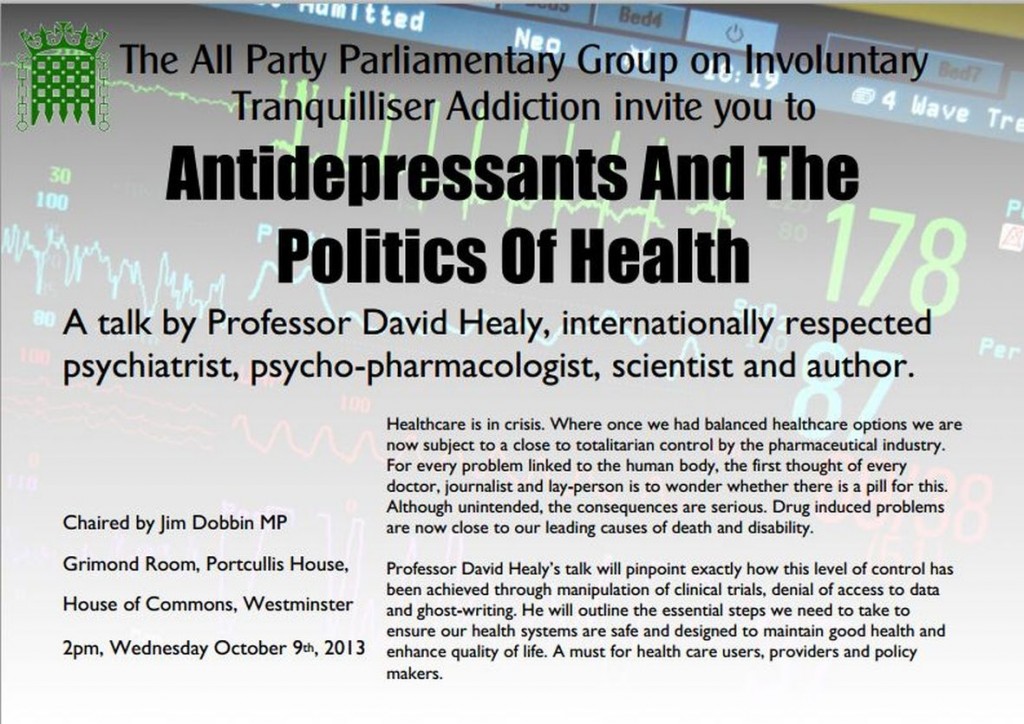
So, yesterday I, along with others, was invited along to the House of Commons in Westminster to hear a talk given by David Healy. If you are reading this blog then chances are you already know who Healy is, if not, check out his website and list of published books he has written on the subject of antidepressant medication and/or the corruption that exists in the world of the pharmaceutical industry.

I've watched David Healy's presentations many times through the medium of Vimeo and YouTube. Yesterday's was pretty easy to follow for the attending crowd as analogies were often used to hammer home the point that we, as consumers, are being totally misled about the safety and efficacy of antidepressant type medication. Flawed clinical trial results, ghostwritten papers and promised transparency that is, in itself, so murky that it's less clear than the Cumbrian skies that GlaxoSmithKline polluted after being accused of  releasing 773 tonnes of waste chemicals back in 2001. [1]

GlaxoSmithKline were used by Healy as an example yesterday, hey, they are, after all, a British company.

You see, Glaxo have promised to be more transparent with their clinical trial results. Yay, big pat on the back for Sir Andrew. After listening to Healy one would suggest a cow pat on the back for GSK's knight.

It transpired that Glaxo's announcement that they are going to be more transparent is nothing more than a good will gesture in the shape of a chastity belt.

Glaxo are opening their doors to the world, they claim...but only if you have Willy Wonka's golden ticket, only if you are prepared to jump through the loopholes put in place for the sole reason of deterring you from getting to the truth.

What's worse is that the UK government have accepted a proposal put forward by GlaxoSmithKline, a proposal which includes the following:

“We are not in favour of placing anonymised individual patient-level data (IPD) in the public domain in an unrestricted manner…  specific individuals should be provided with controlled access to IPD through carefully managed and secure “safe havens”. Access should be facilitated by an independent gatekeeper responsible for ensuring that the data … makes a useful contribution to scientific understanding”. [2]
In other words, we [GSK] have the information you need but we [GSK] have found a way in which you can't have access to it unless you can prove that the data we provide you would make a useful contribution to scientific understanding... even then, we [GSK] would argue that the only people allowed access would be those who would show favoritism toward our company.

The UK government, which incidentally has a Business Council where GSK's Andrew Witty sits [3] will now have to decide whether Glaxo's proposal is the way forward.

Forgive my flippancy. We are talking about a government who fought tooth and nail not to have MP's expenses in the public domain.

GSK - Ball Squeezing the UK Government


Here's the real deal folks.

Glaxo have cupped the testicles of the British government. They are slowly twisting those testicles, with each twist they are threatening/bribing the UK government - let's face it, Glaxo are the past-masters at bribing, right?

The message is clear from Glaxo, either you do business our way or we will leave these shores and conduct our business elsewhere.

Case in point, the UK Seroxat litigation. Glaxo have settled over 3,000 addiction cases in the US. They won't settle similar claims in the UK because, it's my belief, they have the backing of the UK government, a new chief at the helm of all drug-making decisions, Ian Hudson [4] and a UK legal system that has failed on more than one occasion to bring pharmaceutical companies to justice, not because of incompetent lawyers but because the way the system is designed to offer legal aid, or not as the case may be, to victims harmed by pharmaceutical products.

Invites to the meeting yesterday were sent out to both the MHRA and GSK. Neither of them showed.

Bob Fiddaman


[1] North's top polluters named
[2] “Antidepressants and the Politics of Health”
[3] Cameron’s Business Council: the official line-up
[4] Former Glaxo Safety Officer Becomes Head of MHRA


Please contact me if you would like a guest post considered for publication on my blog.